
Tu carrito está vacío


The Best Post Workout Recovery Drinks for Peak Performance
The best post-workout recovery drinks aren't something you just grab off a shelf. They're a strategic formula you build yourself, tailored to the work you just put in.
A truly effective drink zeroes in on the three R's of recovery: Rehydrate with fluids and electrolytes, Refuel with carbs, and Rebuild with protein. Once you master this simple blueprint, you unlock a faster, more efficient path back to 100%.
The Blueprint for an Optimal Post Workout Drink
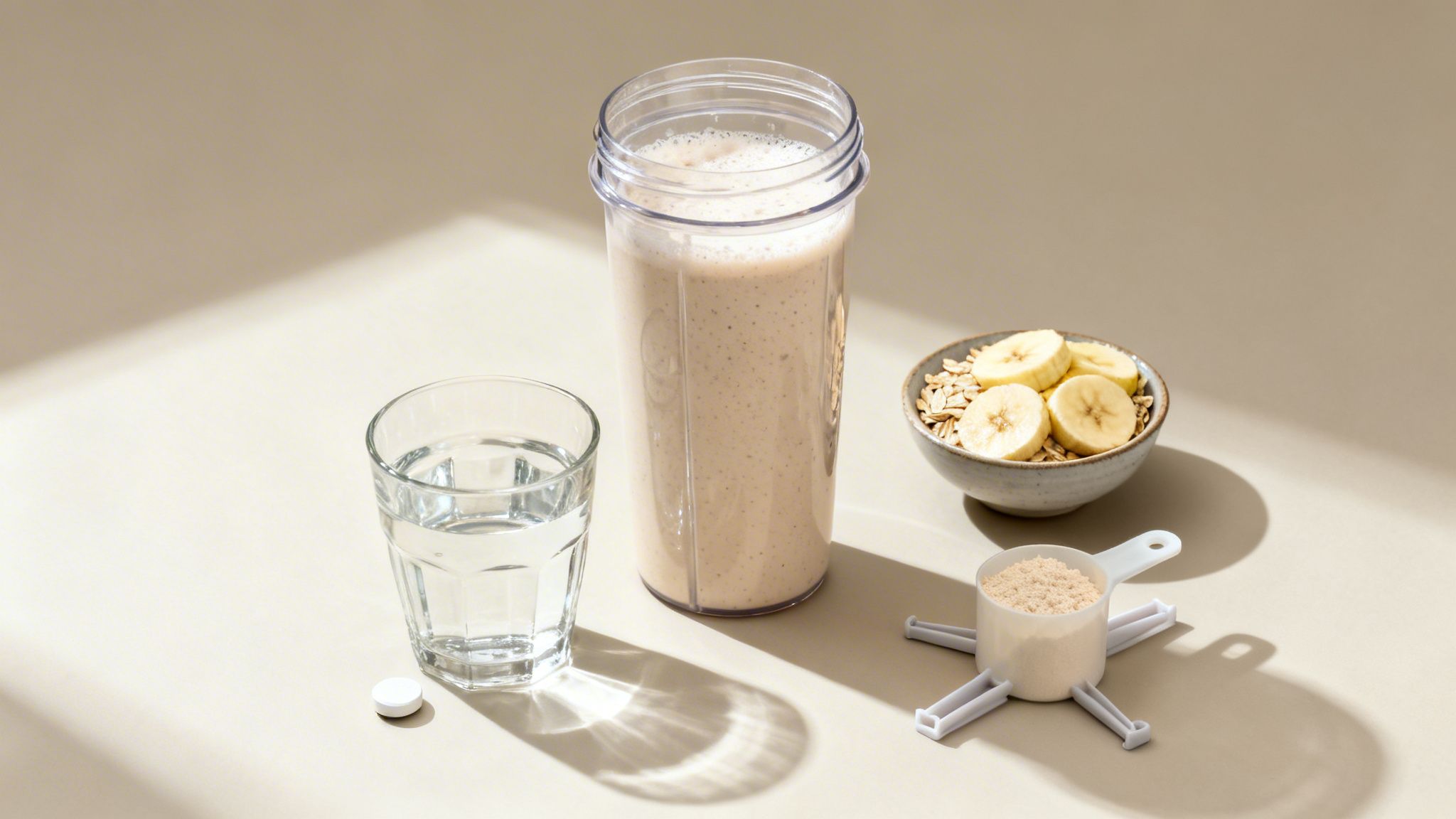
Think of your body after a killer workout like a high-performance race car screeching into the pit lane. Every second counts. Your recovery drink is the pit crew, and each ingredient has a specific job to get you back on the track—stronger and ready for the next lap.
This approach cuts through all the marketing noise about miracle ingredients. It’s about empowering you to build the perfect recovery drink for your body's needs, focusing only on what truly moves the needle for repair and adaptation. You're giving your body the exact raw materials it’s screaming for, right when it needs them most.
The Three Pillars of Recovery
Your recovery drink needs to be built on three non-negotiable pillars. Each one tackles a critical post-exercise need, and if you neglect any of them, you’re short-changing your results and slowing down your progress.
- Rehydrate: Intense training means sweating, and sweat isn't just water—it’s loaded with essential electrolytes. Topping off your fluids and replacing minerals like sodium and potassium is the first critical step to restoring balance and keeping your muscles firing correctly.
- Refuel: Your muscles run on stored carbohydrates called glycogen. During a tough session, you burn through those fuel tanks. A post-workout drink with fast-digesting carbs is all about restocking those depleted stores so you’re primed for the next workout.
- Rebuild: Exercise, by its very nature, creates microscopic tears in your muscle fibers. That’s the signal for growth. High-quality protein delivers the necessary amino acids—the "bricks"—to repair that damage and build back stronger, more resilient muscle tissue.
This isn’t just for elite athletes; it’s a universal principle for anyone who takes their fitness seriously. Whether you’re lifting heavy, running long distances, or crushing a HIIT session, the core needs are the same. The only things that change are the specific ratios and amounts, which we’ll dive into.
One of the biggest mistakes I see is athletes focusing only on protein while completely ignoring carbs and electrolytes. Real recovery is a team sport—all three pillars have to work together to get your body back to its peak.
To make this dead simple, here's a quick checklist to reference when building your drink.
Your Post Workout Recovery Drink Checklist
This table breaks down the essentials for your recovery shake, outlining what each component does and the targets you should be aiming for.
| Component | Primary Role (The 'R') | Why It Matters | Recommended Intake |
|---|---|---|---|
| Fluids (Water) | Rehydrate | Restores fluid balance lost via sweat, supports cellular function, and transports nutrients. | 16-24 oz for every pound lost during exercise. |
| Electrolytes | Rehydrate | Crucial for nerve impulses, muscle contractions, and maintaining fluid balance. Key players are sodium and potassium. | 200-400 mg of sodium and 150-300 mg of potassium. |
| Carbohydrates | Refuel | Replenishes depleted muscle glycogen (your primary fuel source) and spikes insulin to help drive nutrients into cells. | 0.5-0.7 grams per pound of body weight. |
| Protein | Rebuild | Provides the amino acid building blocks needed to repair muscle damage and stimulate muscle protein synthesis (growth). | 20-40 grams of high-quality, fast-digesting protein like whey. |
Stick to these guidelines, and you're well on your way to creating a recovery drink that actually works.
Getting these fundamentals right is the first step. And while post-workout fuel is critical, don't forget that what you consume during your session matters, too. For those longer or more intense workouts, understanding the benefits of intra-workout drinks can give you a performance edge and make this post-workout phase even smoother. When you nail your nutrition at every stage, you create a powerful cycle of performance, repair, and growth that ensures you're not just recovering—you're getting better every single time.
Understanding the Science of Muscle Recovery
Ever wondered what’s really going on inside your body after a brutal workout? It's more than just feeling wiped out. It’s a complex, a biological symphony that, when you get it right, becomes the very engine of your progress. Understanding this science is how you unlock faster, more effective recovery.
Picture your muscle fibers as thousands of tiny, strong ropes. When you train hard, you're creating microscopic tears in those ropes. This sounds bad, but it’s actually the entire point—it's the signal your body needs to repair and rebuild them even stronger than before. That rebuilding process has a name: muscle protein synthesis.
But rebuilding requires raw materials. Your workout also torches your primary fuel source, glycogen, which is just carbohydrate stored in your muscles and liver. It’s like emptying the gas tank in your car; you aren’t going anywhere until you refuel. On top of that, you’re losing vital fluids and electrolytes through sweat, throwing your body's internal balance out of whack.
The Anabolic Window Reimagined
You’ve probably heard people talk about the "anabolic window," usually framed as a frantic 30-minute deadline to slam a protein shake or lose all your gains. The reality is a bit more flexible, but the principle is spot on. It's better to think of this time as a golden hour when your muscles are incredibly receptive to nutrients.
After a tough session, your muscle cells are like dry sponges, ready to soak up everything they need to kickstart the repair job. During this period of heightened sensitivity:
- Insulin sensitivity is cranked up, meaning your body gets incredibly efficient at pulling carbs and amino acids from your blood into your muscle cells.
- Glycogen synthase, the enzyme that restocks your muscle fuel, goes into overdrive.
- Blood flow to your muscles is elevated, creating a nutrient delivery superhighway right where you need it most.
Taking advantage of this window with one of the best post workout recovery drinks jump-starts the rebuilding process right when your body is primed for it. This isn't just gym-lore anymore; athletes are getting serious about recovery science. The global recovery drinks market is projected to grow from around $1.65 billion in 2025 to over $2.24 billion by 2031—a clear sign that people are dialing in their nutrition.
More Than Just Muscle Soreness
Let’s be clear: recovery isn't just about managing delayed onset muscle soreness (DOMS), that all-too-familiar ache that shows up 24 to 48 hours after a hard workout. While a great recovery drink can certainly help with the soreness, the real goal is to drive physiological adaptation.
Proper post-workout nutrition is the conversation you have with your body after you’ve asked it to perform. You’re not just quieting the aches; you’re providing the exact language—protein, carbs, and electrolytes—it needs to understand how to come back stronger.
Without the right fuel at the right time, your body can slip into a catabolic state, where it starts breaking down muscle tissue for energy instead of building it up. This doesn't just kill your strength gains; it leads to fatigue, poor performance, and a higher risk of injury down the road.
Smart recovery nutrition flips the switch, keeping you in an anabolic (building) state. This is where the magic happens. You’re not just patching up the damage from today's workout; you're actively reinforcing your body to handle even more stress tomorrow. To get an even better handle on the repair process, it helps to understand the full range of compounds that can help, which is why exploring the science behind the best supplements for muscle recovery can give you an extra edge.
By understanding the relationship between muscle damage, glycogen depletion, and hydration, you can stop guessing. You're now ready to make informed choices, turning your post-workout drink from a routine habit into a precision tool for building a stronger, more resilient body. Learn more about how to recover faster after your workouts in our comprehensive guide.
The Power Duo: Protein and Carbs for Rebuilding
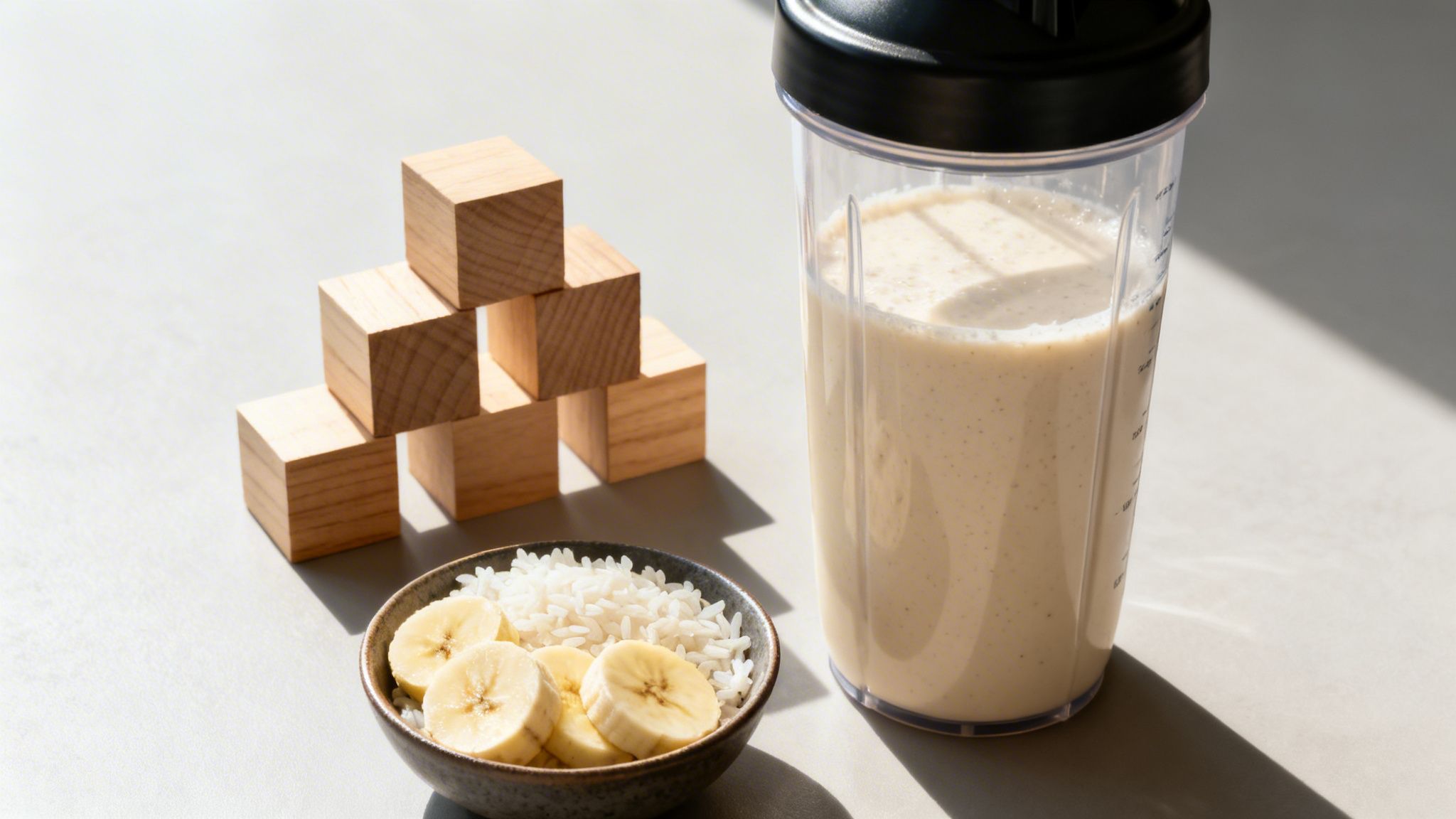
Think of your post-workout recovery as a construction project. If that's the case, protein and carbohydrates are your two most important crew members. Try to build with one and not the other, and the whole operation grinds to a halt. Their teamwork is the secret to getting the job done right—repairing muscle and refueling your tank efficiently.
Here’s a simple way to look at it: protein provides the amino acids, which are literally the "bricks" needed to patch up the micro-tears in your muscles. Carbs, on the other hand, are the "labor and power" that fuel the entire project. They don't just restock your body's depleted energy stores (glycogen); they actually help shuttle those protein bricks exactly where they need to go.
This synergy is what turns your recovery drink from a simple shake into a precision tool. It’s not just about mindlessly dumping protein into your system. It's about giving your body a complete package that handles both rebuilding and refueling at the same time.
Finding the Ideal Carb-to-Protein Ratio
So, what's the magic formula? Well, the perfect balance between carbs and protein isn't a one-size-fits-all deal. It depends entirely on the kind of workout you just crushed. Matching the ratio to your training is where you unlock the real results.
- For Endurance Athletes (3:1 or 4:1 Ratio): After a long run, ride, or swim, your number one priority is to aggressively replenish those massive glycogen losses. A ratio of 3 or 4 grams of carbohydrates for every 1 gram of protein is the sweet spot. This approach prioritizes refueling so you’re ready for the next session, while still delivering enough protein for muscle upkeep.
- For Strength and Power Athletes (2:1 Ratio): Just finished a heavy lifting session? Your main goal is to kick muscle protein synthesis into high gear. Here, a 2-to-1 ratio of carbs to protein is perfect. It provides just enough carbs to spike insulin and drive nutrients into your muscle cells, all without short-changing the high protein intake you need for serious muscle growth.
This strategic thinking is what transforms a basic shake into one of the best post workout recovery drinks you can make.
The single biggest mistake people make with post-workout nutrition is fixating only on protein. Carbs aren't the enemy here; they're the delivery truck that gets the protein to the construction site on time. Skipping them is like having a pallet of bricks with no one around to lay them.
Choosing Your Building Materials Wisely
Just as critical as the ratio is the quality of your ingredients. For a recovery drink to get to work fast, you need sources your body can absorb in a hurry.
Protein Sources Breakdown
When it comes to protein, speed is everything. You want those amino acids hitting your bloodstream as quickly as possible to stop muscle breakdown and kickstart the repair process.
- Whey Protein: This is the undisputed gold standard for post-workout recovery. Whey is loaded with leucine, a key amino acid that acts like a switch for muscle synthesis, and it digests incredibly fast. For a high-quality option that gets the job done, consider something like Pure3 100 Whey Protein Isolate Vanilla.
- Plant-Based Proteins: If you’re vegan or lactose intolerant, you’ve got great options too. Pea, soy, or brown rice proteins work well. The key is to find a blend of different plant sources to ensure you’re getting a complete amino acid profile, which helps mimic the effectiveness of whey.
Carbohydrate Sources Breakdown
For your carbs, you want simple, fast-acting sugars that will rapidly restock your glycogen stores. This is one of the very few times when "sugary" is actually a good thing.
- Dextrose or Maltodextrin: These are simple carbs that require almost no digestion. That means near-instant absorption and a quick insulin response to get the recovery process rolling.
- Whole Food Sources: Fruits are a fantastic natural choice. Bananas and dates deliver simple sugars like fructose and glucose, plus you get the added bonus of valuable micronutrients like potassium, which is crucial for rehydration.
By carefully selecting your protein and carb sources and dialing in the perfect ratio, you create a powerful formula that works in perfect harmony. This is the kind of detail that separates a generic shake from a true recovery powerhouse. If you're looking for other ways to support your body's repair processes, check out our guide on other key supplements for muscle recovery.
The Overlooked Role of Hydration and Electrolytes
While protein and carbs tend to get all the glory, they can't do their jobs without the real unsung heroes of recovery: water and electrolytes. You simply can't recover properly without rehydrating first. Skipping this step is like changing the oil in your car but leaving the radiator bone dry—you're just waiting for a total system failure.
Replacing fluids after a tough workout is about so much more than just quenching your thirst. During an intense session, it's not uncommon to lose 2-3% of your body weight in sweat. That level of dehydration is a direct hit to your performance, slowing down recovery and tanking everything from your cognitive function to your muscular power.
Why Sweat Is More Than Just Water
When you sweat, you're not just losing H₂O. You're also dumping critical minerals called electrolytes. These charged particles—think sodium, potassium, and magnesium—are basically the spark plugs for your body's entire electrical system. They're absolutely essential for nerve signaling, keeping your fluids balanced, and making your muscles contract.
Picture it this way: your nerves send electrical signals that tell your muscles to fire. Electrolytes are what carry that electrical charge. When your levels get too low, those signals get weak and distorted. The result?
- Muscle Cramps: The classic, painful sign of an electrolyte imbalance.
- Fatigue: Your muscles and nerves can't fire on all cylinders, leaving you feeling wiped out.
- Reduced Performance: Your strength, speed, and coordination all take a nose-dive.
- Poor Nutrient Absorption: Without proper fluid balance, it's a lot harder for your body to shuttle those precious carbs and proteins to your muscles.
Ignoring electrolytes is a rookie mistake that can seriously sabotage your recovery, leaving you feeling weak and flat for your next workout. Adding them to your post-workout drink isn't just a good idea; it's a non-negotiable for anyone serious about results.
Gauging Your Hydration Needs
So, how much fluid do you actually need? One of the simplest and most effective tricks is the weigh-in, weigh-out technique.
Just hop on the scale before and after you train. For every pound of body weight you've lost, your goal is to drink 16-24 ounces of fluid to get back to baseline.
This gives you a personalized target that's way more accurate than some generic "drink 8 glasses a day" advice. For example, if you dropped two pounds during a long run on a hot day, you need to get down 32-48 ounces of an electrolyte-rich drink over the next few hours to bring your body back into balance.
Many athletes obsess over grams of protein but completely overlook milligrams of sodium. Proper hydration isn't just a suggestion; it's the foundation that all other recovery processes are built on. Without it, you’re just spinning your wheels.
Building a Hydration-Focused Recovery Drink
Making hydration a priority in your post-workout shake is easy. It’s not about just chugging plain water; it’s about creating a solution your body can actually absorb and use efficiently. This is where a clean, potent electrolyte source becomes a total game-changer.
You can add a measured scoop of a high-quality electrolyte powder, like REVSCI’s Reviver, straight into your protein and carb shake. This immediately turns your drink into a complete recovery tool that tackles all three pillars—Rehydrate, Refuel, and Rebuild—in one shot. This integrated approach also means the electrolytes are helping your body better absorb the other nutrients you're taking in.
For those who want to get into the weeds, you can check out a detailed electrolyte powder comparison to find the best fit for your training. At the end of the day, the best post workout recovery drinks are the ones that treat hydration and electrolytes with the same respect as protein and carbs, creating a truly complete formula for success.
Tailoring Your Recovery Drink to Your Training
A one-size-fits-all approach to recovery just doesn't cut it. The best post-workout recovery drinks aren't generic formulas off a shelf; they're custom-built solutions matched to the exact demands of your training. The fuel a marathon runner needs is a world away from what a powerlifter requires to rebuild and grow.
Think of it like this: you wouldn't put the same fuel in a drag racer that you'd use for a long-haul semi-truck. Each engine is unique. Your body is no different. Dialing in your recovery drink to your specific sport is how you shift from just "recovering" to strategically enhancing your performance.
Let's break down some practical, customized strategies for different types of athletes, complete with specific 'recipes' to make sure your nutrition is perfectly aligned with what you do.
The Endurance Athlete Formula
Endurance athletes, like marathoners and triathletes, are staring down two massive challenges after a long session: completely drained glycogen stores and significant fluid and electrolyte loss. Their number one priority is aggressive refueling and rehydration to get the body ready for the next day's mileage. Muscle repair is important, but it takes a backseat to restocking the fuel tanks.
The ideal mix for these athletes is heavy on carbohydrates and loaded with electrolytes, especially sodium.
- Ideal Carb-to-Protein Ratio: A 3:1 or 4:1 ratio is the gold standard here. For every gram of protein, you need three to four grams of carbohydrates to slam those glycogen stores full again.
- Key Electrolyte Focus: Sodium is the main electrolyte you sweat out. Hitting 300-500 mg of sodium is key to helping your body actually hold onto the fluid you're drinking.
- Sample Drink: Blend 1 scoop of whey or plant-based protein, 60-80 grams of maltodextrin powder (or two large bananas and a tablespoon of honey), a serving of a targeted electrolyte powder like REVSCI's Reviver, and 20 ounces of water. This creates a potent mix for rapid glycogen replenishment.
The Strength Athlete Formula
For powerlifters, bodybuilders, and anyone chasing maximal strength and muscle, the recovery game is completely different. The main goal is to kickstart muscle protein synthesis—the process of repairing and rebuilding muscle fibers to come back bigger and stronger. Sure, glycogen needs topping off, but protein is the undisputed star of the show.
This athlete needs a drink that delivers a powerful dose of high-quality amino acids to the muscles, and fast.
- Ideal Carb-to-Protein Ratio: A 2:1 ratio is your sweet spot. This gives you just enough carbs to spike insulin, which helps drive amino acids into the muscle cells, but keeps the focus squarely on a massive protein dose.
- Key Protein Focus: You're looking for 30-40 grams of a fast-digesting protein like whey isolate. This provides a huge leucine signal, which is the specific amino acid that acts like a light switch for muscle protein synthesis.
- Sample Drink: Combine 1.5 scoops of whey protein isolate, 25-30 grams of dextrose powder (or a large banana), a 5-gram scoop of creatine monohydrate, and 16 ounces of cold water or milk.
The Hybrid Athlete Formula
Hybrid athletes, from CrossFitters to field sport players, need a bit of everything. Their training demands both raw strength and serious endurance, so their recovery drink has to support muscle repair and glycogen replenishment at the same time. They need a versatile formula that doesn't lean too far in one direction.
This calls for a balanced mix that ticks all the boxes. It's where a lot of commercial drinks fall short, as they're often designed for just one type of goal.
A classic mistake is grabbing an endurance-focused, high-carb drink after a strength-heavy CrossFit WOD. You end up shortchanging the protein your muscles are screaming for, which can sabotage strength gains over time. Matching your drink to that day's session is absolutely critical.
- Ideal Carb-to-Protein Ratio: A 2:1 or 3:1 ratio works well, and you can adjust it based on the day's focus. If the workout was more cardio-heavy, lean toward 3:1. If it was a heavy lifting day, stick closer to 2:1.
- Key Ingredient Focus: A blend of fast-acting protein and carbs is a must. And given the high-intensity nature of these workouts and the massive sweat loss, adding electrolytes is non-negotiable.
- Sample Drink: Mix 1 scoop of whey protein, a large banana, a handful of frozen berries (for carbs and antioxidants), a serving of REVSCI's Reviver electrolytes, and 16 ounces of coconut water for an extra hit of potassium.
This simple decision tree can help you visualize a basic hydration strategy based on how much you're sweating and whether you're cramping up—two of the clearest signs you need to focus on electrolytes.
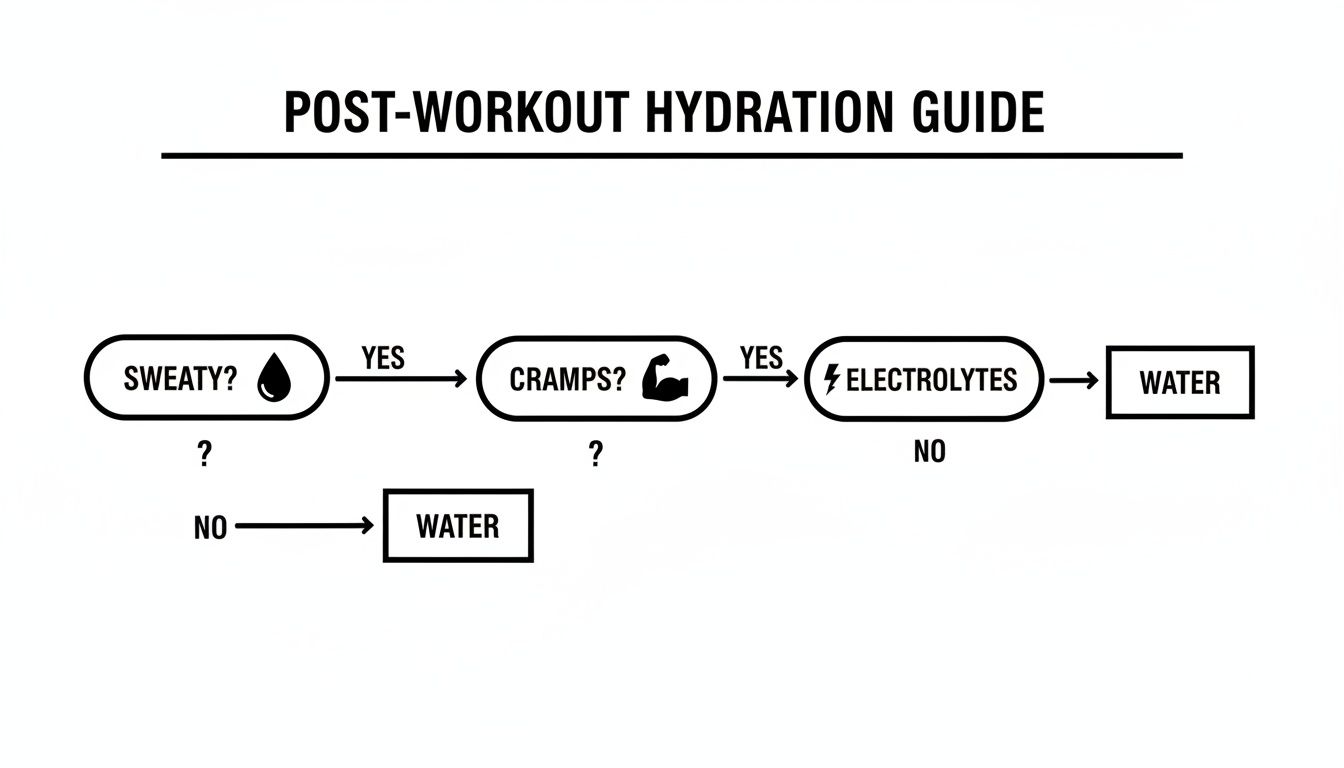
The flowchart makes it obvious: while everyone needs to rehydrate, adding electrolytes becomes absolutely critical when you're sweating buckets or your muscles start cramping.
Athlete-Specific Recovery Drink Formulas
To make it even clearer, here’s a quick-glance table breaking down the ideal post-workout drink components tailored to different athletic goals.
| Athlete Profile | Primary Recovery Goal | Ideal Carb-to-Protein Ratio | Key Electrolyte Focus | Sample Ingredient Mix |
|---|---|---|---|---|
| Endurance Athlete | Glycogen Replenishment & Rehydration | 4:1 | High Sodium & Potassium | Maltodextrin, Whey Protein, REVSCI Reviver |
| Strength Athlete | Muscle Protein Synthesis | 2:1 | Minimal, unless heavy sweating | Whey Isolate, Dextrose, Creatine |
| Hybrid Athlete | Balanced Glycogen & Muscle Repair | 2:1 to 3:1 | Sodium, Potassium, Magnesium | Whey Protein, Banana, Berries, REVSCI Reviver |
This table serves as a solid starting point. Remember to listen to your body and adjust these formulas based on the intensity of your specific session, the environmental conditions, and your own personal recovery feedback.
Got Questions About Recovery Drinks? We've Got Answers.
Even with a solid game plan, you're bound to have questions. When you start digging into the best post-workout recovery drinks, you’ll find a ton of conflicting advice. Let's cut through that noise.
This section tackles the most common questions head-on. No fluff, just clear, science-backed answers to help you dial in your strategy and feel good about what you're drinking. Think of this as your go-to guide for clearing up any lingering doubts.
Is Chocolate Milk Really a Good Recovery Drink?
You've probably heard this one before. Chocolate milk gets a lot of hype for its natural carb-to-protein ratio, which often lands right around 3:1. That makes it a surprisingly solid option for endurance recovery, plus it delivers fluids, calcium, and sodium. It’s cheap, easy, and tastes pretty good after a hard effort.
But let's be real, it’s not the perfect solution. A lot of commercial brands are loaded with added sugar, and for a huge number of people, lactose is a non-starter. So while it can work in a pinch, a purpose-built recovery drink gives you way more control.
It’s easy enough to build something far better yourself. Just combine a quality protein powder with a clean carb source (like a banana) and a measured dose of electrolytes. You'll get a more targeted, effective recovery tool without all the extra junk.
How Soon After My Workout Should I Drink It?
Ah, the famous "anabolic window." This is the period right after a workout when your muscles are practically begging for nutrients. The classic advice is to get your recovery drink down within 30-60 minutes post-workout. During this time, your muscle cells act like sponges, ready to soak up carbs and protein to get a head start on glycogen replenishment and muscle repair.
Now, it's not like a magic window that slams shut at 61 minutes. But for those really tough or long workouts, hitting that window is a key strategy for bouncing back faster. This is especially true for elite athletes or anyone training twice a day.
Think of the anabolic window less like a strict deadline and more like an opportunity. The sooner you give your body the raw materials it needs to rebuild, the faster that critical repair process gets underway.
For more casual gym-goers, the urgency isn't as high. Just focusing on a good, nutrient-dense meal within a couple of hours will also get the job done.
Can't I Just Eat a Meal Instead of a Drink?
For light to moderate workouts? Absolutely. Grabbing some water and eating a balanced meal packed with protein and carbs within an hour or two is a perfectly good recovery plan. You don't always need a specialized shake.
But when you've just put yourself through the wringer, a liquid drink has some clear advantages. Liquids are digested and absorbed much faster than solid food, meaning those nutrients get to your muscles more quickly—right when they need them most.
Plus, let's be honest, who feels like crushing a huge plate of chicken and rice immediately after a brutal leg day? A drink is often way easier to stomach when your appetite is shot. A well-formulated shake also lets you dial in the exact macros you need to hit specific recovery goals, something that’s harder to do with a general meal.
Do I Need a Recovery Drink After Every Workout?
Nope. Not even close. A dedicated recovery drink is a strategic tool, not an everyday habit. Its value is tied directly to the intensity and duration of your training.
For a light jog, a yoga session, or an easy day at the gym, just drink some water and eat your next meal. You'll be fine. Save the recovery drinks for when they really count—after the workouts that tear you down and drain your tank.
Consider pulling out the shaker bottle in these situations:
- Long endurance sessions that push past 90 minutes.
- High-Intensity Interval Training (HIIT) that leaves you gasping.
- Heavy strength training where you're lifting to or near failure.
The key is to match your recovery fuel to the demand of your workout. Don't overdo it on easy days, but don't sell your body short after the hard ones.
Ready to build a recovery drink that actually works for your training? Revolution Science offers clean, research-backed ingredients like our Reviver electrolytes to give your body exactly what it needs—no fillers, no pseudoscience.