
Tu carrito está vacío


Your Guide to Muscle Recovery Supplements
A muscle recovery supplement is designed to give your body the exact nutrients it needs to repair muscle damage from exercise, cut down on soreness, and get you back to growing stronger. These formulas usually pack in a strategic mix of protein, amino acids, and other key compounds that kickstart the rebuilding process, essentially turning your downtime into your biggest advantage.
Why Smart Muscle Recovery Is Your Untapped Advantage
So many athletes get caught up in the details of their training—every rep, every mile, every calorie. But the old "no pain, no gain" mindset is missing half the story. The real gains, the kind that lead to new PRs and lasting strength, happen after the workout is over. This is where smart recovery becomes your most powerful tool.
Think of your workout as the demolition phase. You're intentionally creating tiny tears in your muscle fibers. Recovery is the expert rebuild that comes next. A muscle recovery supplement is like getting a rush delivery of specialized, high-grade materials straight to that construction site.
The Science of Rebuilding Stronger
Your body is an incredible machine, but it needs the right resources to do its job. Without the proper building blocks, the repair process is slow and clumsy, which means you're stuck with prolonged soreness, fatigue, and a frustrating plateau. This is why just kicking your feet up isn't always enough.
Supplements deliver the critical components precisely when your body is primed to use them.
- Accelerated Repair: They provide fast-absorbing proteins and amino acids that act like "quick-setting concrete" for your muscle tissue.
- Reduced Soreness: Ingredients like anti-inflammatories work like a cleanup crew, managing inflammation so you can get back to training sooner.
- Enhanced Performance: By topping off your energy stores and minimizing breakdown, they ensure you show up stronger and more prepared for your next session.
This strategic approach is catching on in a big way. The global market for these supplements was valued at $654 million in 2023 and is on track to break $1 billion by 2030—a clear sign of just how vital they've become in modern fitness.
The crucial shift in mindset is realizing that recovery isn't passive downtime; it's an active, biological process that you can directly influence and optimize for better results.
At the end of the day, skipping recovery is like hiring a demolition crew but forgetting to order the materials to rebuild. You’re left with a pile of rubble instead of a stronger structure. By adding a high-quality muscle recovery supplement to your routine, you’re not just recovering—you are strategically investing in your future performance. If you want to dive deeper into this process, you might be interested in our guide on how to recover faster after a workout.
Decoding What's Actually in Your Recovery Formula
Stepping into the supplement aisle can feel like trying to read another language. The labels are a mess of ingredients, percentages, and scientific names that can leave even seasoned athletes scratching their heads. But figuring out what’s inside your muscle recovery supplement is the key to getting real results.
Think of it as meeting the members of a specialized construction crew, where each one has a vital and unique role in rebuilding your body stronger than before.
To really get it, you have to picture the process these ingredients are designed to support. This simple graphic breaks down the three core stages of muscle adaptation that a quality recovery formula is built to optimize.
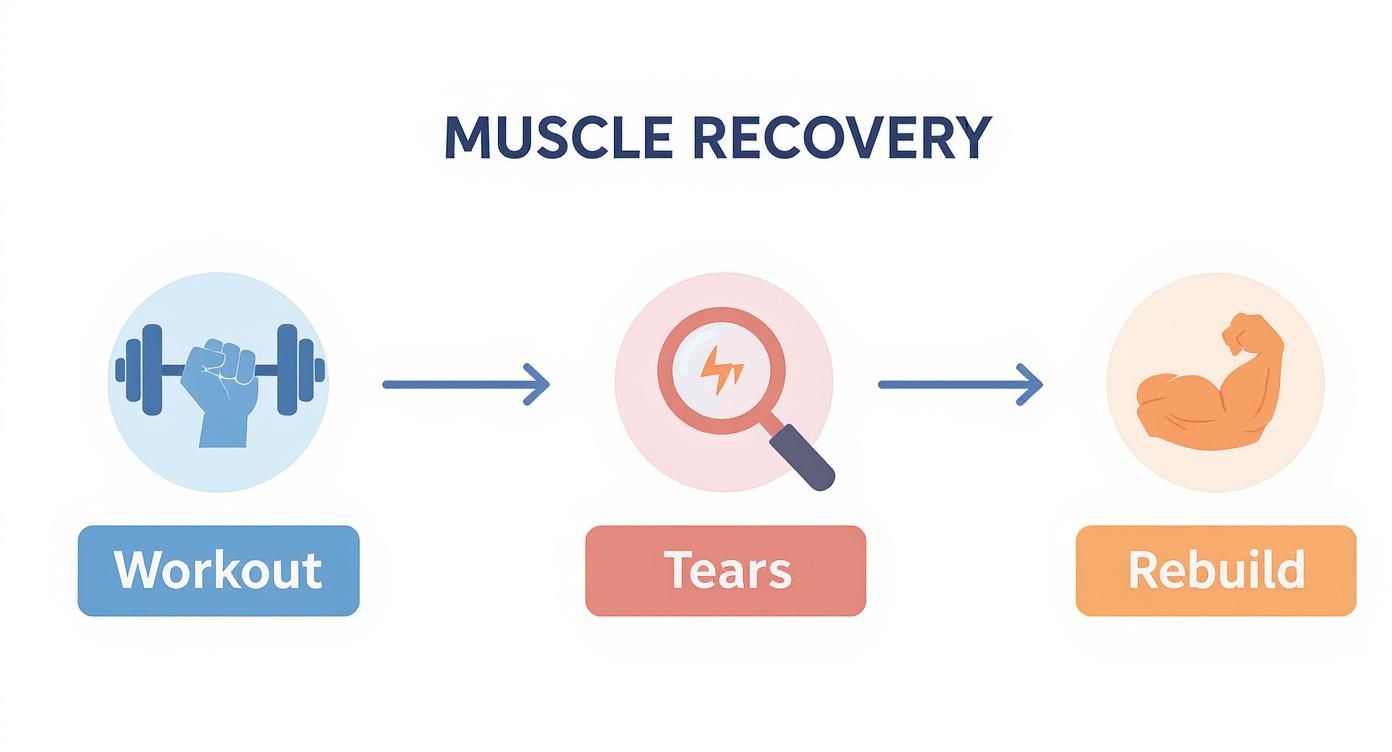
This cycle of stress, repair, and growth is exactly where progress is made. The right ingredients are just powerful catalysts for each step.
Below, we’ll walk through the key players you'll find in the most effective formulas and explain their jobs in plain English.
To make things even clearer, this table sums up the key ingredients, their primary function, and who they benefit the most.
Key Muscle Recovery Supplement Ingredients and Their Functions
| Ingredient | Primary Role (Analogy) | Scientific Function | Best For |
|---|---|---|---|
| Protein (Whey) | The Master Architect | Provides all essential amino acids to fuel muscle protein synthesis (repair). | Everyone |
| BCAAs | The On-Site Foremen | Directly signal the start of muscle repair and reduce exercise-induced damage. | All athletes, especially for reducing soreness. |
| Creatine | The Rapid-Recharge Station | Regenerates cellular energy (ATP) for faster recovery between high-intensity efforts. | Strength and power athletes. |
| Electrolytes | The Hydration & Electrical Crew | Restore fluid balance and support proper nerve-to-muscle communication. | Endurance athletes and those training in heat. |
| HMB | The Protective Scaffolding | Reduces the rate of muscle protein breakdown, protecting existing muscle tissue. | Athletes in a cutting phase or intense training blocks. |
| Tart Cherry | The Inflammation Cleanup Crew | Contains antioxidants that help manage post-exercise inflammation and soreness. | Athletes with high training volume or intense soreness. |
With that overview in mind, let's dive deeper into what makes each of these components so critical for your recovery.
Protein: The Master Architect of Muscle Repair
Let’s start with the absolute foundation: protein. If your muscles are a building, protein is both the blueprint and the raw materials—specifically amino acids—needed to rebuild. After a tough workout, your body is in a state of muscle protein breakdown. Getting a fast-absorbing protein source like whey isolate into your system quickly flips the switch over to muscle protein synthesis, which is just the scientific term for repair and growth.
Whey protein is king here because it's a "complete" protein, meaning it has all nine essential amino acids your body can't make on its own. Think of it as the master architect overseeing the entire job site. Without enough protein, your recovery is like a construction project that’s constantly held up waiting for materials to arrive.
BCAAs: The On-Site Foremen
Within that big bucket of amino acids are three with a unique structure: Branched-Chain Amino Acids (BCAAs). You'll see them listed as leucine, isoleucine, and valine. These are the on-site foremen of muscle recovery. Leucine, in particular, is the guy who walks onto the job site and shouts, "Alright, let's get to work!" It's the primary signal that kicks off muscle protein synthesis.
While a good protein powder provides all the amino acids, BCAAs are "free-form," meaning they get to work almost instantly. They bypass the liver and go straight to your muscle tissue to help reduce exercise-induced damage and dial down the pain of delayed onset muscle soreness (DOMS).
Creatine: The Rapid-Recharge Station
While protein and BCAAs are busy with structural repairs, creatine is handling the energy crisis. Think of it as a rapid-recharge station for your muscle cells. Creatine’s main job is to help regenerate adenosine triphosphate (ATP), which is the high-octane fuel your body uses for short, explosive movements.
When you're training hard, you burn through your ATP stores fast. Supplementing with creatine helps you top off those tanks much quicker, meaning your muscles are ready to go for the next set or the next workout. It doesn't just boost performance during a workout; it supports a stronger, faster recovery between them.
Electrolytes: The Hydration & Electrical Crew
Recovery is about more than just muscle fibers—it’s about getting your entire system back in balance. Electrolytes like sodium, potassium, and magnesium are the electrical and hydration crew. They’re in charge of maintaining fluid balance and making sure your nerves and muscles are communicating properly. You lose these critical minerals through sweat, and when they're out of whack, you'll feel it in the form of fatigue, weakness, and nasty muscle cramps.
Restoring electrolyte balance is non-negotiable for performance. It’s like making sure the electrical wiring in a building is sound—without it, nothing else works right.
Getting electrolytes back in your system post-workout is crucial for rehydrating and avoiding the issues that can sabotage your next session. If cramping is a frequent problem, you can learn more by checking out our guide on how to prevent muscle cramps.
HMB & Tart Cherry: The Specialized Support Team
Beyond the big players, a truly elite muscle recovery supplement will often include a specialized support team to handle very specific jobs.
- HMB (beta-hydroxy beta-methylbutyrate) acts like protective scaffolding. It’s a byproduct of the BCAA leucine that has been shown to slow down muscle protein breakdown. In simple terms, it helps protect the muscle you’ve already built, making the rebuilding process that much more efficient.
- Tart Cherry Extract is the inflammation cleanup crew. Intense exercise creates inflammation—that’s a normal and necessary part of the repair process. But too much of it can ramp up soreness and drag out your recovery time. Tart cherry is packed with powerful antioxidants that help keep that inflammatory response in check.
By understanding the distinct role each ingredient plays, you can move from just grabbing a random supplement to strategically fueling your body's natural recovery engine. This knowledge transforms the label on your bottle from a confusing list into a clear roadmap for hitting your goals.
Matching Your Supplement Strategy to Your Training
Taking a one-size-fits-all approach to recovery is like using a single wrench to fix an entire engine—you might get a few things right, but you'll miss the specific bolts that truly matter. The physical demands on a marathoner are a world away from those on a powerlifter. To be effective, your muscle recovery supplement strategy has to be dialed in to the unique physiological stress your training creates.
You wouldn't follow a sprinter's program to prep for an Ironman, right? The same logic applies to your recovery nutrition. When you match your supplement protocol to your athletic profile, you’re giving your body the exact resources it needs to adapt and get better. Let's break down the blueprints for three common types of athletes.
The Endurance Athlete Protocol
For marathon runners, triathletes, and cyclists, the big battles are glycogen depletion, dehydration, and managing the oxidative stress that comes from hours of effort. Your recovery isn’t just about patching up muscle; it’s a full-system refuel. The primary goal is to restock those energy stores and restore fluid balance as fast as humanly possible.
Your recovery shake is less about building bulky muscle and more about reloading the fuel tanks. Think of it as calling in a rapid-response logistics team to restock a completely depleted supply line.
For the endurance athlete, carbohydrates and electrolytes aren't just nice-to-haves; they are the absolute core of effective recovery. Skipping them is like trying to drive a car on an empty tank of gas.
Post-Long Run or Ride Recovery Protocol:
- Carbohydrates are King: You need to aim for a 3:1 or 4:1 ratio of carbohydrates to protein. This specific ratio has been shown to be incredibly effective at replenishing muscle glycogen, which is the high-octane fuel for long-duration activity.
- Electrolyte Restoration is Critical: You sweat out vital minerals like sodium and potassium. A top-tier electrolyte blend, like REVSCI's Reviver, is essential for proper rehydration and warding off those post-exercise cramps and killer fatigue.
- Moderate Protein Intake: Stick to around 20-25 grams of a fast-digesting protein like whey isolate. This is plenty to kickstart muscle repair without getting in the way of rapid carb and fluid absorption.
The Strength Athlete Protocol
Powerlifters, bodybuilders, and Olympic lifters put their muscles under immense mechanical stress in short, violent bursts. For these athletes, the recovery mission has one singular focus: maximizing muscle protein synthesis (MPS). This is the biological process of repairing damaged muscle fibers and building new, stronger tissue.
Here, your recovery is all about flooding the construction site with an overwhelming supply of raw materials. Every nutrient you take should directly support the goal of building stronger, bigger, and more powerful muscle.
Post-Heavy Lifting Recovery Protocol:
- Prioritize High-Dose Protein: Slamming 30-40 grams of high-quality protein right after your workout creates the amino acid surplus needed to fire up MPS. Whey protein isolate is the gold standard here, thanks to its rapid absorption and high leucine content.
- Incorporate Creatine: For a strength athlete, creatine is non-negotiable. Supplementing with 3-5 grams daily helps rapidly regenerate ATP (your body's energy currency), leading to faster recovery between brutal sessions and supporting long-term strength gains.
- Consider HMB: If you're in an intense training block or cutting calories, HMB can be a powerful ally. It acts as an anti-catabolic agent, essentially putting a shield around your hard-earned muscle to prevent it from being broken down for energy.
The Hybrid Athlete Protocol
Athletes who live in the world of CrossFit, HIIT, and functional fitness face a unique challenge. They need to recover from both punishing strength work and lung-searing conditioning, often in the same session. Their recovery strategy has to be a smart, balanced blend of the two protocols we just covered.
This demands a versatile formula that can simultaneously refuel glycogen, kickstart muscle protein synthesis, and manage that full-body fatigue. It's a delicate balancing act that supports both explosive power and the stamina to keep going.
Post-WOD (Workout of the Day) Recovery Protocol:
- Balanced Macronutrient Ratio: A 1:1 or 2:1 ratio of carbs to protein is the sweet spot. This gives you enough carbs to start replenishing glycogen without slowing down the absorption of critical amino acids for muscle repair.
- BCAAs for Soreness: The sheer volume and variety of movements in hybrid training can leave you incredibly sore. BCAAs can help take the edge off, reducing exercise-induced muscle damage so you can show up ready for the next day's beatdown.
- Comprehensive Support: Look for a muscle recovery supplement that covers all the bases. This means electrolytes for hydration and anti-inflammatory ingredients like tart cherry to help manage the soreness that comes from all that high-impact, high-rep work.
How to Choose a High-Quality Supplement
Knowing which ingredients you need is one thing; finding a muscle recovery supplement you can actually trust is a whole other challenge. The market is flooded with products, and flashy labels don't always mean quality. To make a smart investment in your health and performance, you need to learn to see past the marketing hype and figure out what’s really inside the bottle.
Think of yourself as a detective for your own body. You're searching for clues that prove a product is safe, effective, and transparent. The most important pieces of evidence are certifications from independent, third-party organizations.
Look for Third-Party Certifications
You wouldn't buy a car without knowing it passed a safety inspection, right? Well, third-party certifications are the safety inspection for your supplements. They act as your insurance policy, verifying that what’s on the label is what's in the product—and that it's free from harmful contaminants or banned substances.
Keep an eye out for these gold-standard seals of approval:
- NSF Certified for Sport: This is one of the most rigorous certifications out there. It confirms label claims are accurate, tests for over 270 substances banned by major athletic organizations, and ensures the product was made in a GMP-compliant facility.
- Informed-Sport: This global program tests every single batch of a product for banned substances before it hits the market. Seeing this logo means you can be confident you're getting a clean product.
Without these certifications, you're just taking a company's word for it, which can be a risky bet for any serious athlete. Choosing a brand that invests in this level of testing, like REVSCI, shows a real commitment to quality and your safety.
Learn to Read the Label Like a Pro
Once you've confirmed a product is tested, the next step is to analyze the supplement facts panel. A well-formulated product will be transparent and precise. A low-quality one often hides behind confusing language and weak formulas.
A supplement label should provide clarity, not confusion. If a brand uses vague terms or proprietary blends, it’s often a red flag that they are hiding under-dosed or ineffective ingredients.
Here are the red flags to watch out for:
- Proprietary Blends: This is a major warning sign. A "proprietary blend" lists a mix of ingredients under a single name, only telling you the total weight of the blend—not how much of each ingredient is actually in there. This trick is often used to disguise cheap, under-dosed formulas.
- Unnecessary Fillers: Scan the "other ingredients" list. If you see a long list of artificial sweeteners, colors, and fillers you can't pronounce, it's a sign the product prioritizes taste and texture over purity and performance.
- Clinically Ineffective Doses: This is where knowing your ingredients is crucial. If a product contains creatine but only offers 1 gram per serving, it’s not going to deliver the clinically studied dose of 3-5 grams needed for real results. Always compare the doses on the label to what the research supports.
Embrace Modern Trends in Recovery
The supplement industry is always evolving, with new research and consumer demands shaping the products on the shelf. A high-quality brand will be at the forefront of these positive changes. The market is seeing a major shift, with projections showing nearly 8% annual growth through 2034, driven by new, health-conscious formulations. Learn more about the latest muscle recovery market trends.
This includes a rise in effective plant-based protein options combined with collagen boosters, which appeal to a growing vegan and health-focused audience. Brands are also increasingly focusing on transparency and sustainability, using eco-friendly packaging and clean, simple formulas.
When you choose a muscle recovery supplement, you aren't just buying a product; you're supporting the brand's philosophy and its commitment to both your health and the environment. You can explore more options by checking out our guide on the best supplements for athletes.
Building a Complete Recovery Ecosystem

It’s tempting to look at a muscle recovery supplement as a magic bullet—a single fix for all your post-workout aches and fatigue. While these formulas are incredibly powerful tools for repair, they work best when they're part of a bigger picture. Think of it as a complete recovery ecosystem.
Sustainable progress isn’t about one single product. It’s about building a system where every component—nutrition, sleep, hydration—works together, making each part more effective.
Your supplement is like a high-octane fuel additive for a race car. It makes a huge difference, sure, but it can’t fix a busted engine or flat tires. To win the race, you have to maintain the entire machine. In the same way, your supplement needs the support of great nutrition, deep sleep, and active recovery to really deliver on its promise.
These pillars aren’t just extras; they create the biological environment where your body can actually put the ingredients you're feeding it to good use.
The Foundation of Whole Food Nutrition
Before any supplement can truly get to work, your body needs a solid base of good nutrition. Whole foods deliver the essential macros, vitamins, and minerals that fuel every single function in your body, especially muscle repair. Your post-workout shake is your rapid-response team, but your daily meals are what build the strong foundation for recovery day in and day out.
A solid diet provides the sustained energy and wide range of nutrients you need for long-term adaptation. It's the difference between a quick patch job and building the house on solid ground.
- Protein Pacing: Don’t just slam all your protein at once. Spread your intake throughout the day to keep a steady stream of amino acids flowing to your muscles, which keeps you in an anabolic (muscle-building) state.
- Complex Carbohydrates: Foods like sweet potatoes, oats, and quinoa are your go-to for refilling the muscle glycogen stores that power you through tough workouts.
- Healthy Fats: Sources like avocados, nuts, and olive oil are critical for hormone production and taming inflammation—both essential for solid recovery.
Sleep: The Ultimate Regeneration Tool
If nutrition is the foundation, sleep is the master switch that kicks your body's most powerful regenerative processes into high gear. It's during deep sleep that your body releases a surge of human growth hormone (HGH), a key player in mending damaged muscle tissue and building it back stronger.
You can chug the world's best muscle recovery supplement, but if you aren’t getting 7-9 hours of quality sleep, you’re basically robbing your body of its most important repair window. It’s like hiring a construction crew to rebuild a site but forgetting to turn on the power. Nothing gets done.
Sleep isn’t just passive downtime; it’s the most active and crucial phase of your recovery. It’s a non-negotiable biological need that no supplement can ever replace—only support.
Cutting sleep short consistently throws your hormones out of whack, slows muscle protein synthesis to a crawl, and leaves you feeling physically and mentally wrecked. Prioritizing your sleep is one of the single most effective things you can do to make every other recovery effort count.
The Role of Active Recovery and Hydration
Finally, every good system needs ongoing maintenance. That’s where active recovery and smart hydration come in. These are the practices that keep your body running smoothly between those all-out training sessions.
Gentle activities like foam rolling, stretching, or even just a light walk help boost blood flow to sore, tired muscles. This circulation is key—it delivers fresh, nutrient-rich blood to damaged tissues and helps flush out metabolic junk, speeding up the whole repair process.
Hydration is just as critical. Being even slightly dehydrated can lead to muscle cramps, tank your energy, and mess with nutrient transport. Making sure you’re constantly taking in fluids and electrolytes is non-negotiable. To dial in your strategy, check out this detailed electrolyte powder comparison to find what’s right for your training.
When you integrate all these elements, you transform your supplement from a standalone product into a vital part of a high-performance recovery machine.
Common Questions About Muscle Recovery
Even when you have a solid recovery plan, questions always come up. That’s just part of dialing in your routine. When it comes to using a muscle recovery supplement, we see the same handful of practical concerns pop up again and again.
This section cuts right to the chase. We’re tackling the most frequent questions we hear from athletes with clear, actionable answers grounded in sports science. The goal is to give you the clarity you need to make your recovery strategy as effective as possible.
How Soon After a Workout Should I Take My Supplement?
This is probably the number one question we get, and for good reason—timing is huge. That period right after your workout is often called the "anabolic window," a time when your muscles are practically starving for nutrients. For the best possible results, you want to get your muscle recovery supplement in within 30 to 60 minutes of finishing your session.
During this window, your muscle cells are wide open, ready to soak up protein and carbs to jumpstart the repair process and restock your depleted energy (glycogen) stores. If you wait too long, you can slow down that crucial refueling effort, which can mean more soreness and a delayed start to the rebuilding process.
Think of it like getting first responders to an emergency. The faster they arrive, the quicker the recovery can begin.
Can I Get Everything I Need from Food Alone?
In a perfect world, a meticulously planned diet could cover all your bases. But for athletes who are seriously pushing their limits, relying only on whole foods for that immediate post-workout fix comes with a few big challenges. The single greatest advantage of a supplement is speed.
A liquid shake with fast-acting whey protein isolate and simple carbs gets digested and absorbed way faster than a solid meal like chicken and rice. That speed is absolutely critical during that post-workout anabolic window.
A whole-food diet is the foundation for your long-term health and performance. A supplement doesn't replace that; it's a specialized, fast-acting tool you use precisely when your body needs it most.
Beyond that, trying to get specific, concentrated doses of ingredients like creatine or HMB from food just isn't practical. For example, you'd have to eat several pounds of red meat just to get the amount of creatine in a single effective scoop of a supplement.
Is It Safe to Take Muscle Recovery Supplements Daily?
For most healthy people, taking a high-quality muscle recovery supplement every day is not only safe but often beneficial, especially if you train consistently. The ingredients in any reputable formula—protein, amino acids, electrolytes—are just concentrated forms of nutrients your body already needs.
Using them daily ensures your muscles always have a steady supply of the raw materials they need for repair and growth. This is especially important for ingredients like creatine, which works best when your muscle stores are completely full—a state you maintain with daily intake.
The key, of course, is to choose a product that is third-party tested for purity and banned substances. Always follow the recommended serving size, and if you have any pre-existing health conditions, it's always a good idea to check in with a healthcare professional first.
What Is the Difference Between Pre-Workout and Post-Workout Formulas?
This is a common point of confusion, but the difference is actually pretty simple. It all comes down to their job description.
- Pre-Workout Supplements: These are all about boosting your performance during the workout. They usually have ingredients like caffeine for energy, nitric oxide boosters for blood flow (the "pump"), and compounds like beta-alanine to help you fight off fatigue. The goal is to help you train harder, for longer.
- Post-Workout Supplements: These have one mission: to accelerate recovery after the workout is over. They focus on providing protein for muscle repair, carbohydrates to refill glycogen, and other ingredients like BCAAs or tart cherry to help reduce soreness and inflammation. Their goal is to kickstart the rebuilding process immediately.
Here’s an easy way to think about it: a pre-workout is the high-octane fuel you put in the tank before a race. A post-workout muscle recovery supplement is the expert pit crew that rebuilds the engine afterward.
At REVSCI, we formulate our supplements with clean, research-backed ingredients to support every stage of your performance journey. Explore our complete line of products designed for serious athletes. https://rvsci.com