Your Cart is Empty


Hydration for Athletes: Master Your Performance with a Smart Plan
For any serious athlete, proper hydration is a massive performance multiplier. It’s about so much more than just chugging water when you feel thirsty. A truly effective hydration plan is a strategic weapon, built around your body’s specific needs for fluids and electrolytes—before, during, and after every single session.
Getting this right isn't just a "nice to have." It's a non-negotiable for anyone serious about performance and safety.
Why Smart Hydration Is Your Ultimate Competitive Edge

Forget the generic advice to drink eight glasses of water a day. For an athlete, that’s like bringing a tourist map to climb Mount Everest—it’s laughably inadequate and completely misses the point. Your needs are unique, shaped by your sport, the environment you’re in, and your personal physiology.
Picture two marathon runners hitting mile 20. Runner A feels their energy tank, muscles start to seize up, and focus begins to drift. They’ve been sipping plain water, but it’s not cutting it. Runner B, on the other hand, feels strong and is holding their pace, powered by a precise fluid and electrolyte strategy they dialed in weeks ago. The only thing separating them is their approach to hydration.
The Evolution of Hydration Advice for Athletes
The world of sports hydration science has come a long way. What athletes were told a century ago is worlds apart from the evidence-backed strategies we use today. This table shows just how much our understanding has changed, moving from dangerous myths to effective, personalized protocols.
| Historical Myth | Modern Scientific Principle | Why It Matters for You |
|---|---|---|
| "Drink as little as possible to 'toughen up'." | Strategic fluid intake is critical for thermoregulation and muscle function. | Ignoring thirst doesn't make you tough; it just tanks your performance and puts you at risk. |
| "Thirst is the only indicator you need." | Thirst is a lagging indicator; by the time you're thirsty, performance is already impaired. | Proactive hydration prevents you from playing catch-up and helps you stay ahead of performance drops. |
| "Drink water until your urine is clear." | Over-drinking plain water can lead to hyponatremia (dangerously low sodium levels). | Your body needs electrolytes—especially sodium—just as much as it needs water to function properly. |
| "Replace 100% of your sweat loss with fluids." | The goal is to limit dehydration to <2% body mass loss, not to replace every drop in real-time. | This balanced approach prevents both dehydration and the risks of overhydration, keeping you in a safe, high-performance zone. |
As you can see, blindly following outdated rules can do more harm than good. A modern, scientific approach is safer, more effective, and gives you a significant edge over the competition. We'll explore exactly how to build this kind of plan.
Moving Past Outdated Rules
This guide is designed to cut through the old myths and give you a clear roadmap. We’re going to build a personalized plan that actually works for you.
This means dialing in a few key things:
- Your Personal Sweat Rate: How much fluid you’re actually losing is the starting point for everything.
- Electrolyte Balance: Why minerals like sodium are just as crucial as the water you’re drinking.
- Strategic Timing: When and what you drink can make or break your performance.
Your hydration strategy should be as dialed-in as your training plan. Treating it as an afterthought is one of the most common and costly mistakes an athlete can make, directly impacting power, endurance, and recovery.
Your Path to Peak Performance
Mastering your fluid and electrolyte intake isn’t just about avoiding the dreaded "bonk" halfway through a race. It's a fundamental skill that delivers a huge competitive advantage. A smart plan helps regulate your body temperature, keeps your muscles firing, and maintains sharp cognitive focus when you need it most.
By the time you finish this guide, you’ll have the knowledge to turn hydration from a guessing game into a powerful tool. You’ll learn how to listen to your body, test your strategies, and build a repeatable protocol that unlocks your true athletic potential.
How Dehydration Sabotages Your Performance

Ever hit that wall during a workout where your energy just vanishes? One minute you’re crushing it, the next you feel like you’re moving through mud. More often than not, that sudden drop-off is caused by dehydration—the silent saboteur of athletic performance. Even a small fluid deficit can kick off a chain reaction that tanks your power, focus, and endurance.
Think of your body as a high-performance engine. Sweating is its radiator, a brilliant cooling system designed to vent heat and keep your core temperature from redlining. But just like an engine needs coolant, your body needs fluid to make that system work. As you sweat, you’re literally draining your coolant, and the whole system starts to overheat.
The Cardiovascular Strain Effect
When dehydration sets in, your blood volume drops. This makes your blood thicker, stickier, and harder for your heart to pump through your veins. Your heart is forced to work overtime just to get oxygen out to your muscles, a phenomenon known as cardiovascular strain.
The consequences are immediate and real. Your heart rate shoots up even at a moderate pace, every rep feels harder, and your body starts shunting blood away from your muscles to your skin in a desperate attempt to cool down. This internal battle puts a massive tax on your system, stealing energy that should be fueling your performance.
Dehydration forces your body into crisis mode. It has to choose between cooling you down and powering your muscles—and it can't do either job well. This is exactly why a familiar workout can feel impossibly hard when you're even slightly dehydrated.
This internal struggle is precisely where performance begins to crumble. The numbers don't lie; the impact is significant and measurable, and it starts far earlier than most athletes think.
Quantifying the Performance Drop
It doesn’t take much to feel the effects. Losing just 2% of your body weight in sweat—that’s only three pounds for a 150-pound athlete—is enough to seriously compromise your performance. As dehydration gets worse, the consequences stack up.
- Reduced Power Output: Your muscles lose their explosive snap and force.
- Impaired Cognitive Function: Decision-making slows, reaction time lags, and focus blurs.
- Increased Cramping Risk: Electrolyte imbalances and muscle fatigue set in much faster.
- Poor Thermoregulation: Your body’s cooling system becomes dangerously inefficient.
Alarmingly, many athletes are already behind before they even start. Research shows a staggering 66% of NCAA Division I athletes arrived at practice already dehydrated. This is critical because for every 1% of body weight lost to dehydration, core temperature rises by about 0.15°C, dramatically increasing the risk of heat-related illness and guaranteeing a performance hit. You can dive deeper into these findings over at PMC NCBI.
Understanding this connection is the first step toward taking control. Once you recognize how dehydration actively works against you, it becomes clear that a smart hydration strategy isn't just a good idea—it's an non-negotiable part of any serious training plan.
The Critical Role of Electrolytes in Hydration
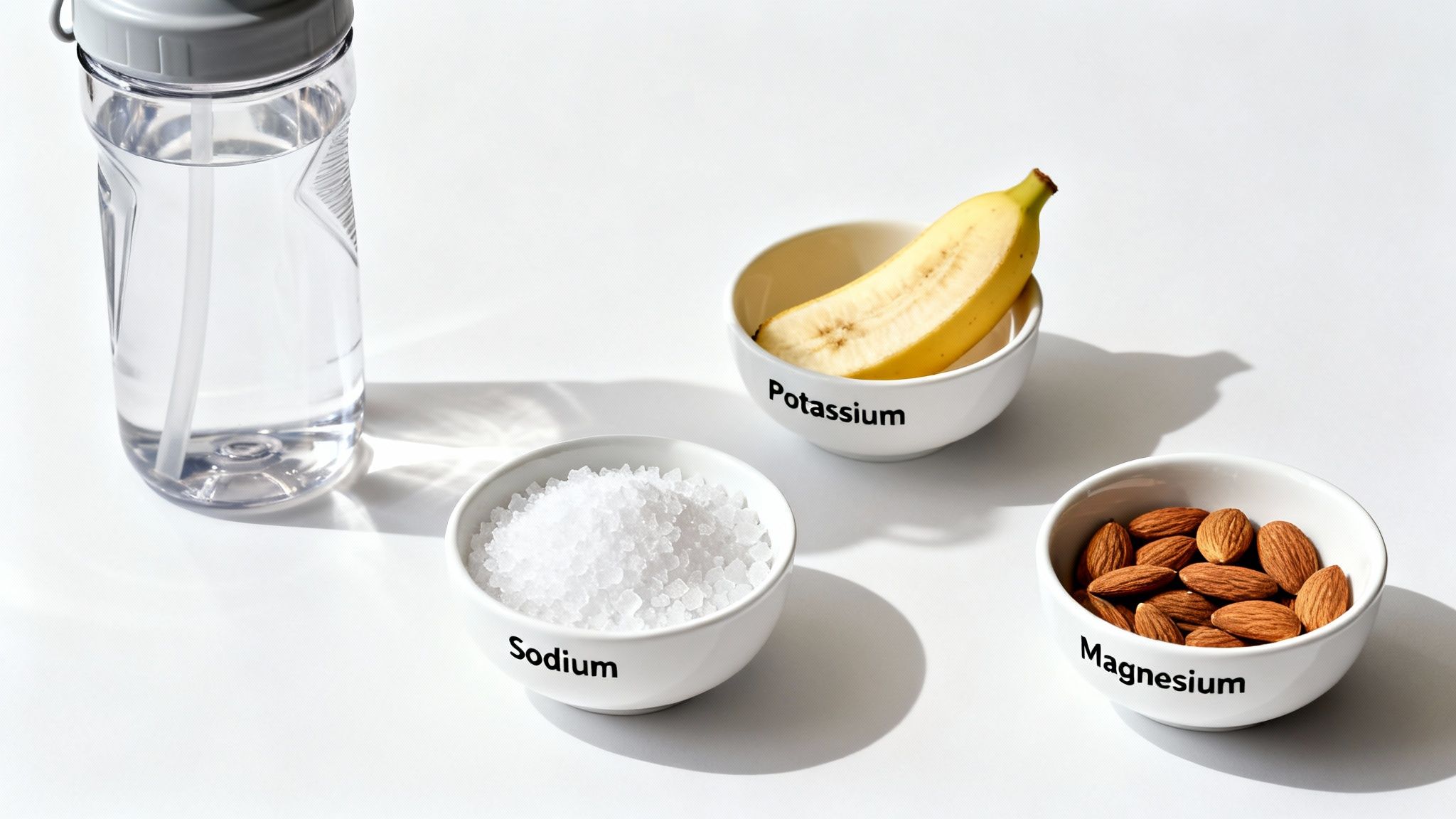
True athletic hydration isn't just about guzzling water—it's about maintaining a precise internal balance. Think of electrolytes as the unsung heroes of your performance. These essential minerals are the gatekeepers for your cells, controlling everything from fluid absorption and muscle contractions to nerve impulses.
Just drinking plain water during intense or long workouts can actually work against you. It can even be dangerous. Imagine pouring fresh water into a salty solution; the saltiness gets diluted. The same thing happens in your body. Chugging plain water while you’re sweating heavily dilutes your body’s sodium levels, a condition called hyponatremia. This can trigger nausea, confusion, and muscle weakness—the very things you're trying to prevent.
This is where you need to shift your mindset from just ‘drinking water’ to ‘strategic fueling.’ For an athlete, effective hydration means replacing both the fluid and the critical electrolytes you lose in sweat.
Meet the Key Players in Performance
While your body uses several electrolytes, a few stand out for their direct impact on how you perform. Getting to know their roles makes it crystal clear why H₂O alone doesn't cut it. For a deeper dive, check out this guide on understanding the essential functions of electrolytes in the body.
- Sodium: This is the big one. It's the most critical electrolyte lost in sweat and the primary driver of fluid balance. Sodium is what helps your body actually hold onto the water you drink and triggers your thirst mechanism in the first place.
- Potassium: Working in tandem with sodium, potassium is essential for regulating fluid balance, firing off proper muscle contractions, and transmitting nerve signals.
- Magnesium: This mineral is a powerhouse for energy production and muscle function. It’s a key player in preventing cramps and supporting your recovery process.
Without these key players on your team, the water you drink simply can't get where it needs to go—inside your cells and muscles.
Why Sodium Is Your Top Priority
Sodium isn't the enemy many people think it is; for an athlete, it's an absolutely essential ally. When you sweat, you lose far more sodium than any other electrolyte, and the amount can be staggering. The thing is, sweat and sodium losses vary wildly from one athlete to another, which makes any one-size-fits-all advice totally useless.
Research from the American College of Sports Medicine shows some athletes can lose 500–700 mg of sodium per hour of hard exercise. In extreme cases, that number can climb past 1,000 mg/h. Do the math for a three or four-hour marathon, and you could be looking at a deficit of 1,500–2,800 mg of sodium. These numbers hammer home why replacing sodium—not just fluid—is non-negotiable for endurance performance.
Forgetting to replace sodium is like trying to refill a leaky bucket. You can pour all the water you want into your system, but without enough sodium to help absorb and retain it, you’ll never stay properly hydrated.
Failing to replenish sodium leads directly to performance-killers like cramping, fatigue, and dizziness. This is exactly why a well-formulated electrolyte powder is a non-negotiable tool for any serious athlete. If you want to dive deeper into what makes a quality supplement, our guide on choosing the right electrolyte powder for your needs will help you move your hydration strategy from a guessing game to a precise, performance-boosting science.
Building Your Personalized Hydration Protocol
Generic hydration advice is the enemy of peak performance. Your body, your sport, and your environment create a unique set of demands—a fingerprint of variables that requires a specific, personalized plan. This is where we stop talking theory and start taking action. We're going to build your strategy from the ground up, starting with the single most important piece of data you can gather about your own body.
This isn't about just grabbing a water bottle on your way out the door. It's a deliberate, strategic process broken into three distinct phases: before, during, and after your workout. Master each one, and you’ll turn hydration from a guessing game into a repeatable advantage that fuels your best work and dramatically speeds up recovery.
Start With a Simple Sweat Rate Test
Before you can build an effective plan, you need to know what you’re up against. Your individual sweat rate is the cornerstone of your entire hydration strategy. Think of it as mission-critical intel—without it, you’re flying blind.
The good news? It’s simple to figure out. All you need is a scale.
- Pre-Workout Weigh-In: Strip down to minimal clothing and weigh yourself right before a training session. Write it down.
- Train as Usual: Go through a typical workout, ideally for one hour, in conditions that mimic your usual training or competition environment.
- Track Your Intake: Precisely measure any fluid you drink during the session (e.g., 16 ounces of water).
- Post-Workout Weigh-In: After your workout, towel off completely and weigh yourself again in the same minimal clothing.
-
Calculate Your Loss: Use this simple formula to find your hourly sweat rate:
- Sweat Loss (oz) = [ (Start Weight - End Weight) in oz ] + Fluid Consumed (oz)
For instance, if you lost 1 pound (16 oz) and drank 16 oz of fluid, your total sweat loss for that hour is 32 ounces. This number is now your personalized starting point, the baseline for everything that follows.
Phase One: Your Pre-Hydration Strategy
Showing up to a workout already dehydrated is one of the most common—and avoidable—performance killers out there. The goal is to start in a state of euhydration, a fancy term for being perfectly hydrated. You want to top off your fluid and electrolyte stores so you begin your session with a full tank.
This pre-loading process needs to start hours before your activity, not minutes.
- 2-4 Hours Before: Aim to drink 16-20 ounces of fluid. This gives your body plenty of time to absorb what it needs and get rid of any excess.
- 15-20 Minutes Before: Have a final top-off of 8-12 ounces right before you get started.
Here’s a pro tip: add electrolytes to your pre-hydration drink. This is a game-changer, especially before long or intense sessions in the heat. It pre-loads your system with the sodium needed to pull fluid into your cells and hold it there, setting you up for success before you've even broken a sweat.
Phase Two: Hydrating During Your Activity
This is where your sweat rate calculation becomes your tactical guide. The objective during exercise isn't to replace every single drop of sweat in real-time—that's nearly impossible. The real goal is to prevent excessive dehydration, specifically to keep your fluid loss below 2% of your body weight.
Use your hourly sweat rate as a baseline. If you lose 32 ounces per hour, your goal is to drink a significant portion of that—maybe 24-28 ounces—spread out evenly over that hour.
Don't wait until you're thirsty to drink. Thirst is a delayed signal. By the time you feel it, your performance is already on the decline. Get in the habit of sipping fluids consistently every 15-20 minutes.
For any activity lasting longer than 60 minutes, plain water just won't cut it. Your drink needs to contain electrolytes, especially sodium, to replace what you're pouring out in sweat. REVSCI Reviver Electrolytes are formulated to give you clean, effective replenishment without junk fillers. You can dive deeper into why you need electrolytes without artificial sweeteners to hit your peak.
Phase Three: The Post-Workout Recovery Plan
The work isn't over when you stop moving. The recovery phase is your window to fully replenish fluid and electrolyte deficits. Getting this right is critical for repairing muscle, cutting down on soreness, and priming your body for the next session.
The target is to replace 125-150% of the fluid weight you lost. For every pound of body weight lost, you should aim to drink 20-24 ounces of fluid over the next few hours. That extra volume accounts for the fluid you'll continue to lose through urine. Pair your fluid with a high-sodium electrolyte solution like REVSCI’s to speed up rehydration and get back to 100% faster.
Ready to put this all together? Here is a simple guide to help you dial in your timing and dosing.
Your Hydration Timing and Dosing Guide
This table breaks down the three-phase approach into a practical, at-a-glance reference. Use it as a starting point and adjust based on your sweat rate and training conditions.
| Hydration Phase | Timing | Recommended Fluid Intake | REVSCI Electrolyte Dosing |
|---|---|---|---|
| Pre-Hydration | 2-4 hours before activity | 16-20 oz | 1 scoop in your fluid |
| Pre-Workout Top-Off | 15-20 minutes before activity | 8-12 oz | N/A (rely on pre-hydration dose) |
| During Activity | Sip every 15-20 minutes | Match 75-80% of your sweat rate | 1 scoop per 16-24 oz of water |
| Post-Workout Recovery | Within 2 hours of finishing | 20-24 oz per pound of body weight lost | 1-2 scoops in your first recovery bottle |
Remember, this is your blueprint. Consistent use and small adjustments over time will help you build a hydration plan that feels like second nature and delivers elite-level results.
Adapting Your Plan for Different Conditions
Your hydration protocol should be a living document, not a rigid set of rules. You have to adjust it based on what the day throws at you.
- Heat and Humidity: This is the big one. High heat and humidity will crank up your sweat rate, sometimes dramatically. You'll need to increase both your fluid and sodium intake to keep up.
- Endurance vs. Strength: Endurance sports rack up huge total sweat losses over time, demanding a constant drip-feed of fluids and electrolytes. Athletes in these disciplines can benefit from exploring the specific hydration needs for runners. Strength athletes might have lower total sweat loss, but they still need to crush their pre-session hydration to maintain optimal power output.
By consistently applying this three-phase approach and fine-tuning it for your unique circumstances, you can build a truly personalized hydration protocol that drives performance, accelerates recovery, and gives you a powerful competitive edge.
Solving Common Hydration-Related Problems
Even with the best-laid plans, things can go sideways. A sudden muscle cramp, a gut-wrenching side stitch, or GI issues can wreck an otherwise perfect training session or race. These are rarely random; they're usually your body's way of telling you that your hydration or fuel strategy is off.
Learning to read these signals and troubleshoot them on the fly is a critical skill for any serious athlete. Think of yourself as your own pit crew chief. You wouldn't ignore a warning light on the dashboard—you’d diagnose and fix the problem. The same goes for your body. By understanding what causes these issues, you can make targeted adjustments that keep you firing on all cylinders.
Decoding Muscle Cramps
We've all been there. That sudden, vice-like grip of a muscle cramp is one of the most frustrating things an athlete can experience. For years, everyone pointed the finger at simple dehydration or fatigue, but we now know the story is a bit more complicated. The real culprit is often an electrolyte imbalance, and more specifically, a significant loss of sodium.
When you sweat heavily, you're not just losing water; you're pouring out sodium. This mineral is absolutely critical for the communication between your nerves and muscles. When sodium levels plummet, your nerves can become "hyper-excitable." They start misfiring, sending faulty signals that tell your muscles to contract when they shouldn't.
A muscle cramp is often a loud and clear signal that your sodium losses have outpaced your intake. It’s less about how much water you’ve lost and more about the concentration of key electrolytes you have left.
While sodium is the main player, other electrolytes like magnesium and potassium also have supporting roles in muscle function. A deficiency in these can lower your cramp threshold, making you that much more likely to seize up. To get a deeper dive into the science, you can find more on how to prevent muscle cramps and build a more resilient strategy.
Conquering Gut and GI Issues
Nothing brings an athlete to a screeching halt faster than gastrointestinal (GI) distress. Nausea, bloating, and that sloshing feeling in your stomach are common complaints, especially during long-haul endurance events. More often than not, the problem can be traced back to the type and concentration of what you’re putting in your bottles.
Many commercial sports drinks are just sugar bombs. A high concentration of carbohydrates (usually anything over 6-8%) can slam the brakes on how quickly fluid leaves your stomach. This delay is what causes that awful, bloated feeling that tanks your performance. Under stress, your gut has to choose between digesting fuel and absorbing fluid—it can't do both well at the same time.
The fix usually involves a two-part approach:
- Separate Fuel from Fluid: Stick to a clean electrolyte drink for your primary hydration, like REVSCI’s flavorless formula. Get your calories from separate sources like gels or chews.
- Practice Your Plan: Your gut can be trained just like your muscles. Never, ever try a new hydration or fueling strategy on race day. Use your long training runs and rides to figure out exactly what works for you.
This simple flowchart breaks down the core process of a winning hydration strategy, covering everything from prepping your body beforehand to performing and recovering effectively.
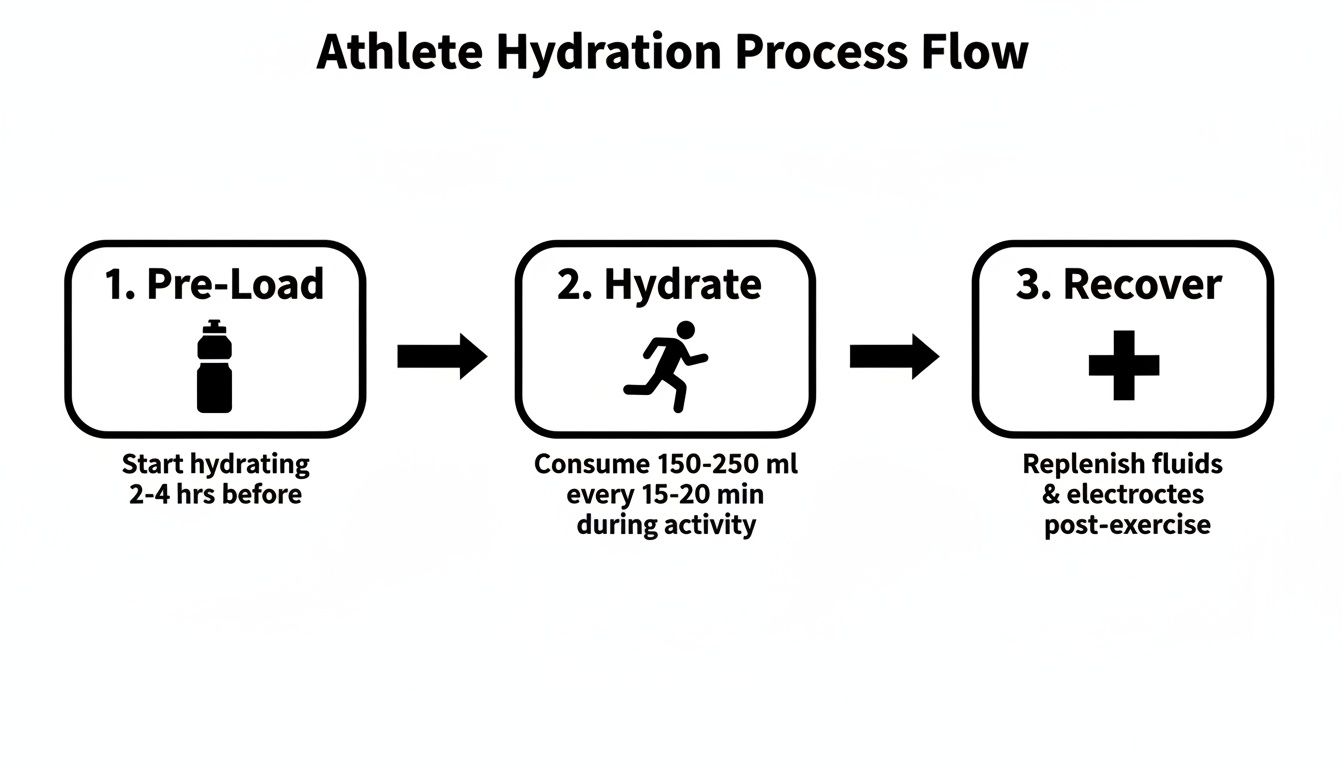
This visual is a great reminder that hydration isn’t a one-time event. It’s a continuous cycle that supports every single phase of your training and competition.
The Mystery of the Side Stitch
A side stitch is that sharp, stabbing pain that hits you just below the rib cage. It can be incredibly painful and completely derail your focus. While scientists still debate the exact cause, a leading theory is that it’s related to irritation of the parietal peritoneum—the membrane that lines your abdominal wall.
Chugging huge volumes of fluid, especially sugary or hypertonic drinks, right before or during hard exercise can be a major trigger. The weight and volume in your stomach can pull on the ligaments that connect to your diaphragm, causing spasms and that sharp pain.
To fight this, focus on taking smaller, more frequent sips of fluid instead of guzzling a bottle all at once. Building up your core strength and practicing diaphragmatic (or "belly") breathing can also make a huge difference in keeping side stitches at bay.
Putting Your Hydration Plan Into Action
You've done the work. You now have a blueprint to stop guessing about hydration and start using it as a serious competitive edge. We've moved beyond generic advice like "drink eight glasses a day" and built a framework that's grounded in your own unique physiology.
The biggest takeaways should be crystal clear: your hydration needs are deeply personal, electrolytes aren't optional, and a structured plan is your ticket to unlocking consistent, high-level performance.
Think of mastering hydration as a process, not a one-and-done task. It’s a constant feedback loop. You test your strategy in training, you listen to what your body is telling you, and you make smart tweaks along the way. Every single session is a chance to collect more data and dial in your approach for different scenarios—maybe that’s bumping up your sodium for a long run in the humidity or nailing your pre-load before a heavy squat day.
From Knowledge to Mastery
Your success now comes down to consistently applying these core ideas. You’ve learned how to calculate your sweat rate, you know when to prioritize electrolytes, and you have a structure for what to drink before, during, and after your workouts. That knowledge is power—it puts you in complete control of a critical piece of the performance puzzle.
This process of constant refinement is what separates the good athletes from the great ones. The end goal is a plan so ingrained and intuitive that it becomes second nature.
Mastering your hydration strategy is an ongoing conversation with your body. Learn to listen to the signals—cramps, fatigue, thirst—and respond with a precise, practiced plan. This skill is your ultimate tool for repeatable success.
By putting these principles into practice, you're not just drinking smarter; you're building a more resilient, high-performing athletic machine. You have the tools to perform better, recover faster, and stay safer while chasing your goals.
For those looking to dial in their fueling even further, a logical next step is understanding the role of well-formulated intra-workout drinks and how they fit into a complete strategy.
Frequently Asked Hydration Questions
You can have the most dialed-in plan on paper, but questions always pop up in the real world. Here are straight-up answers to the most common hydration questions we get from athletes who are serious about pushing their limits.
How Do I Know if I Am Properly Hydrated?
Forget the complicated math for a second. The simplest, most effective tool you have is built right in: your urine color.
You're aiming for a pale, lemonade-like yellow. If what you see is dark, closer to apple juice, that's a direct signal from your body to up your fluid intake. While it's not a perfect real-time gauge during a hard effort, it's an incredibly reliable way to check your baseline hydration status day-to-day.
Can I Drink Too Much Water?
Absolutely, and it’s a serious risk. Guzzling huge amounts of plain water, especially over several hours of activity, can dangerously dilute the sodium concentration in your blood. This condition is called hyponatremia, and it's a medical emergency that can lead to confusion, nausea, and in severe cases, can be fatal.
This is exactly why electrolytes aren't optional for serious athletes. Sodium is the key that unlocks hydration—it helps your body actually absorb and hold onto the water you're drinking, keeping that critical fluid balance right where it needs to be for you to perform safely.
Does Caffeine Actually Dehydrate Me?
This is one of those old-school myths that just won't die, but the science has pretty much put it to rest. While caffeine does have a mild diuretic effect (it makes you pee), the amount of fluid you get from your coffee or tea more than makes up for that small loss.
For anyone who has caffeine regularly, that effect is even weaker. So no, your morning coffee isn't wrecking your hydration strategy. Just don't let it take the place of your dedicated water and electrolyte plan.
How Should Hydration Differ for Strength vs Endurance Sports?
Your strategy has to match the mission. The demands are different, and so is the approach.
- Endurance Athletes: The game is all about staving off dehydration and cramping over the long haul. You're losing a ton of fluid and sodium, and your main job is consistent replacement to prevent your performance from tanking. Think steady sips of an electrolyte drink.
- Strength Athletes: While you might not be sweating for hours on end, hydration is still critical for peak power and keeping your joints healthy. The focus shifts to front-loading—making sure your muscles are fully hydrated before you even touch a heavy barbell.
Dial in your performance with a no-nonsense approach. Revolution Science provides clean, research-backed electrolyte formulas designed to support your specific goals without fillers or artificial junk. Take control of your hydration and see the difference at https://rvsci.com.