
Your Cart is Empty


preworkout with caffeine: The Complete Guide to Safe Dosing and Timing
A pre-workout with caffeine is basically a high-octane fuel designed to kick your body and mind into high gear right before you train. Its whole purpose is to help you go harder, last longer, and get more out of every single rep and set by revving up your central nervous system. Think of it as flipping the "on" switch for peak performance.
How Caffeinated Pre-workout Supercharges Your Training
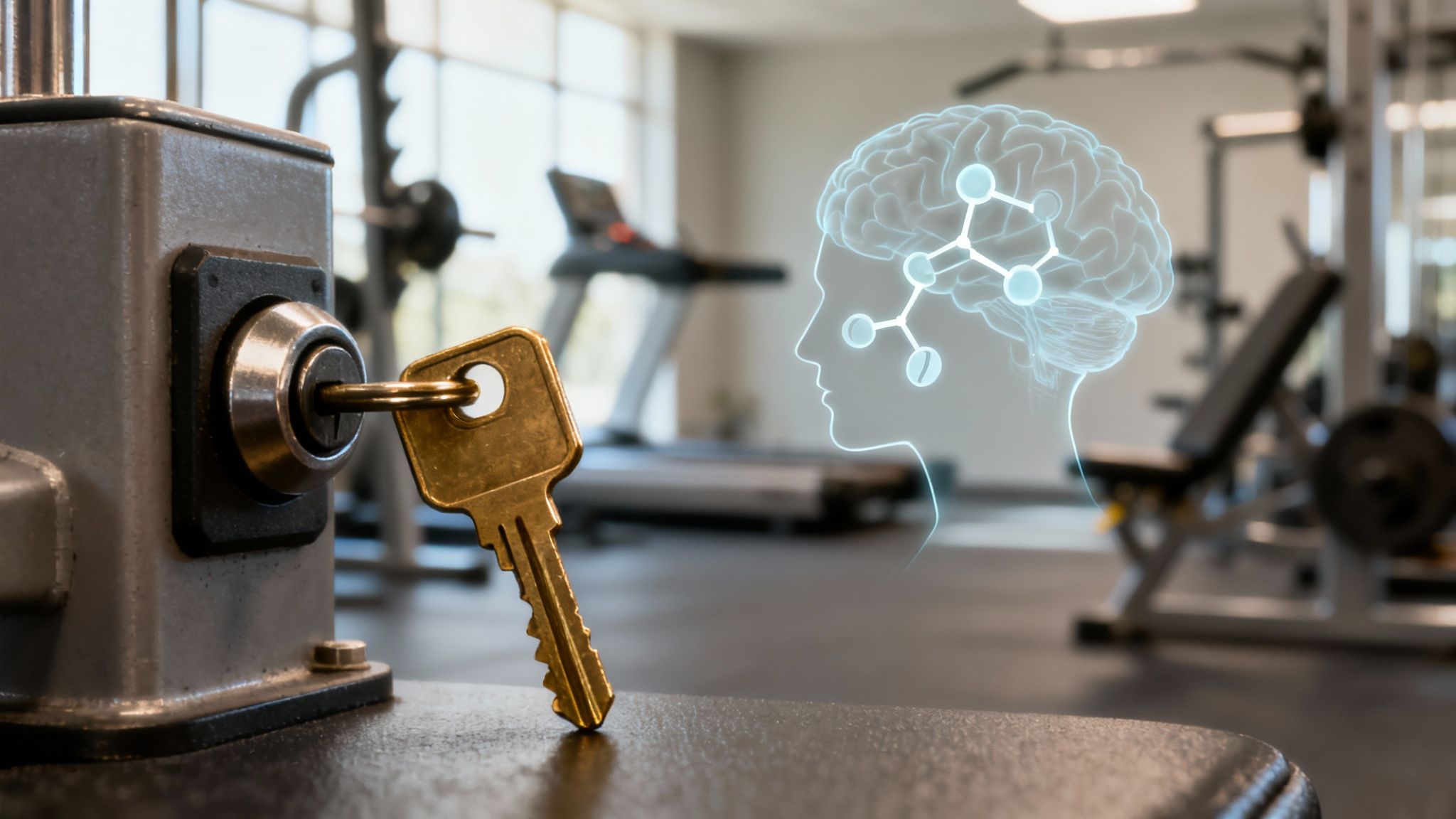
To really get how pre-workout does its thing, you have to know about a little compound in your brain called adenosine. As you go about your day and burn energy, adenosine builds up. It’s like a dimmer switch for your brain, binding to receptors and telling your body it's time to chill out and feel tired. It’s your body’s natural brake pedal.
Here’s where caffeine comes in. Its molecular shape is a dead ringer for adenosine. When you down your pre-workout, the caffeine zips up to your brain and slides right into those adenosine receptors, almost like a key fitting into a lock. But instead of turning the key to make you sleepy, caffeine just sits there and blocks it.
By jamming up the receptors, caffeine stops adenosine from ever delivering its "you're getting tired" message. It’s like putting a block under your car’s brake pedal—the signal to slow down never reaches the engine. This one simple action kicks off a chain reaction of effects that directly amp up your workout.
Unlocking Your Body's Accelerator
With your brain’s natural braking system out of commission, your body’s accelerator—the central nervous system—can finally redline. This sparks a flood of stimulating neurotransmitters, the chemical messengers that get your brain and body primed for action.
You'll notice a few key things happen:
- Increased Alertness: Your brain literally starts firing faster. You feel more awake, sharp, and ready to attack the weights.
- Enhanced Focus: With those fatigue signals silenced, you can lock in on what you're doing, whether it's nailing your form on a heavy squat or pushing through the final mile.
- Elevated Mood: The release of chemicals like dopamine just makes you feel good and fired up to train. Motivation goes way up.
This is why that scoop you mix up 30 minutes before the gym can take you from feeling drained and lazy to completely dialed-in and bursting with energy.
Think of it this way: Adenosine is that nagging voice in your head telling you how tired you are after a long day. Caffeine is a pair of noise-canceling headphones that completely silences that voice, so all you hear is the music pushing you to perform.
From Brain to Muscle
This mental boost isn't just in your head; it translates directly to physical power. The jolt to your central nervous system doesn’t just wake you up, it makes the signals from your brain to your muscles faster and more efficient. The result is stronger muscle contractions and better coordination.
On top of that, caffeine can encourage your body to burn fat for fuel, which saves your precious muscle glycogen stores for when you really need them late in a workout. This is a massive advantage, especially for endurance athletes. The immediate rush of energy and focus you feel from a pre-workout with caffeine is very real—it’s a powerful biological process that temporarily shatters your body's self-imposed limits and sets the stage for real, measurable gains.
The Performance Benefits of Using Preworkout With Caffeine
That initial jolt you get from a preworkout with caffeine is impossible to miss. But what's that buzz actually doing for your training? It's more than just feeling wide awake; the effects ripple out into real, measurable gains in your strength, endurance, and focus. These aren't just feelings—they're concrete advantages backed by a mountain of research and countless hours in the gym.
This is exactly why caffeine is the undisputed king of the supplement world. Stimulant-based formulas absolutely dominate the market, making up over 80% of all pre-workout sales. And within that massive slice of the pie, caffeine itself is in a staggering 87% of those products. Its popularity is no accident—it's built on a solid foundation of enhancing energy, sharpening focus, and flat-out boosting physical performance. You can dig into more data on the pre-workout market to see just how central caffeine is to the way we train today.
Boosting Raw Strength and Power
If your goal is to move heavy weight, caffeine is one of the best tools in your arsenal. It works by directly firing up your central nervous system, essentially upgrading the signal from your brain to your muscles. This makes the communication faster and more forceful, leading to more powerful and efficient muscle contractions.
What does that look like in the gym?
- Increased Maximal Strength: Study after study shows athletes can lift heavier one-rep maxes after taking caffeine. It's a reliable performance-enhancer.
- Greater Muscular Endurance: You'll often find you can bang out an extra rep or two on your sets. Over time, that extra volume is a massive driver for muscle and strength gains.
- Enhanced Power Output: For explosive movements like box jumps, sprints, or Olympic lifts, caffeine helps you generate that force more quickly and aggressively.
Imagine your nervous system is the wiring in a house and your muscles are the lights. Caffeine acts like flipping the main breaker, surging more power through the circuits. When you demand that power, you get a stronger, more explosive output.
Extending Your Endurance and Stamina
Endurance athletes get just as much, if not more, out of a caffeinated pre-workout. One of its most potent effects is its ability to change your Rate of Perceived Exertion (RPE). Put simply, it makes hard work feel easier.
When you're deep in the pain cave during a long run or a brutal conditioning session, your brain is getting flooded with signals of fatigue and discomfort. Caffeine acts like a filter, dampening those signals so you can push right through the mental barriers that would normally make you quit.
Caffeine essentially plays a trick on your brain, convincing it that you're less tired than you really are. By lowering how hard the effort feels, it gives you the green light to hold a higher intensity for longer. It's what turns "I'm done" into "one more rep."
This psychological edge allows you to maintain a faster pace and delay hitting the wall. It also helps your body burn fat for fuel more efficiently, which spares your precious muscle glycogen for those moments when you really need to dig deep and give it everything you've got.
Sharpening Mental Focus and Reaction Time
A great workout is a mental game as much as it is a physical one. A preworkout with caffeine brings your cognitive function into sharp relief, which is absolutely critical for both performance and safety.
By boosting your alertness and concentration, you can forge a much stronger mind-muscle connection. You become acutely aware of your form, making sure every single rep is perfect. This isn't just about maximizing gains; it's about preventing injury.
On top of that, caffeine is proven to slash reaction time. For athletes in dynamic sports, that's a game-changer. You can explode off the starting line faster, change direction on a dime, or make a micro-adjustment to your form in the middle of a heavy lift. It keeps you locked in and ready for anything.
Timing and Dosing Your Preworkout for Peak Results
To get the absolute most out of your preworkout, it’s not just about what’s in the scoop—it’s about when you take it and how much you use. Nailing your timing and dosage is the difference between a pretty good workout and a phenomenal one. Think of it like a race car; a powerful engine doesn't mean a thing if you don't know exactly when to hit the gas.
The golden window for taking your preworkout is between 30 and 60 minutes before you start training. This timeframe is non-negotiable. It gives the caffeine enough time to be fully absorbed into your bloodstream, hitting peak concentration right as you’re wrapping up your warm-up. This ensures you feel the full surge of energy, focus, and power from your very first set to your last.
Take it too early, and you might peak before your main lifts. Take it too late, and you could feel sluggish at the start and uncomfortably wired long after you’ve left the gym. That 30-60 minute sweet spot is your launchpad.
Your training goal should dictate how you approach your preworkout, as different objectives benefit from different performance boosts.

Whether you're chasing raw power, extended endurance, or razor-sharp focus, you can leverage your supplement strategically to get there.
Tailoring Doses for Strength vs. Endurance
Your dosing strategy needs to line up with your training goals. An athlete prepping for a one-rep max has completely different demands than someone gearing up for a 10-mile run, and their preworkout intake should reflect that.
For strength and power athletes, the name of the game is explosive, short-duration output. A higher dose of caffeine, typically in the 3-6 mg per kilogram of body weight range, has been shown to be incredibly effective. This amount lights up the central nervous system, priming your muscles for those intense, forceful contractions needed to move heavy weight.
Endurance athletes, on the other hand, need sustained energy over a much longer period. While that same 3-6 mg/kg range is still the evidence-based sweet spot, many find that a more moderate dose works best to avoid jitters or a mid-session crash. For them, caffeine's biggest benefit is its ability to lower the perception of effort, making those grueling miles feel just a little bit easier.
Finding Your Personal Caffeine Threshold
Here’s the thing: no two people process caffeine the same way. Your genetics, body weight, and even your daily coffee habit all influence what’s called your caffeine metabolism. This is why your training partner might feel amazing on 300 mg while 150 mg is more than enough to get you dialed in.
The number one rule of preworkout dosing is simple: start low and go slow. It is always better to take a little less and dial it up next time than to take too much and spend your workout dealing with anxiety and a racing heart.
Begin with a dose on the low end—somewhere around 1.5-3 mg per kilogram of body weight—and pay close attention to how your body responds. This helps you find your "minimum effective dose," which is the smallest amount you need to see a real benefit without the unwanted side effects. Starting with a well-formulated product, like a pre-workout powder with a moderate 180 mg of caffeine, is an excellent way to safely assess your personal tolerance.
To give you a practical starting point, we've put together some guidelines based on body weight and training goals.
Caffeine Dosing Guidelines Based on Goal and Body Weight
This table offers some sensible starting points for caffeine intake before your workout. Remember, everyone's tolerance is different, so it's critical to begin at the lowest end of your recommended range and see how you feel.
| Body Weight | General Performance (mg) | Strength & Power Focus (mg) | Endurance Focus (mg) |
|---|---|---|---|
| 120 lbs (54 kg) | 100 - 160 mg | 160 - 320 mg | 160 - 270 mg |
| 150 lbs (68 kg) | 130 - 200 mg | 200 - 400 mg | 200 - 340 mg |
| 180 lbs (82 kg) | 160 - 240 mg | 240 - 490 mg | 240 - 410 mg |
| 210 lbs (95 kg) | 190 - 280 mg | 280 - 570 mg | 280 - 475 mg |
Treat this table as a guideline, not a rigid prescription. Mastering your preworkout routine is all about personal calibration. Listen to your body, track how you feel and perform, and adjust as needed. That’s how you unlock consistent, powerful results in the gym.
Managing Caffeine Tolerance and Cycling Effectively
Ever notice how that first scoop of a preworkout with caffeine hit you like a lightning bolt, but now you need more and more just to feel the same spark? You're not imagining it. That’s a classic case of caffeine tolerance. Your body is a master of adaptation, and when you constantly hit it with a stimulant, it works to find a new normal, dulling the effects over time.
Think of it like listening to your favorite hype track before a big lift. The first few times, it gets your blood pumping. After the hundredth listen? It's just background noise. Your brain's receptors react to caffeine in a similar way. Consistent use makes them less sensitive, and that incredible edge you once felt begins to fade.
This is where people get into trouble, chasing that original feeling by adding another half-scoop. It's a slippery slope that can lead to dependency and a higher risk of side effects. To keep your preworkout working for you long-term, you need to be smarter than your tolerance.
Implementing a Caffeine Cycling Strategy
The best way to fight back against tolerance is with a tactic called caffeine cycling. It's simple: you take planned, strategic breaks from all caffeine sources. This gives your body’s adenosine receptors a chance to reset and get back to their original sensitivity. The concept is straightforward, but the results are powerful.
One of the most proven and effective protocols is the 4-to-1 cycle:
- On-Cycle (4 Weeks): Use your caffeinated preworkout as usual before your key training sessions for four straight weeks.
- Deload Week (1 Week): Go completely caffeine-free for one full week. That means no preworkout, no coffee, no tea, no energy drinks.
- Reintroduction: When you reintroduce your preworkout after that week off, you'll be amazed. That old potency is back, and you'll likely find a smaller dose feels more effective than ever.
This reset doesn't just make your preworkout hit harder; it prevents you from becoming reliant on it. If going completely cold turkey feels daunting, using a stimulant-free preworkout powder during your deload week is a great move. It keeps your pre-gym ritual intact and still delivers performance benefits like better pumps and focus, just without the stimulants.
A caffeine cycle isn't a sign of weakness; it's a mark of intelligent training. By strategically taking breaks, you ensure your preworkout serves as a powerful tool for peak performance, not just a daily crutch to feel normal.
The Risks of Stacking Stimulants
In a desperate attempt to feel that kick again, some people start stacking. This means they combine their caffeinated preworkout with other stimulants, like a fat burner or multiple energy drinks throughout the day. This is an incredibly risky game. It can easily skyrocket your total caffeine intake way past the recommended safe upper limit of around 400 mg per day.
When you stack stimulants, you're not just asking for some jitters—you're dramatically increasing your risk for serious side effects. We're talking about heart palpitations, severe anxiety, digestive issues, and dangerously high blood pressure. The tiny benefit you might feel isn't worth the massive health gamble.
Instead of piling on more, focus on resetting your system through cycling. A well-designed preworkout is formulated to be effective on its own. Trust the science, respect your body, and use a cycling strategy to keep your preworkout a safe and powerful part of your fitness arsenal.
Understanding the Potential Risks and Side Effects
While a preworkout with caffeine can feel like you’ve just unlocked a new superpower, it's not a magic bullet. With great power comes the need for a little respect and responsibility. To be completely transparent, the very things that give you that incredible performance boost are also what can cause a few unwanted side effects.
The most common complaints are almost always tied to the dose—take too much, and you'll likely feel it. You might get the classic "jitters," a general feeling of restlessness, or even a wave of anxiety. This is simply your nervous system going into overdrive; the same mechanism that dials in your focus can also crank the dial a little too high, leaving you feeling uncomfortably wired.
On top of that, some people find their stomach isn't a fan. High concentrations of caffeine and other ingredients can sometimes irritate the digestive system, leading to discomfort or that dreaded mid-squat dash to the restroom.
Protecting Your Sleep and Heart Health
The biggest, and most frequently ignored, side effect is how it can absolutely wreck your sleep. Caffeine has a half-life of about five to six hours. That means half the dose you took is still floating around in your system hours after you've racked the weights. Chugging a potent preworkout late in the afternoon is a surefire way to spend your night staring at the ceiling, robbing your body of the deep, restorative rest it desperately needs.
Let's be clear: you don't build muscle in the gym—you build it when you recover. Trading quality sleep for a temporary workout buzz is a bad deal every single time. It will kill your long-term progress and wear down your health.
Beyond just a bad night's sleep, going overboard on caffeine can get more serious. It can temporarily spike your heart rate and blood pressure. For a healthy person using a sensible dose, this usually isn't a big deal. But for anyone with a pre-existing heart condition, it’s something you absolutely cannot ignore. Your body will give you warning signs. If you feel your heart pounding in a way that feels wrong, that’s your cue to back off the dose or stop completely.
Minimizing Risks and Using Preworkout Safely
The good news is that nearly all of these risks can be managed with a smart, mindful approach. The goal is to get all the performance-enhancing perks without any of the baggage.
Here are a few simple strategies to keep your experience positive and productive:
- Start Low and Go Slow: Don't ever jump in with a full or "heaping" scoop. Start with a half-scoop to see how your body reacts. You can always work your way up if you feel you need more.
- Time It Right: Give yourself a strict caffeine "curfew." As a rule of thumb, avoid taking preworkout within 8-10 hours of when you plan to go to bed. Protect your sleep at all costs.
- Stay Hydrated: Caffeine can act as a mild diuretic. Sipping on water before, during, and after your workout will counteract this and can even help minimize feelings of jitteriness.
- Never Dry Scoop: Just don't. Always mix the powder with the recommended amount of water. Tossing it back dry is a choking hazard and makes it way too easy to take more than you intended.
The supplement industry is a massive economic force, which tells you just how popular these products are. The global market for caffeine powder, a key ingredient in almost every preworkout, was valued at over USD 1.06 billion and is expected to nearly double by 2035. You can dig into the caffeine powder market's growth trends if you're curious about the industry's scale. This explosive growth just makes it more important to be a smart, educated consumer.
By understanding how these products work—both the good and the bad—you can use them as the powerful tools they're meant to be. If you're looking for more info tailored to male athletes, check out our guide on energy supplements for men. In the end, it’s all about a responsible approach that empowers you to decide what’s truly right for your body and your goals.
How to Choose a Safe and Effective Preworkout
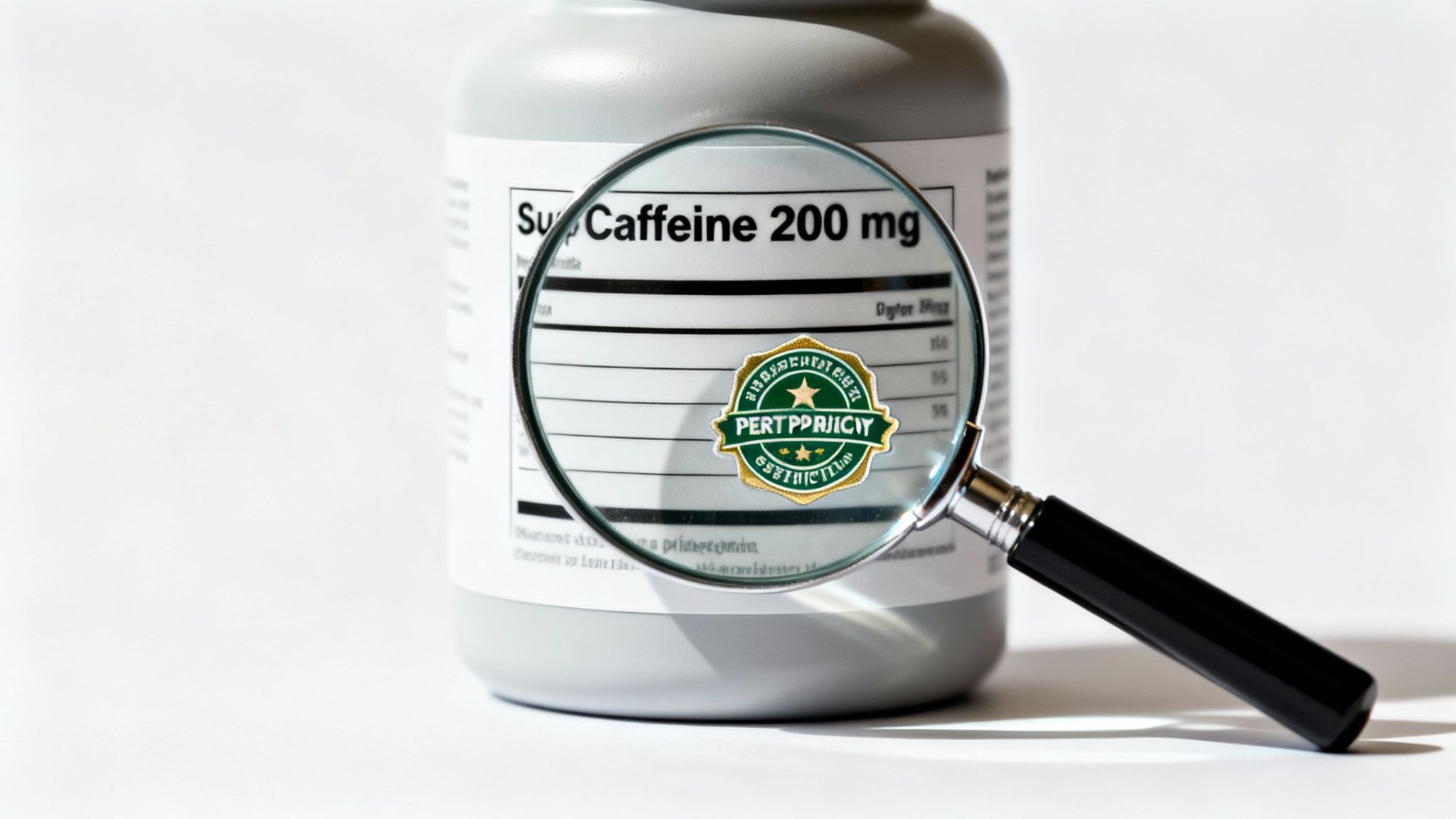
Stepping into the supplement aisle can feel overwhelming. You’re hit with a wall of brightly colored tubs all promising explosive energy and skin-splitting pumps. It's tough to know which preworkout with caffeine is a smart investment and which is just flashy marketing.
The single most important skill you can develop is learning to read the label. This is where the real story is told, far away from the hype. Look past the front-of-tub claims and get straight to the "Supplement Facts" panel to see what’s really inside.
Pay attention to more than just the caffeine dose. You want to see other proven ingredients that support performance in different ways. Staples in high-quality formulas, like L-citrulline and beta-alanine, are there for a reason. L-citrulline helps boost nitric oxide for a better "pump" and nutrient delivery, while beta-alanine helps you buffer acid so you can squeeze out those last few growth-stimulating reps.
Look for Third-Party Certifications
The supplement industry is notoriously under-regulated. That means you can’t always trust that what's on the label is actually what's in the tub. This is where third-party testing certifications become your most trusted allies, acting as an independent stamp of approval that verifies a product's purity and potency.
Keep an eye out for these logos:
- NSF Certified for Sport: This is the gold standard for athletes. It ensures the product is free from over 270 banned substances and that the label claims are accurate.
- Informed-Sport: This certification also tests every single batch for banned substances before it’s released, giving competitive athletes total peace of mind.
Seeing one of these logos means the company has invested serious money to prove their product is clean, safe, and honestly labeled.
Avoid Proprietary Blends
One of the biggest red flags on any supplement label is a "proprietary blend." This is a tactic where a company lumps a bunch of ingredients together under a made-up name, listing only the total dose for the entire blend. This hides the exact amount of each individual ingredient.
A proprietary blend is like a restaurant giving you a "secret sauce" but refusing to tell you the ingredients. You have no idea if you’re getting a performance-enhancing dose of L-citrulline or just a tiny sprinkle mixed with cheaper fillers.
Transparent labeling is the mark of a trustworthy brand. When every ingredient and its exact dosage is clearly listed, it shows the company is confident in its formula and respects your right to know exactly what you’re putting into your body. This transparency is crucial for finding what will work for you; for a deeper dive, read our post on what makes a great preworkout.
The global pre-workout market, driven largely by caffeine, was valued at nearly USD 21 billion and is projected to surge to almost USD 38 billion by 2035. With so much money on the line, being an informed consumer is your best defense. By prioritizing certified, transparently labeled products, you ensure your preworkout is a powerful tool, not an expensive risk.
Got Questions About Pre-Workout with Caffeine?
Even after you get the science down, a few real-world questions always pop up. Let's tackle the most common ones so you can use your pre-workout safely, effectively, and get the results you're chasing.
Can I Take Pre-Workout Every Day?
You can, but it’s definitely not the smartest play for long-term gains. Using a caffeinated pre-workout daily is a fast track to building up a tolerance. Before you know it, you'll need more and more just to feel that initial kick, which really defeats the purpose and makes you reliant on it.
The best strategy is to save it for your toughest training days—the ones where you really need to be switched on. To keep it working for you, cycle it. A good rule of thumb is to use it consistently for 4-6 weeks, then take a full 1-2 week break to let your body reset its sensitivity.
What Happens If I Take Pre-Workout and Don't Work Out?
You’re going to get all the stimulation without any of the release. Think increased heart rate, a feeling of being wide-awake, and a pretty good chance of jitters or anxiety—but with nowhere for that energy to go. Without a workout to channel it all, those side effects can feel way more intense and just plain uncomfortable.
It’s not dangerous if it happens once by accident, but it’s not a pleasant experience and completely misses the point of the supplement. It's like flooring the gas pedal on a sports car while it's stuck in neutral. All noise, no movement.
Think of a caffeinated pre-workout as high-octane fuel for a specific job: intense physical exertion. Using it without the workout is like filling up a race car just to let it sit in the garage—it’s a waste and puts unnecessary strain on the engine.
How Long Do the Effects Last?
You’ll feel that peak performance window—the surge of energy, sharp focus, and extra power—for about 2 to 4 hours. The strongest effects usually hit you around 30 to 60 minutes after you drink it.
But here’s the important part: caffeine’s half-life is around 5-6 hours. That means half the dose is still circulating in your system long after that initial buzz has faded. This is exactly why taking a pre-workout too late in the afternoon can wreck your sleep, and quality sleep is non-negotiable for recovery and growth.
At Revolution Science, we're committed to giving you the knowledge to train smarter, not just harder. Our clean, research-backed formulas are built to support your performance goals safely and effectively.
Explore our transparently dosed supplements and find the right fuel for your fitness journey at https://rvsci.com.