
Tu carrito está vacío


How to Avoid Muscle Cramps During Exercise A Proven Guide
To sidestep muscle cramps during exercise, you need to tackle two things at once: neuromuscular conditioning and precise hydration.
It's about training your body to handle the stress of your sport while also diligently replacing the fluids and key electrolytes—especially sodium—you lose through sweat. There's no single magic bullet; it's about building a more resilient system that's ready for anything you throw at it.
Understanding Why Muscle Cramps Happen
That sudden, vise-like grip of a muscle cramp mid-workout is an unmistakable signal from your body to stop what you're doing. For years, conventional wisdom just blamed dehydration or low potassium, but the real science tells a much more interesting story.
To actually prevent muscle cramps, we have to look past the old myths and dig into the two main culprits: neuromuscular fatigue and significant electrolyte imbalances. These two factors often team up, creating the perfect storm for those painful, involuntary contractions that can completely derail a workout or competition.
The Role of Neuromuscular Fatigue
Think of the link between your brain and your muscles like an electrical circuit. Your brain sends signals down your spinal cord and through your nerves, telling specific muscle fibers when to contract and relax. It's a beautifully coordinated dance.
But when you push yourself hard, especially for a long time or at an intensity your body isn't ready for, this whole system can get over-excited and tired.
The "wires" get crossed. The nerve signals become a jumbled mess, causing the muscle to lock up instead of relaxing. This is why cramps so often strike:
- Near the end of a long race, when your muscles are at their absolute breaking point.
- During a new, challenging movement, when that specific neuromuscular pathway is still under construction.
- When you're undertrained for the effort, because the muscles and nerves just aren't prepared for the workload.
Bottom line: a well-trained muscle is a cramp-resistant muscle. Its communication lines are strong, efficient, and less likely to misfire.
The Critical Impact of Electrolyte Loss
If neuromuscular fatigue sets the stage, then losing electrolytes and fluid is like throwing gasoline on the fire. When you exercise, you sweat. That sweat isn't just water; it's loaded with crucial minerals called electrolytes, and sodium is the most important one you lose.
These electrolytes are non-negotiable for maintaining fluid balance and allowing your nerves and muscles to talk to each other properly. When you sweat out a ton of sodium and fluid without replacing them, the environment around your muscle cells changes. The fluid shifts, compressing the space and irritating nerve endings, making them much more likely to fire off randomly.
This dehydration-induced excitability is the perfect partner for the fatigue-driven misfirings we just talked about.
A huge mistake athletes make is chugging plain water. Over-hydrating with just water can dilute the sodium left in your blood, leading to a dangerous condition called hyponatremia—which, ironically, can make you cramp even more.
Understanding this dual-cause model is the first real step toward a solid prevention plan. It’s not about just drinking more water or eating a banana. It’s about combining smart training with a personalized hydration and electrolyte strategy.
You need to know not just that you're sweating, but what you're losing in that sweat. For any serious athlete, learning how to calculate sweat rate is a total game-changer. Other underlying issues, like poor circulation, can also make you more susceptible. Taking steps toward improving circulation naturally can sometimes help shed light on recurring issues. By tackling both the electrical (neuromuscular) and chemical (electrolyte) sides of the problem, you build a body that's far more resilient to muscle cramps.
Building Your Pre-Workout Anti-Cramp Foundation
The best way to stop a cramp isn't some magic trick you pull out mid-workout. It’s about laying the groundwork hours, and even days, before you even start sweating. True prevention goes way beyond chugging a bottle of water on the way to the gym; it's about creating a resilient internal environment through consistent, smart preparation.
This means dialing in your daily hydration habits and eating a diet loaded with the right minerals. Your muscles are counting on a steady supply of electrolytes like sodium, potassium, and magnesium to fire correctly. Keep those levels topped off, and your body is far better equipped to handle the stress of hard training without seizing up.
Shifting From Guesswork to Data
The real game-changer in beating cramps is to stop guessing what your body needs and start knowing what it's losing. A one-size-fits-all approach to hydration and electrolytes is a recipe for failure. The key is understanding your own physiology, and the single most powerful tool for that is calculating your sweat rate.
Figuring out your sweat rate is surprisingly simple and something you can do at home. This number tells you exactly how much fluid you lose per hour of exercise. Once you have that data, you can build a hydration plan with military precision, ensuring you replace what you actually lose—not what some generic chart says you should.
The Power of Consistent Hydration and Electrolyte Balance
Hydration isn't just about what you drink during your workout. Showing up to a session already dehydrated is like asking for a cramp. You need to aim for consistent fluid intake all day, every day. This creates a stable fluid reserve your body can tap into when things get intense.
Of course, water alone often isn't enough, especially for those of us who are heavy sweaters. This is where electrolytes come in.
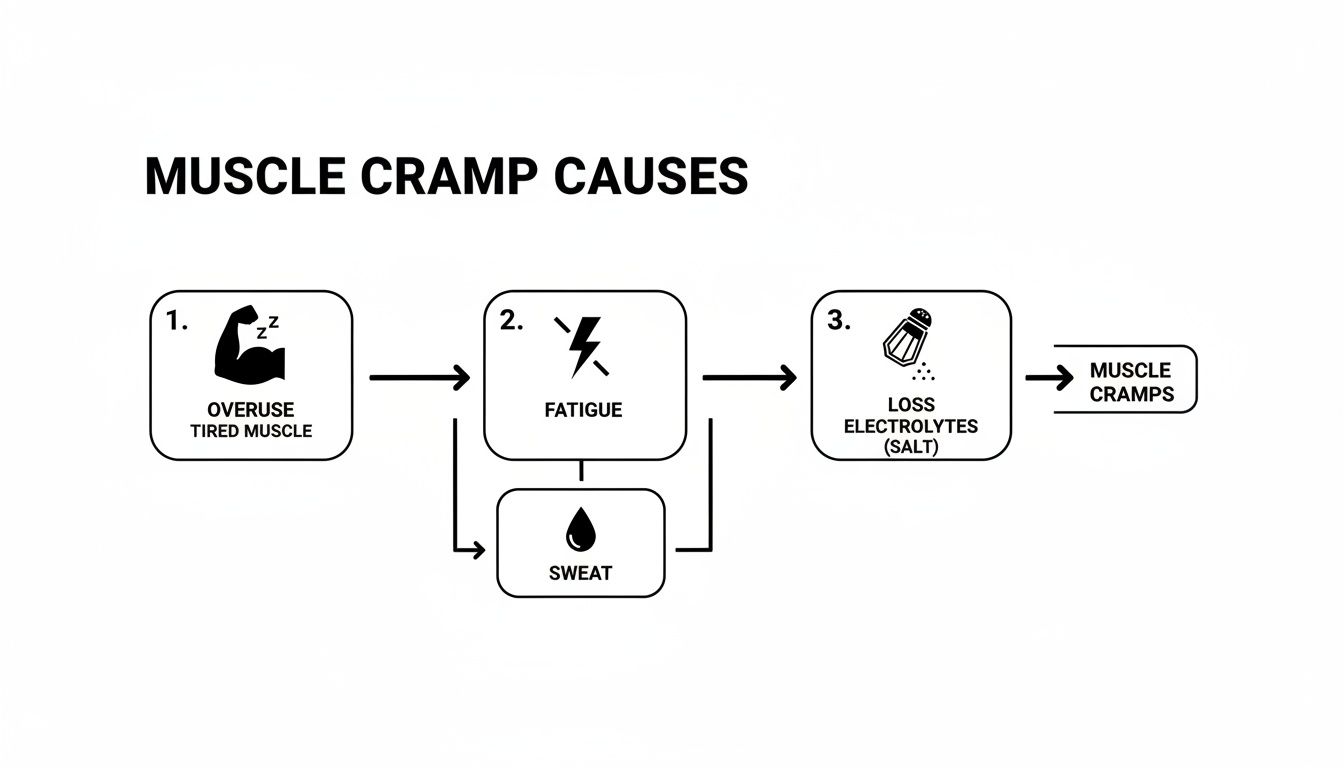
As you can see, when muscle fatigue kicks in and the sweat starts pouring, the loss of critical electrolytes like sodium throws your muscle function out of whack. This is a direct pathway to cramping. Your pre-workout routine has to include topping off these mineral stores.
Getting electrolytes from whole foods is a great place to start:
- Potassium: Think bananas, sweet potatoes, spinach, and avocados.
- Magnesium: Load up on nuts, seeds, whole grains, and leafy greens.
- Sodium: Don't be afraid of salted nuts, pretzels, or just adding a little extra salt to your meals before a tough workout.
Proper fluid intake is an absolute cornerstone of performance, and you can dive deeper with these hydration tips for athletes.
Let's talk about sodium for a minute. It has been unfairly demonized in general health talks, but for athletes, it is the single most important electrolyte for warding off cramps. You lose far more sodium in your sweat than any other mineral, period.
The link between sodium loss and muscle cramps isn't just a modern theory; it's a lesson learned the hard way. Early studies of industrial workers in scorching hot environments discovered that those drinking only plain water suffered from debilitating cramps. In one facility, adding salt to their drinking water nearly eliminated cramps entirely, while a nearby factory using only plain water saw up to 12 hospitalizations for cramps in a single day.
This history teaches us a critical lesson: replacing heavy sweat loss with plain water can dilute the sodium left in your system, making cramps more likely. A well-formulated electrolyte drink or supplement before your workout ensures your tank is full. For a complete breakdown, check out our guide to hydration for athletes.
Smart Training Progression Prevents Overload
Your anti-cramp foundation isn't just about what you eat and drink; it's also about how you train. Neuromuscular fatigue is a massive trigger for cramps. A muscle that is shocked by an intensity or duration it isn't prepared for is a muscle prime for cramping.
This is where smart training progression comes in. It’s all about gradually increasing the demands on your body, giving your muscles, nerves, and tissues time to adapt and get stronger. Avoid making huge, sudden leaps in your training volume or intensity.
For instance, if you're a runner, don't suddenly jack up your weekly mileage by 50%. If you're a powerlifter, don't try to hit a new one-rep max every single week. This patient, methodical approach builds resilience in your neuromuscular system, making it far less likely to misfire and lock up when you're pushing your limits. Combine this with a data-driven hydration strategy, and you’ve built a powerful, multi-layered defense against cramps.
Mastering Your Warm-Up to Prevent Cramps
A proper warm-up is so much more than just a half-hearted jog on the treadmill to "get loose." Think of it as a crucial conversation with your nervous system. You're priming your body for the intense work ahead and, in doing so, drastically cutting your risk of a mid-workout cramp.
So many athletes make the mistake of rushing or skipping this step, leaving their muscles unprepared and vulnerable. This is a direct invitation for the neuromuscular fatigue that triggers those painful, workout-ending contractions.
The real goal here is to move past generic, passive movements and embrace a targeted, active warm-up. We're talking about a specific sequence designed to boost blood flow, improve mobility, and—most importantly—"wake up" the exact muscles and neural pathways you're about to put to the test. This preparation sends a clear signal to your body: it's time to perform.
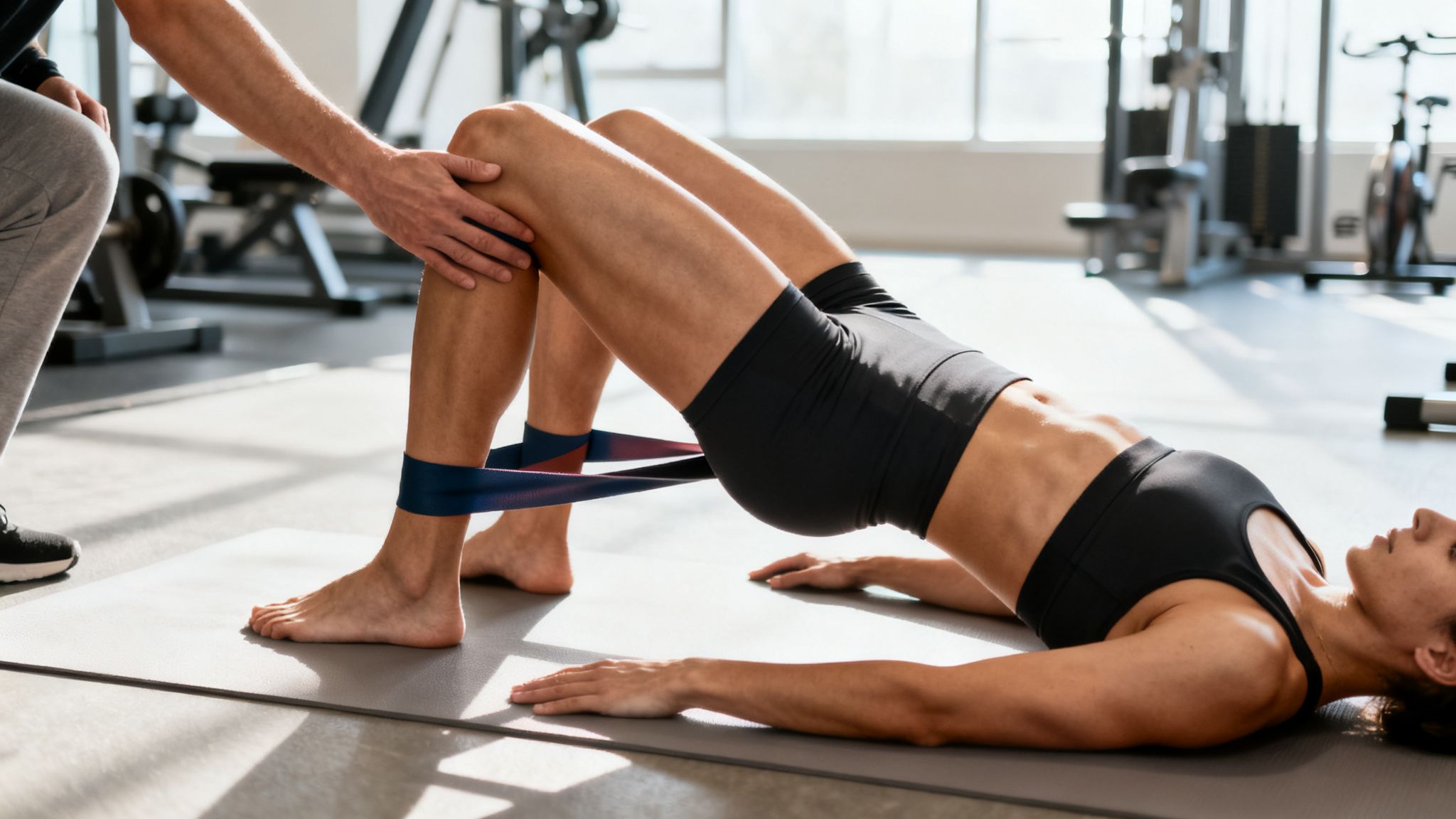
From General Movement to Specific Activation
A truly effective anti-cramp warm-up has two distinct parts. First, you raise your core temperature and get mobile with dynamic stretching. This isn't your old-school, hold-a-stretch-for-30-seconds routine; it’s all about active, fluid movement.
Great examples of dynamic movements include:
- Leg Swings: Forward, backward, and side-to-side to really open up the hips.
- Walking Lunges with a Twist: This hits the glutes, quads, and core all while improving thoracic mobility.
- Arm Circles: Perfect for getting the shoulder girdle ready for any upper-body work.
This initial phase gets the blood flowing and lubricates the joints. But to truly bulletproof your muscles against cramps, the next step is key: targeted activation drills. This is where you speak directly to the muscles that will be doing the heavy lifting.
Activation isn't about getting tired; it’s about forging a powerful mind-muscle connection. You're essentially teaching your brain to fire the right muscles in the right order, which boosts efficiency and dramatically reduces the kind of strain that leads to cramping.
For a runner, this means firing up the entire posterior chain. Think glute bridges, banded side steps, and single-leg Romanian deadlifts with just your body weight. These moves make sure the powerful glute muscles are ready to work, preventing the hamstrings and calves from getting overworked and seizing up. For a lifter getting ready for squats, bodyweight squats and goblet squats with a very light kettlebell help groove the movement pattern and switch on the quads and core.
Building Your Custom Anti-Cramp Routine
Your warm-up should always mirror the demands of your workout. The more specific you are, the better your defense against cramps will be. Here’s a simple framework to follow:
- General Mobility (3-5 minutes): Kick things off with some light cardio like a jog or spin, then move into dynamic stretches that take your major joints through their full range of motion.
- Specific Activation (3-5 minutes): Perform 1-2 sets of 10-15 reps of exercises targeting the main muscles for that day's session. Use light resistance, like a band, or just your bodyweight. The key is to feel the muscle contract.
- Movement Rehearsal (2-3 minutes): Finish up with a couple of very light sets of your first big exercise. If it's deadlift day, this means a few reps with just the empty barbell.
This whole process takes 10-15 minutes at most, but it’s one of the most powerful tools you have for preventing cramps. It prepares your body on a deep, neurological level, ensuring your muscles fire efficiently and can handle the stress you're about to throw at them.
This prep work, paired with smart fueling, sets the stage for a powerful, cramp-free performance. You can learn more about dialing in your nutrition in our guide on the best time to take electrolytes.
In-Workout Strategies to Keep Cramps Away
All the prep work you do before a workout is crucial, but it’s your actions during the session that ultimately keep muscle cramps from derailing your performance. This is where your plan meets reality.
Making real-time adjustments to your fueling, pacing, and cooling can be the difference between hitting a new PR and getting stopped in your tracks by a painful muscle seizure. Too many athletes try to just "push through it," but a cramp is your body's loud and clear signal that it's running low on critical resources. Having a proactive plan is everything.
Fueling with Precision: Your Mid-Workout Protocol
That sweat rate data you collected? It's now your most valuable tool. It turns your fueling from a shot in the dark into a precise, actionable strategy. The main goal during exercise is to replace the sodium and fluids you’re losing in real-time, which helps prevent your neuromuscular system from getting over-excited and misfiring.
Let's put that sweat rate to work. If you found you lose about one liter of sweat per hour, a good starting point for sodium replacement is 500-700 mg per hour. But remember, this is just a baseline.
- For heavy, salty sweaters—the kind who end up with white, crusty stains on their clothes—you might need closer to 1,000-1,500 mg of sodium every hour, especially when it's hot.
- For lighter sweaters working out in cool weather, 300-500 mg per hour could be all you need.
It's important to sip this electrolyte solution consistently throughout your workout, not chug it all at once. For instance, if your target is 600 mg of sodium an hour, you could break that down into 150 mg every 15 minutes. This steady drip keeps your electrolyte balance stable. For more ideas, check out our guide on the benefits of intra-workout drinks.
Pro Tip: Never, ever try a new fueling strategy on race day. Use your training sessions to experiment with different electrolyte powders, capsules, or chews to see what your gut can handle when you're pushing the pace.
Below is a table with some starting points to help you dial in your electrolyte plan.
Sample Electrolyte Dosing Protocol Per Hour of Exercise
This table provides starting point recommendations for sodium intake during exercise, based on sweat rate and environmental conditions. Adjust based on personal experience.
| Condition | Low-to-Moderate Sweater (<1 L/hr) | High Sweater (>1.5 L/hr) |
|---|---|---|
| Cool / Low Humidity | 300-500 mg sodium | 600-800 mg sodium |
| Moderate / Warm | 500-700 mg sodium | 800-1,200 mg sodium |
| Hot / Humid | 700-1,000 mg sodium | 1,200-1,500+ mg sodium |
Use these numbers as a guide, but always listen to your body and adjust based on how you feel.
Pacing: The Art of Managing Fatigue
Going out too hard, too fast is one of the most common—and totally preventable—causes of muscle cramps. It floods your neuromuscular system with fatigue signals, overwhelming its ability to function correctly long before your electrolytes are even an issue.
Smart pacing is all about matching your effort to your current fitness level. Think of your energy for a given session as a finite resource. If you burn through 75% of it in the first half of a race, you’re basically asking for a painful, cramp-filled second half.
A classic example is the marathoner who gets swept up in the race-day adrenaline and runs the first 10K way faster than their goal pace. By mile 20, their calves and hamstrings are screaming. Why? Because those muscles have been working at an unsustainable intensity for too long, causing the neural signals to misfire and trigger cramps.
Here’s how to pace smarter:
- Start Conservatively: Your workout or race should feel almost too easy at the beginning.
- Use Your Tech: Don't just go by feel. Rely on your heart rate monitor, power meter, or GPS watch to keep your effort honest.
- Aim for Negative Splits: In endurance events, a well-paced effort often means finishing the second half slightly faster than the first.
When you respect your body's limits and distribute your energy intelligently, you keep that neuromuscular fatigue in check. It's a massive piece of the anti-cramp puzzle.
Keeping Cool to Protect Your Muscles
Your core body temperature directly influences your cramp risk. As you heat up, you sweat more, which accelerates fluid and electrolyte loss. A hotter internal environment also puts more stress on your entire system, making you fatigue faster.
Staying cool is a simple but incredibly powerful strategy for warding off cramps. By keeping your core temperature down, you slow that depletion rate and help your muscles keep firing on all cylinders.
Try these simple cooling tactics:
- Douse Yourself: Pour water over your head and neck at aid stations or between sets. The evaporation provides an immediate cooling effect.
- Dress the Part: Wear light-colored, breathable clothing that wicks sweat away from your skin.
- Acclimate to the Heat: If you're racing in a hot climate, try to train in similar conditions for 7-14 days beforehand to help your body adapt.
For a runner, this might mean grabbing two cups of water at every aid station—one to drink, one to dump over your head. For a lifter in a stuffy gym, it could be as simple as using a fan between sets. These small actions add up, reducing the overall strain on your body and helping you finish strong and cramp-free.
What to Do When a Cramp Still Happens
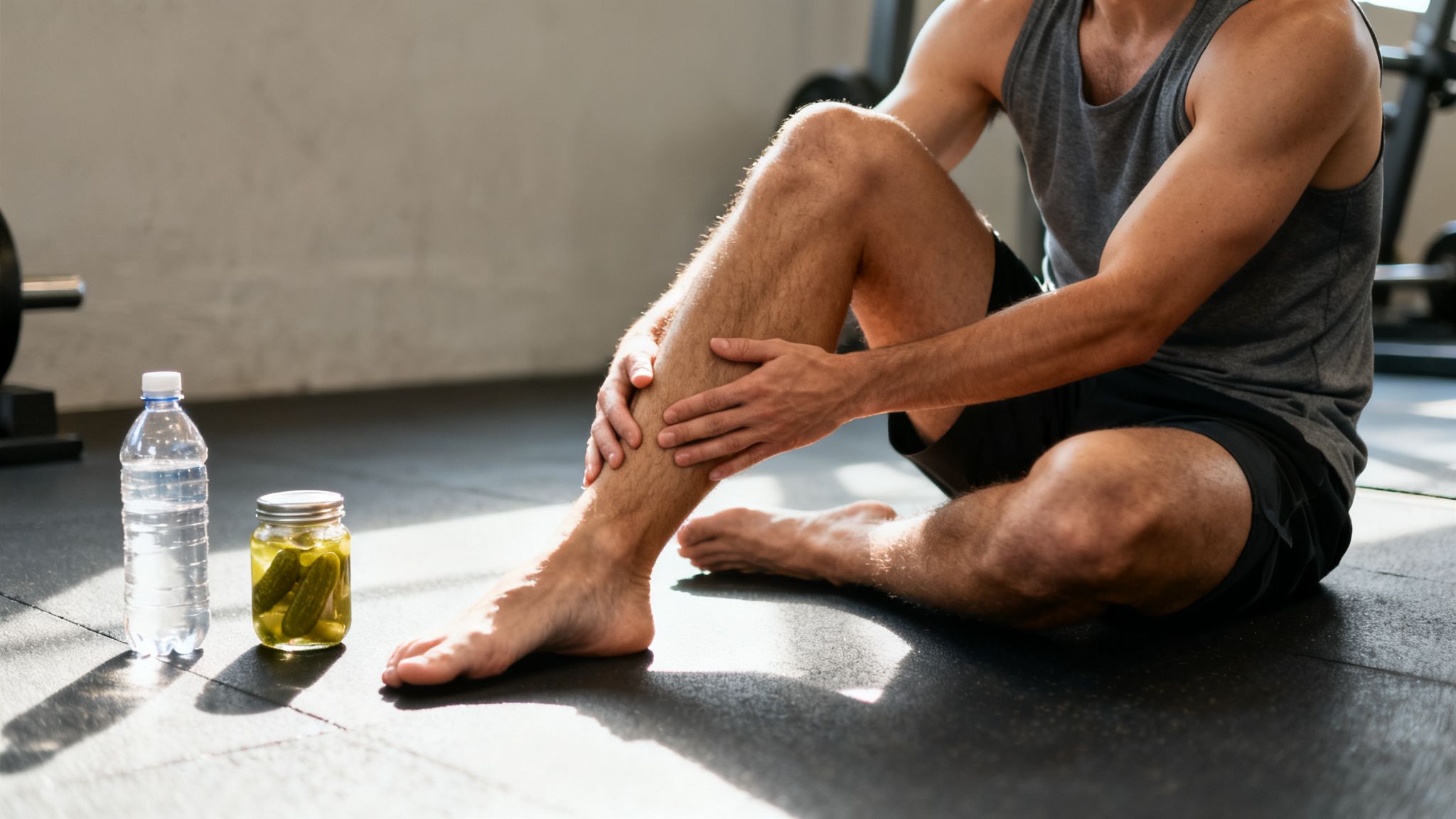
Let's be real—even with perfect prep, a cramp can ambush you mid-workout. That sudden, vice-like grip is a universal sign of frustration for any athlete. But how you react in that moment can mean the difference between a quick reset and your workout being completely over.
Your gut reaction might be to fight through it or aggressively stretch the muscle, but both can backfire. The second you feel that muscle seizing up, stop everything. Powering through only deepens the contraction and seriously ups your risk of a muscle strain.
Gently Relieve the Tension
Your mission here is to coax the muscle into relaxing, not force it into submission. A slow, passive stretch is your best tool. If your calf locks up, for instance, sit down, straighten your leg, and gently pull your toes toward your shin until you feel a light release. Just hold it there.
Whatever you do, don't bounce. Any jerky movements can trigger a protective reflex, causing the muscle to clench even harder. A light massage over the area can also work wonders, helping to manually persuade the muscle fibers to let go.
- Calf Cramp: Gently draw the top of your foot back toward your knee.
- Hamstring Cramp: Lie down, lift the affected leg, and gently pull it toward your chest while keeping a slight bend in the knee.
- Quad Cramp: Stand up and hold onto a wall for balance, then pull your heel toward your glute.
Once that initial, eye-watering pain fades, applying a warm towel or heating pad can soothe the area. The warmth helps increase blood flow, which encourages the muscle to finally chill out.
The Pickle Juice Phenomenon
You've probably heard the stories or seen pros take a shot of pickle juice to kill a cramp instantly. It sounds like an old wives' tale, but there's some real science backing it up. And spoiler: it's not about the electrolytes or hydration, because it works far too quickly for that.
The current thinking is that the acetic acid in the brine triggers a specific neurological reflex. When it hits receptors in the back of your throat, it fires off a powerful signal to your central nervous system that basically overrides the haywire nerve signals causing the cramp. A small shot—just 1-2 ounces—is often all it takes to get relief.
Turn Every Cramp into a Lesson
The single most important thing you can do after a cramp isn't just treating it—it's analyzing it. Think of every cramp as a data point. Your body is giving you direct feedback on your preparation or execution. Don't just brush it off; use it as a chance to dial in your strategy for avoiding muscle cramps during exercise next time.
Treat every cramp as a learning opportunity. It's your body's way of giving you direct, personalized feedback. By analyzing what went wrong, you turn a frustrating setback into valuable data for your next performance.
Run through a quick mental checklist after your workout:
- Hydration: Did I actually drink enough beforehand? Did I stick to my electrolyte plan, or did I start skipping it when I felt good?
- Pacing: Did I go out way too hot? Was I pushing an intensity that my body just wasn't trained for yet?
- Nutrition: Did I eat something different before this workout?
- Conditions: Was it way hotter or more humid than I've been training in?
This quick post-cramp audit is how you find the holes in your game plan. Maybe you need to up your sodium on hot days, or maybe you need to learn some discipline and hold back on your pace during the first half of a race. This investigative approach is what separates the athletes who are always sidelined by cramps from those who learn to master them.
When Muscle Cramps Signal a Bigger Problem
That searing, grab-and-hold pain of a muscle cramp is something most of us know all too well. Usually, it's just a frustrating sign that you've pushed your body to its limits—a temporary hiccup from fatigue or an electrolyte imbalance.
But sometimes, that sudden, painful contraction is your body waving a red flag, trying to tell you something more significant is going on. Knowing how to tell the difference is a crucial part of being a smart, resilient athlete.
A cramp that hits you mid-workout or immediately after a grueling session is one thing. The alarm bells should start ringing when cramping happens without any obvious reason. If you're getting hit with frequent, severe cramps while resting, or if they're waking you up at night, it's time to listen up. This might be more than just a simple muscle misfire.
Differentiating Cramps from Concern
Think about the context. A calf seizing up at mile 22 of a marathon makes sense. A vicious, recurring cramp while you're just watching TV? That’s a whole different story.
You need to be on the lookout for these specific warning signs:
- Cramps without exertion: Spasms that hit you frequently when you're not even active.
- Extreme severity or duration: Cramps that feel unusually intense or hang on for several minutes.
- Other symptoms show up: The cramp comes with friends like swelling, redness, changes to your skin, or noticeable muscle weakness in that spot.
While exercise-associated muscle cramps (EAMC) are incredibly common, their frequency shouldn't make you dismiss a persistent problem. Research shows just how prevalent they are, hitting as high as 67% of triathletes and 70% of marathon runners. You can explore more about these findings and what they mean for athletes.
Still, persistent cramping can sometimes be tied to bigger issues like circulation problems, nerve compression, or even certain metabolic disorders.
Your body is an incredible feedback system. An occasional exercise cramp is part of the athletic journey, but persistent, unexplained cramps are a clear signal to dig deeper. This isn't about causing alarm; it's about being a proactive athlete who actually listens to what their body is saying.
If your cramps fit this more concerning profile, don't play doctor. The smartest move is to book an appointment with a healthcare professional. They can run the right tests to rule out any underlying conditions and make sure your plan for how to avoid muscle cramps during exercise is both safe and effective for you.
Got Questions About Muscle Cramps? Let's Clear Them Up.
Even with the best plan, muscle cramps can still be a source of confusion. When you’re in the thick of training, you need clear, straightforward answers to fine-tune your strategy and get rid of those nagging doubts for good. Here’s a rundown of the most common questions I hear from athletes.
Why Am I Cramping at Night Instead of During My Workout?
This one is incredibly frustrating. You finish a tough session, feel fine, then wake up in the middle of the night with a locked-up calf. What gives?
Night cramps (or nocturnal leg cramps) often have different triggers than the ones that strike mid-workout. Sometimes, it’s a delayed reaction to a hard effort earlier in the day as your muscles are still struggling to fully relax.
More often than not, though, other factors are at play. Dehydration from the day can catch up to you at night. Mineral imbalances, especially low magnesium, are a common culprit. Even something as simple as an awkward sleeping position that keeps a muscle shortened for hours can be enough to trigger a cramp.
Does Stretching Actually Stop Cramps?
This is a huge point of confusion. While holding a good static stretch after a workout is fantastic for recovery and long-term flexibility, it does very little to prevent a cramp from happening during your next session.
What’s far more effective is a dynamic warm-up that gets your neuromuscular system fired up and ready for action.
Think of it this way:
- Before you train: Your focus should be on dynamic movements and activation drills. You want to wake the muscles up, not put them to sleep.
- After you train: This is the time for static stretching. Help those tight, fatigued muscles relax, lengthen, and kickstart the recovery process.
Stretching is a vital tool in your arsenal, but only if you use the right type at the right time.
Can Certain Foods Make Me More Likely to Cramp?
Absolutely. Your diet is the foundation of your performance, providing the essential minerals your muscles need to contract and relax properly. If your diet is low in key electrolytes, you’re already behind before you even start sweating.
A diet heavy in highly processed foods often lacks the minerals found in whole foods. If that’s your go-to, your electrolyte stores might be chronically low. Making sure you’re eating foods rich in potassium (like sweet potatoes and bananas) and magnesium (nuts and seeds), and getting enough sodium before a tough workout, is a non-negotiable part of any anti-cramp strategy.
Think of your pre-workout nutrition as pre-loading your fuel tank. If you start with low reserves of sodium and other key minerals, you're setting yourself up to run on empty much faster once the work begins.
Is Pickle Juice a Myth, or Does It Really Work?
It’s not a myth! Pickle juice can work, and it can work astonishingly fast. But it's not because it's rehydrating you or rapidly replenishing your electrolytes—it simply doesn't work that quickly.
The magic is in the acetic acid from the vinegar. When that brine hits receptors in the back of your throat, it’s believed to trigger a powerful neurological reflex. This signal travels up to your brain and then back down to the cramping muscle, essentially telling the over-excited nerves to calm down. It's a neurological hack, not a hydration fix.
At Revolution Science, we believe in tackling performance issues with precision. Our Reviver Electrolytes are formulated with the clean, effective ingredients you need to maintain proper hydration and mineral balance, helping you stay strong and cramp-free. Ditch the guesswork and fuel your performance at https://rvsci.com.