
Tu carrito está vacío


How to Calculate Sweat Rate a Guide for Peak Performance
Forget the vague advice to "just drink more water." If you're serious about your performance, it's time to get specific. Knowing your personal sweat rate is one of the most powerful, yet overlooked, tools in an athlete's arsenal.
This isn't just about avoiding thirst; it's about transforming hydration from a guessing game into a precise, data-backed strategy. It all boils down to a simple formula: (Pre-exercise weight - Post-exercise weight) + Fluid consumed = Total sweat loss.
By dividing that number by your workout duration, you get a clear hydration target. This moves you beyond generic advice and into a plan built for your body.
Why Your Sweat Rate Is a Game Changer for Performance

When you sweat, you lose fluid, and your blood volume drops. This simple fact kicks off a cascade of negative effects: your heart has to pump harder, your core temperature climbs, and your muscles start burning through precious glycogen stores much faster.
It doesn’t take much. Losing as little as 2% of your body weight through sweat is enough to tank your performance, mess with your concentration, and sap your power output.
The Strategic Advantage of Personalized Hydration
A personalized hydration plan is your best defense against the most common performance killers. When you know exactly how much fluid you’re losing per hour, you can replace it proactively, stopping problems before they even start.
This knowledge is absolutely critical for:
- Preventing Premature Fatigue: Proper hydration keeps blood flowing to your muscles, delivering the oxygen they need while clearing out metabolic waste.
- Avoiding Muscle Cramps: Dehydration and the electrolyte imbalances that come with it are the main culprits behind those race-ending, session-stopping cramps.
- Maintaining Cognitive Function: Your brain is mostly water. Keeping it hydrated ensures you stay sharp and make smart decisions, even when you’re physically exhausted.
Knowing your sweat rate is the difference between surviving a workout and dominating it. It allows you to create a hydration and electrolyte strategy that is built for your body, not for a generic average.
Tailoring Your Plan for Peak Performance
For endurance athletes like marathoners and triathletes, calculating sweat rate is non-negotiable. It’s how you dial in hydration to fend off cramps and bonking during those long, grueling efforts. The gold standard for this is the simple pre- and post-exercise nude body mass method, a technique backed by over a century of sweat physiology research.
But this isn't just for runners and cyclists. This data is just as crucial for a strength athlete trying to maintain power output set after set, or a tactical professional who needs to stay sharp under pressure.
To really get the most out of this information, it helps to see how your results stack up against normative data in physiotherapy and sports science. This data-driven approach is a key piece of a much larger performance puzzle. You can learn more about other ways to level up your training in our guide on how to improve athletic performance.
The Field-Tested Method for Measuring Your Sweat Rate
So, we've covered the why. Now, let's get into the how.
Figuring out your personal sweat rate sounds like something you'd need a sports science lab for, but it’s surprisingly straightforward. The method used by pro coaches and exercise physiologists is called the pre- and post-exercise body mass method. It's the gold standard, and you can easily do it yourself.
The whole point is to isolate one key variable: how much weight you lose from sweat. To nail this, we’ll measure your body weight right before and right after a workout, while carefully tracking every drop of fluid you drink. Think of it as your own personal science experiment. The data you collect is the foundation for building a truly personalized hydration plan.
Gathering Your Essential Tools
Before you start, you'll need a few things to get an accurate measurement. Precision is the name of the game here, so don't cut corners.
- A Precise Digital Scale: This is non-negotiable. That old analog scale in the bathroom won’t cut it. You need a digital scale that measures in small increments—ideally to 0.1 pounds or 0.05 kilograms—to pick up on the subtle changes.
- A Marked Water Bottle: Grab a bottle with clear volume markings in ounces or milliliters. This is how you'll track exactly how much fluid you take in.
- Your Usual Workout Gear: The test needs to reflect your reality. Wear what you normally wear for the type of session you're testing.
- A Towel and a Notebook: Simple, but crucial. You'll need the towel for a proper weigh-in after you're done and the notebook to write down your numbers immediately.
Once you have your gear, pick a workout that’s at least 60 minutes long and represents the intensity and conditions you’re planning for. A solid 60-minute tempo run or a tough 90-minute lifting session are perfect examples.
To keep everything straight, use this simple checklist. It's an easy way to make sure you don't miss a step and end up with skewed data.
Sweat Rate Calculation Checklist
| Step | Action Required | Pro Tip |
|---|---|---|
| 1. Prep | Empty bladder and bowels completely before weighing in. | This removes a major variable that can throw off your starting weight. |
| 2. Pre-Weigh | Weigh yourself completely nude on a digital scale. | Clothing absorbs sweat, so weighing in nude is the only way to be sure. |
| 3. Record | Write down your Pre-Exercise Body Weight immediately. | Don't rely on memory. Jot it down right away. |
| 4. Hydrate | Measure your fluid intake precisely during the workout. | Start with a full, measured bottle and track any refills. |
| 5. Post-Workout | Towel-dry thoroughly from head to toe. | Your skin and hair hold a surprising amount of sweat. Get it all off. |
| 6. Post-Weigh | Weigh yourself nude again on the exact same scale. | Consistency is key. Even a different spot on the floor can alter the reading. |
| 7. Record | Write down your Post-Exercise Body Weight right away. | Now you have all the raw data you need for the calculation. |
Following these steps methodically will give you the clean, reliable numbers you need to build an effective hydration strategy.
The Pre-Workout Weigh-In Protocol
Your first data point—your starting weight—is critical. The goal is a clean baseline before you’ve lost a single drop of sweat.
First things first: use the restroom. Emptying your bladder and bowels eliminates a big variable that could easily skew your results.
Next, get on the scale completely nude. Even lightweight workout clothes absorb a surprising amount of sweat. Weighing in nude before and after is the only way to guarantee you're only measuring changes in your actual body mass. Record this number immediately—this is your Pre-Exercise Body Weight.
Pro Tip: Always use the same scale, on the same hard, level surface. A scale on a plush carpet can read differently than one on a tile floor. Consistency is absolutely everything here.
Recording Exercise and Fluid Intake
With your starting weight logged, it's time to train. During the workout, your only job—besides doing the work—is to keep a close eye on how much you drink.
Start with a full, pre-measured bottle. If you finish it and need more, make a note of exactly how much you refilled. If you don’t finish the bottle, you’ll just measure what’s left at the end. For example, if you started with a 24-ounce bottle and have 8 ounces left, you consumed 16 ounces. This value is your Fluid Consumed.
It’s also smart to document the conditions. Note the temperature, humidity, and your perceived intensity. These factors directly influence your sweat rate, and having this context will help you build a much richer hydration profile over time.
The Post-Workout Weigh-In
As soon as your workout ends, the clock is ticking to get that second measurement. Before you chug any recovery drinks or grab a snack, it's time to weigh in again.
The first step is to towel off completely. Your skin and hair can hold onto a lot of sweat, and we want to measure what your body lost, not what’s still sitting on the surface. Pat yourself dry, head to toe.
Next, strip down to the same state as your first weigh-in: completely nude. Step back onto the exact same spot on your digital scale and record the number. This is your Post-Exercise Body Weight.
You now have all the key pieces of data. With these numbers, you’re ready to accurately calculate your fluid loss. To learn more about turning this data into a complete strategy, our guide on hydration for athletes offers deeper insights into crafting your plan.
How to Use the Sweat Rate Formula
You've done the hard part—you’ve tracked your workout, weighed yourself, and measured your fluids. Now it’s time to turn those raw numbers into something you can actually use.
Putting it all together is simpler than it sounds. This is where we convert that data into real, actionable intelligence about your body. The basic formula just accounts for the weight you lost and the fluid you drank over a specific period.
This calculation gives you a clear, objective measure of your fluid loss per hour, forming the foundation of a hydration strategy that’s built specifically for you.
This flowchart breaks down the simple process of gathering the data you need.
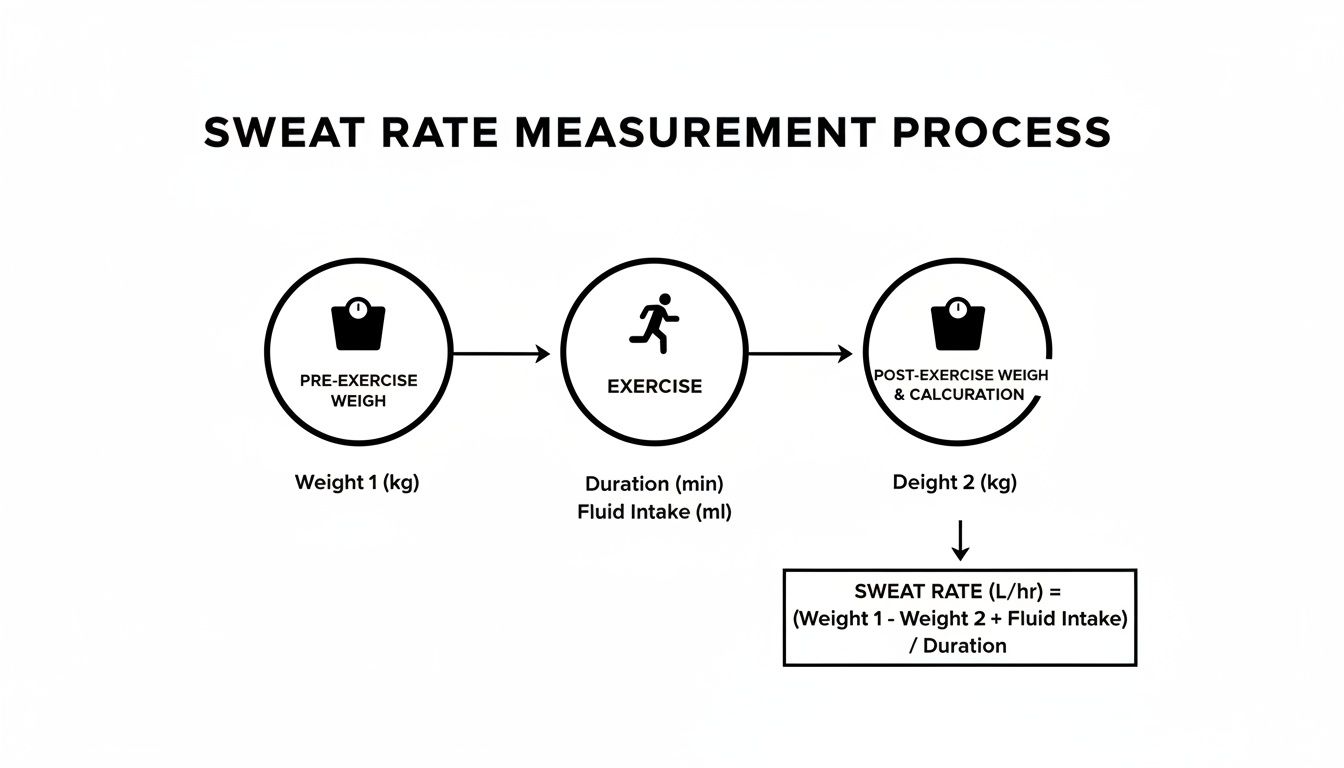
As you can see, it all comes down to three key actions: weighing yourself before you start, doing your workout, and weighing yourself again right after. All while keeping tabs on how much you drank.
Breaking Down the Sweat Rate Calculation
The formula itself is pretty straightforward. At its core, you’re just figuring out your total sweat loss and then dividing it by how long you worked out to get an hourly rate.
Here’s the basic structure:
- (Pre-Exercise Weight - Post-Exercise Weight) + Fluid Consumed = Total Sweat Loss
- Total Sweat Loss / Exercise Duration (in hours) = Sweat Rate per Hour
Let's unpack each piece so you know exactly what you're working with. Every number plays a key role in making sure the final result is as accurate as possible.
The Variables in Action
Getting a reliable result is all about understanding what each number actually represents.
- Pre-Exercise Body Weight: This is your baseline. Get it after you’ve emptied your bladder and are weighed completely nude. Think of it as your starting hydrated mass.
- Post-Exercise Body Weight: This is your finish line, measured under the exact same conditions (nude, after toweling off all the sweat). The difference between this and your starting weight is your net fluid loss from sweat.
- Fluid Consumed: This is the total volume of liquid you drank during your session. It's a critical piece because any fluid you drank offset some of that sweat loss. Adding it back into the equation gives us the true, total amount of sweat your body produced.
- Exercise Duration: The total time of your workout, but you need to express it in hours. For example, a 90-minute session becomes 1.5 hours. This lets us standardize the result into a clean hourly rate.
By accounting for both your weight change and your fluid intake, you get a complete picture of what’s happening inside your body during exercise. It's far more accurate than just looking at weight loss alone.
Real-World Example in Metric Units
Let's put this into practice. Imagine a runner finishing up a tough, 90-minute tempo run on a warm day.
- Pre-Exercise Weight: 70.0 kg
- Post-Exercise Weight: 68.8 kg
- Fluid Consumed: 750 mL (which is 0.75 L)
- Exercise Duration: 90 minutes (1.5 hours)
Now, we just plug those numbers into the formula:
-
Calculate Weight Loss:
- 70.0 kg - 68.8 kg = 1.2 kg of weight lost.
-
Calculate Total Sweat Loss:
- 1.2 kg (weight loss) + 0.75 L (fluid consumed) = 1.95 L total sweat loss. (Remember, 1 kg of weight loss is equal to 1 L of fluid loss).
-
Calculate Sweat Rate per Hour:
- 1.95 L / 1.5 hours = 1.3 L/hr.
Boom. This runner's sweat rate for this specific workout is 1.3 liters per hour. That number is now their personal target for fluid replacement when training in similar conditions.
Real-World Example in Imperial Units
The formula works just as smoothly with imperial units. Let’s take a weightlifter grinding through a 2-hour gym session.
- Pre-Exercise Weight: 185.0 lbs
- Post-Exercise Weight: 182.5 lbs
- Fluid Consumed: 32 fl oz
- Exercise Duration: 2 hours
Here’s the breakdown:
-
Calculate Weight Loss in Ounces:
- 185.0 lbs - 182.5 lbs = 2.5 lbs of weight lost.
- We need to convert this to fluid ounces. Since 1 lb of weight loss is roughly 16 oz of fluid, we get: 2.5 lbs x 16 oz/lb = 40 oz.
-
Calculate Total Sweat Loss:
- 40 oz (from weight loss) + 32 oz (fluid consumed) = 72 oz total sweat loss.
-
Calculate Sweat Rate per Hour:
- 72 oz / 2 hours = 36 oz/hr.
For this session, the weightlifter’s sweat rate is 36 ounces per hour. This gives them a clear, actionable target for their in-gym hydration. No more guesswork.
Turning Your Sweat Rate Into a Hydration Strategy
Alright, you've crunched the numbers and now you have your personal sweat rate. That single number is the key to moving beyond guesswork and finally building a hydration plan that actually works for you. But a number on its own is just data; the real magic happens when you turn it into a concrete action plan.
Think of your sweat rate as your personal hydration fingerprint for a specific workout, in a specific environment. Now, let’s figure out what it means and build a repeatable strategy to keep you ahead of performance-killing dehydration.
Understanding Your Sweat Rate Results
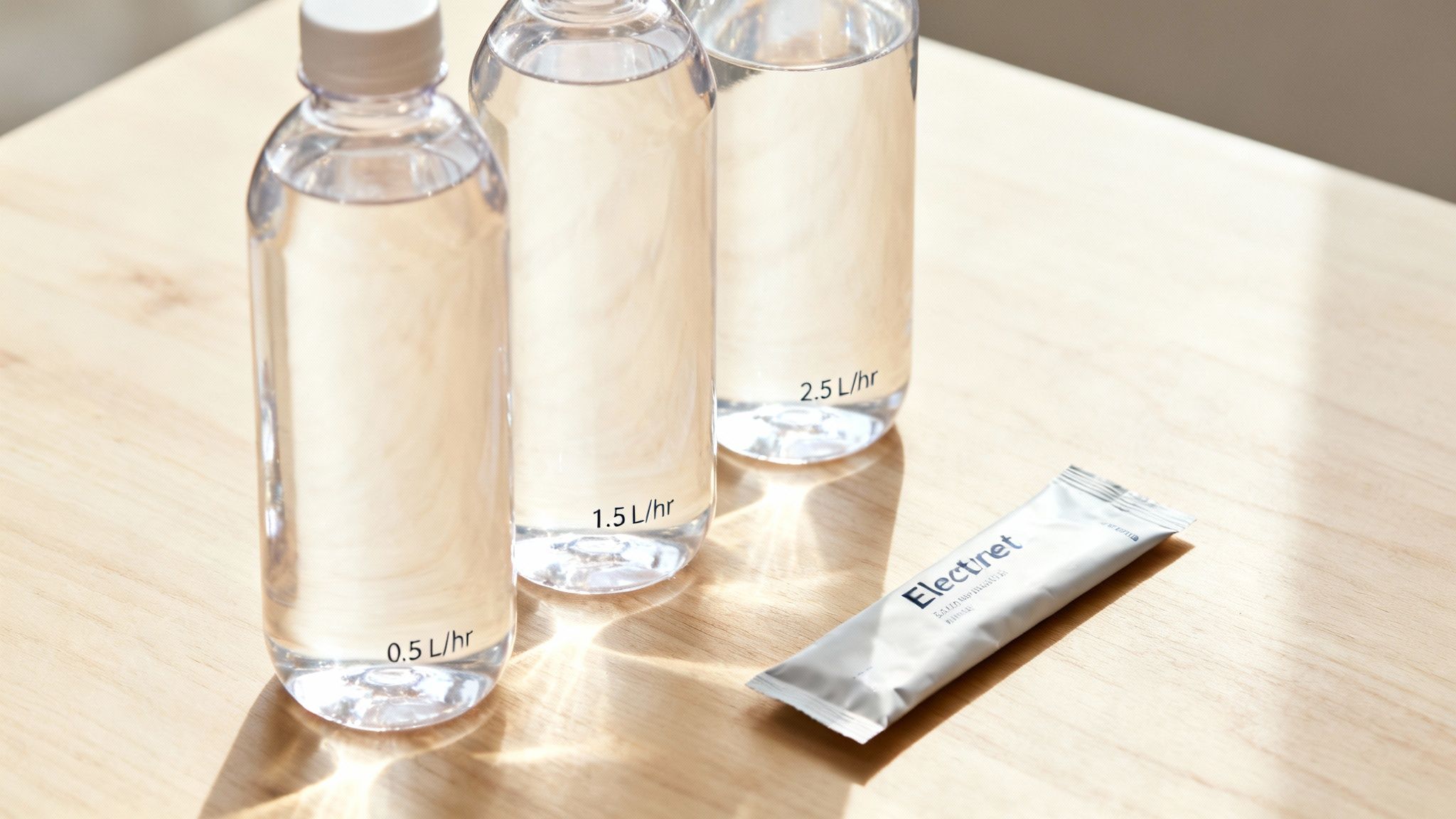
Sweat rates vary wildly between athletes. It's a mix of genetics, body size, fitness level, and how acclimated you are to the heat. It’s not uncommon for one person to lose a mere 0.5 L/hr on a cool-weather jog, while a larger, highly-trained athlete might pour out over 2.5 L/hr during intense work in the heat.
Here’s a simple breakdown of what your number might mean:
- Low Sweat Rate (Under 1.0 L/hr): You likely fall here during lower-intensity workouts, in cool conditions, or if you're a smaller athlete. Your fluid needs are more manageable.
- Moderate Sweat Rate (1.0 to 1.5 L/hr): This is a super common range for many of us during a solid hour-long session in temperate weather. A structured plan becomes critical here.
- High Sweat Rate (Over 1.5 L/hr): This points to serious fluid loss. It’s common in high-intensity sports, hot and humid conditions, or for bigger athletes. For you, hydration has to be a top priority.
Knowing where you land on this spectrum gives you a sense of urgency and tells you how precise you need to be with your hydration and electrolyte protocol.
Crafting Your Personalized Hydration Plan
With your hourly sweat rate in hand, you can build a simple but powerful plan. The goal isn't to replace 100% of what you lose mid-workout—that’s often a recipe for gut distress. Instead, you want to limit your total body weight loss from fluid to less than 2%.
A great starting point is to aim for replacing 75-80% of your hourly sweat loss. For most athletes, this is the sweet spot that maintains performance without overwhelming your stomach.
Let’s run through an example. If your sweat rate is 1.2 L/hr (about 40 oz/hr), your target intake becomes:
- 1.2 L x 0.80 = 0.96 L per hour (or about 960 mL)
- 40 oz x 0.80 = 32 oz per hour
To hit this, you’d aim to drink about 8 ounces (240 mL) every 15 minutes. This kind of consistent, spaced-out sipping is far more effective than chugging a whole bottle at once. For a deeper dive, especially for endurance events, check out our guide on hydration for marathon runners.
Don't Forget the Electrolytes (Especially Sodium!)
Drinking plain water is only half the battle. When you sweat, you’re also losing critical electrolytes, and sodium is the big one. It’s essential for maintaining fluid balance, nerve function, and muscle contraction. If you don't replace it, you risk cramping or, in serious cases, hyponatremia—a dangerous drop in blood sodium levels.
Sodium loss is incredibly individual. Some of us are "salty sweaters," leaving behind a gritty, white residue on our skin and gear. Others lose far less.
- Low Sodium Sweaters: A standard electrolyte formula is often enough to stay balanced.
- Salty Sweaters: You'll need a more potent mix with higher sodium to keep up with your losses.
As you build your plan, it’s critical to consider not just the fluid but also the implications of electrolyte imbalance, which can derail even the best-trained athletes.
The table below breaks down how you can match your fluid and electrolyte intake to your specific sweat rate.
Hydration Plan Based on Sweat Rate
| Sweat Rate (L/hr) | Recommended Fluid Intake (per hour) | Example REVSCI Electrolyte Protocol (per hour) |
|---|---|---|
| < 1.0 L | 500-750 mL (16-25 oz) | 1 scoop of Reviver Electrolytes in your bottle |
| 1.0 - 1.5 L | 750-1200 mL (25-40 oz) | 1 to 1.5 scoops of Reviver Electrolytes, potentially adding a salt capsule |
| > 1.5 L | 1200-1500+ mL (40-50+ oz) | 1.5 to 2 scoops of Regains for higher sodium, or 2 scoops of Reviver |
This table provides a solid starting point. Remember to test your strategy in training before relying on it for a big race or game day.
Putting It All Together: Example Strategies
Let's see how this works for a couple of different athletes.
Scenario 1: The Cyclist (Moderate Sweater)
- Athlete Profile: Sweat rate of 1.1 L/hr.
- Fluid Goal: Target 80% replacement, which is 880 mL/hr.
- Action Plan: Drink about 220 mL (around 7.5 oz) every 15 minutes.
- Electrolyte Plan: One scoop of Reviver Electrolytes mixed into their bottle provides a balanced profile to cover their losses without overdoing it.
Scenario 2: The Football Player (Heavy & Salty Sweater)
- Athlete Profile: Trains in the summer heat with a sweat rate of 1.8 L/hr and notices heavy salt stains on their jersey.
- Fluid Goal: Aim for 80% replacement, which is a hefty 1.44 L/hr.
- Action Plan: Drink 360 mL (about 12 oz) every 15 minutes.
- Electrolyte Plan: This athlete needs a lot more sodium. They'd likely use a more concentrated mix, like 1.5 to 2 scoops of Regains per liter of water, to match their high losses and stave off cramping.
Knowing your numbers is a massive competitive advantage. It empowers you to create a personalized strategy that keeps you performing at your best, no matter the conditions.
Common Mistakes and Advanced Considerations
Getting a handle on your sweat rate is a massive step forward, but let's be clear: a single test only gives you one piece of the puzzle. If you really want to build a bulletproof hydration strategy, you need to sidestep the common errors that can torpedo your results and start thinking about the more advanced factors at play. Precision comes from getting the little details right.
A small mistake—like using a wonky scale or forgetting to account for a mid-run bathroom break—can easily skew your data. These seemingly minor details might lead you to create a hydration plan based on faulty information, which completely defeats the purpose of doing the test in the first place.
Avoiding Common Calculation Pitfalls
The most frequent errors are often the simplest ones to fix. The name of the game is consistency and attention to detail. If your process isn't repeatable, your results won't be reliable. Simple as that.
Here are the top mistakes I see athletes make all the time:
- Forgetting to void: Always, and I mean always, empty your bladder (and bowels, if you can) right before both your pre- and post-workout weigh-ins. This eliminates a huge variable that has nothing to do with sweat loss.
- Using different scales: Your scale at home and the one at the gym are almost certainly calibrated differently. Stick to the exact same digital scale for every single test. This is non-negotiable for consistent measurements.
- Inaccurate fluid tracking: Don't just eyeball how much you drank. Measure your fluid before you start and measure what's left when you're done. If you have to refill your bottle, track that amount precisely.
- Weighing with wet hair or skin: Towel off completely after your workout and before you step on that scale. Damp hair and skin can hold several ounces of water, which will artificially lower your calculated sweat loss.
By treating this whole process like a science experiment, you ensure the data you're collecting is clean, accurate, and actually useful.
The Impact of Environment and Intensity
Here's something crucial to understand: your sweat rate is not a static number. It’s a dynamic metric that changes—sometimes dramatically—based on your surroundings and how hard you're pushing. A test you do on a cool, breezy morning will give you a completely different result than one done on a blistering, humid afternoon.
This is exactly why a single test is just a starting point. To build a truly comprehensive hydration profile, you have to test your sweat rate under the different conditions you actually train and compete in.
Your body's response during a 70°F (21°C) recovery run is fundamentally different from its response during an 85°F (29°C) race-pace effort. You need data for both scenarios to be truly prepared.
For powerlifters and older athletes chasing PRs without cramping up, nailing this calculation is vital. It means your recovery is fueled by precisely matching what you lost. This is especially critical when studies show that 40% of gym enthusiasts misjudge their hydration needs by as much as 30%. Normative data from 2022 really drives this home, with cyclists averaging 1.4 L/h, runners 1.1 L/h, and football players hitting a massive 2.1 L/h in the heat. To dig into these sport-specific findings, you can read the full research on sweat rate variability.
Building a Complete Hydration Profile
Your ultimate goal should be to build a "hydration playbook" with different strategies for different scenarios. Think of it this way: you wouldn't wear the same gear for a winter run and a summer track session, right? Your hydration plan needs that same level of specificity.
Consider testing your sweat rate in these different situations:
- Cool vs. Hot Days: Get a baseline for temperate weather and another for when the temperature really climbs.
- Low vs. High Humidity: Humid air is a game-changer. It prevents sweat from evaporating efficiently, which often leads to higher sweat rates as your body works overtime to cool down.
- Easy vs. Hard Efforts: A chilled-out recovery pace and an all-out interval session will produce wildly different results. You need to know both.
Over time, you'll start to develop an intuitive feel for your body's needs, but it will be backed by hard data. You'll know exactly how to adjust your fluid and electrolyte intake for pretty much any situation, which is the key to unlocking consistent, long-term performance. For more on fine-tuning your intake, check out our guide on the best time to take electrolytes.
Your Sweat Rate Questions Answered
When you start digging into any new performance metric, you're bound to have a few questions. That’s a good thing. Understanding your sweat rate is a powerful tool, but getting the details right is what makes it truly game-changing. This section tackles the most common queries that pop up when athletes first learn to calculate their sweat rate.
Think of this as your troubleshooting guide. We'll clear up the little things that can make the difference between a rough guess and a precise measurement you can actually build a strategy around.
How Often Should I Calculate My Sweat Rate?
Your sweat rate isn't a static, "one-and-done" number. It’s a moving target that shifts with your fitness and the environment. As a rule of thumb, plan to re-test your sweat rate every 4-6 weeks if you're in a consistent training block.
More importantly, you need to re-test whenever a major variable changes. Always run the numbers again in these key moments:
- Seasonal Changes: The gap between training in the crisp air of spring and the thick humidity of summer is huge. Your body adapts, and your sweat rate will change right along with it.
- Traveling to a New Climate: Got a race in a hotter or more humid spot? You have to know how your body will respond there, not just back home.
- Big Leaps in Fitness: As you get fitter, your body often gets better at cooling itself, which can absolutely alter how much you sweat.
A critical time for re-testing is after heat acclimatization. It usually takes 10-14 days for your body to adapt to hotter conditions. That process alone can drop your sweat rate by 20-30%. Testing before and after is essential.
Can My Diet Affect My Sweat Rate?
This is a common one, and the answer isn't a simple yes or no. Your day-to-day diet has a very small direct effect on your sweat rate—the actual volume of fluid you lose per hour. That number is mostly driven by your genetics, how hard you’re working, and the weather.
However, your diet can influence your sweat sodium concentration. If you’re consistently on a low-sodium diet, your body might get more efficient at hanging onto that electrolyte, leading to less salty sweat over time. On the other hand, a high-sodium diet might do the opposite. For most of us, though, these shifts are minor compared to our genetic baseline.
The main takeaway here is that your diet won't throw your fluid loss calculation way off. Your top priority should always be replacing the fluid and electrolytes you lose, no matter what you had for your last meal.
Is It Possible to Have a High Sweat Rate but Not Be a Salty Sweater?
Absolutely. This is a critical distinction that a lot of athletes get wrong. Sweat rate (the volume you lose) and sweat sodium concentration (the amount of salt in that sweat) are two totally separate things.
It’s completely possible to be a high-volume sweater who loses tons of fluid but very little sodium. On the flip side, someone could have a low sweat rate but lose incredibly salty, concentrated sweat. You can’t assume one based on the other.
This is exactly why a complete hydration strategy has two parts. First, you calculate your sweat rate to figure out how much fluid you need. Second, you get a handle on your sodium needs—either by looking for the tell-tale white, gritty salt stains on your gear or through more precise lab testing.
What Is the Biggest Mistake People Make When Measuring Sweat Rate?
Without a doubt, the single biggest mistake is a lack of consistency in the process. The whole point of the test is to isolate one variable: weight lost through sweat. Any little inconsistency introduces errors that make your final number useless.
Here are the most common pitfalls that wreck data accuracy:
- Using a different scale for the pre- and post-workout weigh-ins.
- Forgetting to subtract the weight of the fluid you drank.
- Weighing in with clothes on for one measurement and nude for the other.
- Not toweling off completely before the final weigh-in.
If you want data you can actually trust, you have to treat this like a science experiment. Use a precise digital scale, follow the exact same steps every single time, and write your numbers down immediately. This diligence is what separates a wild guess from a reliable metric.
At Revolution Science, we build our formulas on precision and data. Once you've nailed your sweat rate calculation, our products like Reviver Electrolytes and Regains provide the clean, effective fuel you need to replenish exactly what you lost. Learn more and build your personalized hydration strategy at https://rvsci.com.