
Tu carrito está vacío


A Modern Tactical Athlete Training Program That Forges Elite Performance
A tactical athlete training program is worlds away from your typical gym routine. It's a highly specialized fitness plan built for the unique demands faced by military operators, law enforcement officers, and firefighters. The focus isn't on aesthetics; it's on building operational readiness—the raw strength, endurance, and resilience needed to perform under chaotic, high-stakes conditions.
This kind of training ensures you're an asset, not a liability, when everything is on the line.
Defining The Modern Tactical Athlete
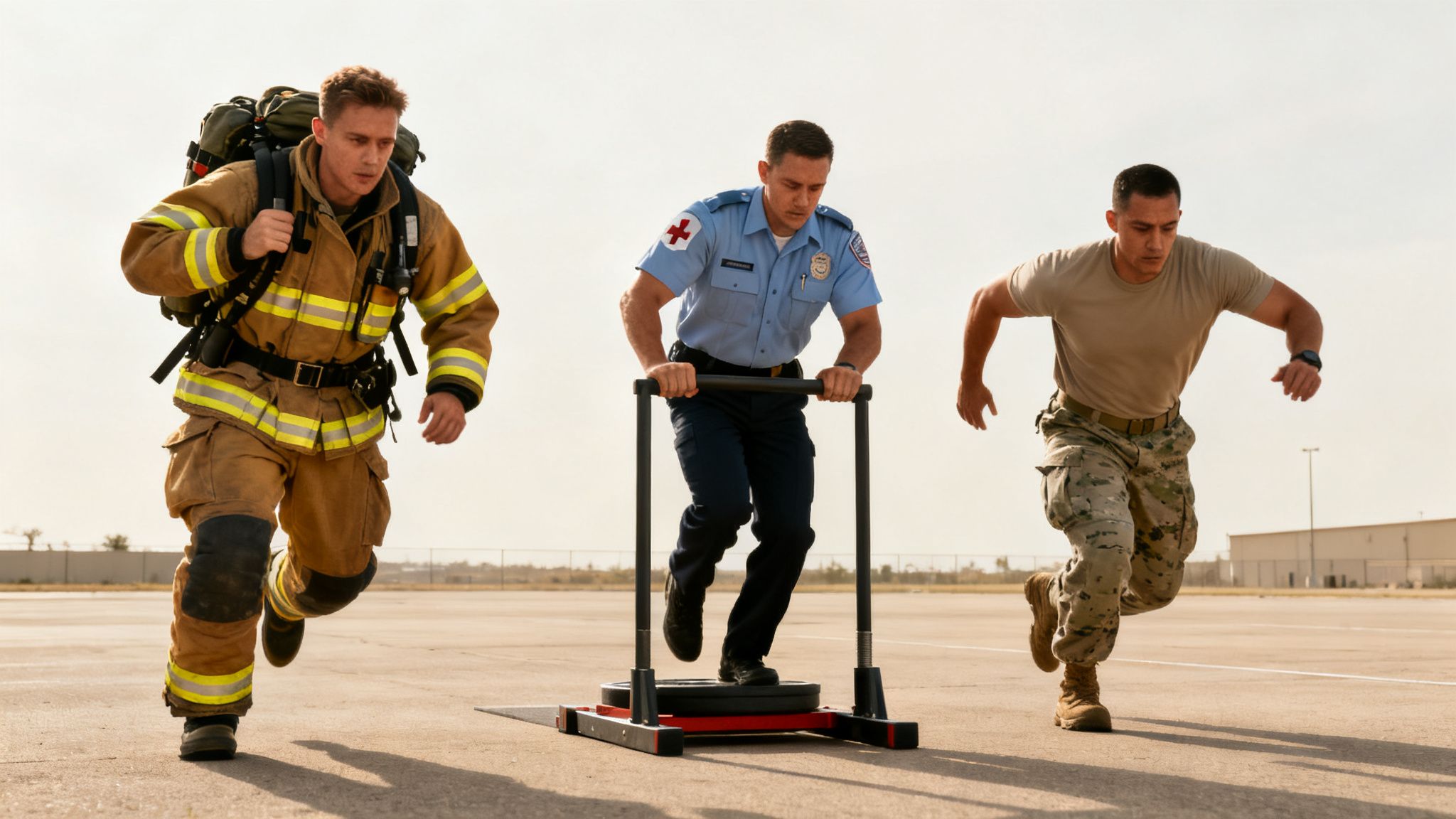
The term "tactical athlete" draws a clear line in the sand. It separates a professional whose life depends on their physical fitness from someone just looking to get in shape. These are the individuals who must be ready for anything, at a moment's notice, often without a chance to warm up.
Think about a police officer launching from a patrol car into a dead sprint, weighed down by 20 pounds of gear. Or a firefighter, jarred from sleep, who throws on 75 pounds of equipment and immediately starts battling a blaze in extreme heat. These aren't gym scenarios—they demand a completely different kind of physical and mental preparedness.
The Core Pillars of Tactical Fitness
To build an operator who can meet these demands, a training program has to be built on a rock-solid foundation of specific physical and mental attributes. This isn't just about passing a PT test; it’s about creating a durable, resilient body that can thrive in the toughest environments imaginable.
Here's a breakdown of what that looks like in the real world:
Core Pillars of Tactical Fitness
| Pillar | Description | Real-World Application |
|---|---|---|
| Strength and Power | Absolute, functional strength to move heavy, awkward objects or people. This is about real-world force, not just lifting a barbell. | Dragging a partner to safety, hoisting heavy equipment up a ladder, or breaching a door. |
| Endurance | The ability to sustain high-output effort for long durations, often under load and immense psychological stress. | A multi-hour foot patrol in full kit, a prolonged firefight, or a search and rescue operation on rough terrain. |
| Agility and Mobility | Moving efficiently and quickly over, under, and around obstacles without losing balance or control. | Navigating a cluttered building during a raid, climbing a fence, or maintaining footing on unstable ground. |
| Resilience | A combination of physical durability to resist injury and the mental toughness to stay focused and make clear decisions under fire. | Pushing through pain to complete the mission and staying calm enough to perform complex tasks under pressure. |
This holistic approach is about more than just peak performance—it's about career longevity. The physical toll of these jobs is brutal, and intelligent, targeted training is your best defense against a career-ending injury.
The goal is to forge a body that doesn't just pass a fitness test but can withstand the rigors of a multi-decade career. Performance and injury prevention are two sides of the same coin.
The proof is in the data. The Warrior Athletic Training program at Fort Benning demonstrated that by teaching proper running mechanics, flexibility, and nutrition, they cut lost training time by a staggering 1,692,872 soldier hours. This saved over $40.5 million in medical costs. That's the power of smart training.
Ultimately, the modern tactical athlete embodies total readiness. Their gear, from their boots to their watch, is chosen for function and durability. Even accessories like Garmin Instinct Tactical Edition bands are selected to support mission success. This comprehensive mindset is what sets true professionals apart.
If you're ready to dig deeper, our guide on how to improve athletic performance lays out foundational strategies that are directly applicable to building an elite tactical athlete.
Establishing Your Performance Baseline
Before you can build a more capable, resilient operator, you need to get brutally honest about your starting point. A serious tactical training program isn't about guesswork; it's about precision. The first step is always establishing a solid performance baseline—gathering real, objective data on your current abilities so you can build a roadmap with clear, mission-focused targets.
If you skip this, you’re just training in the dark. You have no real way to program effective loads, measure whether you're actually getting better, or identify the weak points that could become a massive liability out in the field. This isn't about chasing vanity numbers in the gym; it's about knowing your operational readiness, inside and out.
Key Performance Indicators for the Tactical Athlete
Forget the bodybuilding metrics. Your baseline needs to reflect the incredibly diverse demands of your job. A proper assessment will test different facets of your physical capacity, giving you a complete, unvarnished picture of your strengths and weaknesses.
These are the essential tests to lock in your starting numbers:
- Aerobic Capacity (1.5-Mile Run): This is a classic for a reason. It’s a gut-check of your cardiovascular endurance, measuring your ability to sustain a high heart rate over time—a critical skill for a long foot pursuit or navigating a massive fireground under load.
- Maximal Strength (3-Rep Max Deadlift): We use a 3RM instead of a risky 1-rep max. It gives us a much safer but still incredibly accurate measure of your absolute strength. This is the raw power that translates directly to lifting a downed partner or heaving heavy debris out of the way.
- Relative Strength (Max Rep Pull-ups): Your ability to move your own bodyweight is non-negotiable. Max pull-ups are a pure test of upper-body pulling strength relative to your size, a key indicator for climbing, hoisting gear, or just controlling your own body in tough situations.
- Agility (T-Agility Test): The operational environment is pure chaos. The T-Agility test measures your ability to accelerate, decelerate, and change direction on a dime. These are the skills you need for navigating unpredictable terrain or reacting to a sudden threat without hesitation.
Together, these tests give you a balanced snapshot of your fitness. They cover endurance, raw power, functional strength, and the kind of explosive quickness needed to react under pressure.
From Numbers to Mission-Focused Goals
Once you have your baseline numbers, the real work begins. The next step is to translate that raw data into meaningful, actionable objectives. We use the SMART framework for this—Specific, Measurable, Achievable, Relevant, and Time-bound. Vague goals like "get stronger" are completely useless.
A tactical athlete’s goals have to be tied directly to the demands of the job.
Instead of just saying, 'I want to improve my run time,' a real goal sounds like this: 'Drop my 1.5-mile run time by 45 seconds in 12 weeks to ensure I can keep pace during team movements with full kit.'
See the difference? This approach gives you clarity and purpose. It transforms a simple workout into a training session with a clear mission. For example, let's say your 3RM deadlift is 315 lbs, but you gas out trying to carry odd objects. Your goal might be: "Increase my sandbag-over-shoulder lift from 150 lbs to 180 lbs in 12 weeks to improve my casualty carry proficiency."
This creates a powerful feedback loop. Your baseline assessment informs your goals, your goals dictate your training plan, and your future re-assessments prove your progress. This methodical approach is the absolute cornerstone of any successful tactical training program.
Of course, properly fueling this progress is critical, especially when you're pushing your physical limits. As you ramp up the intensity, paying close attention to your hydration and electrolyte balance becomes non-negotiable for both performance and safety. To get a handle on this crucial element, you can learn exactly how to calculate your sweat rate and adjust your intake. This is how you ensure your body has what it needs to adapt and get stronger.
Structuring Your Training with Block Periodization
For tactical athletes, there is no off-season. This simple fact means that old-school bodybuilding splits or a constant grind of random high-intensity workouts aren't just ineffective—they're a liability. Your job demands that you build multiple, often conflicting, physical qualities at the same time. Think raw strength and long-haul endurance.
Trying to max out both simultaneously is a recipe for burnout and injury. The smartest way to manage this balancing act is through block periodization.
This model organizes your training into a long-term plan, called a macrocycle, which usually spans 8–12 weeks. This is then broken down into smaller, focused training blocks known as mesocycles, each lasting about 3–4 weeks. Instead of trying to get better at everything all at once, each block zeros in on one or two specific physical qualities while simply maintaining the others.
It’s a system designed to prevent the physiological chaos of trying to be a powerlifter and a marathon runner in the same week. It gives your body a clear signal, allows it to adapt to a specific stress, and lets you bank real, measurable gains. Then you move on, layering new qualities on top of the old ones to build a truly resilient athletic base.
This timeline lays out the basic flow: assess where you are, set clear goals, and then build the plan that gets you there.
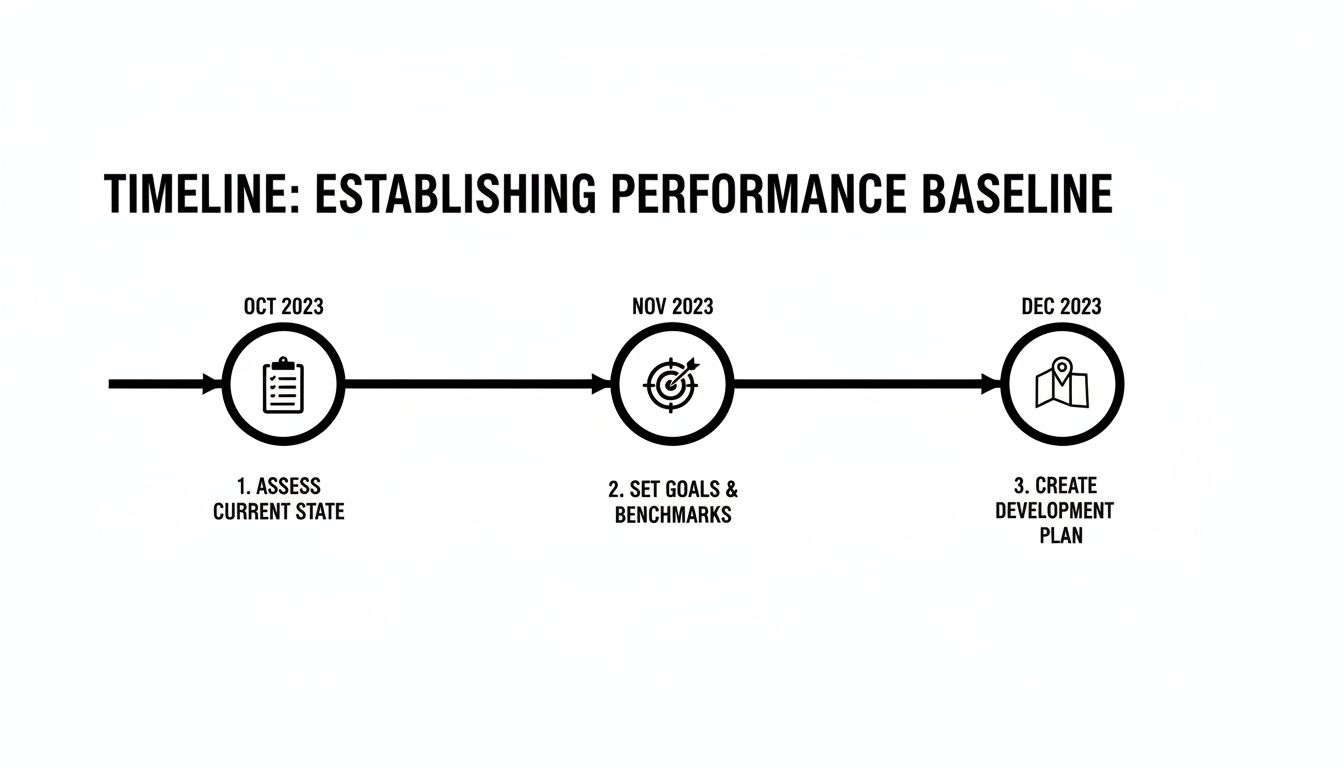 This is the heart of smart training. Every single workout has a purpose and is a deliberate step toward a specific objective, not just random effort for the sake of it.
Designing a 12-Week Macrocycle
Let’s get practical. A typical 12-week macrocycle for a tactical athlete can be carved into three distinct four-week blocks. This structure lets you build your physical capabilities systematically, stacking one quality on top of another until you're at peak readiness.
Here’s what that looks like in the real world:
- Block 1 (Weeks 1-4): General Physical Preparedness & Strength. The mission here is to build a rock-solid foundation of absolute strength. Think heavy, foundational movements like trap bar deadlifts, overhead presses, and squat variations. Conditioning is kept at a lower intensity, focusing on building your aerobic base to support recovery and fuel the harder work to come.
- Block 2 (Weeks 5-8): Power & Strength-Endurance. With a solid base of strength in place, we shift focus to converting it into explosive power and the ability to repeat those hard efforts. This is where you bring in box jumps, kettlebell swings, and med ball throws. Strength work continues, but with more emphasis on speed. Conditioning gets ramped up with more intense work-capacity circuits.
- Block 3 (Weeks 9-12): Work Capacity & Job-Specific Endurance. This is the final phase where everything comes together. Training becomes highly specific to the actual demands of your job. You'll be doing loaded carries, ruck marches, and high-intensity intervals that mimic the energy systems you’ll use in a real-world callout. The goal is to peak your ability to perform under load, for as long as it takes.
This isn't just theory. Research on Naval Special Warfare (NSW) Operators using a 12-week block-periodized program showed significant gains in agility and total body strength compared to other training styles. This approach sharpens readiness without jacking up injury risk—a critical factor when you consider that only 51% of tactical athletes currently do any dedicated speed and agility work. You can get more details on these findings from the University of Kentucky's College of Health Sciences.
Real-World Application for a Firefighter
Let's put this into a real-world context. Take a firefighter who knows their annual physical ability test (PAT) is three months out. They can use this framework to dial in their training and peak perfectly on test day.
- Months 1-2 (Strength Focus): Let's say it's a slower period for call volume. This is the perfect time to run a strength block. The focus is on heavy deadlifts, weighted pull-ups, and farmer's carries—the raw strength needed for forcible entry and victim drags.
- Month 3 (Work Capacity Focus): As the PAT gets closer, they pivot to a work capacity block. Training now starts to look a lot more like the test itself: stair climbs in a weighted vest, dummy drags, and hose pulls. The strength they built in the first two months directly fuels their ability to sustain high-power output during these specific tasks.
This strategic shift means the firefighter isn't just working out. They are intelligently building the exact physical qualities they need, right when they need them. They’ll show up on test day stronger, more durable, and completely prepared for the mission.
This is what it means to train smart, not just hard. By adopting a block periodization model, your tactical athlete training program becomes a calculated, long-term strategy for elite performance and career longevity.
Your Weekly Training Blueprint in Action
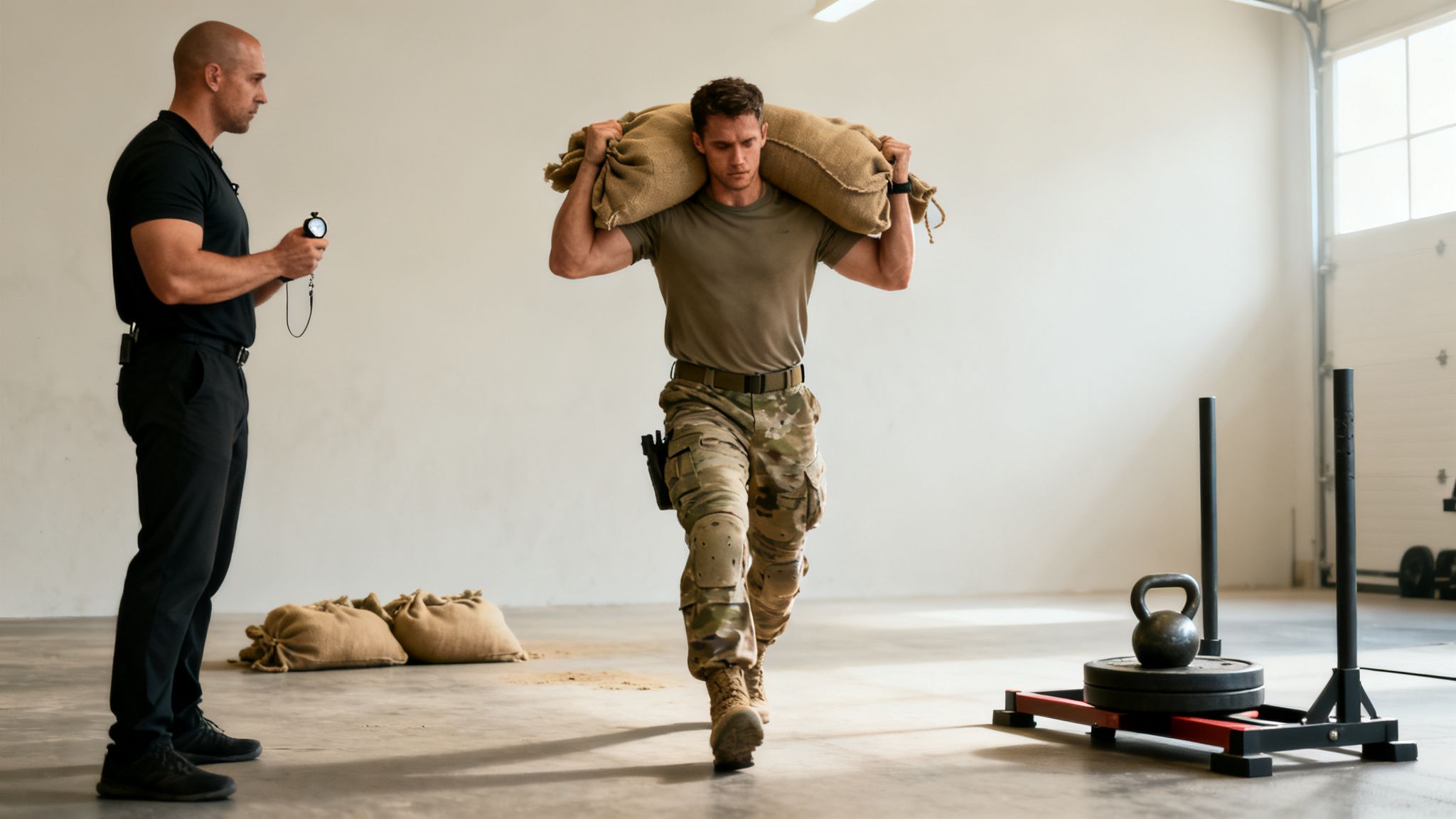
This is where the rubber meets the road. A great plan on paper is useless until you execute it, and for a tactical athlete, that execution happens week in, week out. Your weekly schedule is what translates the big-picture goals of your training blocks into daily, grind-it-out workouts that actually build strength, power, and operational readiness.
The real trick is crafting a schedule that pushes you hard but doesn't break you down. Most operators find a four or five-day training week hits the sweet spot between stimulus and recovery. It allows for consistent progress without redlining your system. After all, there’s no off-season in this line of work.
Sample Weekly Template: Strength Focus
When you're in a strength block, the mission is simple: get stronger. The priority is increasing absolute force production, which means heavy iron. Conditioning takes a back seat—it's still there to maintain your aerobic base, but it's not supposed to interfere with the neurological and muscular adaptations you get from heavy lifting.
Here’s what a solid four-day split could look like:
-
Day 1: Max Effort Lower Body
- Main Lift: Trap Bar Deadlift - Work up to a heavy set of 3-5 reps.
- Accessory Work: Goblet Squats (3x8-10), Reverse Lunges (3x10 per leg), Glute-Ham Raises (3x12). These build muscle and support the main lift.
-
Day 2: Max Effort Upper Body
- Main Lift: Weighted Pull-ups - Work up to a heavy set of 3-5 reps.
- Accessory Work: Barbell Overhead Press (3x6-8), Dumbbell Rows (3x10 per arm), Push-ups (3x max reps). A good mix of vertical and horizontal pressing and pulling.
-
Day 3: Rest or Active Recovery
- Keep it simple. A 30-45 minute walk, some light stretching, or foam rolling does the trick.
-
Day 4: Dynamic Effort Lower Body & Carries
- Main Lift: Box Squats - 6 sets of 3 reps at 60-70% of your max. Focus on speed and explosive power out of the bottom.
- Loaded Carry: Farmer's Walks - 4 sets of 50 yards (heavy). Nothing builds grip and core stability quite like picking up heavy things and walking with them.
-
Day 5: Dynamic Effort Upper Body & Conditioning
- Main Lift: Bench Press - 6 sets of 3 reps at 60-70% of your max, driving the bar up with max velocity.
- Conditioning: 20 minutes on an assault bike or rower at a steady, Zone 2 pace.
Sample Weekly Template: Endurance Focus
When it's time to build your engine, the roles reverse. Strength work shifts to maintenance mode—you’re just trying to hang on to the gains you made while dramatically increasing your work capacity.
This template weaves in more conditioning and job-specific grit:
-
Day 1: Strength Endurance Upper & HIIT
- Main Work: Bench Press (5x5 at 75%), immediately followed by max reps of Bodyweight Pull-ups.
- Conditioning: 8 rounds of 30-second sprints on a ski erg with 90 seconds of rest. This is a brutal but effective way to build your anaerobic capacity. You can find more on this in our guide to building endurance for running.
-
Day 2: Strength Endurance Lower & Loaded Carry
- Main Work: Back Squats (5x5 at 75%), followed by Kettlebell Swings (5x15).
- Job-Specific Skill: Sandbag-to-Shoulder Lifts (6 sets of 3 reps per side). This directly simulates hoisting awkward gear or a person.
-
Day 3: Rest or Active Recovery
- Get off your feet. Some low-impact activity like swimming or dedicated mobility work is perfect.
-
Day 4: Long-Duration Endurance
- Main Work: Ruck March - 45-60 minutes with a moderate load (e.g., 45 lbs) over uneven terrain. This is non-negotiable for building mission-specific endurance.
-
Day 5: Job-Specific Circuit
- Get after it. 5 rounds for time: 200m shuttle sprint, 10 burpees, 150-foot sled drag. This circuit mimics the "sprint, work, move heavy crap" reality of the job.
I see too many guys treat job-specific drills as an afterthought. That's a huge mistake. You have to integrate them with purpose. A ruck march isn't just a walk; it's a dedicated endurance session. Running an O-course is a full-body workout that tests strength, agility, and pure grit. Schedule these things just like you would any other lift.
Think of these templates as a framework, not a rigid prescription. You have to bend it to fit your schedule, your recovery, and the specific demands of your job. The best tactical athlete training program is the one you can stick to, week after week.
Fueling and Recovering for the Mission
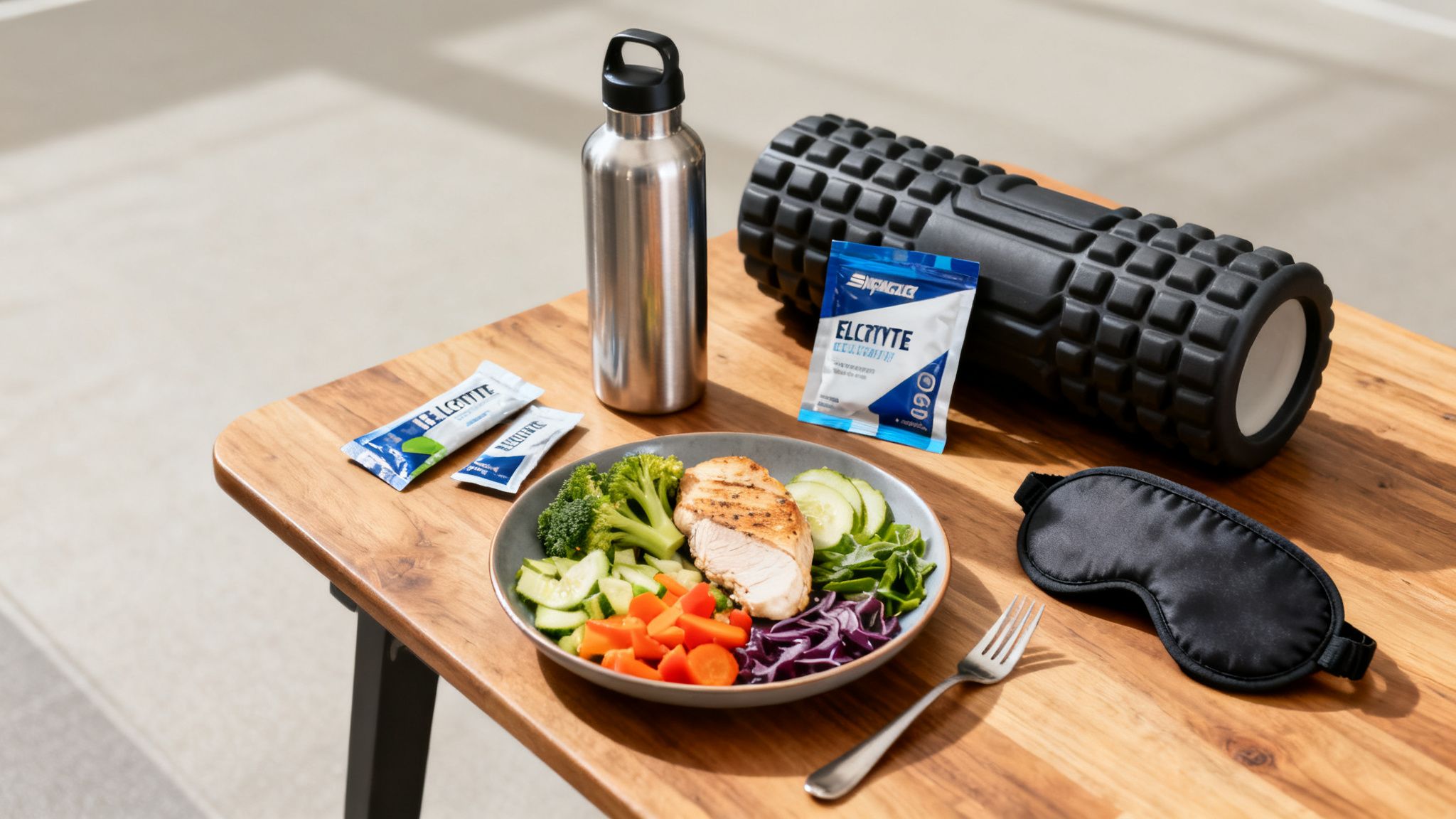
The toughest lifts and most grueling conditioning sessions are only half the battle. You build real, lasting progress in any tactical athlete training program during the hours spent outside the gym. Neglecting your nutrition and recovery is like building a high-performance engine but fueling it with cheap gas—sooner or later, it’s going to break down.
Elite operators treat fueling and recovery with the same seriousness as their physical training. It’s not about complicated diets or expensive gadgets. It’s about mastering the fundamentals that keep your body and mind ready for whatever comes next.
The Foundation of Performance Nutrition
For tactical athletes, nutrition is about function, not aesthetics. Your body is a tool, and food is the fuel that makes it work. The core principle is simple: prioritize whole, nutrient-dense foods that give you sustained energy, support muscle repair, and keep inflammation in check.
Forget the restrictive fads. Your focus should be on building consistent habits around these key areas:
- Protein for Repair: Aim for a steady intake of high-quality protein all day. This is crucial for repairing the damage from intense training and building a more resilient body.
- Carbohydrates for Fuel: Carbs are your primary energy source for high-intensity efforts. Focus on complex carbohydrates like oats, sweet potatoes, and brown rice for sustained energy. Don't be afraid to use simple carbs right around your training window to fuel immediate performance.
- Healthy Fats for Hormones: Dietary fats from sources like avocados, nuts, and olive oil are vital for hormone production—including testosterone, which is essential for strength and recovery.
Strategic Hydration and Supplementation
Hydration is a non-negotiable performance multiplier. Even a 2% loss in body weight from dehydration can tank your cognitive function and physical output. That’s a dangerous deficit in a high-stakes environment. A solid starting point is to drink half your body weight in ounces of water daily.
But water alone isn't always enough, especially during intense activity or in hot climates. This is where smart supplementation becomes a strategic advantage.
Plain water can't replace the critical electrolytes you lose through sweat. Sodium, potassium, and magnesium are essential for muscle function and nerve signaling. Failing to replace them is a direct path to cramping, fatigue, and performance collapse.
This is precisely where products like REVSCI Reviver Electrolytes fit into a tactical athlete's toolkit. A clean, filler-free electrolyte formula lets you manage your fluid balance based on your specific needs, sweat rate, and the conditions you're operating in. It’s about giving your body exactly what it needs to perform, without the junk it doesn’t.
Non-Negotiable Recovery Protocols
Recovery isn't passive; it's an active process. The stress of the job, combined with demanding training, requires a deliberate approach to rest and repair.
Prioritize Your Sleep
Sleep is your most powerful recovery tool. Period. During deep sleep, your body releases growth hormone, which is critical for tissue repair. Aiming for 7-9 hours of quality sleep per night is one of the most effective things you can do to boost performance, regulate stress hormones like cortisol, and stay sharp. It’s not a luxury; it’s mission-critical.
Implement Active Recovery
On your rest days, "rest" doesn't mean sitting on the couch all day. Active recovery is all about low-intensity movement that promotes blood flow, helps clear out metabolic waste from your muscles, and reduces soreness without adding more training stress.
-
Examples of Active Recovery:
- A 30-45 minute walk or light jog
- Foam rolling and mobility drills
- A casual swim or bike ride
For those seeking every possible edge, exploring other recovery modalities can be beneficial. Techniques like red light therapy for athletes can offer an additional way to support cellular repair and reduce inflammation. If you want a deeper dive on optimizing this crucial downtime, you can read our guide on how to recover faster after a workout.
Got Questions? Let's Talk Real-World Tactical Training
Stepping into a serious tactical training program always unearths a ton of practical questions—the kind that don't get answered in a generic PDF template. The reality of this job means unpredictable schedules, limited gear, and unique physical demands. You need smart, flexible answers.
Let's dig into some of the most common questions that pop up when you decide to get serious.
How Do I Train Around Long, Irregular Shifts?
First rule: flexibility is your greatest asset. Think of this program as a blueprint, not a brittle script that shatters if you miss a day. If you're walking in the door after a brutal 24-hour shift, that's your recovery day. Period. Trying to force a heavy lifting session when you're physically and mentally smoked is a one-way ticket to injury.
Plan your most demanding workouts, like a heavy lower body day, for your scheduled days off. The goal here is consistency over perfection. Hitting three or four high-quality sessions a week is infinitely better than slogging through six mediocre ones. Your body doesn't know it's "leg day on Monday"; it only knows stress and recovery. Listen to it.
What If I Don't Have a Fully-Equipped Gym?
Some of the most capable operators I've known train with next to nothing, because that’s what’s available downrange. The magic isn't in the machine, it's in the principle of progressive overload—constantly forcing your body to adapt to a bigger challenge. You can build incredible, functional strength with just a few key items.
- Sandbags: If I had to pick one tool, this would be it. You can squat, press, carry, and drag them. They build that awkward, real-world strength you just can't get from a perfectly balanced barbell.
- Kettlebells: A must-have for developing explosive hip power with swings and building rock-solid core stability with goblet squats and Turkish get-ups.
- Weighted Vest: This is the simplest way to level up your bodyweight basics. Throw it on for push-ups, pull-ups, and lunges. It’s also non-negotiable for job-specific work like ruck marches or stair climbs under load.
No barbell for back squats? Do heavy sandbag-to-shoulder reps or weighted Bulgarian split squats until your legs are shaking. No sled? Find a hill and sprint it, or drag that sandbag across a field. Focus on the foundational human movements—push, pull, hinge, squat, carry—and get creative with making them harder over time.
How Often Should I Re-Test My Benchmarks?
Testing is critical. It's the only way to know if what you're doing is actually working. But testing too often is a rookie mistake. Constantly trying to hit a new one-rep max drains your central nervous system and eats up valuable time that should be spent building strength, not just demonstrating it.
My advice? Re-test your key performance indicators—like your 1.5-mile run or 3-rep max deadlift—at the end of each 8-to-12-week training block. This gives your body enough time to make real, measurable adaptations.
Testing this way accomplishes two things: it validates all your hard work and gives you a new, accurate baseline to work from. Those new numbers are what you'll use to set smart, data-driven goals for your next training cycle. Trust the process, let the gains stack up, and save the all-out efforts for when they truly matter.
Isn't This Just a CrossFit Program?
Not at all. While both use high-intensity, functional movements, their fundamental goals are worlds apart. It's the difference between sport and profession. CrossFit is the "sport of fitness," where the entire aim is to optimize performance for a competitive event.
A tactical program, on the other hand, is built for occupational performance and survivability. The goal is career longevity, not a podium finish. This means training is structured around your professional life, with a much heavier emphasis on injury prevention. You’ll also see more job-specific work that you won't find in a typical CrossFit class—things like rucking, odd-object carries, and drills that directly mimic the physical demands of your job.
A CrossFit-style metcon can be an outstanding conditioning tool within a tactical program, but the overall structure is laser-focused on one thing: forging a durable, resilient operator who can perform under pressure for an entire career.
A serious training program demands equally serious support for your body. Revolution Science delivers clean, research-backed supplements to make sure your fueling and recovery are as dialed-in as your training. When you're pushing your body to the limit, a trusted source for essentials like electrolytes isn't a luxury—it's a critical part of your performance toolkit.
Explore the full range of performance nutrition at https://rvsci.com.