
Tu carrito está vacío


A Runner's Guide to Performance Nutrition for Running
Proper nutrition for running isn't just a small part of your training plan—it's the most powerful tool you have. It’s all about combining the right foods at the right times to fuel your performance and kickstart your recovery. This isn't about restrictive diets; it's about strategically using carbs for immediate energy, protein for muscle repair, and healthy fats for those long-haul efforts.
Get this right, and you'll unlock your true potential.
Why Your Running Performance Starts on Your Plate

Think of your body like a high-performance race car. You wouldn’t fill it up with cheap, low-grade fuel before the biggest race of the season, would you? So why would you guess when it comes to fueling your own body? Strategic fueling is what separates a good training cycle from a great one, giving you a real competitive edge that goes way beyond generic diet advice.
This guide is here to break down the science of performance nutrition into simple, actionable steps you can use right away. Whether you're lacing up for your first 5k or chasing a new marathon PR, understanding what to eat and when to eat it is absolutely fundamental.
The Pillars of Runner's Nutrition
We're going to dive into the essential pillars that support every single stride. Mastering these concepts will give you a rock-solid foundation for consistent performance and long-term running health. We'll be covering:
- Macronutrients for Energy: Getting to know how carbohydrates, proteins, and fats work as a team to power your runs and rebuild your body even stronger than before.
- Mastering Hydration: Learning why water alone often isn't enough and how electrolytes are the key to keeping your muscles firing on all cylinders.
- Timing Your Intake: Discovering the critical windows for pre-run fuel, mid-run energy, and post-run recovery that will help you maximize every single session.
Think of food not just as calories, but as specific instructions you give your body. A pre-run banana says "go," while a post-run protein shake says "rebuild."
This is your roadmap to eating like a dedicated runner. By the end, you'll walk away with practical insights to finally unlock the speed and endurance you've been working so hard for. For an even deeper look, check out our complete guide to sports nutrition for endurance athletes. Our goal is to empower you with the knowledge to build a fueling plan that truly works for your unique body and ambitious goals.
Your Three Core Fuel Sources: The Runner's Playbook
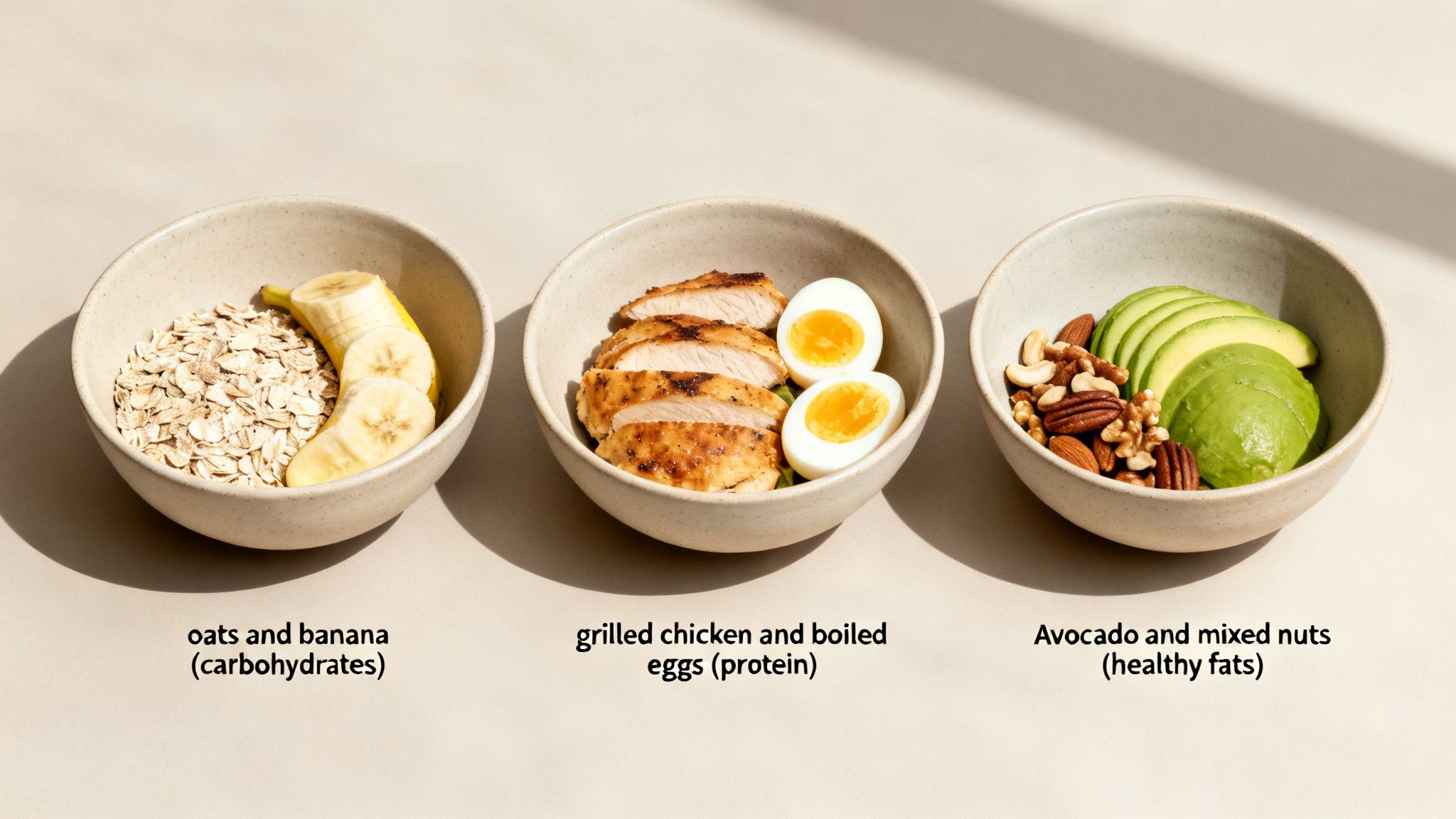
To really dial in your nutrition, we need to pop the hood and look at the engine that drives your performance. Your body runs on three main "macronutrients": carbohydrates, protein, and fats. Instead of getting bogged down in scientific jargon, let's break down what each one actually does for you as a runner.
Think of them as a highly specialized crew, each with a critical job to get you over the finish line feeling strong. This isn't about restriction; it's about giving your body the right tools at precisely the right time.
Carbohydrates: The High-Octane Fuel
Let's get one thing straight: carbohydrates are the undisputed king of running fuel. Think of them as the high-octane gasoline for your muscles. They are your body's preferred, most efficient energy source, broken down into glucose for immediate power and stored as glycogen in your muscles and liver for later.
That stored glycogen is like a fully charged battery pack, ready to go when you are. The second you start moving, your body taps into these reserves to power every single stride, especially during hard efforts like sprints or hill repeats. Run out of glycogen, and you hit the dreaded "wall." It's that awful, sudden feeling of total fatigue where your legs turn to lead.
But not all carbs are created equal. They fall into two camps:
- Simple Carbohydrates: This is your quick-burn fuel. Think of it like a turbo boost—fast to digest, giving you a rapid spike of energy. We’re talking fruits, honey, and energy gels. They're perfect for a quick snack 30-60 minutes before a run or for refueling mid-race.
- Complex Carbohydrates: This is your steady, long-lasting energy. These are like slow-release fuel pellets, providing sustained power for hours. Sources include oats, brown rice, quinoa, and sweet potatoes. These should be the foundation of your daily meals, keeping those glycogen stores consistently topped off.
Protein: The Muscle Repair Crew
If carbs are the fuel, protein is the expert pit crew working tirelessly behind the scenes. Its main job isn't to provide energy during the run but to repair and rebuild the muscle tissue that gets broken down every time you train.
Every run creates tiny micro-tears in your muscle fibers. Eating enough protein gives your body the amino acids it needs to patch up that damage, making your muscles stronger and more resilient for the next workout. Skimping on protein is like racing a car without ever servicing it—sooner or later, things are going to break.
This focus on carbs for fuel and protein for repair is a modern understanding. Back in the early 20th century, some Olympians, thinking protein was the key to endurance, would choke down up to 320 grams per day! By the 1936 Olympics, however, a study of nearly 4,700 athletes showed a massive shift: competitors were now eating around 850 grams of carbohydrates daily. It’s no wonder carb-loading is proven to boost performance by 2-3% in events over 90 minutes.
Fats: The Endurance Fuel Reserve
Finally, we have fats—your long-haul endurance fuel reserve. While your body burns through carbs for high-intensity efforts, it turns to fat for energy during lower-intensity, longer-duration runs, like a slow and steady marathon pace.
Healthy fats are also critical for absorbing certain vitamins (A, D, E, and K) and play a huge role in producing hormones that regulate everything from your metabolism to your recovery. So don't be afraid of fats; just focus on quality sources.
To simplify these roles, here’s a quick-reference table that breaks it all down.
Macronutrient Roles for Runners
| Macronutrient | Primary Role (Analogy) | Best Food Sources for Runners |
|---|---|---|
| Carbohydrates | High-Octane Fuel: Your immediate, high-intensity energy source. | Oats, bananas, sweet potatoes, brown rice, whole-wheat bread, energy gels. |
| Protein | The Repair Crew: Rebuilds and strengthens damaged muscle tissue post-run. | Chicken, fish, eggs, Greek yogurt, lentils, tofu, protein powders. |
| Fats | Endurance Reserve: Your long-haul, low-intensity energy source. | Avocado, nuts, seeds, olive oil, fatty fish (like salmon). |
Seeing how each macronutrient has a specific job makes it easier to build a smart, effective fueling plan.
Key Takeaway: Your goal is to get the right balance of all three. Prioritize complex carbs in your daily meals, use simple carbs strategically around your runs, eat enough protein to recover properly, and include healthy fats for overall health and endurance.
By understanding these fundamentals, you can start making smarter choices that directly impact your performance. To see how this applies in real-time, check out our guide on the best intra-workout carbs to learn how to fuel during your runs.
Mastering Nutrient Timing for Peak Performance
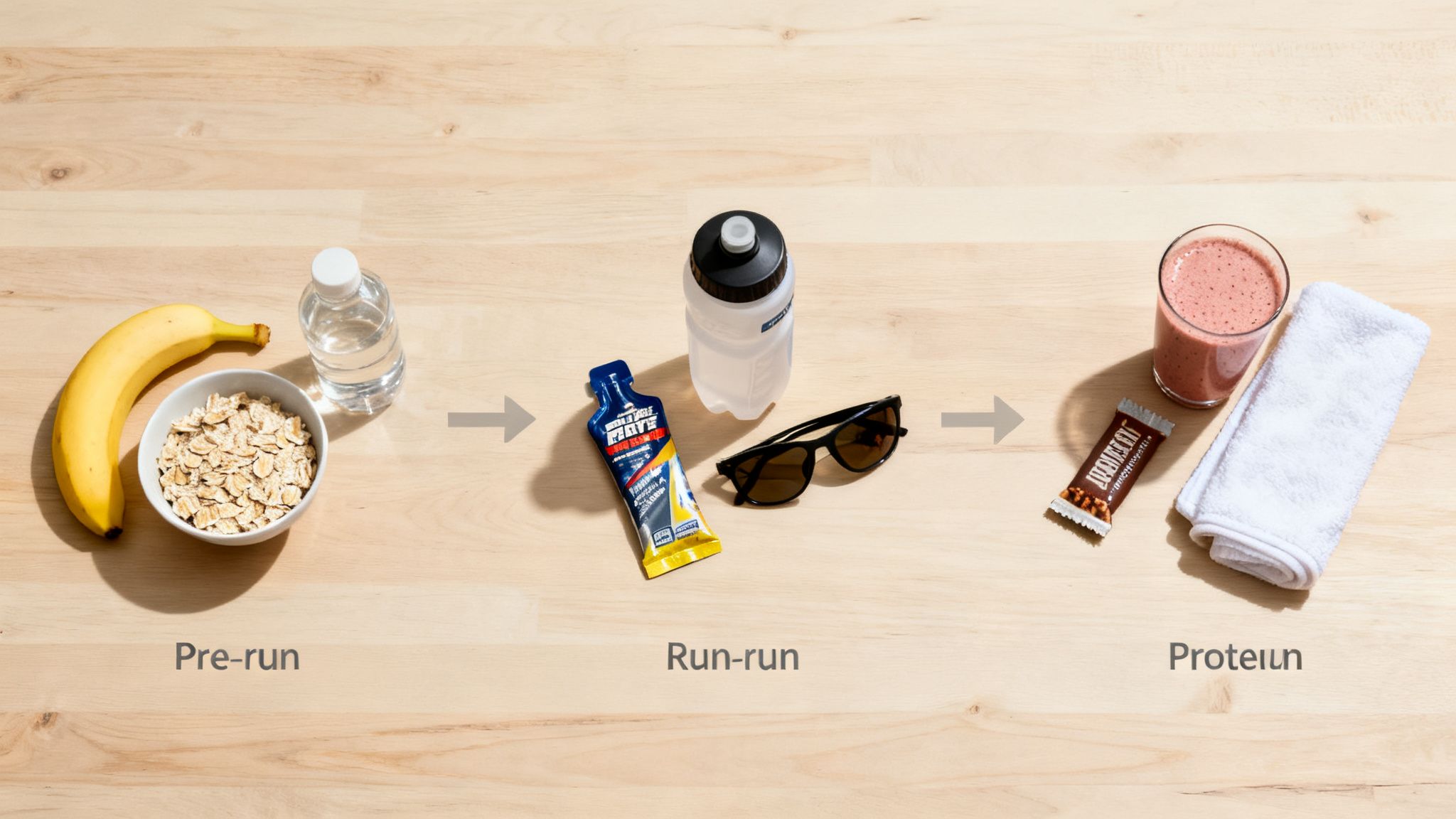
Knowing what to eat is a great start, but the real secret weapon that separates good runners from great ones is knowing when to eat it. This is the whole game of nutrient timing—strategically fueling your body to match exactly what you’re demanding from it.
Think of it like being the crew chief for a race car. You wouldn’t try to refuel while it's flying down the track, and you wouldn’t change the tires after the race is over. Perfect timing is everything. For you, this means breaking your nutrition plan into three critical windows: before, during, and after your run.
Pre-Run Fueling: The Launch Sequence
Your pre-run meal has one main job: topping off your glycogen stores. This is the high-octane, easily accessible fuel your muscles are going to burn through first. The goal is to load up on simple, fast-acting carbs without bogging down your digestive system, which is a surefire recipe for cramps and a sluggish pace.
The key is to adjust what you eat based on how much time you have before lacing up.
- 2-3 hours before you run: This is the sweet spot for a small, balanced meal. You'll want to focus on complex carbohydrates with a touch of protein. Think a bowl of oatmeal with berries, or a slice of whole-wheat toast with a banana and a smear of peanut butter.
- 30-60 minutes before you run: When time is tight, you need energy that hits your system fast. Now’s the time for simple carbs that are low in fat and fiber. A ripe banana, a handful of dates, or a quick serving of a clean supplement like Revolution Science's Regains will give you that instant burst of fuel without the digestive drama.
A critical rule of thumb: Never try a new pre-run meal on race day. Your training runs are your personal lab. Use them to experiment and dial in the exact foods and timing that make you feel powerful and light on your feet.
During-Run Fueling: Keeping the Engine Running
For any run lasting under 90 minutes, your stored glycogen and a solid pre-run snack will usually get you to the finish line just fine. But once you push past that mark, you have to start refueling on the move to avoid "bonking" or hitting that dreaded wall. This is where you actively replace the carbs and electrolytes you’re sweating out.
The science behind in-race fueling has come a long way. Back in the 1920s, doctors at the Boston Marathon first connected low blood sugar to exhausted runners, sparking a shift from pure guesswork to actual science. By the 1960s, breakthroughs like Gatorade proved that taking in carbs during exercise could dramatically boost endurance.
Today, while elite athletes might be crushing 90-120 grams of carbs per hour, a fantastic starting point for most of us is 30-60 grams per hour.
Here’s how to make that happen:
- Energy Gels & Chews: They’re designed for quick absorption and are a breeze to carry.
- Sports Drinks: These are multitaskers, delivering both carbohydrates and electrolytes at the same time.
- Whole Foods: Some runners swear by dates, small bananas, or even applesauce pouches.
Start taking in fuel around the 45-60 minute mark, and then keep it up with small, regular amounts every 30-45 minutes after that. The goal is a steady drip of energy, not a massive sugar bomb. For a deeper dive, check out our guide on the best time to take electrolytes.
Post-Run Recovery: The Golden Hour for Repair
The second you stop your watch, another clock starts ticking: your recovery window. Those first 30-60 minutes after a run are often called the "golden hour" for a reason. Your body is primed to absorb nutrients and kickstart the repair process. Your muscles are basically like sponges, ready to soak up carbs to restock glycogen and protein to rebuild damaged muscle fibers.
Your number one priority should be a snack or meal with a 3:1 ratio of carbohydrates to protein. This combo is the gold standard for getting recovery started on the right foot.
- Carbohydrates: Refill the glycogen tanks you just emptied. This is absolutely essential if you want to be ready for your next workout.
- Protein: Delivers the amino acids your body needs to repair those tiny micro-tears in your muscles, which is how they get stronger.
Great post-run options include a smoothie with fruit and protein powder, Greek yogurt with berries, or the classic: chocolate milk. For a convenient and perfectly formulated choice, mixing Regains into a post-run shake gives your body the clean carbs and protein it's screaming for, speeding up your recovery and cutting down on muscle soreness. Nail this final step, and you’ll get the full benefit from every single mile you run.
The Science of Hydration and Electrolyte Balance
Proper hydration is so much more than just drinking water—it's about keeping a precise internal balance that allows your body to fire on all cylinders.
Think of your body's fluid balance like the oil in an engine. When the level is just right, everything runs smoothly. But when it drops even slightly, friction builds, the engine overheats, and performance absolutely plummets.
For a runner, this means a higher heart rate, trouble focusing, and a major drop in power. In fact, losing just 2% of your body weight in sweat can seriously sabotage your performance. This is where the real science of hydration becomes a non-negotiable part of your nutrition for running.
More Than Just Water
Water is essential, no doubt. But on its own, it’s often not enough, especially during long, hot runs where you’re really sweating. When you sweat, you don't just lose water; you also lose critical minerals called electrolytes. These are the unsung heroes of your performance.
Think of electrolytes as the electrical wiring for your muscles and nerves. The most important ones for runners are sodium, potassium, magnesium, and calcium. They're in charge of:
- Muscle Contractions: They carry the electrical signals that tell your muscles to fire.
- Fluid Balance: Sodium is especially key here. It helps your body hold onto the water you drink, making sure it gets to your cells where it’s actually needed.
- Nerve Function: They keep the communication lines between your brain and your body humming along without a hitch.
When you run low on electrolytes, that wiring starts to fail. The result? Debilitating muscle cramps, fatigue, and a frustrating loss of coordination. This is why just chugging plain water on a two-hour run can sometimes make things worse by diluting your body's remaining electrolyte concentration.
Calculating Your Sweat Rate
So, how much should you actually be drinking? The honest answer is: it’s personal. A simple way to get a solid estimate of your fluid needs is to calculate your sweat rate. It sounds technical, but it’s really just a straightforward weighing exercise.
- Weigh Yourself: Before a run, hop on the scale with minimal clothing.
- Go for a Run: Head out for one hour at your typical race pace. The key here is to not drink anything during the run.
- Weigh Yourself Again: After the run, towel off any sweat and weigh yourself again in the same clothes.
- Calculate the Difference: Every pound you lost is roughly equivalent to 16 ounces (about 500 mL) of fluid. That number is your hourly sweat rate.
For example, if you lost one pound during your one-hour run, your sweat rate is approximately 16 ounces per hour. This gives you a personalized baseline to build your hydration plan around.
Smart Hydration for Better Performance
Once you know your sweat rate, you can build a much smarter hydration strategy. The goal isn’t to replace every single drop you lose mid-run, but to prevent that performance-killing level of dehydration. This is where a targeted formula makes a world of difference.
Many sports drinks are just loaded with sugars and other fillers that can cause stomach issues. A clean, effective solution like Revolution Science's Reviver Electrolytes is designed to give you exactly what you lose in your sweat—and nothing more. It helps you replenish crucial sodium and potassium to fight off cramps and maintain muscle function, allowing you to sustain your power mile after mile.
By combining water with a precisely formulated electrolyte supplement, you ensure your body gets both the fluid and the minerals it needs to perform at its peak. To see exactly how to dial this in for your own training, you can learn more about the best electrolytes for runners and find the perfect balance.
Tailoring Your Fueling For Different Race Distances
Fueling for a quick 5k is a completely different game than prepping for a 26.2-mile marathon. Your race distance is the single biggest factor that dictates your nutrition strategy, from what you eat the week before to what you stuff in your pockets on race day.
The shorter the race, the more you can rely on the fuel you already have stored in your muscles. But as the miles start stacking up, what you eat and drink during the run becomes absolutely critical for success. Think of it this way: a 5k is a high-intensity sprint powered by yesterday’s dinner and this morning's breakfast. A marathon is an ultra-endurance event that demands a meticulous, rolling refueling plan to keep you from hitting the wall.
Let’s break down how to dial in your nutrition based on your goal.
Fueling Plan by Running Distance
To make it simple, let’s look at how the core strategies of carb-loading, mid-race fueling, and hydration shift as the distance increases. Each race demands a different approach.
| Race Distance | Carb-Loading Focus | During-Race Fueling | Hydration Strategy |
|---|---|---|---|
| 5k (3.1 miles) | Not necessary. Focus on a good pre-race meal. | None required. Your stored energy is sufficient. | Water as needed, especially in heat. |
| 10k (6.2 miles) | Minimal. A carb-focused meal the night before helps. | Generally not needed unless run time exceeds 90 mins. | Sip water at aid stations. Electrolytes if a heavy sweater. |
| Half Marathon (13.1 miles) | Recommended. A 1-2 day "mini" carb-load tops off stores. | Crucial. Start at 45-60 mins. Aim for 30-60g carbs/hour. | Drink water and electrolytes consistently from the start. |
| Marathon (26.2 miles) | Essential. A proper 2-3 day carb-load is non-negotiable. | Mandatory. Start early. Aim for 60-90g carbs/hour. | Systematic plan for water and electrolytes is vital. |
This table shows a clear progression: as the race gets longer, your fueling strategy needs to become more structured and disciplined to match the demands on your body.
Fueling For 5k and 10k Races
For shorter distances like the 5k and 10k—races that usually take less than 90 minutes—your main focus is just solid day-to-day nutrition. You don't need a complicated carb-loading plan or a belt full of gels. The glycogen your muscles already have stored is more than enough to get you to the finish line feeling strong.
The most important meal is the one you have 2-3 hours before the race. Go for something small, easy to digest, and rich in complex carbs. A bowl of oatmeal with a banana or a bagel with a bit of almond butter is perfect. It tops off your energy without sitting like a rock in your stomach.
Fueling For The Half Marathon
This is where in-race fueling officially enters the chat. A half marathon pushes most runners well past that 90-minute threshold, which is when you start to seriously drain your stored energy. To keep your pace steady and avoid hitting a wall, you have to start putting carbs and electrolytes back in during the race.
- Pre-Race: A solid, carb-focused breakfast is still your foundation.
- During Race: Start taking in fuel around the 45-60 minute mark. Plan on consuming 30-60 grams of carbohydrates per hour. For most people, that looks like one energy gel every 45 minutes or consistent sips of a sports drink.
- Hydration: Grab water and electrolyte drinks early and often, making the most of aid stations.
The golden rule here is to practice your exact fueling strategy on your long training runs. Your gut needs to be trained just like your legs. Figuring out which gels or chews agree with your stomach is a massive part of successful race prep.
One of the biggest mistakes runners make is waiting until they feel tired to take a gel. By then, it's already too late. Start fueling early to stay ahead of the energy crash.
Fueling For The Marathon and Beyond
The marathon is a different beast entirely. It demands a detailed, disciplined nutrition strategy. Here, underfueling isn’t just a risk—it's a near-guarantee that you'll meet the infamous wall. Your body simply cannot store enough glycogen to cover 26.2 miles without help.
A comprehensive marathon nutrition guide can be a lifesaver, but the core principles are clear:
- Carb-Loading: For 2-3 days leading up to the race, shift your diet so that carbohydrates are the star of every meal. The goal is to max out your muscle glycogen stores.
- Race-Day Breakfast: Eat a familiar, carb-heavy breakfast 3-4 hours before the starting gun.
- In-Race Fueling: This is non-negotiable. You must consume 60-90 grams of carbohydrates per hour. This might mean a gel every 30-45 minutes, supplemented with chews and a performance drink like REVSCI's Respire for a steady flow of energy.
- Electrolyte Management: Sweat doesn't just cost you water; it costs you sodium. Consistently replacing it with a product like Reviver Electrolytes is absolutely vital for preventing cramps and maintaining muscle function.
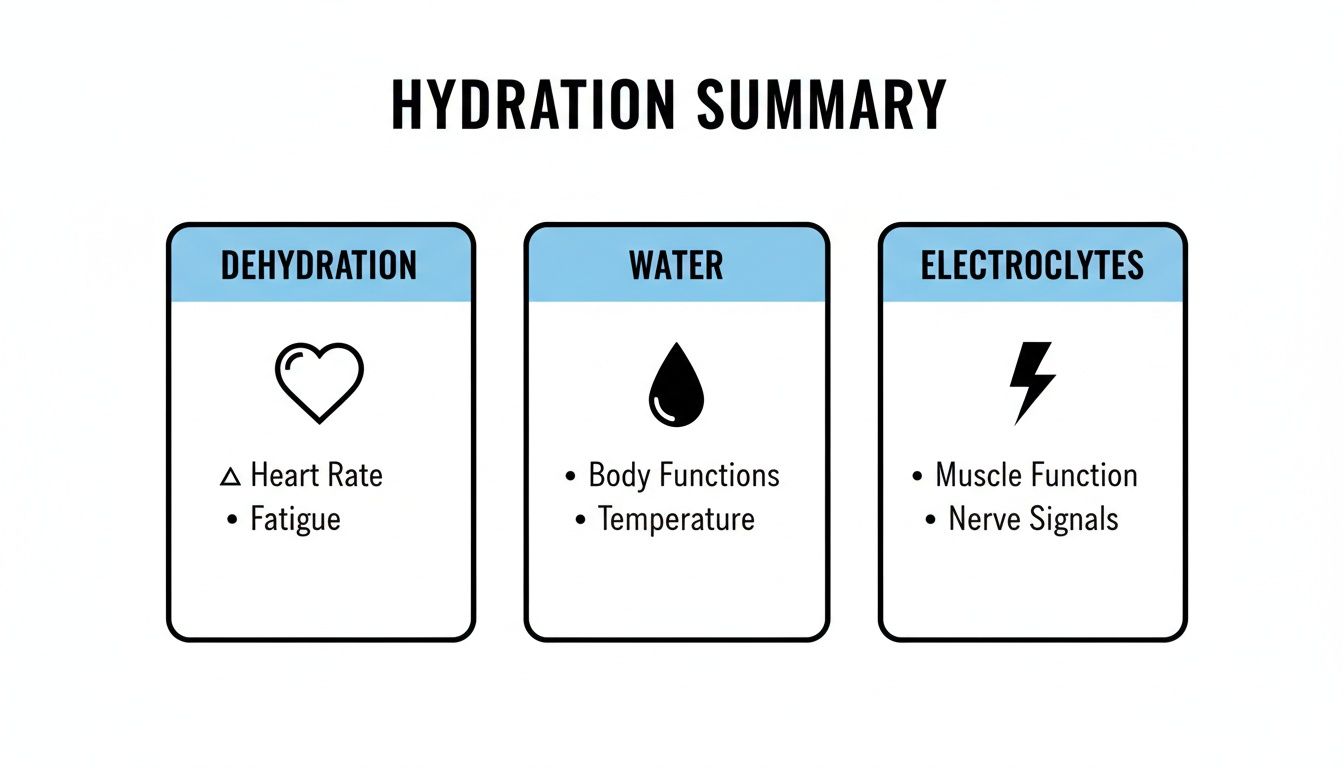
This just drives the point home: proper hydration is a two-part equation. Dehydration tanks your performance, and staying on top of both water and electrolytes is how you keep the engine running smoothly.
Building Your Personal Nutrition Blueprint
This guide isn't here to give you a rigid, one-size-fits-all meal plan. Think of it more as a blueprint—a set of proven principles you can use to figure out what truly clicks for your body and your running goals. When it comes to fueling, the perfect plan is always personal.
Success really just boils down to consistently applying the core concepts we've covered. It’s about fueling your body with the right mix of carbohydrates, protein, and fat. It's about nailing your nutrient timing to max out your energy and recovery. And it's about getting smart with your hydration, electrolytes, and knowing how to adapt your strategy for a quick 5k versus a grueling marathon.
Your Training Runs Are Your Laboratory
If you take only one thing away from this guide, let it be this: nothing new on race day. This is the golden rule of running nutrition. Your long training runs are your personal performance lab—the perfect opportunity to experiment with different pre-run meals, test out energy gels, and dial in the exact hydration strategy that keeps you feeling strong from start to finish.
Treat every long run as a dress rehearsal for race day. Practice with the same breakfast, the same gels, and the same hydration products you plan to use when it counts. This process builds not just physical readiness but unshakable confidence.
This philosophy of self-discovery and optimization is at the heart of what we do at REVSCI. Our focus is on creating clean, effective, research-backed tools so you have everything you need to perfect your own performance formula.
As you build out your complete nutrition plan, you might also look into specific dietary additions. For a deep dive into the recommended supplements for runners that can give you an extra edge in performance and recovery, this resource is incredibly thorough.
The time to start experimenting is now. Take these principles, apply them to your training, and begin building the personalized plan that will unlock your best performance yet. Explore our range of clean supplements and join a community of athletes dedicated to running smarter and stronger.
Your Running Nutrition Questions, Answered
Let's be honest, figuring out what and when to eat for your runs can feel like a complicated puzzle. But it doesn't have to be. We're going to tackle some of the most common questions runners have, giving you straightforward, practical answers to help you fuel with confidence.
How Soon Before a Run Should I Eat?
The perfect pre-run meal timing really comes down to two things: what you're eating and how your own stomach feels about it. Think of it as a countdown to go-time.
For a bigger, more substantial meal packed with complex carbs—think a bowl of oatmeal or some whole-wheat toast with avocado—you'll want to give your body a good 3-4 hours to digest everything. But if you're just grabbing a small, simple snack for a quick hit of energy, 30-60 minutes beforehand is the sweet spot. A ripe banana, a couple of dates, or a quick energy gel are perfect for this.
The single most important rule in running nutrition is this: nothing new on race day. Treat your training runs like a science lab. This is your time to experiment with different foods and timings to figure out what truly works for you.
What Should I Eat to Avoid Stomach Problems?
Nothing ruins a good run faster than GI issues. If you want to keep your stomach happy, the best strategy is to steer clear of foods that are high in fiber, fat, or a lot of spice in the hours before you head out. These all slow down digestion and can lead to cramping and other unpleasantness.
When you're actually on the run, simple and fast-absorbing carbohydrates are your best friend. This is where energy gels, chews, or a clean, easy-to-digest carb drink mix like REVSCI's Regains can be a total game-changer. Remember, you have to train your gut just like you train your legs. Start practicing with your race-day fuel during your long training runs to build up your tolerance.
Do I Need Electrolytes for Every Run?
Nope, not every run calls for an electrolyte boost. If you're heading out for a shorter, easy-paced run under 60 minutes in cool weather, plain old water is probably all you need to stay hydrated.
But when your runs get longer or the heat and humidity crank up, that's a different story. For any run lasting over 60-90 minutes, or any workout in the heat, replacing lost electrolytes is absolutely critical. When you sweat, you're not just losing water; you're losing essential minerals like sodium that your muscles need to function properly. Using a targeted supplement like REVSCI's Reviver helps put back what you've lost, keeping cramps at bay and your performance strong.
Is It Okay to Run on an Empty Stomach?
Running fasted—which usually means first thing in the morning before you've eaten—can actually be a decent training tool for some people. It can help teach your body to get better at burning fat for fuel. That said, this approach is really only a good idea for short, easy runs that are less than an hour long.
For any kind of hard workout—we're talking track intervals, tempo runs, or your weekly long run—you will absolutely perform better with some fuel in the tank. Getting some easily digestible carbs in beforehand gives your muscles that quick energy they need to handle the intensity, which will ultimately make you faster and reduce your risk of injury.
Ready to build a fueling plan that's all yours? Revolution Science creates clean, research-backed supplements specifically for athletes like you. Check out our products to find the right fuel to help you crush your running goals at https://rvsci.com.