
Your Cart is Empty


Finding the Best Electrolytes for Athletes
When it comes to electrolytes, there's one mineral that stands head and shoulders above the rest for serious athletes: sodium. It's the primary electrolyte you lose in sweat, so any formula worth its salt (pun intended) needs to deliver. A solid starting point for most tough training sessions is a drink with at least 500 mg of sodium per serving. This ensures you're actually replacing what your body is sweating out.
Your Guide to Optimal Athlete Hydration
Dialing in your electrolyte strategy isn't about finding a single magic product. It’s about building a smart, personalized plan that works for your body and your sport.
Think of electrolytes as the spark plugs for your muscles and nervous system. They’re simply minerals that carry an electrical charge when dissolved in water, and they’re absolutely critical for everything from a sprinter’s explosive start to a marathoner’s ability to grind out the final miles.
If you run low on them, your body's internal communication network starts to fail. This guide is designed to cut through the marketing hype and show you exactly how to replace what you lose, with a sharp focus on the king of electrolytes: sodium. We’ll give you a clear roadmap, starting with the basics and moving all the way to real-world, practical applications.
Building Your Performance Foundation
Let's be clear: this is not one-size-fits-all advice. A truly effective hydration plan hinges on understanding your own individual needs. We'll help you build that personalized electrolyte plan from the ground up to fuel peak performance and sidestep common issues like cramping, bonking, and mental fog. It’s time to move past generic recommendations and figure out what your body actually needs to compete at its best.
Here’s what getting your strategy right empowers you to do:
- Maintain Fluid Balance: The right electrolyte mix helps your body hold onto the water it needs, preventing the performance-killing effects of dehydration.
- Support Nerve Function: Electrolytes are non-negotiable for transmitting the nerve signals that tell your muscles to contract, keeping your movements smooth and powerful.
- Prevent Muscle Cramping: Getting enough sodium, potassium, and magnesium is your best defense against those painful, involuntary muscle contractions that can stop a workout or race in its tracks.
By understanding the 'why' behind electrolyte replacement, you can move beyond simply grabbing a sports drink and start building an intentional strategy that gives you a true competitive edge.
This guide is for every athlete, from the weekend warrior hitting the trails to the elite competitor chasing a personal best. And for those of you tackling the toughest endurance events, our detailed usage guide for triathlons and marathons offers specific protocols to help you nail your fueling and hydration plan when it matters most.
It’s time to take control and unlock your full athletic potential.
Why Electrolytes Are Your Performance Power Grid
Let's think about this in a way that makes sense. Imagine your body is a high-tech city. Your nervous system? That’s the electrical grid powering everything from the streetlights to the massive skyscrapers. Every single thing relies on that power.
In your body, that power grid is responsible for every muscle twitch, every heartbeat, every thought. And the electrolytes—minerals like sodium and potassium—are the actual copper wires that carry those electrical messages. Without them, the signals flicker, fade, and eventually die out completely.
When that internal grid is humming along perfectly, your muscles contract instantly, your focus is laser-sharp, and your energy systems fire on all cylinders. But the moment you start working out and sweating, you're actively losing these critical minerals, which is like yanking wires out of the grid and draining power from the entire system.
The Science of the Performance Crash
This isn't just a convenient analogy; it’s physiology 101. Electrolytes are simply minerals that carry an electric charge when they’re dissolved in fluid. It's this exact electrical potential that lets them manage the most fundamental functions your body needs to perform as an athlete.
When you sweat, you lose two things: water and electrolytes. If you make the common mistake of only replacing the water, you end up diluting the concentration of the electrolytes left in your bloodstream. This imbalance throws a wrench into the electrical signaling your body depends on for peak function.
And that’s the starting pistol for a performance crash. It’s not just a feeling of being "tired"—it's a full-blown systemic breakdown. The signals telling your muscles to fire become weak and erratic. Your brain struggles to stay in the game. Your body can’t even regulate its own temperature properly.
Think of it like this: You wouldn't try to run a high-performance engine on watered-down fuel. It’s going to sputter, stall, and fail. Your body is no different. Pounding plain water during intense exercise is like diluting your fuel source right in the middle of a race.
From Depletion to Debilitation
This internal electrical meltdown quickly shows up as real, performance-killing symptoms. Understanding this direct line from electrolyte loss to physical failure is the whole key to finding the best electrolytes for athletes. It’s not about fixing the problem; it's about preventing it from ever starting.
The most common signs your power grid is failing include:
- Muscle Cramps: This is the classic sign everyone knows. When you run low on minerals like sodium, potassium, and magnesium, the nerve signals firing into your muscles get disorganized. They start contracting involuntarily and painfully. A cramp is literally a short-circuit in your muscular wiring.
- Premature Fatigue: Ever feel gassed way before you should? That's because your muscles aren't firing efficiently. Every stride, lift, or pedal stroke takes more mental and physical effort because the communication line between your brain and muscles is fuzzy. You still have plenty of fuel in the tank, but the ignition system is failing.
- Mental Fog and Dizziness: Your brain is the command center, and it needs a rock-solid electrolyte balance to work right. When sodium levels drop, you can get hit with confusion, bad decision-making, and dizziness. That’s not just bad for your performance—it’s a major safety risk.
For any serious athlete, proper electrolyte replenishment isn't some optional "add-on." It’s a non-negotiable part of performance, safety, and recovery. By keeping your internal power grid fully charged, you ensure every system has the electrical currency it needs to operate at its absolute peak, from the first minute to the last. Trying to win a race while your internal lights are flickering out is a battle you'll never win.
Decoding Your Personal Sweat and Sodium Needs
Generic hydration advice fails athletes for one simple reason: you aren't generic. The amount of sweat you lose—and what’s in it—is as unique as your fingerprint. It’s a complex mix of your body size, genetics, fitness level, and the environment you’re training in.
Following a one-size-fits-all plan is like trying to run a marathon in shoes that are three sizes too big. It just won’t work, and it’s bound to cause problems.
Think about it: a 300-pound lineman grinding through practice in the August heat has wildly different fluid and sodium needs than a 130-pound marathoner running on a cool, dry morning. The lineman’s sheer size and work rate mean he’s going to be losing sweat at a much faster clip. This is exactly why getting a handle on your personal numbers is the first step to building an electrolyte strategy that actually works.
The science backs this up. A landmark study on football players found that larger athletes, like linemen, sweated at a staggering rate of 2.3 liters per hour. Smaller players? They were closer to 1.6 liters per hour. Over a single practice, that lineman could lose over 10 liters of fluid, which shows just how extreme individual needs can get.
Calculating Your Personal Sweat Rate
Figuring out your sweat rate isn't some complex procedure reserved for a sports science lab. It’s something you can easily do at home with a decent scale. This simple test gives you a powerful baseline for understanding just how much fluid you need to replace during a typical workout.
Consider it an audit of your body’s cooling system. By measuring what goes out, you can calculate exactly what you need to put back in to stay balanced and perform at your best.
Here’s a simple, step-by-step way to nail down your approximate sweat rate:
- Pre-Workout Weigh-In: Before you start, weigh yourself completely nude. Get that number down to the decimal.
- Train for One Hour: Go do your thing for exactly 60 minutes. Critically, keep track of how much fluid you drink (e.g., if you finish a 500 mL or 16.9 oz bottle, make a note of it).
- Post-Workout Weigh-In: As soon as you’re done, towel off completely so you’re not weighing any sweat left on your skin. Weigh yourself nude again and record it.
-
Do the Math:
- Subtract your post-workout weight from your pre-workout weight. That’s your total weight lost.
- Convert that weight loss into fluid ounces or milliliters (1 lb ≈ 16 oz or 454 mL).
- Now, add the amount of fluid you drank during the workout to that total. The final number is your estimated hourly sweat rate.
Example Calculation:
Pre-workout weight: 175 lbs
Post-workout weight: 173 lbs
Fluid consumed: 16 oz
Weight lost: 2 lbs (which is 32 oz of fluid)
Total fluid loss: 32 oz (from sweat) + 16 oz (consumed) = 48 oz per hour
This number is your starting point. You’ll want to repeat this test in different conditions—a hot, humid day versus a cool, dry one, or an easy jog versus a punishing interval session—to see how your sweat rate changes.
Identifying If You Are a Salty Sweater
Knowing how much you sweat is only half the battle. You also have to figure out what you're sweating out. While sweat is mostly water, the concentration of sodium is what varies dramatically from person to person, and it has the biggest impact on your performance.
Some athletes lose a pretty minimal amount of sodium. Others, who we call "salty sweaters," can lose several grams in a single hour. For these athletes, just drinking water or a low-sodium sports drink is a recipe for disaster, quickly leading to cramps, fatigue, or even dangerous conditions like hyponatremia.
You don’t need a lab test to get a good idea of where you stand. Just look for these classic signs after a tough workout:
- White, chalky stains on your dark workout clothes, hat, or helmet straps.
- Your skin feels gritty and salty after the sweat dries.
- Sweat that stings your eyes more than usual.
- A noticeable salty taste if sweat drips into your mouth.
- Frequent muscle cramps during or after long sessions, even when you think you’re well-hydrated.
If this list sounds a little too familiar, chances are you’re a salty sweater who needs to prioritize electrolyte solutions with a higher sodium content. For runners who tick these boxes, our guide on the best electrolytes specifically for running offers targeted advice for dialing in that sodium intake.
When you combine your sweat rate with an understanding of your sodium loss, you have the power to create a truly personalized plan—one that ensures you’re putting back exactly what your body needs to keep performing at its peak.
The Five Core Electrolytes That Fuel Performance
When we talk about the best electrolytes for athletes, we're not just throwing around buzzwords. We're talking about a specific team of essential minerals that work together to keep your internal power grid online and firing on all cylinders.
While lots of minerals carry an electrical charge, five stand out as the non-negotiable A-team for any serious athlete. Think of them as a highly specialized crew, not just a random mix of ingredients. Sodium is the crew chief, managing hydration. Potassium is its partner, handling muscle communication. Magnesium runs the power plant, Calcium is the structural engineer, and Chloride handles cleanup.
Let's break down exactly what each one does for you on the field, road, or in the gym.
Sodium: The Master Regulator of Fluid Balance
If there's one electrolyte you absolutely cannot afford to ignore, it's sodium. It's the mineral you lose most in your sweat, and it’s the primary driver of both your thirst signal and your body's ability to actually hold onto water.
Think of sodium as a magnet for water; where sodium goes, water follows. This relationship is what maintains your blood volume, which is critical for performance. When you sweat out sodium and only replace it with plain water, you're actually diluting your blood. This is a bad signal. Your body panics, shuts off the "hold onto fluid" command, and you end up peeing out the very water you desperately need.
Beyond hydration, sodium is non-negotiable for transmitting nerve impulses and making muscles contract. Without enough of it, the communication lines between your brain and your muscles get staticky, leading to slower reactions and weaker movements.
Potassium: The Muscle Communicator
Potassium works in a tight, essential partnership with sodium. Together, they create the famous sodium-potassium pump—a microscopic mechanism in every single one of your cells that generates the electrical charge needed for every nerve signal and muscle contraction. It's fundamental to movement.
Sodium mostly hangs out outside your cells, while potassium lives inside. This separation creates an electrical gradient, like the positive and negative terminals of a battery. When you sweat, you lose some potassium, and if this delicate balance gets thrown off, it can lead directly to muscle weakness and those all-too-familiar cramps.
For most athletes, a solid diet covers daily potassium needs. But during long, grueling events, replacing even small amounts is the key to keeping your muscular system firing cleanly.
Your body is a finely tuned electrical machine. The sodium-potassium balance is what allows that machine to work. An imbalance is like trying to run on a faulty current—it's inefficient, weak, and prone to short-circuiting in the form of cramps.
Figuring out your personal sweat needs is the first step to getting this balance right. It’s a simple process of moving from a general idea of your body to a specific plan based on your actual sweat rate and how much sodium you lose.
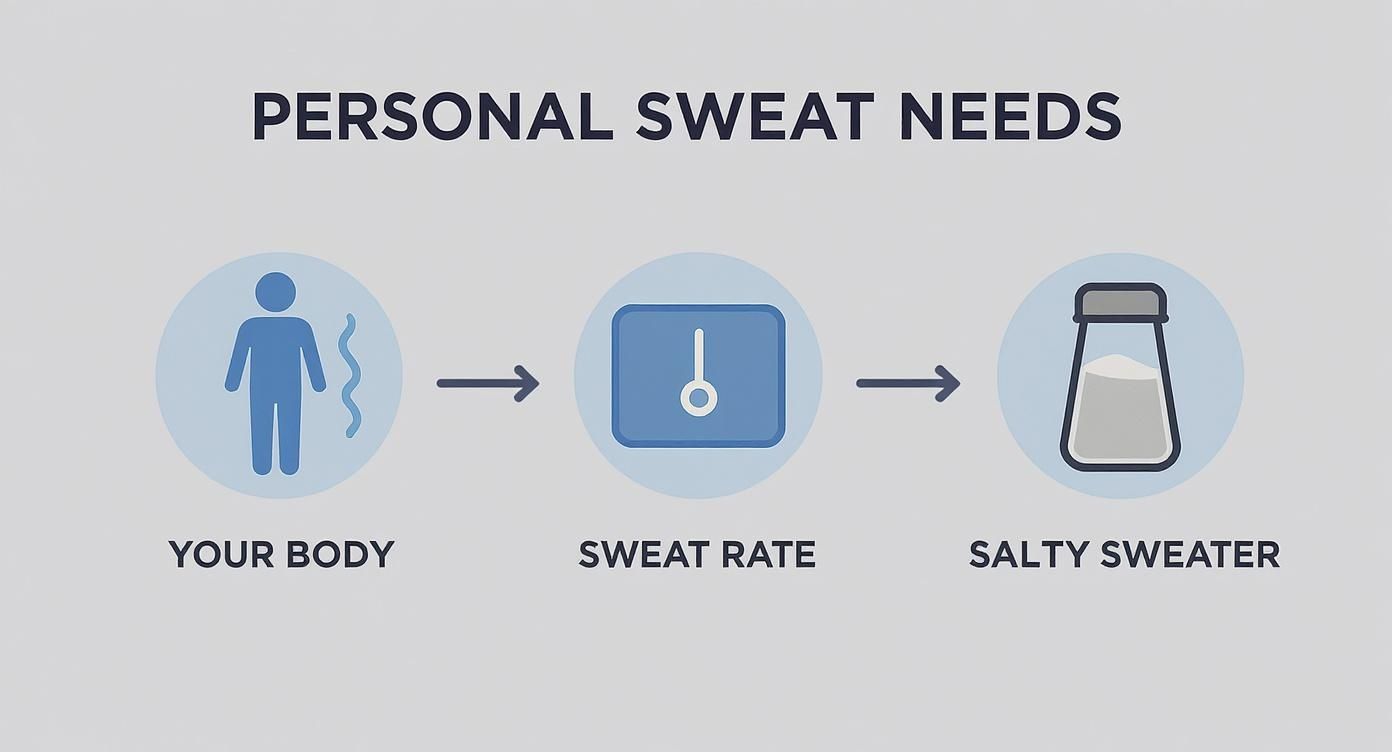
This visual shows that a truly personalized hydration strategy starts by assessing your unique sweat profile—from how much you sweat to how salty that sweat is.
Magnesium: The Energy and Relaxation Mineral
Magnesium is the unsung hero of the electrolyte world. It’s a workhorse, involved in over 300 enzymatic reactions in the body. It plays a massive role in everything from creating cellular energy (ATP synthesis) to allowing your muscles to relax.
Here’s a simple way to think about it: when your muscles contract, they need calcium. When they relax, they need magnesium. If you have an imbalance—too little magnesium for the amount of calcium present—your muscles can get stuck in a state of partial contraction. This is a major cause of cramping, tightness, and that feeling of being "locked up."
Many athletes are walking around with low magnesium levels without even knowing it. Since you lose it in sweat, intense training can quickly push you into a deficiency. This can show up as persistent cramps, muscle twitches, or just feeling like you can't fully recover between sessions.
Calcium and Chloride: The Supporting Cast
While sodium, potassium, and magnesium grab the headlines, calcium and chloride are the crucial supporting actors that make the whole show run.
- Calcium: Most people think of calcium for bone health, but its job in performance is immediate and critical. It’s the spark that initiates muscle contractions. Every single time you fire a muscle—whether it's for a deadlift or a sprint—you need calcium to make it happen.
- Chloride: As the second-most-abundant electrolyte in sweat right after sodium, chloride is sodium's partner in crime. It binds with sodium to help maintain fluid balance and blood pressure. It also plays a key part in your body's acid-base balance, helping to buffer the metabolic junk that builds up during hard exercise.
The sheer volume of sodium lost in sweat makes it the undisputed priority for replacement. Research on athletes in punishing sports like American football shows that sweat sodium concentration can average 1,000-1,400 mg per liter. With some athletes sweating up to 2.3 liters per hour, one person could lose a mind-boggling 2,300-3,220 mg of sodium in a single hour. That's a number you simply cannot replace with food alone during activity.
You can dive deeper into these findings on athletic sweat loss to see the raw data. This massive loss is precisely why effective electrolyte formulas are built on a robust sodium foundation, with the other core minerals playing their vital supporting roles to keep the entire system balanced and functional.
How to Choose the Right Electrolyte Supplement
Walking down the supplement aisle can be completely overwhelming. You're hit with a wall of powders, tablets, capsules, and pre-mixed drinks, all promising to unlock your peak performance.
The secret to finding the best electrolytes for athletes is to tune out the flashy marketing and zero in on three things that actually matter: format, sodium, and sugar.
Choosing a format is mostly about personal preference and what fits your life. Powders are super versatile and cost-effective, tablets are a lifesaver for travel, and ready-to-drink options are pure grab-and-go convenience. But honestly, the form factor is far less important than what's inside the bottle.
Decoding the Supplement Label
You shouldn't need a PhD to read a supplement label. Your first and most important stop should be the sodium content. Why? Because sodium is the mineral you lose in the highest concentration when you sweat, and a ton of popular sports drinks are laughably underdosed for a serious athlete.
Go ahead, grab a typical grocery store sports drink. You'll probably see somewhere around 150-250 mg of sodium per serving. For an athlete sweating out over 1,000 mg of sodium an hour, that’s like trying to put out a forest fire with a water pistol. It's just not going to make a real difference.
When you're sizing up a supplement, look for a sodium dose that actually matches your output. A great starting point for moderate to intense training is a formula with at least 500 mg of sodium per serving, with the ability to scale up for heavy sweaters or brutal, hot conditions.
Once you've checked the sodium, glance at the potassium and magnesium ratios. These guys are crucial, but you lose them in much smaller amounts. A well-designed product will reflect this, building on a solid sodium foundation. You can see how different brands stack up in our detailed electrolyte powder comparison guide.
The Great Carbohydrate Debate: Sugar or No Sugar?
The next big decision is whether you need carbs (sugar) in your formula. The answer comes down to one thing: how long and how hard you're training. Think of it this way—carbs are your body's high-octane fuel, while electrolytes are the engine oil that keeps everything running without seizing up.
Here's a simple way to figure out what you need:
-
For workouts under 90 minutes: If your goal is pure hydration without tacking on extra calories, a zero-sugar electrolyte formula is your best bet. It's perfect for strength training, shorter runs, or anyone on a low-carb or keto diet. You get all the essential minerals to fend off cramps and maintain fluid balance, without any fuel you don't need.
-
For workouts over 90 minutes: Once you push past that 90-minute mark in a marathon, triathlon, or long-distance ride, your body's stored energy (glycogen) starts running on empty. This is where a formula with carbohydrates becomes non-negotiable. The carbs deliver a steady stream of fuel to your working muscles, while the electrolytes keep you hydrated and firing on all cylinders.
The type of sugar matters, too. Lots of mass-market drinks are loaded with high-fructose corn syrup, which can spell disaster for an athlete's digestive system. If you’re fueling for the long haul, look for formulas with easily digestible carbs like dextrose or maltodextrin.
At the end of the day, the best electrolyte supplement is the one that's built for your specific needs. By learning to read the label and understanding when to add fuel to the fire, you can cut through the noise and find a product that gives your body exactly what it needs to perform—and nothing it doesn't.
Common Hydration Mistakes and How to Fix Them

Even with a perfect understanding of the science, simple mistakes in practice can completely derail your performance. It's something we see all the time: athletes swinging between two dangerous extremes—drinking way too little or drinking way too much.
Dehydration is the obvious enemy, the one we all know leads to fatigue and cramps. But over-hydrating with plain water is just as risky. This can trigger a nasty condition called exercise-associated hyponatremia, where you chug so much water that you dilute the sodium in your blood to dangerously low levels. This isn't just a performance killer; it's a serious medical emergency that proper electrolyte intake is designed to prevent.
The Over-Hydration Trap
One of the biggest mistakes athletes make is trying to "get ahead" of thirst by forcing down excessive amounts of plain water, especially when it’s hot. It’s a well-intentioned habit that can backfire, flushing out the very sodium your muscles and nerves need to fire properly. The result? Dizziness, confusion, and nausea.
This is exactly why the timing and composition of your fluids are so critical. You have to replace not just the water you lose through sweat, but the vital electrolytes that go with it.
Thinking of a sports drink as a magic bullet is a mistake. The best electrolytes for athletes are part of a broader strategy that includes smart pacing, listening to your body, and acclimatizing to the heat.
Supplements Are Not a Substitute for Smart Strategy
It’s tempting to think an electrolyte supplement can erase the effects of poor planning, but they are tools, not get-out-of-jail-free cards. A 2020 analysis of endurance athletes found that just popping supplements didn't necessarily prevent electrolyte imbalances. In fact, a staggering 41% of participants still developed sodium imbalances.
Even more telling, 88% of those cases happened during hot races. This tells us that your environment and total fluid intake are often more predictive of problems than the supplement itself. You can read the full Stanford study on athlete electrolyte use to dig deeper into the data.
To truly fix your hydration, you need an intelligent, balanced approach. Start here:
- Drink to Thirst: For most athletes, your body’s thirst signal is a surprisingly reliable guide. Don’t force fluids down if you don’t feel the need.
- Prioritize Sodium: When you do drink during hard efforts, make sure your beverage has enough sodium to start replacing what you’re sweating out.
- Practice in Training: Never, ever try a new hydration plan on race day. Use your training sessions to dial in exactly what works for you under different conditions.
Ultimately, avoiding these common pitfalls means treating hydration like any other skill you train. For a focused deep-dive on one of the most common hydration-related issues, check out our guide on how to prevent muscle cramps.
Common Questions About Athlete Electrolytes
Even with the best plan, you're bound to have questions. Let's tackle some of the most common ones we hear from athletes, clearing up any confusion so you can dial in your hydration strategy.
Can I Just Get My Electrolytes From Food?
For your day-to-day life off the field or away from the gym, absolutely. A well-rounded diet full of fruits, veggies, and whole foods does a great job of keeping your baseline mineral levels topped up.
But when you're deep into a tough training session or a long race, things change. The sheer amount of sweat you lose—especially sodium—is often more than you can practically replace with food alone. That’s where a good supplement comes in, giving you a fast and efficient way to keep up with what your body is putting out in real-time.
Are Electrolyte Supplements Safe To Take Every Day?
For most athletes, they are perfectly safe when used as intended. The whole game is about matching your intake to your output. If you're sweating a lot, you need more. If you're not, you need less.
On rest days or during a light deload week, your body simply doesn't need that high level of supplementation. It really comes down to listening to your body and adjusting your plan to fit what you're doing that day.
Do I Need Electrolytes for a Short Workout?
Probably not. If you’re training for under 60 minutes in a cool, comfortable environment, just staying hydrated with water is usually enough to get the job done.
The exception? If you know you're a heavy or salty sweater, or if you're heading out into brutal heat and humidity. In those cases, hitting a pre-workout electrolyte drink can be a smart move to make sure you start the session properly balanced.
Will Electrolytes Help with Muscle Soreness?
This is a common misconception. While electrolytes like magnesium and potassium are absolutely critical for muscle function and can help stop those awful, debilitating cramps, they don't do much for delayed onset muscle soreness (DOMS).
Staying properly hydrated with electrolytes is a huge piece of the overall recovery puzzle, for sure. But that deep, next-day soreness? That's coming from the microscopic tears you create in your muscles when you train hard.
Ready to build a no-nonsense hydration strategy that actually works? The team at Revolution Science formulates clean, effective supplements like Reviver Electrolytes, designed to meet the real demands of serious athletes. Explore our research-backed solutions at https://rvsci.com.