
Your Cart is Empty


A Practical Guide to Muscle Building Supplements
Walk into any supplement store, and you'll be hit with a wall of brightly colored tubs and bottles, all promising to help you pack on muscle. But what exactly are muscle-building supplements?
At their core, they’re designed to do one thing: support the hard work you’re already putting in. They provide the raw materials your body needs for repair and growth—things like protein and amino acids—or give your energy systems a boost with ingredients like creatine. They are assistants, not miracle workers. They can't replace a solid diet or a smart training plan.
Building Your Foundation Beyond the Hype
Before we even talk about specific products, we need to get one thing straight. The fitness industry is notorious for hype, promising lightning-fast results from a single scoop. The reality is that real, lasting muscle is built on two things you can't buy in a bottle: consistent, challenging resistance training and a diet packed with the right nutrients.
I like to think of the body as a high-performance car. Your workouts are the engine, creating the stimulus that signals the need to get stronger. Your nutrition—your protein, carbs, and fats—is the premium fuel that powers that engine and rebuilds it after every hard drive.
Where Do Supplements Fit In?
So, if training is the engine and food is the fuel, what are supplements? They're the performance additives. Think of them as the turbocharger that lets you push a little harder in the gym or the high-grade oil that helps the engine recover faster and more efficiently.
This is a critical distinction. Pouring a "performance additive" into a car with a broken engine or an empty tank won't do a thing. The same goes for supplements. They only work when they have a solid foundation of training and nutrition to amplify.
The goal is to use supplements as strategic tools, not magic pills. They are meant to complement your efforts in the gym and kitchen, helping you overcome plateaus, enhance recovery, and optimize the biological processes that lead to muscle growth.
The Science of Building Muscle
At a biological level, building muscle comes down to a process called muscle protein synthesis (MPS). Every time you lift weights, you’re creating tiny micro-tears in your muscle fibers. This is a good thing! It's the signal your body needs to kick off a repair cycle, pulling in amino acids from the protein you eat to rebuild those fibers bigger and stronger than before.
This is where the right supplements can lend a hand. They support this natural process in a few key ways:
- Providing Building Blocks: Protein powders give you a fast, convenient source of the essential amino acids needed for that repair job.
- Enhancing Work Capacity: Ingredients like creatine can increase your output during high-intensity sets, creating a more powerful stimulus for growth.
- Reducing Fatigue: Some compounds help clear out the metabolic junk that builds up during exercise, letting you train harder for longer.
The supplement industry is absolutely massive. The sports supplement market was valued at a staggering $90.24 billion in 2024 and is still growing, which shows just how many people are looking for that extra edge. Understanding how to navigate this market is crucial. For a deeper dive, our guide on supplements for athletic performance can help you build an effective, evidence-based strategy.
The Four Proven Pillars of Muscle Growth
Once your training and nutrition are dialed in, supplements can act as powerful force multipliers. But instead of getting bogged down by flashy labels and bogus claims, we’re going to focus on the four supplements with the most scientific horsepower behind them. These are the pillars that have stood up to rigorous testing, time and time again.
Think of these four compounds as specialists on your muscle-building team. Each one has a very specific job, whether it's supplying raw building materials or helping you grind out more reps in the gym. Knowing what each one does is the key to using them smartly.
Pillar 1: Creatine Monohydrate — The Power Booster
Creatine is probably the most-studied sports supplement ever, and for a simple reason: it flat-out works. Its main job is to crank up your ability to perform high-intensity work, which is exactly the kind of effort that signals your muscles to grow.
Here’s a simple way to think about it. Your muscles have tiny, rechargeable batteries for quick, explosive movements. This is your ATP-PC system. When you're in the middle of a heavy set of squats, that battery drains in just a few seconds. Creatine acts like a rapid-recharging station, topping that battery back up almost instantly.
What does that mean for you? It means you can squeeze out one or two more quality reps on your biggest lifts. That might not sound like much, but over weeks and months, those extra reps add up to a massive increase in the stimulus for growth. It’s the difference between hitting a wall and smashing right through it.
Key Takeaway: Creatine lets you train harder and heavier by regenerating your muscles' immediate energy source (ATP). More training volume and intensity directly lead to more muscle.
For most people, a daily dose of 3-5 grams of creatine monohydrate is all it takes to keep your muscles fully loaded. Don't sweat the timing too much—just take it consistently every single day. Some people like to do a "loading phase" of 20 grams a day for a week to get results faster, but it’s not required to get the full benefits.
Pillar 2: Protein Powders — The Essential Building Blocks
If creatine is the power booster, think of protein as the pile of bricks and mortar. After you’ve broken down muscle tissue in the gym, your body is screaming for amino acids to repair the damage and rebuild everything bigger and stronger. Protein supplements are simply a super convenient and high-quality source of those building blocks.
Whey and casein, both from milk, are the two most common players. Whey is famous for its fast digestion, which makes it perfect for a post-workout shake to kickstart recovery. Casein, on the other hand, is a slow-digesting protein, giving you a steady drip of amino acids that’s great before bed.
The demand for good protein isn't a secret. The protein supplement market was valued at around $7.7 billion in 2025 and is projected to more than double to $16.7 billion by 2035. Animal-based proteins are expected to command nearly 58.6% of that market, largely because their complete amino acid profiles are so effective for muscle repair. You can dig deeper into these numbers by reviewing the full protein supplement market analysis.
- Whey Protein: Your go-to for post-workout recovery because it gets to work fast.
- Casein Protein: Ideal before bed or between meals to keep your muscles fed for hours.
- Plant-Based Proteins: Fantastic options like pea, soy, and rice blends are out there if you have dairy issues or follow a plant-based diet.
Remember, supplements are meant to supplement your diet, not replace real food. Shoot for a total daily protein intake of 1.6 to 2.2 grams per kilogram of body weight. A 20-40 gram shake after your workout is a smart, easy way to help hit that target.
Pillar 3: Beta-Alanine — The Fatigue Fighter
While creatine fuels your explosive strength, beta-alanine is your best friend for muscular endurance. It’s the stuff that helps you push through that deep muscle burn during longer sets, letting you work harder for longer.
Here's how it works. As you exercise intensely, your muscles produce metabolic byproducts that make them more acidic. This is what causes that burning feeling that eventually forces you to stop a set. Beta-alanine helps your body produce more carnosine, a compound that acts like a buffer.
Think of carnosine as a sponge that soaks up all that acid. With more of it in your muscles, you can delay fatigue and bang out more reps, especially in sets that last between 60 and 240 seconds. This is a game-changer for anyone doing high-rep bodybuilding work or grueling functional fitness circuits.
The standard dose is 3.2 to 6.4 grams per day. It’s often best to split this into smaller doses to avoid a harmless but weird side effect called paresthesia—that tingly feeling on your skin.
Pillar 4: HMB — The Muscle Protector
HMB (short for a mouthful: Beta-hydroxy beta-methylbutyrate) comes from the amino acid leucine. Its main gig isn't so much about building new muscle as it is about protecting the muscle you've already got. It’s an anti-catabolic, which is a fancy way of saying it stops muscle breakdown.
This makes it incredibly useful in a couple of specific situations:
- For Beginners: When you first start lifting hard, the muscle damage can be pretty brutal. HMB can help reduce some of that initial soreness and damage, letting you recover and adapt faster.
- During a Diet: When you're in a calorie deficit to lose fat, you risk losing muscle right along with it. HMB acts like a bodyguard for your hard-earned muscle, helping ensure you’re burning fat, not tissue.
If your muscle is a brick wall, protein is what adds new bricks (anabolism), while HMB stops workers from taking bricks away (anti-catabolism). The sweet spot for dosing is 3 grams per day, usually split into three separate 1-gram doses to keep levels steady.
Let's pull all this together into a quick-reference guide.
A Quick Guide to Effective Muscle Builders
This table boils it all down, giving you a clear snapshot of the what, why, when, and how much for each of our four proven pillars.
| Supplement | Primary Function | Daily Dosage | Optimal Timing |
|---|---|---|---|
| Creatine Monohydrate | Increases strength & power output | 3-5 grams | Any time, just be consistent |
| Protein Powder | Provides muscle repair materials | 20-40 grams per serving | Post-workout or to meet daily goals |
| Beta-Alanine | Delays muscle fatigue & burn | 3.2-6.4 grams | Split into 2-3 smaller doses |
| HMB | Prevents muscle breakdown | 3 grams | Split into three 1-gram doses |
By focusing on these four pillars, you can build a supplement plan that’s based on solid science, not marketing hype. Each one offers a unique advantage, and when combined with your hard work in the kitchen and the gym, they create a powerful synergy to help you reach your goals faster.
Combining Supplements for Your Specific Goals
Knowing what each supplement does is just step one. The real magic happens when you start making them work together—creating a powerful, combined effect that’s dialed in for your specific goals. We call this stacking.
Think of it like building a championship sports team. You wouldn’t just sign five all-star quarterbacks. You need players with different, complementary skills: a powerhouse defense, a lightning-fast offense, and a precise special teams unit. They all have to work in harmony to win the game.
Supplement stacking is the exact same idea. By intelligently combining different compounds, you can hit multiple biological pathways at once. This creates a synergistic effect that’s far greater than what any single supplement could do on its own, allowing you to build a plan that’s genuinely personalized.
Stacking for the Strength and Power Athlete
If you live for the feeling of a heavy barbell on your back, your goals are straightforward: maximize force production and recover faster between those brutal sessions. Your supplement stack needs to directly support that mission.
The foundation here is built on two undisputed heavyweights. First, creatine monohydrate, the undisputed king for its ability to rapidly recycle energy for those heavy, low-rep sets. Second, a high-quality whey protein isolate to deliver the amino acids your muscles are screaming for right after a workout.
Here’s what a go-to strength stack looks like:
- Creatine Monohydrate (5g daily): Your raw power source. It’s what helps you grind out that extra rep or two that really triggers growth. The timing isn't critical, but consistency is.
- Whey Protein Isolate (30-40g post-workout): This delivers the fast-acting building blocks for muscle repair precisely when your body is primed to use them.
- Citrulline Malate (6-8g pre-workout): This one is all about blood flow. It boosts nitric oxide, which helps shuttle more nutrients to your working muscles and gives you that satisfying "pump."
This combination ensures you have the fuel to lift heavy and the recovery support to come back even stronger next time.
Stacking for the Endurance Athlete
Runners, cyclists, and other endurance athletes are playing a different game entirely. They need to fight off fatigue during long-haul efforts, preserve their hard-earned muscle, and bounce back quickly from high-volume training.
The core of an endurance stack, therefore, looks quite different. The priority shifts to buffering metabolic acid and supplying a steady stream of aminos to prevent the body from breaking down its own muscle tissue for fuel.
An effective stack for going the distance includes:
- Beta-Alanine (4-6g daily): Meet your new best friend for fighting fatigue. By boosting carnosine in your muscles, it helps buffer that acid buildup that causes the "burn," letting you hold your pace longer.
- Branched-Chain Amino Acids (BCAAs) or Essential Amino Acids (EAAs): Sipping on 5-10g of these during a long run or ride gives your muscles an alternative fuel source, which can significantly reduce muscle protein breakdown.
- Electrolyte Formula: This isn't optional—it's essential. Replacing the sodium, potassium, and magnesium you lose through sweat is non-negotiable for preventing cramps and maintaining performance.
This strategic trio helps you go farther, feel stronger, and recover more completely between training days. You can dive deeper by exploring our guide to the best supplements for athletes, which covers the needs for all kinds of disciplines.
This diagram helps visualize how different supplements all support the central goal of muscle health and performance, just in their own unique ways.
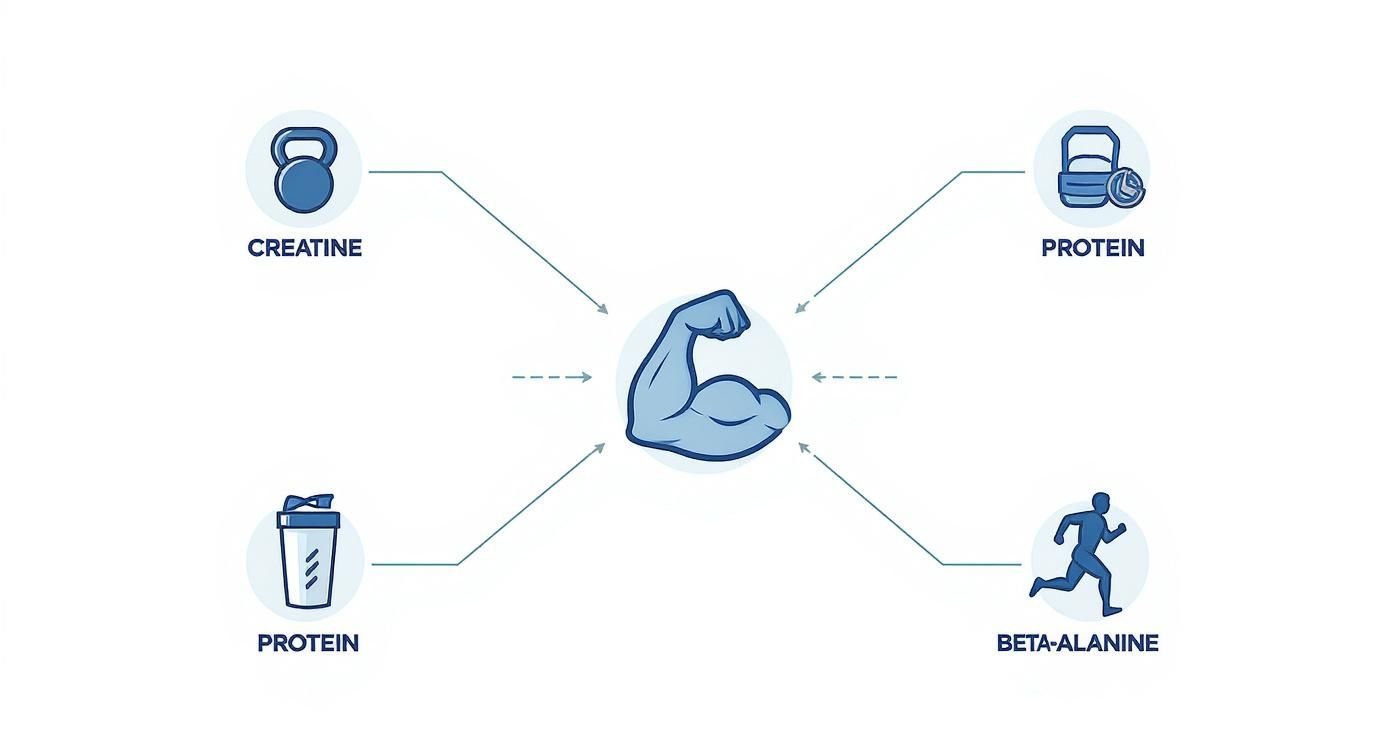
As you can see, the goal might be singular—stronger, healthier muscles—but the paths to get there are diverse.
Stacking for the Aging Athlete
For anyone training over 40, the game changes again. Building muscle is still the goal, but preserving it becomes just as critical. The body’s natural decline in muscle protein synthesis means you have to be more strategic to stay in a muscle-building state.
Key Insight: As we age, our bodies just don't respond to training and protein the way they used to. A smart supplement stack can help level the playing field by improving protein synthesis and fighting off muscle breakdown.
A stack designed for longevity and performance might look like this:
- HMB (3g daily): This is a star player for preventing muscle breakdown (catabolism), which becomes a much bigger threat as we get older.
- High-Leucine Protein Blend (30-40g): Leucine is the amino acid that flips the switch for muscle growth. Older adults often need a higher dose of it to kickstart that process effectively.
- Vitamin D3 & Calcium: These are absolute fundamentals. They're critical for maintaining bone density and supporting muscle function, helping you stay active and injury-free for the long haul.
This targeted approach addresses the unique physiology of the aging athlete, helping you maintain strength and function for years to come. By tailoring your stack, you turn general knowledge about muscle building supplements into a precise, personal strategy.
How to Read Labels and Choose Quality Products
Walking into the supplement aisle can be overwhelming. You're faced with a wall of products, all screaming bold promises from their labels. So, how do you know what actually works and what’s just expensive powder in a fancy tub?
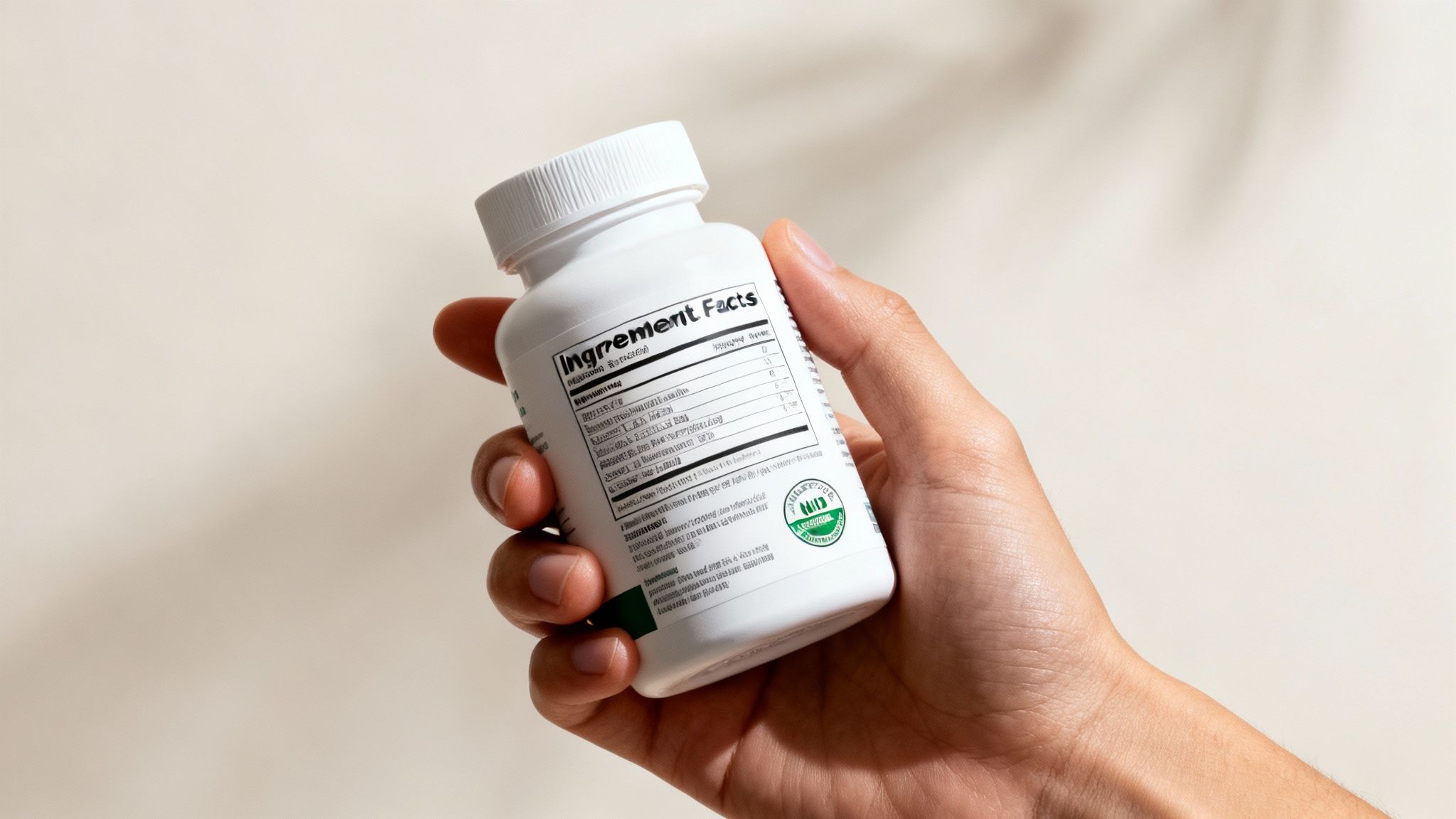
The secret isn’t in the flashy marketing on the front; it’s in knowing how to decipher the "Supplement Facts" panel on the back. Once you learn to read that story, you can make informed choices based on evidence, not hype. Trust me, both your wallet and your muscles will thank you.
This is a massive industry. Valued at roughly $15 billion in 2025, the global muscle-building supplement market is projected to grow by about 7% per year through 2033. With that much money on the line, being a smart consumer is more critical than ever. You can dig deeper into this growing market at Archive Market Research.
Decoding the Supplement Facts Panel
The first thing I always look for is total transparency. The label should clearly list every single active ingredient and its specific dose in milligrams (mg) or grams (g). No exceptions. This allows you to check if the amounts match up with what clinical research has shown to be effective.
Now, let's talk about the biggest red flag in the entire industry: the proprietary blend. This is a sneaky tactic where a company lumps a bunch of ingredients under a cool-sounding name but doesn't tell you how much of each is included.
A "proprietary blend" is almost always a way to hide that the effective (and expensive) ingredients are just sprinkled in, while the rest of the mix is cheap filler. If a company won’t tell you exactly what’s in their product, you shouldn’t give them your money.
The Gold Standard: Third-Party Testing
Here's a hard truth: the supplement industry isn't tightly regulated. That means quality can be all over the place. A third-party certification is your best insurance policy—it’s an independent verification that what’s on the label is actually what’s in the bottle.
These testing organizations also screen for harmful contaminants, heavy metals, and banned substances. For any competitive athlete who undergoes drug testing, this isn't just a nice-to-have; it's an absolute necessity.
Keep an eye out for these logos on the packaging:
- NSF Certified for Sport: This is the top tier. It screens for over 270 banned substances and confirms the label's accuracy.
- Informed-Sport / Informed-Choice: These programs test every single batch of a product for prohibited substances before it ever hits the shelf.
Seeing one of these seals means you can trust the product is safe, pure, and accurately dosed.
A Quick Checklist for Vetting Brands
When you're sizing up a new supplement, run it through this simple checklist. It’s my go-to process for cutting through the noise.
- Transparent Labeling: Does it clearly list the dose for every active ingredient? Or is it hiding behind a proprietary blend?
- Effective Dosages: Are the key ingredients—like creatine at 3-5g—included at research-backed levels?
- Third-Party Certification: Is it certified by a reputable group like NSF or Informed-Sport?
- Minimal Extra Ingredients: Is the formula clean, or is it loaded with artificial sweeteners, colors, and other junk? A clean ingredient list is just as important here as it is for hydration, which you can read about in our electrolyte powder comparison guide.
Stick to these guidelines, and you'll be able to confidently choose high-quality supplements that will actually help you reach your goals.
Your Step-by-Step Supplement Action Plan
Alright, we've covered a ton of ground. But information is useless unless you act on it. This is where the rubber meets the road—a simple, practical roadmap to turn all this knowledge into real-world results. This isn't about running out and buying every bottle on the shelf. It’s about being smart and strategic to amplify the hard work you're already putting in.
Think of this as your personal blueprint for adding supplements to your routine the right way. We'll walk through a logical sequence, from looking in the mirror to tracking your progress, making sure every step you take is a step forward.
Step 1: Start With a Personal Audit
Before a single scoop of anything crosses your lips, you need to take an honest look at your foundation. Are you actually showing up and training hard, consistently? Is your diet dialed in with enough protein and calories to even allow for growth?
Here’s your first task: track your training and nutrition for one full week. I mean everything. This data is gold because it will show you exactly where the holes are. And you have to fill those holes with food and better habits first. Remember, muscle building supplements are gap-fillers, not crater-fillers. They can’t fix a broken plan.
Step 2: Define Your Primary Objective
What’s the one thing you’re trying to achieve right now? Your answer here dictates everything that follows. Vague goals like “get bigger” are a recipe for a scattered, ineffective approach.
You have to get specific. For example:
- "I want to add 20 pounds to my squat in the next 12 weeks." Okay, now we're talking. This immediately points toward supplements that support strength and power, like creatine.
- "I want to gain 5 pounds of lean mass over the next six months." This goal screams for consistent, high-quality protein intake and solid recovery support.
- "I need to hang onto my muscle while I’m in a cutting phase." This suggests looking at anti-catabolic options like HMB to protect your hard-earned gains.
A crystal-clear goal is your filter. It stops you from wasting money on things that don't directly serve that mission. Pick one primary objective to start.
Step 3: Choose Your Foundational Supplement
With your objective locked in, it’s time to choose just one or two core supplements that directly support it. Fight the urge to build a massive, complicated stack from day one. By starting simple, you can actually tell how your body is responding to each new addition.
For the vast majority of people chasing muscle and strength, the best places to start are almost always:
- Creatine Monohydrate: The undisputed king for boosting performance and raw strength in the gym.
- Whey or Plant-Based Protein Powder: A ridiculously convenient tool for hitting your daily protein numbers and fast-tracking recovery after a workout.
By focusing on the proven, foundational supplements first, you're putting your money on what actually works. These have decades of science behind them and will give you the biggest bang for your buck.
Step 4: Implement and Track Everything
Progress is powered by consistency. It’s that simple. Once you’ve picked your supplement, build it into your daily routine and do not miss a day. Set a reminder on your phone or tie it to something you already do without thinking, like making your morning coffee.
And here’s the most critical part: track your results. You have to measure the things that matter for your specific goal. That could be your body weight, your numbers on key lifts, or tape measurements of your arms and legs. Cold, hard data is the only way you’ll ever know if what you’re doing is actually working. Supplements are just a tool; your relentless consistency is what really builds the physique you're after.
Your Top Supplement Questions, Answered
Let's be honest, the world of muscle-building supplements can feel like the Wild West. It’s a maze of marketing hype and conflicting advice, and it's completely normal to have questions. This section is designed to clear the air.
We're going to cut through the noise and give you direct, evidence-based answers to the big questions we hear all the time. Think of this as your go-to FAQ for making smart, confident decisions about your supplement strategy.
Are Muscle-Building Supplements Safe for Long-Term Use?
This is easily the most important question, and the answer is a qualified "yes." For most healthy people, foundational supplements like creatine monohydrate and high-quality whey protein are considered very safe for long-term use. We're talking about ingredients backed by decades of solid scientific research.
However, safety always hinges on two things: you and the product. If you have any pre-existing health conditions, especially related to your kidneys or liver, it's non-negotiable to talk to your doctor before starting any supplement plan.
The biggest safety risk often isn't the main ingredient itself, but what else is in the bottle. Always, always look for products that have been third-party tested by an independent lab like NSF or Informed-Sport. This is your only real assurance that the product is pure, free of contaminants, and actually contains what the label says it does.
How Long Until I Actually See Results?
Everyone wants to know when they'll start seeing changes in the mirror. The truth is, supplements work on different schedules, and they're entirely dependent on your training and nutrition consistency. They are amplifiers, not magic pills. They magnify the results of your hard work.
Some effects pop up pretty quickly. Take creatine, for example. As your muscles become fully saturated, you might notice a real difference in your strength and power in the gym within just a couple of weeks. You'll be able to squeeze out an extra rep or add a little more weight to the bar, which is what drives progress.
Other supplements play the long game. Protein powder is all about consistently feeding your muscles the building blocks they need to repair and grow over time. You won’t "feel" it working after you drink a shake, but over months, that consistent supply of amino acids is what leads to visible changes in muscle size and definition.
Can I Build Muscle Without Any Supplements?
Absolutely. 100% yes. Let’s get this straight: supplements are optional tools, not the price of admission for building a great physique. The real cornerstones of muscle growth will always be a smart, challenging training program, a diet that provides enough protein and calories, and getting enough sleep to recover.
Countless people have built incredible strength and lean mass by focusing solely on those fundamentals. Whole foods must always be your base. Supplements just step in to make the process a bit more convenient or efficient.
- To Fill Gaps: A protein shake is a lifesaver when you're rushing between work and the gym and can't get a proper meal in.
- To Boost Performance: Creatine can give you a measurable edge in strength and power that’s very difficult to get from food alone.
- To Aid Recovery: The right supplements might help you bounce back a little faster, letting you hit your next workout with more intensity. For those interested in more advanced recovery and hormone support, the concepts discussed in our article on human growth hormone supplements offer a deeper dive.
Think of it this way: supplements can help take you from 90% to 100%, but they can’t do the heavy lifting required to get you to that 90% in the first place. That part is all you.
At Revolution Science, we formulate clean, research-backed supplements to support your hard work, not replace it. Our products are transparently dosed and third-party tested to ensure you get exactly what you need to perform at your best. https://rvsci.com