
Your Cart is Empty


Best Supplements for Athletic Performance
When it comes to athletic performance, the right supplements are game-changers, not magic pills. A handful of proven compounds, backed by solid science, can deliver real results when you need them most. We’re talking about tools like creatine monohydrate for raw power, caffeine to crush fatigue, beta-alanine for that high-intensity burn, and protein to rebuild and repair.
These aren't shortcuts. They work best when layered on top of a rock-solid foundation of smart training and dialed-in nutrition.
Your Guide to Performance Enhancing Supplements
Stepping into the world of sports nutrition can feel like navigating a minefield. Flashy labels and bold promises are everywhere, making it nearly impossible to tell what actually works from what’s just expensive dust. This guide is here to cut straight through that noise.
We’re focused on clear, evidence-based answers that give you a genuine competitive edge. Think of supplements as strategic amplifiers for all the hard work you’re already putting in. A well-timed scoop can be the difference-maker that helps you smash through a plateau, bounce back faster from a brutal workout, or lock in your focus when it counts.
Understanding the Landscape
The demand for these products is absolutely massive. The global sports supplement market was valued at around USD 25.3 billion in 2025 and is on track to hit a staggering USD 43.6 billion by 2032. You can see the market growth projections for yourself. This explosion reflects a worldwide movement towards fitness and athletic participation, but it also means the market is flooded with options, making informed choices more critical than ever.
At its core, a smart supplement strategy is about efficiency. It’s about giving your body the specific resources it needs, exactly when it needs them, to perform at its peak and recover effectively.
To make things simple, we’ll kick things off with a quick-reference table that summarizes the most trusted and effective supplements out there. This will give you an at-a-glance look at what each one does and who it's for.
Top Evidence-Backed Supplements for Athletes at a Glance
Here’s a quick rundown of the heavy hitters in the world of sports supplements. This table highlights the compounds that have consistently stood up to scientific scrutiny, delivering measurable benefits for dedicated athletes.
| Supplement | Primary Benefit | Best For |
|---|---|---|
| Creatine Monohydrate | Increases power output and muscle mass | Strength, power, and sprint athletes |
| Caffeine | Reduces perceived effort and fatigue | All athletes needing a performance boost |
| Beta-Alanine | Buffers muscle acid, delaying fatigue | High-intensity efforts (1-4 minutes) |
Think of this as your cheat sheet. From here, we'll dive deep into the science behind each one, breaking down how they work, the right way to dose them, and how to apply them to your specific sport. This structured approach will arm you with the knowledge to build a safe and effective plan tailored to your personal goals.
The Power Trio for Explosive Performance
If you were to build a superhero team of athletic supplements, three names would always be at the top of the roster, backed by decades of research and countless real-world wins. This is the power trio: Creatine Monohydrate, Caffeine, and Beta-Alanine. They represent the gold standard for anyone looking to boost explosive strength, sharpen their focus, and push high-intensity endurance to the limit.
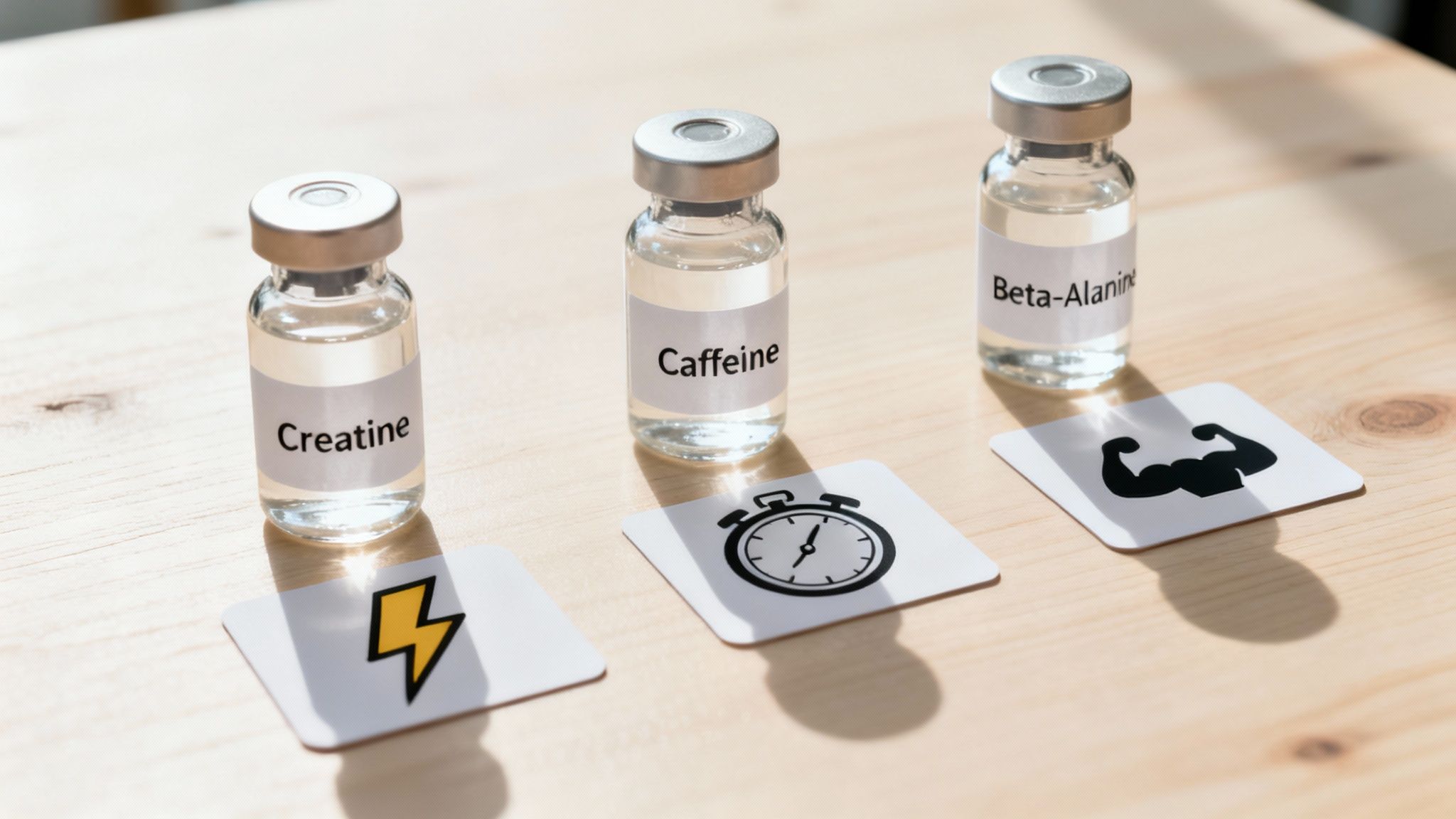
These compounds aren’t just hype; they're among the most rigorously studied ergogenic aids you can get your hands on. Each one works through a unique biological pathway to give you a measurable edge. Let’s break down exactly how each one helps make you a better, more powerful athlete.
Creatine Monohydrate: The ATP Recycler
Think of your muscles having a small, super-charged battery specifically for all-out efforts like a heavy deadlift or a 100-meter sprint. This battery is called ATP (adenosine triphosphate). The only problem? You’ve only got about 10 seconds of charge before it’s completely drained.
This is where creatine comes in. It acts as your body's personal ATP recycling system. It donates a phosphate molecule to rapidly recharge spent ATP, turning it back into immediate, usable energy. This lets you sustain maximum power for just a few seconds longer—often the exact difference between a new PR and a failed attempt.
This simple mechanism is why creatine is a non-negotiable staple for many of the world's strongest athletes. You can see how a well-formulated pre-workout, which often includes creatine, can benefit Olympic weightlifters and power athletes who live and die by this energy system.
Key Takeaway: By rapidly regenerating the body's primary energy currency for explosive movements, creatine directly translates to improved strength, more reps per set, and faster sprint times.
Who Benefits Most?
- Strength Athletes: Powerlifters and weightlifters can expect to move heavier loads for more reps.
- Team Sport Athletes: Football, basketball, and hockey players who rely on repeated, short bursts of intense activity.
- Sprinters: Track cyclists and runners who need maximum power right out of the blocks.
A common and proven protocol involves a loading phase of 20 grams per day (split into four 5-gram doses) for 5-7 days, followed by a maintenance dose of 3-5 grams per day. You can also skip the load and just take 3-5 grams daily; it’ll just take about three to four weeks to fully saturate your muscles.
Caffeine: Your Central Nervous System Ally
Caffeine is the most widely used performance-enhancer on the planet, and for good reason. It works primarily as a ‘central nervous system ally,’ basically tricking your brain into feeling less tired and less pain.
It does this by blocking adenosine, a neurotransmitter that tells your brain you're getting drowsy. By getting in the way, caffeine keeps you feeling alert, focused, and energized. More importantly for athletes, it significantly lowers your rate of perceived exertion (RPE). This means a tough workout physically feels easier, letting you push harder and longer before your mind tells you to quit.
This effect makes caffeine one of the most versatile supplements out there, helping everyone from marathoners to those chasing a max-effort lift.
Beta-Alanine: The Muscle Fatigue Buffer
Ever felt that intense burning sensation in your muscles during a gut-wrenching set or a final all-out sprint? That's metabolic acidosis—an accumulation of hydrogen ions that drops your muscle pH and kills your ability to contract forcefully.
Beta-alanine acts as a direct muscle fatigue buffer. Your body uses it to produce carnosine, a compound that soaks up these performance-killing hydrogen ions like a sponge. By boosting your muscle carnosine levels, beta-alanine helps you maintain a more optimal pH, allowing you to sustain high-intensity work for longer.
Think of it as adding a few extra reps to your set or holding your top speed for just a few more crucial seconds. It doesn’t give you energy directly; it delays the onset of the muscular fatigue that forces you to stop.
Dosing and What to Expect
- Effective Dose: To really boost muscle carnosine, a daily dose of 3.2–6.4 grams is the sweet spot.
- Saturation Period: Just like creatine, beta-alanine needs to build up. You’ll need at least four weeks of consistent use to feel the effects.
- The "Tingles": A common, harmless side effect is a tingling sensation called paresthesia. Splitting your daily dose into smaller amounts (like 1.6 grams twice a day) can help minimize this.
For athletes in events lasting one to four minutes—like 400-meter runners, competitive swimmers, or CrossFitters—beta-alanine can be a game-changer by directly fighting the primary cause of fatigue in that time frame.
Building Your Engine for Recovery and Endurance
While explosive power gets a lot of the glory, championships are often won on the back of superior recovery and relentless endurance. To build a truly resilient athletic engine, you have to focus on the foundations that keep you going strong, workout after workout. Here, we're shifting gears from short-burst power to the supplements that help repair muscle, boost oxygen delivery, and lock in the hydration you need for long-haul performance.
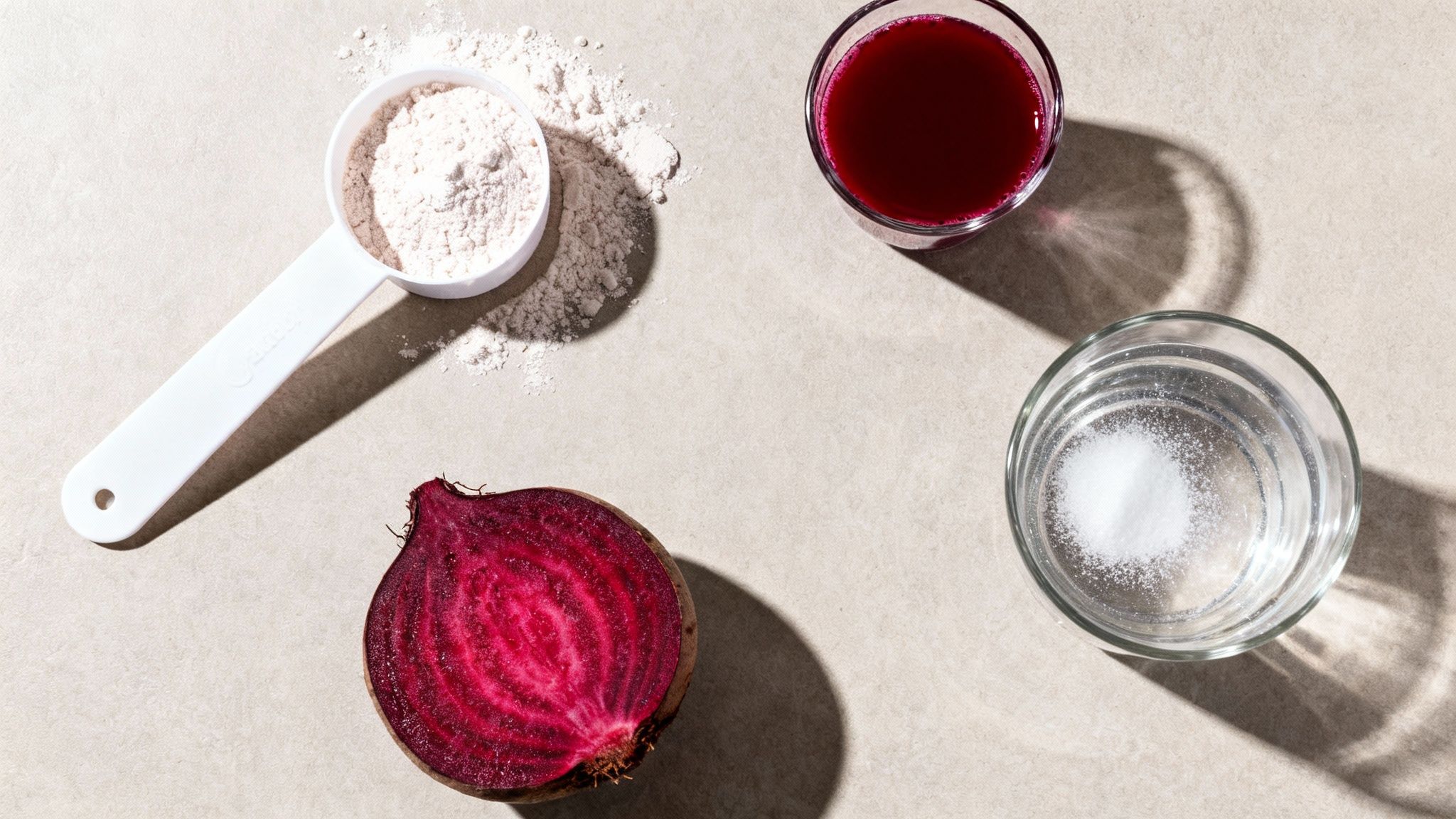
This is all about constructing the support system that allows your high-performance machinery to function day in and day out. We'll get into the literal building blocks of muscle, the secret weapons for better blood flow, and the essential minerals that keep your internal systems firing on all cylinders.
Protein and Amino Acids: The Building Blocks of Recovery
Think of your muscles as a brick wall. Every tough training session chips away at it, causing tiny bits of damage. Protein and its component parts, amino acids, are the mortar and fresh bricks you need to not only repair that wall but build it back even stronger. That whole process is called muscle protein synthesis, and it's the physical mechanism behind every bit of adaptation and growth you earn.
If you don't have an adequate supply of these building blocks, your body simply can't repair itself effectively. The result? Lingering soreness, slow recovery, and a frustrating plateau in your strength and endurance gains. It’s no wonder protein and amino acid supplements are a cornerstone of sports nutrition, dominating the market as athletes everywhere use them to fuel muscle growth and slash recovery time.
Choosing Your Protein Source
- Whey Protein: This is a fast-digesting, milk-derived protein that's packed with leucine—the key amino acid that flips the switch on muscle protein synthesis. It's the perfect choice for a post-workout recovery shake.
- Casein Protein: Also from milk, casein is the polar opposite of whey. It digests very slowly, feeding your muscles a steady stream of amino acids over several hours. This makes it an excellent option right before bed to support repair while you sleep.
- Plant-Based Proteins: Options like soy, pea, and rice protein are fantastic for vegan athletes or anyone with a dairy sensitivity. Just look for blends that combine a few different sources to make sure you're getting a complete amino acid profile.
For a much deeper dive into optimizing your recuperation, our guide on supplements for muscle recovery covers all the bases.
Nitrates: The Blood Flow Enhancers
For any endurance athlete, oxygen is currency. The more efficiently you can pump oxygen-rich blood to your working muscles, the longer and harder you can go. This is exactly where nitrates come in, acting as powerful "blood flow enhancers."
When you get nitrates from foods like beetroot juice or leafy greens, your body converts them into a molecule called nitric oxide. This molecule tells your blood vessels to relax and widen—a process known as vasodilation.
Think of it like swapping out the old, narrow plumbing in your house for wider pipes. This bigger diameter allows more blood to flow through with less resistance, supercharging the delivery of oxygen and nutrients while also clearing out metabolic junk more efficiently.
This boost in efficiency means your muscles can produce the same amount of power while using less oxygen, which effectively lowers the energy cost of your exercise. For a marathoner or cyclist, that translates directly to better stamina and a much stronger finishing kick.
Electrolytes: The Body's Electrical System
Hard work means sweat, and sweat is a lot more than just water. It’s loaded with critical minerals we call electrolytes—specifically sodium, potassium, magnesium, and calcium. These minerals are non-negotiable for managing your body's fluid balance, nerve signals, and muscle contractions.
Losing too many electrolytes without replacing them is a surefire way to kill your performance. This kind of imbalance can trigger:
- Debilitating muscle cramps
- A noticeable drop in power output
- Mental fog and a loss of focus
- In severe cases, dangerous dehydration
Just chugging plain water during a long or intense workout won't cut it. In fact, it can dilute the electrolytes you have left, making the problem even worse. This is why a strategic replacement plan is a non-negotiable part of any serious athlete’s playbook.
By strategically hydrating with a product like REVSCI’s Reviver Electrolytes, you turn a basic need into a serious performance tool. You're putting back exactly what you lose through sweat, ensuring your body's internal communication lines and muscle function stay dialed in. This keeps cramps at bay and helps you maintain a high output from start to finish—something that becomes absolutely critical during long endurance events or when training in the heat. Properly managing your electrolytes is one of the biggest keys to unlocking your true endurance potential.
Building Your Sport-Specific Supplement Stack
Knowing what individual supplements do is one thing. Knowing how to stack them strategically for your sport is where you find your edge. There’s no universal “best” stack—what a powerlifter needs to thrive looks completely different from what a marathon runner requires to go the distance. Your goals, your training load, and the specific energy systems you tax day-in and day-out should be the architects of your supplement plan.
This is about moving beyond a one-size-fits-all approach and building a personalized game plan. We’ll lay out some sample protocols for three distinct athlete profiles, showing you exactly what to take and when to take it for maximum impact.
The Strength Athlete Stack
For athletes measured by pure, explosive power—think weightlifters, sprinters, and football linemen—the game is all about maximizing force production and recovering fast between brutal sessions. The supplement stack needs to directly fuel the ATP-PC energy system, the high-octane fuel source for those short, all-out bursts of effort.
A typical daily protocol might look like this:
- Pre-Workout (30-60 minutes before): A dose of 200-300 mg of caffeine is a game-changer for blunting the feeling of effort and sharpening focus for a heavy lift. Pair this with 3.2-6.4 grams of beta-alanine (a daily habit to build up muscle carnosine) to fight off that burning fatigue during higher-rep sets.
- Intra-Workout: If your session is pushing past the 90-minute mark, sipping on 5-10 grams of Essential Amino Acids (EAAs) can be a smart move to prevent your body from breaking down hard-earned muscle tissue for fuel.
- Post-Workout (within 60 minutes after): This window is absolutely critical. Getting in 5 grams of creatine monohydrate (assuming you're on a maintenance dose) plus 25-40 grams of a fast-acting protein like whey isolate will kickstart the muscle repair process and slam the door on muscle breakdown.
The Endurance Athlete Stack
Marathoners, cyclists, and triathletes live and die by their aerobic efficiency and ability to resist fatigue. For them, supplementation is all about maintaining hydration, ensuring a steady stream of energy, and making the body better at using oxygen over the long haul.
The name of the game for endurance is sustainability. Your stack is there to prevent the classic performance killers: dehydration, electrolyte depletion, and bonking from empty glycogen stores.
Here’s a look at an endurance-focused plan:
- Pre-Workout (30-60 minutes before): Taking 300-500 mg of nitrates, often from beetroot extract, can seriously improve blood flow and how efficiently your muscles use oxygen. A lower dose of 100-200 mg of caffeine can also help reduce how hard an effort feels without making you feel jittery on a long run.
- Intra-Workout: This is non-negotiable for any serious endurance effort. You need to be taking in 30-60 grams of carbohydrates per hour and consistently sipping an electrolyte solution like REVSCI’s Reviver Electrolytes to replace the crucial minerals you’re losing through sweat.
- Post-Workout (within 60 minutes after): Recovery here is all about replenishment. A shake with a 3:1 or 4:1 ratio of carbohydrates to protein is the gold standard for rapidly restocking spent muscle glycogen while also providing the building blocks for repair.
For a deeper dive specifically for runners, check out our complete guide on the best supplements for runners.
The Hybrid Athlete Stack
The hybrid athlete—like a CrossFit competitor, soccer player, or basketball player—has a unique problem to solve. They need explosive power and the gas tank to keep going. Their supplement strategy has to be just as versatile, supporting both high-intensity bursts and the ability to recover on the fly.
This requires a smart blend of tactics from both the strength and endurance playbooks.
- Pre-Workout (30-60 minutes before): A powerful foundation can be built with a daily stack of 3-5 grams of creatine, 3.2 grams of beta-alanine, and 200 mg of caffeine. This combo supports both immediate power and the capacity to do more work over time.
- Intra-Workout: During a long, grinding WOD or a tough match, a mix of electrolytes and fast-digesting carbs is essential for keeping energy levels topped off and holding off cramps.
- Post-Workout (within 60 minutes after): To cover all your bases, a recovery shake with 25-30 grams of protein and 30-50 grams of carbs is perfect. It drives muscle repair and refills the energy tanks so you're ready for whatever comes next—a non-negotiable for the hybrid athlete's demanding schedule.
Sample Supplement Protocols by Athlete Type
To make this crystal clear, let's look at how these daily protocols stack up side-by-side. Think of this as a starting template you can adjust based on your specific training demands, schedule, and how you feel.
| Timing | Strength Athlete Protocol | Endurance Athlete Protocol | Hybrid Athlete Protocol |
|---|---|---|---|
| Pre-Workout | 200-300 mg Caffeine, 3.2-6.4 g Beta-Alanine | 300-500 mg Nitrates, 100-200 mg Caffeine | 200 mg Caffeine, 3.2 g Beta-Alanine |
| Intra-Workout | 5-10 g EAAs (for sessions > 90 min) | 30-60 g Carbs/hr, Electrolytes | Electrolytes, Fast-Digesting Carbs |
| Post-Workout | 5 g Creatine, 25-40 g Protein | 3:1 or 4:1 Carb-to-Protein Shake | 30-50 g Carbs, 25-30 g Protein |
| Daily Habit | 3-5 g Creatine | (As needed based on training) | 3-5 g Creatine |
Remember, this table illustrates a single day's timing. Supplements like creatine and beta-alanine require consistent daily intake to be effective, regardless of whether it's a training day or a rest day. Use this as your guide, listen to your body, and dial in the perfect stack that helps you perform at your absolute best.
How to Choose Safe and Effective Supplements
In the world of athletic performance, what’s inside your shaker cup matters just as much as the weight on the bar. But let's be honest, the supplement market is a crowded and often confusing space. Becoming a savvy consumer isn't just about boosting your performance—it’s about protecting your health and making sure you get exactly what you paid for.
Navigating this landscape starts with one non-negotiable rule: third-party certification. Think of it as an independent quality check that verifies a product’s purity and what the label claims. In an industry where regulations can be frustratingly loose, these certifications are your best defense against contaminants, banned substances, and sketchy dosages.
Decoding Certifications and Labels
When you're looking for the best supplements for athletic performance, your eyes should immediately scan for these gold-standard seals of approval. They're proof that a product has been put through the wringer for quality and safety.
- NSF Certified for Sport: This is one of the most respected certifications out there. It verifies that the product actually contains what the label says it does, has been tested for nasty contaminants, and is screened for over 270 substances banned by major athletic organizations.
- Informed-Sport: This is a global program that takes things a step further by testing every single batch of a product before it ever hits the shelf. If you see this logo, you know that supplement has been thoroughly screened for a huge range of substances prohibited in sports.
Beyond the seals, you need to learn to read a supplement label like a pro. One of the biggest red flags to watch for is the “proprietary blend.” This is a sneaky trick that lets companies hide the exact amounts of each ingredient under a single combined weight. More often than not, it means the key, effective ingredients are underdosed and padded out with cheap fillers. A transparent label will always list each ingredient and its precise dosage.
A truly effective supplement doesn't need to hide behind vague blends or marketing hype. The best brands, like REVSCI, prioritize transparency, letting their clean, science-backed formulas speak for themselves.
Prioritizing Purity and Clean Ingredients
Choosing clean supplements means ditching all the unnecessary junk that does nothing for your performance. Look for products that are free from artificial flavors, sweeteners, and fillers. This commitment to purity ensures you’re fueling your body with only what it needs to excel.
For instance, many athletes are discovering how clean formulas can do more than just build muscle—they can also support other critical functions, like hormonal balance. You can explore how some supplements support natural processes in our guide on HGH supplements.
As athletes get smarter, product formats are evolving, too. With over a third of supplement users taking products daily, convenience has become key. This has pushed brands toward more palatable options. Gummies, for example, saw their market share rocket from 2% to 17% between 2020 and 2025.
The timeline below gives you a clear picture of how a hybrid athlete might structure their supplement intake for the best possible results.
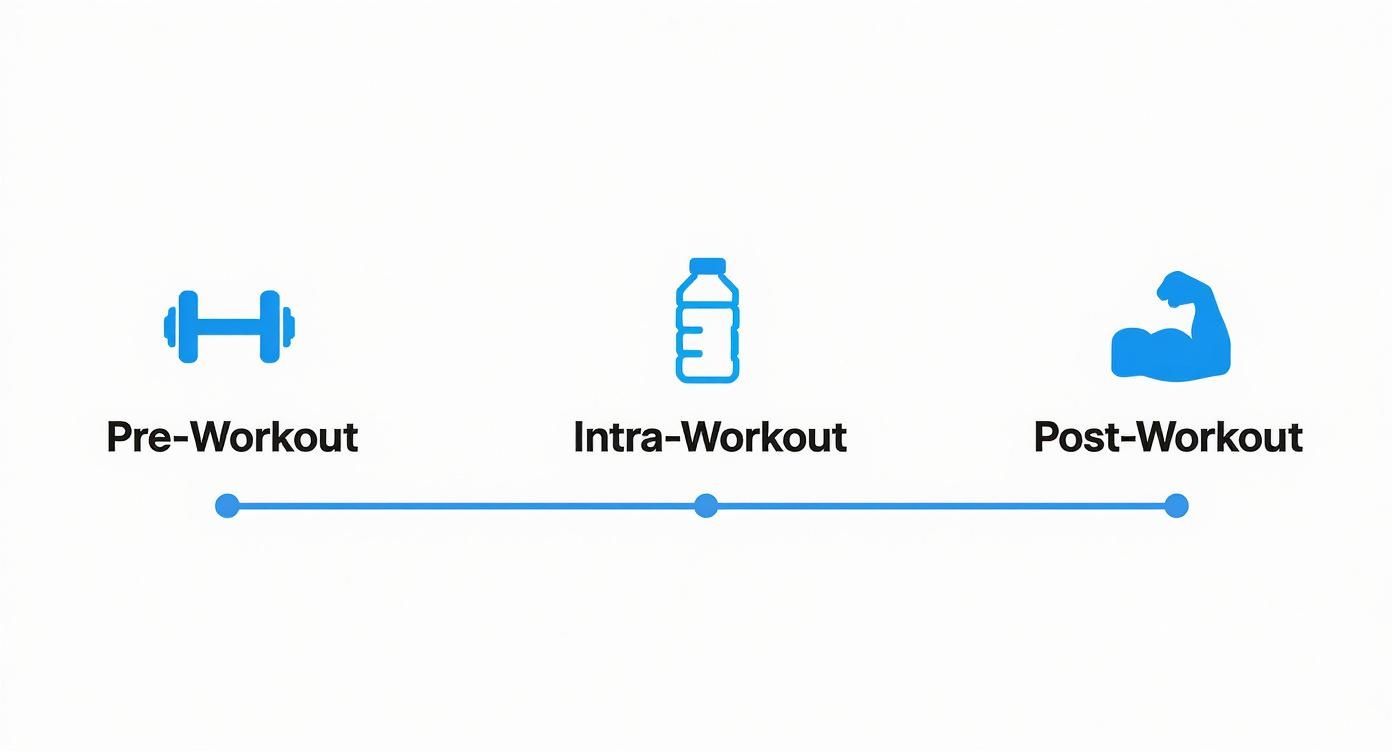
This visual guide breaks down the strategic timing for pre-, intra-, and post-workout supplementation to maximize your energy, hydration, and recovery.
Creating Your Strategic Performance Blueprint
Let’s bring this all home. The best supplements are powerful tools, but they aren't magic bullets. A truly effective strategy is always built on the non-negotiables: consistent training, smart nutrition, and dedicated recovery. These are the absolute pillars of your success.
Only when that foundation is rock solid should you even think about layering in proven performance enhancers. Your blueprint is about adding specific supplements to solve specific problems—fueling your engine for the brutal work ahead.
The Systematic Approach to Stacking
Start with the essentials that directly support your goals. For most athletes, that means locking down foundational support from protein for repair and electrolytes for hydration. From there, you can strategically introduce high-impact compounds like creatine or beta-alanine to target power output or muscular endurance.
The key is to build your stack methodically. Introduce only one new supplement at a time and give it at least two to four weeks to see how your body responds. This disciplined approach eliminates the guesswork and lets you gauge its true impact on your performance and recovery.
Your supplement plan shouldn't be about chasing trends or piling on products. It's about building a sustainable, personalized system that directly supports long-term athletic progress and helps you consistently perform at your best.
Core Principles for Your Blueprint
As you dial in your strategy, never lose sight of these core principles:
- Foundation First: Supplements amplify hard work; they don’t replace it. Period.
- Start Slow: Introduce one new element at a time to isolate its effects and see if it's actually working for you.
- Be Patient: Compounds like creatine and beta-alanine aren't a one-and-done deal. They require weeks of consistent use to build up in your system and become effective.
- Prioritize Purity: Always choose third-party tested products. This is your only guarantee that what's on the label is what's actually in the bottle.
Following this systematic process creates a powerful, customized blueprint for smashing your goals and achieving peak potential.
Frequently Asked Questions
You've got the big picture, but the world of supplements is all about the details. Getting the timing, stacking, and expectations right is what separates a good strategy from a great one. Let’s dial in some of the most common questions athletes have so you can build your plan with confidence.
Think of this as your final check-in before putting your blueprint into action. We’ll cover the nitty-gritty to make sure you’re getting the most out of every single scoop.
Do I Need to Cycle Supplements Like Creatine?
The idea of "cycling"—taking something for a while, then stopping—gets thrown around a lot, especially with creatine. But for good old creatine monohydrate, the science is crystal clear: cycling is not necessary.
Unlike some stimulants where your body might build a tolerance, creatine works by filling up your muscles. Once they’re fully saturated, a simple, consistent daily maintenance dose of 3-5 grams keeps them topped off. There’s no evidence that taking a break offers any extra benefit, and countless long-term studies have confirmed it's perfectly safe for continuous, daily use. So, just keep it simple and consistent.
How Can I Safely Stack a Pre-Workout?
Stacking multiple supplements can be a fantastic way to customize your approach, but you need to be smart about it—especially with pre-workouts that already contain stimulants like caffeine. The whole game is about avoiding overlap and hitting effective doses without going overboard.
Here’s a simple way to think about building a smart stack:
- Know What’s in the Tank: First thing’s first, read the label on your pre-workout. Get familiar with the exact amounts of key players like caffeine, beta-alanine, and citrulline.
- Spot the Gaps: Is your pre-workout giving you the full clinical dose of everything you need? For instance, a lot of formulas include just 1-2 grams of beta-alanine, but the research points to a daily dose of 3.2-6.4 grams to really see the fatigue-fighting benefits.
- Fill Gaps with Singles: Instead of just grabbing another complex formula, add what’s missing with single-ingredient products. If your pre-workout is light on beta-alanine, add a separate scoop to hit that target. This way, you get what you need without accidentally doubling down on stimulants.
Safety First: The non-negotiable rule of stacking is to watch your total stimulant intake. A good ceiling to stay under is 400mg of caffeine from all sources within a few hours. Pushing past that is a recipe for jitters, anxiety, and a nasty crash later.
How Long Until I See Results from Supplements?
This is a huge one. Setting realistic expectations is key, because not all supplements work on the same clock. They really fall into two different camps.
Immediate-Effect Supplements
These are the ones that work acutely—you feel them pretty quickly after you take them.
- Caffeine: You know the feeling. That energy and focus boost will hit you within 30-60 minutes.
- Nitrates: You can expect the blood flow and endurance benefits to kick in within 1-2 hours of taking them.
Saturation-Based Supplements
These are the long game. They need to build up in your system over time with consistent daily use. You won't feel a "kick" on day one, because their real power comes from accumulation.
- Creatine: To fully saturate your muscles and see those strength gains, you’re looking at 3-4 weeks of daily use (or about a week if you do a loading phase).
- Beta-Alanine: It takes at least 4 weeks of daily dosing to build up enough carnosine in your muscles to really start buffering that burn and fighting off fatigue.
Understanding this difference is everything. Have patience with the saturation-based players—their powerful, long-term effects are the reward for your consistency.
Ready to build your performance blueprint with clean, effective, and transparently-dosed supplements? Revolution Science provides the foundational tools you need to fuel your ambition without the fillers or hype. Explore our research-backed formulas at https://rvsci.com.