
Your Cart is Empty


Best Supplements for CrossFit to Maximize Performance
The best supplements for CrossFit are the ones that directly support the sport's brutal demands: strength, endurance, and the ability to recover before the next day's WOD. The non-negotiables? Protein powder to rebuild muscle, creatine monohydrate for that explosive power, electrolytes to stay hydrated and firing, and caffeine for a pre-workout kick. A smart approach always starts with these foundational pieces.
Building Your Ultimate CrossFit Supplement Stack
Walking into the supplement aisle can feel a lot like staring at a WOD you’ve never seen before—a little intimidating, with way too many moving parts. But the goal isn’t to stuff your gym bag with every tub and bottle on the shelf. It’s about being strategic. It's about choosing the right tools to handle the incredible physiological stress CrossFit puts on your body.
Think of your nutrition as the high-octane fuel and supplements as the performance additives. You can’t out-supplement a bad diet, period. But with a solid food foundation, the right additions can absolutely sharpen your edge, slash recovery time, and help you smash through those plateaus that have been holding you back. This guide is here to cut through the noise and focus on what actually moves the needle.
Top CrossFit Supplements At a Glance
Before we dive deep, here's a quick look at the core four supplements every serious CrossFitter should consider. Think of these as the foundational pillars of any effective stack.
| Supplement | Primary Benefit | Best Time to Take |
|---|---|---|
| Protein Powder | Muscle Repair & Growth | Post-Workout |
| Creatine | Power & Strength Output | Daily (Anytime) |
| Electrolytes | Hydration & Performance | Intra-Workout |
| Caffeine | Energy & Focus | Pre-Workout |
Getting these four dialed in will cover the vast majority of your performance and recovery needs, setting you up for success long-term.
Foundational vs. Performance Supplements
The smartest way to build your supplement protocol is to think in two distinct categories. This simple mental model keeps you from wasting money on niche products before you have the essentials locked down.
-
Foundational Supplements: These are your daily drivers. They support overall health, recovery, and your body’s ability to handle the relentless grind of training. This is where protein, electrolytes, and omega-3s live. They form the bedrock of your entire regimen.
-
Performance Supplements: These are your tactical tools, used specifically to boost your output during a workout. They provide an immediate, tangible lift in energy, power, or endurance. Creatine, caffeine, and beta-alanine are prime examples.
By building your foundation first, you guarantee your body has the raw materials it needs to repair, adapt, and get stronger. Only then should you start layering in performance enhancers to truly maximize your effort on the gym floor.
The secret to a successful supplement strategy is precision. It's not about taking more; it's about taking the right things at the right time to meet the specific demands of your training.
A Growing Demand For Targeted Nutrition
If you're looking for an edge, you're not alone. The market for CrossFit-specific supplements is booming, with growth rates hitting over 15% annually as more athletes demand nutrition tailored to their unique training. The entire global sports supplement market is on track to hit a staggering $43.6 billion by 2032, largely driven by the explosion of hybrid fitness models like CrossFit.
This trend signals a huge shift toward smarter, more informed supplement use. Athletes today want clean, effective, and science-backed products—a world away from the "mystery proprietary blends" of the past. As we get into the specifics, from replacing key minerals covered in our electrolyte powder comparison to perfectly timing your pre-workout, you’ll learn how to build a protocol that’s both safe and incredibly effective.
The Foundational Four: Building Your Supplement Base
Think about building a house. You wouldn't worry about the paint color or the fancy fixtures before you’ve poured a rock-solid foundation. It just doesn’t make sense. The same logic applies to your performance in the gym.
In the world of CrossFit nutrition, four key supplements form that unshakable base: Protein, Creatine, Electrolytes, and Omega-3 Fatty Acids.
Getting these four right isn’t just about adding more stuff to your routine. It’s about giving your body the essential raw materials it needs to handle the relentless, varied demands of CrossFit. Nail these, and every other part of your training and recovery will level up.
Protein: The Master Rebuilder
Picture your muscles after a brutal WOD. It's like a demolition crew just went through town. Muscle fibers are torn down, and now the construction crew has to come in and rebuild everything—but this time, stronger than before.
That construction crew is protein.
Protein supplies the amino acids your body uses for muscle protein synthesis (MPS), which is the scientific way of saying "repairing and growing muscle tissue." Without enough protein, your body simply can't recover effectively. You'll hit a wall with your progress, feel sore for days, and might even start losing hard-earned muscle. For CrossFitters, adequate protein isn't a suggestion; it's a non-negotiable.
There's a reason protein supplements are everywhere. Projections show they'll make up nearly 67.4% of the entire sports supplement market in 2025, a market expected to hit $43.6 billion by 2032. The demand speaks for itself—this stuff works.
Choosing Your Protein Source
Not all protein powders are the same. The best one for you hinges on your goals, digestion, and any dietary restrictions you might have.
-
Whey Protein: This is the gold standard for a reason. It's a fast-digesting protein derived from milk and packed with leucine, a key amino acid that basically flips the "on" switch for muscle building.
- Whey Concentrate: A great all-around choice. It’s about 70-80% protein, with a little fat and carbs left in for flavor and texture.
- Whey Isolate: This is a more filtered version, with most of the lactose and fat removed. It boasts a higher protein content (90% or more) and is perfect if you're sensitive to dairy.
- Casein Protein: The other milk protein, casein is the total opposite of whey. It digests slowly, releasing amino acids steadily over several hours. This makes it a fantastic choice right before bed to fuel recovery while you sleep.
- Plant-Based Protein: For vegans or anyone avoiding dairy, modern plant-based blends are better than ever. Combinations of pea, rice, and soy protein provide a complete amino acid profile that rivals whey. If you want to dive deeper, our guide on amino acid supplements explains why getting the full spectrum is so critical.
Creatine: The Immediate Energy Reservoir
If protein is the construction crew, creatine is the rapid-recharge battery pack for your muscles. It's one of the most studied sports supplements on the planet, with hundreds of studies confirming its safety and effectiveness for high-intensity exercise.
Your body uses a molecule called adenosine triphosphate (ATP) for short, explosive bursts of energy—like a heavy clean and jerk or a max-effort box jump. The catch? You only have a few seconds' worth of ATP stored up. Creatine swoops in to help regenerate ATP incredibly quickly, letting you grind out another rep or two when you'd normally hit a wall.
By topping off your immediate energy stores, creatine monohydrate directly leads to more strength, more reps during a metcon, and faster recovery between sets.
For CrossFitters, that means being able to push harder in the moments that define your performance. The protocol is simple: take 3-5 grams of creatine monohydrate every day. No need for complicated loading phases or cycling off. Just stay consistent, and your muscles will stay saturated and ready to go.
Electrolytes: The Body’s Electrical System
You can have the most powerful engine in the world, but if the wiring is faulty, you're not going anywhere. Electrolytes—minerals like sodium, potassium, and magnesium—are your body's wiring. They carry the electrical signals that control everything from muscle contractions to nerve function and hydration.
When you're dripping sweat halfway through a WOD, you're losing more than just water. You're losing these essential minerals. This deficit can quickly lead to:
- Muscle cramping
- Premature fatigue
- A noticeable drop in power and endurance
- Brain fog and poor decision-making
Chugging plain water isn't enough to fix the problem because it doesn't replace what you've lost. Using an electrolyte supplement like Reviver Electrolytes during or after your workout keeps that internal communication system online, preserving performance and jump-starting your recovery.
Omega-3 Fatty Acids: The Inflammation Manager
Every high-performance machine needs routine maintenance to prevent long-term wear and tear. CrossFit puts a ton of stress on your joints, muscles, and nervous system, which creates inflammation. While a little bit of inflammation is a good thing—it signals the body to adapt—chronic, runaway inflammation will sabotage your recovery and health.
Omega-3 fatty acids, especially the EPA and DHA found in fish oil, are powerful anti-inflammatory agents. Think of them as the lube for your joints and the cleanup crew for systemic inflammation.
A consistent daily dose of 1-2 grams of combined EPA and DHA can help manage soreness, keep your joints feeling good, and support your body’s ability to bounce back from the daily grind. This makes omega-3s an essential piece of the puzzle for anyone serious about longevity in this sport.
Performance Boosters for Intensity and Endurance
Alright, you've built the engine with a solid nutritional foundation. Now it’s time to add the turbocharger. Foundational supplements are all about building a resilient, high-capacity machine; performance boosters are about redlining that machine when the clock starts. These are the tools you pull out tactically to crank up the intensity, stave off fatigue, and push your limits when it actually counts.
Think of your body like a high-performance car. Protein and creatine are the core components—the engine block and pistons that give it raw power and durability. But when you need an immediate burst of speed for a race, you use high-octane fuel and hit the nitrous. That's exactly what caffeine, beta-alanine, and amino acids do for a CrossFit athlete.
These are the go-to supplements when your goal is to directly impact your output right now. They sharpen your focus, buffer that all-too-familiar muscle burn, and protect your hard-earned muscle from the stress of a brutal metcon. Nailing their timing and dosage is the key to unlocking what you're truly capable of.
Caffeine: The Ultimate Pre-Workout Catalyst
Caffeine is easily the most proven, accessible, and effective performance aid on the planet. Its real magic lies in its ability to trick your brain into feeling less tired while jacking up your alertness and focus. It pulls this off by blocking adenosine, the neurotransmitter that tells your body it’s time to slow down.
During a tough WOD, this has a massive downstream effect. By lowering your rate of perceived exertion (RPE), caffeine essentially makes hard work feel easier. That soul-crushing set of 21 thrusters is still going to be brutal, but with caffeine on board, your brain's "panic" signal gets muffled, letting you push deeper into the pain cave.
To get the biggest bang for your buck, timing is everything. Take 1.8–2.7 mg per pound of body weight (that’s about 200-400mg for most people) roughly 60 minutes before your workout. This gives it plenty of time to hit peak concentration in your bloodstream right when you need it.
Caffeine is way more than just an energy jolt; it's a performance multiplier. It reduces how hard you think you're working, which allows you to sustain a higher intensity for longer—the very definition of success in CrossFit.
It's also crucial to manage your tolerance. If you’re pounding coffee all day, every day, the performance-enhancing effects can get watered down. Try cycling your caffeine intake, saving the bigger doses for your most demanding training days to keep its edge sharp. We dive deeper into the strategic use of stimulants in our article on how pre-workout powder benefits Olympic weightlifters, where timing is absolutely critical.
Beta-Alanine: The Lactic Acid Buffer
You know that deep, searing burn that creeps into your muscles during a high-rep set of wall balls or a 500-meter row? That's metabolic acidosis in action. Hydrogen ions build up, your muscle pH drops, and fatigue forces you to either slow down or stop completely.
Beta-alanine is your primary defense against that burn.
It works by boosting your body's stores of carnosine, a molecule that acts like a sponge for those acidic ions. By soaking them up, carnosine helps keep your muscle pH stable, pushing back the onset of that debilitating fatigue.
This is what allows you to squeeze out a few extra reps or hold your pace for just a little longer. It’s especially powerful for efforts that last between 30 seconds and 10 minutes—which, let's be honest, is the sweet spot for the vast majority of CrossFit metcons.
To work its magic, beta-alanine needs to build up in your system.
- How it works: Increases muscle carnosine levels to buffer the acid that causes muscle burn.
- Best for: High-intensity efforts lasting 1-10 minutes (think "Fran" or "Helen").
- Dosage: A daily dose of 3-4 grams is what you need to saturate your muscle stores over a few weeks.
- Timing: You can split the daily dose to minimize the harmless tingling sensation (paresthesia) some people feel.
Unlike caffeine, beta-alanine is not something you'll feel "kick in" right after you take it. The benefit comes from consistent, daily use over time. Think of it as a long-term investment in your muscular endurance.
EAAs and BCAAs: The Muscle Protectors
During an intense, long-duration WOD, your body can flip into a catabolic state—a fancy way of saying it starts breaking down muscle tissue for energy. That's the absolute last thing you want when you're trying to get stronger and leaner. Essential Amino Acids (EAAs) and Branched-Chain Amino Acids (BCAAs) are your insurance policy against this.
The three BCAAs—leucine, isoleucine, and valine—are particularly important because they can be used directly by the muscle for fuel. Sipping on them during a workout gives your body an alternative energy source, which helps spare your muscle tissue from being torn apart.
But while BCAAs are great, having the full spectrum of all nine EAAs is even better. It provides a more complete signal to kickstart muscle protein synthesis and repair. Think of BCAAs as your star players, but the EAAs are the entire team you need to win the game. A product like Regains is designed to deliver these crucial building blocks.
Using them intra-workout is a smart move. It fuels your performance, gets the recovery process started before the WOD is even over, and protects the muscle you’ve worked so damn hard to build.
Optimizing Your Post-Workout Recovery Protocol
The whole point of CrossFit is intensity. You break your body down so it can rebuild itself stronger, faster, and tougher than before. But here's the thing: that "rebuilding" part doesn't happen on its own. It’s an active process that demands a smart recovery plan. Just chugging a protein shake and calling it a day is like stopping a WOD one round short—you're leaving huge gains on the table.
Think of recovery as part of your training, not just the time between sessions. This is where the real adaptation happens. It means going beyond the basics and strategically using supplements that manage inflammation, keep your immune system firing, and give your body every single tool it needs to repair and grow.
The Myth of the Anabolic Window
For years, the fitness world was obsessed with the "anabolic window." Everyone lived in fear of this imaginary 30-60 minute timer after a workout, convinced that if you didn't slam a protein shake in that time, all your hard work was for nothing.
The good news? Modern science has pretty much busted that myth. While getting protein and carbs in within a few hours of training is still a great idea, you don't need to sprint to the locker room. The muscle protein synthesis (MPS) response actually stays elevated for up to 24 hours after a tough workout. The real key is hitting your total daily protein and calorie goals, consistently.
We've shifted from a frantic, 30-minute sprint to the shaker bottle to a sustained, 24-hour marathon. The new focus is on constantly providing your body with the nutrients it needs to recover and adapt, which fits a real-world schedule and still delivers incredible results.
Beyond Protein: Total Recovery Support
Once you’ve got your daily protein dialed in, the next level of recovery is all about managing the systemic stress that CrossFit puts on your entire body. This is where targeted supplements can make a massive difference in how you feel and perform the next day. A powerful approach is to bring in ingredients that directly fight inflammation and support your overall wellness.
- Tart Cherry: This powerhouse antioxidant has become a go-to for its proven ability to dial down muscle soreness and inflammation after brutal workouts. It works by fighting oxidative stress, helping you bounce back faster from those metcons that leave you seeing stars.
- Turmeric (Curcumin): Curcumin, the active compound in turmeric, is one of nature’s most potent anti-inflammatory agents. It's a game-changer for managing the joint pain and systemic inflammation that come with a high-impact sport like CrossFit.
Adding these to your routine takes your post-workout plan from simple refueling to a full-blown repair and restoration process. To go even deeper on this, check out our guide on how to recover faster after a workout for more strategies.
The Overlooked Heroes of Recovery
Some of the most critical recovery supplements fly completely under the radar. They aren't flashy, but they work in the background, shoring up the fundamental systems that let you perform at a high level day after day. For any serious CrossFitter, two of these are non-negotiable.
First up is Vitamin D. A lot of people think of it as just the "sunshine vitamin," but its role in athletic performance is huge. It’s absolutely essential for a strong immune system, which helps you stay healthy and avoid missing training days. More importantly, it’s critical for calcium absorption and bone metabolism—a must-have for anyone doing heavy barbell work and high-impact movements. Since so many people are unknowingly deficient, it’s a foundational piece for both performance and long-term durability.
Second, a complete recovery blend like Respire tackles recovery from a totally different angle. By focusing on respiratory support and cellular health, it helps ensure your entire system is running on all cylinders. Recovery isn't just about sore muscles; it's about bringing your entire body back into balance after the stress of a workout. This kind of holistic approach ensures you aren't just rebuilding muscle, but reinforcing your entire physiological foundation for the next WOD.
How to Build Smart Supplement Stacks for CrossFit
Just grabbing a random assortment of supplements and hoping for the best is like throwing plates on a barbell with your eyes closed. It’s messy, inefficient, and you're definitely not going to hit your goals. The real gains come when you start to stack supplements intelligently, matching what you take to what your workout demands that day. This is where you shift from just using supplements to using them as precision tools for performance.
A heavy back squat day and a 40-minute grinder of an AMRAP are two completely different beasts, and they demand completely different support from your body. When you tailor your supplement stack, you're giving your body exactly what it needs to perform, push through, and recover optimally. It's all about creating a synergistic effect to get the most out of every drop of sweat.
Tailoring Stacks to Your WOD
First things first: look at the whiteboard. Are you going heavy today, chasing a new one-rep max where raw strength is king? Or are you diving headfirst into a long metcon that will test every ounce of your muscular and cardiovascular endurance? That single question is the key to unlocking your supplement protocol for the day.
For example, on a heavy lifting day, your primary mission is to generate explosive power. This makes a supplement like creatine, which fuels your immediate energy system, an absolute non-negotiable. But if you're staring down the barrel of a workout like "Murph," you're fighting a long-term battle against dehydration and muscle fatigue. That's when electrolytes and beta-alanine become the heroes of the story.
Let's look at how to build these stacks.
Supplement Stacks for Different CrossFit Workouts
Building the right stack is all about matching the supplement to the specific physiological stress of the workout. This table breaks down two common scenarios you'll face in CrossFit: a day focused purely on strength and power versus a classic, high-volume endurance metcon.
| Training Goal | Pre-Workout Stack | Intra-Workout Stack | Post-Workout Stack |
|---|---|---|---|
| Strength & Power Day | Creatine (5g), Caffeine (200-400mg) | Plain Water or EAAs | Protein Powder (25-40g), Creatine (if not taken pre) |
| Endurance Metcon | Beta-Alanine (3-4g), Caffeine (200-300mg) | Electrolytes (Reviver), EAAs (Regains) | Protein Powder (25-40g), Tart Cherry |
As you can see, the approach is fundamentally different. For strength days, it's all about maximizing immediate power output and kickstarting muscle repair. For endurance WODs, the priority shifts to sustaining your performance by managing hydration and buffering that muscle burn, with recovery focusing more on taming the inflammation that comes from all that volume.
Finding Supplement Synergy
Some supplements just work better together. Think of them as power couples that create an effect far greater than the sum of their parts. Understanding these pairings can give you a serious edge.
-
Creatine & Beta-Alanine: This is the ultimate 1-2 punch for high-intensity performance. Creatine fuels those first few seconds of all-out effort, and just as that system starts to fade, beta-alanine steps in to buffer the acid that causes that burning sensation. Together, they let you go harder, for longer, across multiple rounds.
-
Caffeine & EAAs: Kicking things off with caffeine pre-workout sharpens your focus and makes the work feel a little easier. Following that up by sipping on EAAs during the session gives your muscles a direct fuel source, helping to prevent breakdown and get a head start on the recovery process before you’ve even dropped the barbell.
This simple decision tree can help you visualize how to adapt your post-workout strategy based on how your body feels.
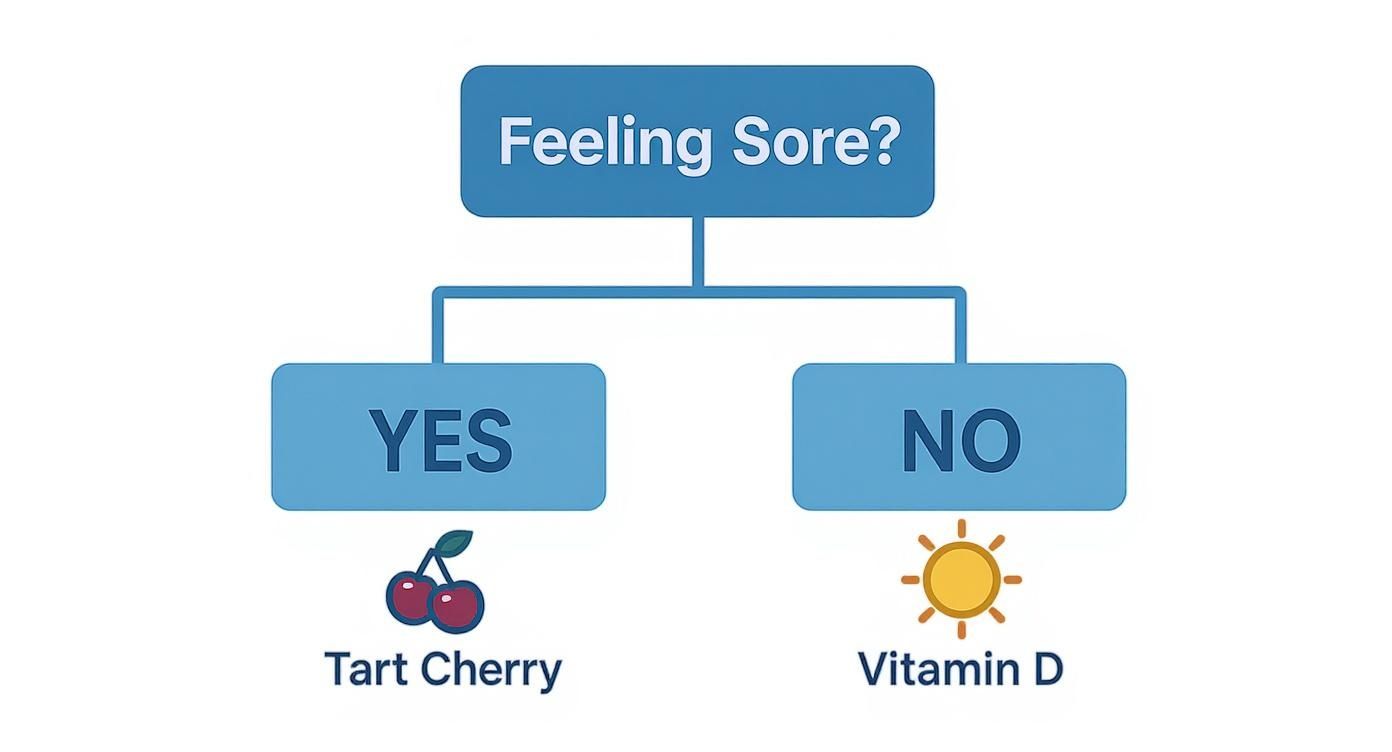
Simply put, if you’re wrecked with muscle soreness, an anti-inflammatory like tart cherry is your best move. If you're feeling pretty good, supporting your overall recovery systems with Vitamin D is a smart, proactive choice.
Putting It All Together
Let's walk through how this works in the real world with two very different WODs.
WOD 1: "LINDA" (Heavy Lifting)
10-9-8-7-6-5-4-3-2-1 reps for time of:
Deadlift: 1.5x bodyweight
Bench Press: bodyweight
Clean: 0.75x bodyweight
For this grinder, your stack is all about brute force. You'd pop some caffeine about an hour before class and make sure you’ve had your daily creatine. Afterward, a protein shake is non-negotiable to start repairing the serious muscle fiber damage from those heavy loads.
WOD 2: "HELEN" (Endurance & Speed)
3 rounds for time of:
400-meter run
21 kettlebell swings (53/35 lb)
12 pull-ups
The game completely changes here. A moderate dose of caffeine and your daily beta-alanine will still be your friends. But the MVP for this workout is hydration—you’d be sipping on Reviver Electrolytes during or right after to replace all the minerals you sweated out. Post-workout, something with tart cherry could be a lifesaver for managing the soreness that’s bound to hit from all those high-rep swings.
When you start thinking this way, your supplement cabinet stops being a random collection of tubs and becomes a targeted arsenal, ready to deploy the right tools for whatever challenge CrossFit throws at you.
How to Choose a Trusted Supplement Brand
Let's be honest: the supplement industry can feel a bit like the Wild West. Because it isn’t strictly regulated, the quality, purity, and even safety of products can vary wildly from one brand to another. This makes choosing a company you can trust one of the most important decisions you'll make when building out your supplement stack.
Your first line of defense against sketchy, low-quality, or contaminated products is third-party testing. For any serious athlete, this is completely non-negotiable. Certifications from independent organizations act as a seal of approval, verifying that what’s on the label is actually in the bottle and that the product is clean from harmful junk.
Understanding Key Certifications
When you're scanning a product label, keep an eye out for these two gold-standard logos. They are specifically designed to give athletes total peace of mind.
-
NSF Certified for Sport: This is one of the most rigorous certifications you can find. It confirms that the product contains exactly what the label says it does, has been tested for over 270 substances banned by major athletic organizations, and is manufactured in a facility that gets audited annually for quality and safety.
-
Informed-Sport: This certification program takes things a step further by testing every single batch of a product for banned substances before it ever hits the market. Seeing this logo means the specific tub in your hands has been screened for safety.
Investing in third-party tested supplements isn't just about chasing performance; it's about protecting your health and ensuring you never fail a drug test because of an accidentally contaminated product.
Beyond certifications, look for brands that operate with complete transparency. You should immediately be skeptical of products that hide their formulas behind vague "proprietary blends," which list a bunch of ingredients without telling you the exact dose of each one.
A trustworthy brand will proudly display every single ingredient and its precise amount. This puts the power back in your hands, letting you make an informed choice about what you’re putting in your body for your CrossFit journey.
Answering Your Top Questions About CrossFit Supplements
When you start digging into the world of supplements for CrossFit, a few questions always seem to pop up. Let's tackle them head-on with some straight answers to help you make smart choices for your performance.
So, are supplements even necessary? The short answer is no, not mandatory. Think of them as performance accelerators. They are incredibly powerful tools for speeding up progress, but only after your nutrition and sleep are dialed in. A solid diet is the non-negotiable foundation; supplements are the high-performance upgrades you build on top.
How Quickly Will I See Results?
This is where patience and consistency really pay off, because the timeline varies. With something like creatine, you'll probably feel the difference—like extra strength and more reps—within one to two weeks of consistent use.
Beta-alanine, on the other hand, is a long-term player. It needs about a month to really build up in your system before you start noticing its awesome fatigue-buffering benefits.
Can I Take Pre-Workout Every Day?
It’s tempting, but daily use of stimulant-based pre-workouts isn't the best strategy. Over time, your body builds a tolerance to caffeine, which means its effects get weaker.
To keep that pre-WOD kick potent when you need it most, try stimulant cycling. This just means saving it for your toughest training days or taking a week off every month or two to reset your tolerance.
At Revolution Science, our philosophy is to build your performance on a foundation of clean, effective, and transparently formulated supplements. Explore our full range of products to find the perfect fuel for your next WOD. Learn more at rvsci.com