
Your Cart is Empty


Your Guide to Amino Acids Supplement Performance
Let's get straight to it: think of amino acids as the literal building blocks of your body. They're the non-negotiable raw materials used to construct proteins, and an amino acids supplement is simply a concentrated, fast-acting source of these critical materials.
For anyone serious about performance and recovery, they're an absolute game-changer for speeding up muscle repair and supporting the entire system.
What Are Amino Acids and Why Do They Matter

Your body is one massive, never-ending construction project. Every single second, it's breaking down old tissues and building new ones. The materials for all this work are amino acids, which are the individual molecules that link together to create proteins.
And proteins do far more than just build big biceps. They form your muscles, skin, and organs, sure, but they also function as the enzymes that digest your food and the hormones that regulate your mood. If the supply of amino acids dries up, the entire project grinds to a halt.
The Three Classes of Amino Acids
To really get why a supplement can be so effective, you need to understand that these "building blocks" come in three distinct types. Each has a unique role to play.
-
Essential Amino Acids (EAAs): These are the nine aminos your body absolutely cannot make on its own. You have to get them from food or supplements. Think of them as specialty parts you have to order—without them, crucial jobs like muscle repair simply can't happen.
-
Non-Essential Amino Acids: Your body is a pretty smart factory. It can manufacture these aminos itself, usually by repurposing other molecules. These are the "in-house" supplies, so getting them from outside sources isn't a priority.
-
Conditionally Essential Amino Acids: Now here's where it gets interesting. Under normal, low-stress conditions, your body can produce enough of these. But during periods of intense stress—like brutal workouts, injury, or illness—your body's demand for them goes through the roof. Internal production can't keep up, and they effectively become "essential."
The real power of an amino acids supplement is its ability to deliver a complete, rapidly absorbed shot of essential amino acids right when your body is screaming for them—completely bypassing the slow digestion of whole foods.
Bridging the Gap with Supplementation
A solid diet is always the foundation, but for hard-training athletes, it often isn't enough. After a tough workout, your muscle tissue is damaged and desperate for repair materials. This is where a fast-acting amino acid supplement comes in.
It provides an immediate infusion of the most critical EAAs to kickstart the recovery and rebuilding process. This is a world away from chugging a protein shake. A shake contains whole proteins that your digestive system has to work to break down, which takes time and energy. An amino acid formula delivers the building blocks directly into your system for near-instant use.
For those looking to maximize every bit of effort, understanding how this fits into a larger strategy is key. You can explore a wider array of options in our comprehensive guide to the best muscle growth supplements. This approach ensures your body has everything it needs to not just repair, but to rebuild bigger and stronger than before.
Decoding EAAs vs BCAAs for Your Goals
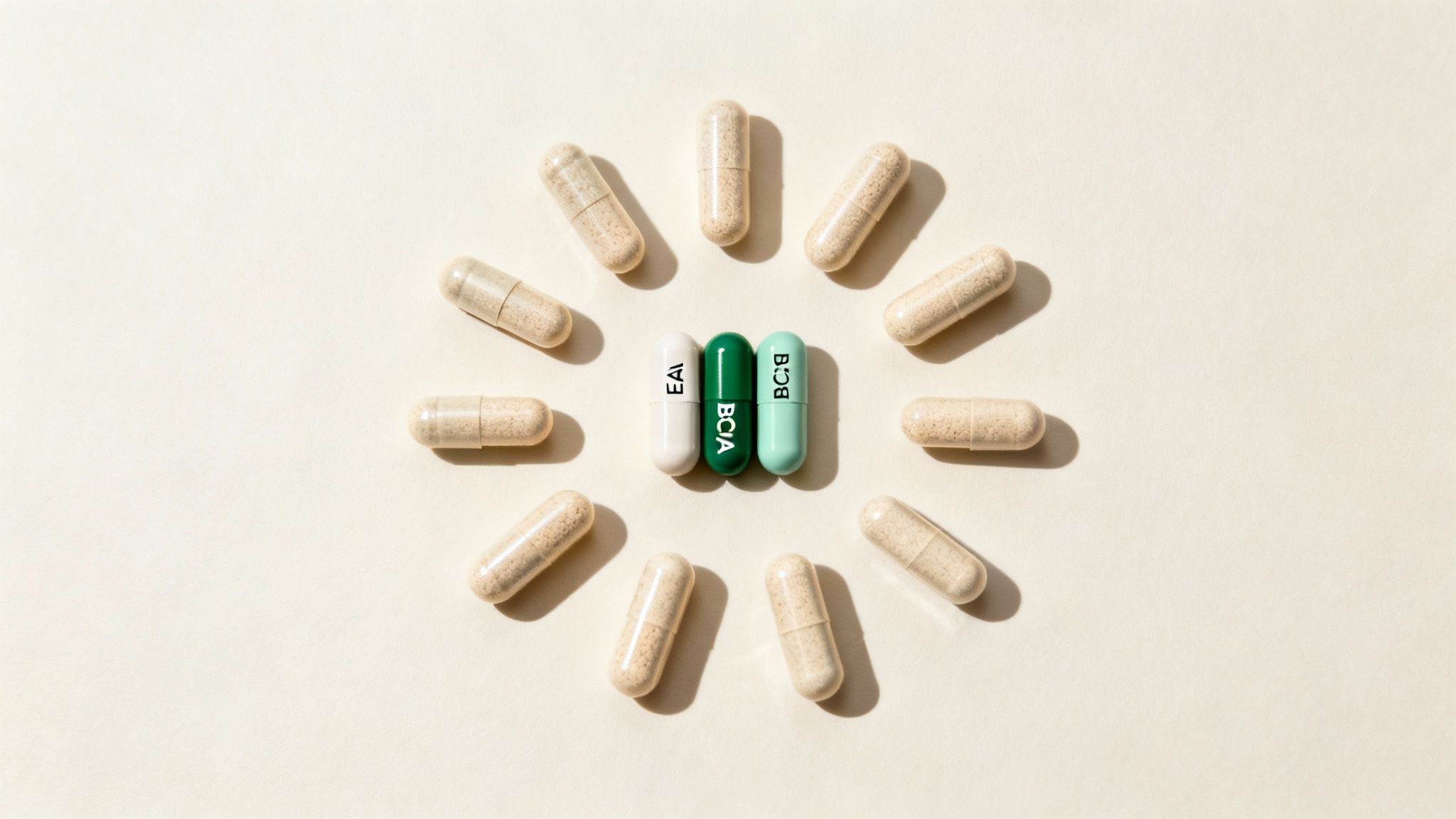
When you dive into the world of amino acid supplements, the alphabet soup of acronyms can be overwhelming. You'll constantly run into two big ones: EAA (Essential Amino Acids) and BCAA (Branched-Chain Amino Acids).
Getting the difference right isn't just about memorizing definitions. It’s about picking the right tool for the job to get the results you're after.
At its core, the relationship is simple: BCAAs are just one part of the EAA family. Your body needs nine essential amino acids from food or supplements to function. Three of those—leucine, isoleucine, and valine—are the famous BCAAs.
For a long time, BCAAs got all the credit, especially when it came to building muscle. This was largely because leucine is a powerful trigger for kickstarting muscle protein synthesis.
But here's the thing: relying on BCAAs alone is like trying to build a house with just a framing crew. They’re absolutely essential for starting the job, but you still need the electricians, plumbers, and roofers—the other six EAAs—to actually finish the house.
Why a Complete EAA Profile Is Superior
Think of your muscle-building process as a high-performance engine. To run at its best and generate maximum power, it needs all nine essential "parts"—the full EAA team.
Leucine acts like the ignition key. It turns the engine on, which is why it gets so much attention.
But just turning the key isn't enough. If the other eight EAAs aren't there, the engine sputters and dies. Your body simply can't sustain the process of building new muscle without a complete set of building blocks. Supplementing with only BCAAs is like turning the ignition over and over again with an empty gas tank.
Research consistently shows that a complete EAA supplement stimulates a significantly greater muscle protein synthesis response compared to BCAAs alone. This is because all nine EAAs are required to build new muscle tissue effectively.
EAA vs BCAA Quick Comparison
To make the choice crystal clear, let's put these two side-by-side to see what they offer and where they fall short.
| Feature | Essential Amino Acids (EAAs) | Branched-Chain Amino Acids (BCAAs) |
|---|---|---|
| Composition | Contains all nine essential amino acids, including the three BCAAs. | Contains only three of the nine essential amino acids (leucine, isoleucine, and valine). |
| Muscle Protein Synthesis | Provides a complete profile to fully support and sustain the muscle-building process. | Primarily initiates the process via leucine but lacks the other aminos needed to complete it. |
| Primary Use Case | Ideal for maximizing muscle growth, enhancing recovery, and providing comprehensive support. | Can help reduce muscle soreness and fight fatigue, but is less effective for building muscle. |
| Overall Value | Offers a more complete and efficient solution for comprehensive performance and recovery. | A more limited, specialized tool. Modern research favors the complete profile of EAAs. |
This shift toward understanding EAA superiority is clear in the market. The global demand for amino acids is booming, valued at USD 33.72 billion in 2025 and projected to hit an incredible USD 69.11 billion by 2034. This growth is being driven by athletes and fitness enthusiasts who want comprehensive, effective solutions for muscle recovery and performance. You can dig into more data on the expanding amino acids market on Precedence Research.
What About Conditionally Essential Aminos
Beyond the essentials, you might also see conditionally essential amino acids like glutamine or arginine listed in formulas. Under normal, everyday conditions, your body can make enough of these on its own. No problem.
But "normal" goes out the window during periods of extreme physical stress—think marathon prep, injury recovery, or a brutal high-volume training block.
In these "conditional" situations, your body's demand can outpace its ability to produce them. That's when supplementing can provide critical support for your immune system and help accelerate the healing process. For a deeper dive into optimizing your post-workout strategy, check out our guide on the best supplements for muscle recovery.
At the end of the day, choosing the right amino acid supplement means starting with a complete EAA profile as your foundation. This is the only way to ensure you're giving your body all the tools it truly needs to repair, rebuild, and perform at its absolute best.
How Amino Acids Fuel Performance and Recovery
So, we've broken down the difference between EAAs and BCAAs. Now for the million-dollar question: how does an amino acid supplement actually work inside your body to deliver real-world results? It’s not magic, but it’s close. The whole process boils down to a few powerful biological mechanisms.
These aren't just abstract concepts from a textbook; they are the direct drivers behind the faster recovery, increased strength, and better endurance you’re looking for.
Picture your body after a brutal workout. It’s like a construction site, but instead of steel and concrete, you have damaged muscle fibers that need to be repaired and reinforced, fast. An amino acid supplement is like an express delivery service, rushing the most critical building materials straight to the job site.
Igniting the Muscle-Building Engine
The single most important process for repairing and growing muscle is called Muscle Protein Synthesis (MPS). This is the biological pathway your body uses to take amino acids and build new muscle proteins. It’s how you repair the microscopic tears from exercise and, in turn, make the muscle stronger and bigger.
Think of Leucine, one of the three BCAAs, as the foreman on the construction site who blows the whistle to start the work. It’s the primary trigger for MPS, signaling to your cells that it's time to rebuild.
But as we covered, the foreman is useless without his crew. A complete amino acids supplement provides all nine essential amino acids—the entire construction crew—needed to see the project through. Once Leucine sends the signal, a full EAA profile ensures the rebuilding work can actually get done efficiently.
Without a sufficient supply of all nine EAAs in your bloodstream, the muscle protein synthesis sparked by your workout will stall. This means you miss the critical window for optimal growth and repair.
Shielding Your Muscles from Breakdown
Getting stronger isn't just about building new muscle; it's also about protecting what you've already earned. During long or particularly intense workouts, your body can flip into a catabolic state, where it starts breaking down your own muscle tissue for energy.
This process, known as muscle protein breakdown, is the enemy of progress. It actively undermines all your hard work and slams the brakes on your recovery.
Taking an amino acid supplement, especially before or during your workout, gives your body a readily available pool of fuel. It’s like telling your system, "Hey, no need to raid our hard-earned muscle for energy; use these free-floating aminos instead!" This anti-catabolic effect is a game-changer for preserving lean mass, especially during tough training cycles or a cutting phase.
Fighting Fatigue on Two Fronts
Fatigue isn’t just one thing. It's a complex opponent with both a physical and a mental component, and amino acids help you fight back on both fronts so you can push harder, for longer.
-
Reducing Physical Fatigue: By providing a direct energy source, aminos help spare your primary fuel reserves (muscle glycogen). This can delay that "hitting the wall" feeling, which is absolutely vital for endurance athletes. You can dive deeper into this in our guide to sports nutrition for endurance athletes.
-
Combating Central Fatigue: Here’s a cool bit of brain science. As you exercise, an amino acid called tryptophan crosses into your brain and converts to serotonin, which contributes to feelings of tiredness and lethargy. The BCAAs actually compete with tryptophan for the same ride into the brain. By flooding your system with BCAAs, you essentially block a lot of the tryptophan from getting through, which can noticeably reduce how tired you feel and cut through the mental fog during a long session.
Real-World Scenarios and Tangible Benefits
Let's translate this science into results you can actually feel in the gym, on the road, or on the field. The mechanisms we just talked about lead directly to some of the biggest wins for any athlete.
-
Drastically Reduced Muscle Soreness: One of the first things people notice is a huge reduction in Delayed Onset Muscle Soreness (DOMS). By kickstarting repair and limiting muscle damage, EAAs help you bounce back faster. You just feel less wrecked the day after a tough session. For example, a lifter who normally feels crippled for two days after a heavy squat workout might find they're just mildly stiff for one.
-
Accelerated Recovery Between Sessions: Faster repair means you're ready to go hard again, sooner. Instead of needing three days off after a monster deadlift day, you might feel fresh and ready in two. Over time, this allows for more training frequency and volume—a key driver of long-term progress.
-
Sustained Energy for Longer Workouts: An endurance runner might find that sipping on an amino acid drink during their run helps them push past the wall they usually hit around mile 18. By fighting off central fatigue and providing a trickle of fuel, they can hold their pace and stay mentally sharp much deeper into the run.
At the end of the day, an amino acid supplement works by optimizing your body's natural systems for repair and energy. It gives you the right materials, at precisely the right time, to turn the stress of your workout into a powerful stimulus for getting better.
Strategic Timing and Dosing for Maximum Impact
Knowing what amino acid supplements do is just the first step. The real magic happens when you know when and how much to take. This is what separates decent results from truly game-changing ones.
Think of it like a master chef adding a specific spice at the perfect moment. Your supplement timing and dosage are the keys to unlocking the full power of those aminos. This isn't about just tossing back a scoop when you feel like it; it's about a strategic plan that lines up with your body's most critical moments.
Pre-Workout Priming for Performance
Taking an amino acid supplement about 30 minutes before you train is like handing your muscles a shield before they go into battle. Intense or long workouts can put your body into a catabolic state, where it starts breaking down hard-earned muscle tissue for fuel.
A pre-workout dose floods your system with easy-to-use aminos, basically telling your body, "Hey, use these floating around in the bloodstream, not the muscle we worked so hard to build." This protective, anti-catabolic effect is absolutely crucial for preserving your lean mass while you're pushing your limits.
Your goal—whether it's raw performance or building size—should dictate your strategy.
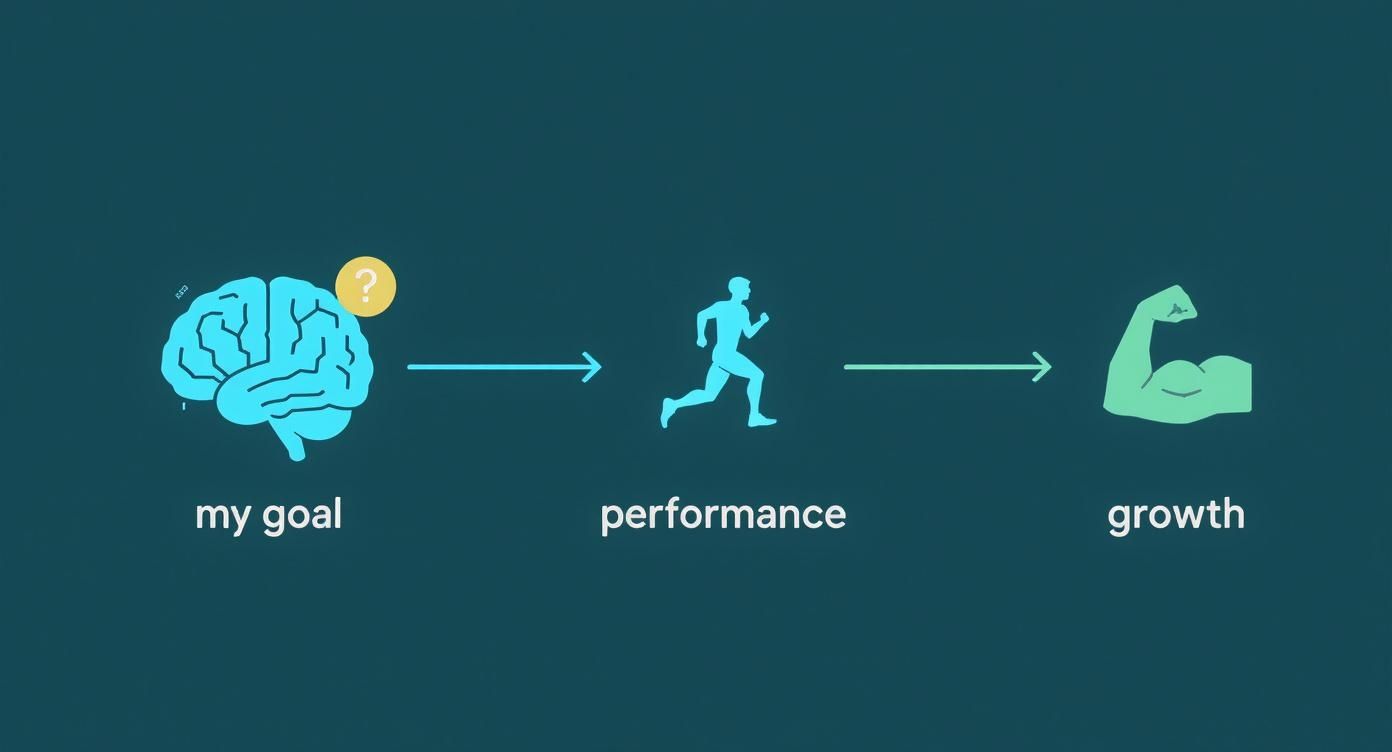
As you can see, all paths lead to progress, but the route you take with your supplementation should directly support your main objective, whether that's endurance or muscle growth.
Intra-Workout Fuel for Sustained Effort
For anyone grinding through workouts longer than 60-90 minutes, sipping on an amino acid drink during your session can make a world of difference. This is a go-to strategy for endurance athletes, CrossFitters, and anyone hitting high-volume training days.
As you keep pushing, this intra-workout fuel helps you fight fatigue on two fronts: physical and mental. It provides a steady drip of energy to your working muscles while also helping to block tryptophan (a fatigue-inducing amino) from crossing into your brain. The result? You stay sharper and more focused, for longer.
The point of intra-workout aminos isn't to build muscle right then and there. It's to sustain your performance, push exhaustion further down the road, and minimize the damage that comes from prolonged, intense effort.
Post-Workout Recovery and Growth
That window of time right after your workout is famously called the "anabolic window," and for good reason. Your muscles are primed—they're damaged, depleted of fuel, and screaming for nutrients to start the repair process.
Consuming an amino acid supplement within 30-60 minutes post-exercise is the most direct way to kickstart recovery. You’re delivering the essential building blocks exactly when they're needed most, igniting muscle protein synthesis—the process of repairing and rebuilding muscle fibers stronger than before. This rapid support can also help put a serious dent in delayed onset muscle soreness (DOMS).
If you want to go deeper on this critical recovery phase, check out our expert advice on how to recover faster after a workout.
Amino Acid Timing Protocol by Goal
To make it simple, here’s a quick-reference table to help you dial in your timing based on what you're trying to achieve.
| Goal | Optimal Timing | Primary Benefit |
|---|---|---|
| Muscle Growth | Pre- or Post-Workout | Maximizes muscle protein synthesis and minimizes muscle breakdown (catabolism). |
| Endurance | Intra-Workout | Delays physical and mental fatigue, providing a sustained energy source. |
| Recovery | Post-Workout | Rapidly delivers building blocks to repair muscle tissue and reduce soreness. |
Choosing the right window ensures you’re getting the biggest bang for your buck from every single scoop.
General Dosage Guidelines
While everyone's needs will differ based on their body weight and how hard they train, a great starting point for a quality EAA formula is 10-20 grams per serving. The most important thing to look for is that your dose contains at least 3 grams of Leucine, which is the primary driver of muscle protein synthesis.
- For Strength Athletes & Bodybuilders: A 15-20 gram serving either pre- or post-workout is perfect for maximizing muscle preservation and sparking growth.
- For Endurance Athletes: A 10-15 gram serving sipped during a long session will help sustain energy and fend off muscle breakdown.
- For General Fitness: A single 10-gram serving timed around your workout will deliver powerful recovery and performance benefits.
It’s this growing understanding of targeted nutrition that explains why the global amino acids market, valued at USD 29.9 billion in 2022, is projected to hit USD 75.3 billion by 2035. More and more athletes are realizing that precision is key. By fine-tuning your timing and dosage, you can transform your amino acid supplement from a simple product into a high-performance tool.
How to Choose a High-Quality Amino Acids Supplement
Walking down the supplement aisle can feel like a pop quiz you didn't study for. With countless tubs promising incredible results, how do you cut through the noise and separate the real science from the sales pitch?
Choosing a top-tier amino acids supplement isn’t about picking the flashiest label. It's about knowing exactly what to look for to guarantee you’re getting a pure, potent, and effective product. Since the supplement industry is notoriously under-regulated, your job as a savvy consumer is more critical than ever. A great product starts with total transparency and a commitment to quality that goes far beyond slick marketing.
Start with Third-Party Testing Certifications
Before you even glance at the ingredient list, hunt for a seal from a third-party testing organization. This is your first and most important quality check.
These independent labs verify that a product actually contains what the label claims and is free from banned substances or harmful contaminants. For any serious athlete, this is completely non-negotiable.
- NSF Certified for Sport: This is one of the most respected certifications in the game. It confirms the product is free of over 270 substances banned by major athletic organizations.
- Informed-Sport: This global program takes it a step further by testing every single batch of a product for banned substances before it hits the market, giving you an extra layer of security.
Seeing one of these logos on an amino acid supplement means you can trust that what’s in the bottle matches the label and is safe for competition. It’s the ultimate mark of a brand that takes quality seriously.
This level of scrutiny is becoming the standard as consumers demand cleaner, more effective products. The global amino acid nutritional supplement market has seen massive growth, fueled by a rising focus on health and targeted sports nutrition. As the market evolves, advanced delivery systems and a push for personalized formulas are making these supplements more effective than ever. You can explore more about these market trends and future directions to see where the industry is heading.
Scrutinize the Supplement Facts Panel
Once you've confirmed a product is tested, it's time to become a label detective. The Supplement Facts panel is where the truth is, and a quality brand will have nothing to hide.
First and foremost, avoid proprietary blends at all costs. These are sneaky concoctions listed under a vague name like "Amino Performance Matrix" that only give you a total dosage for the entire blend. This practice allows companies to hide the exact amount of each amino acid, often underdosing the most important (and expensive) ones.
Instead, look for a fully transparent label that lists the precise dosage of every single ingredient. It's the only way to know if you're getting a clinically effective dose.
Key Ingredients to Look For
A high-quality EAA formula should be built around a few core principles. When you read the label, make sure it checks these boxes:
- A Complete EAA Profile: The formula absolutely must contain all nine essential amino acids. Anything less is incomplete and just won't be as effective at stimulating muscle protein synthesis.
- Sufficient Leucine Content: Leucine is the primary driver of muscle repair and growth. Look for a formula that provides at least 3 grams of L-Leucine per serving to effectively "flip the switch" on muscle protein synthesis.
- No Unnecessary Fillers: Scan the ingredient list for junk like excess sugars, artificial colors, or strange chemical names. A clean amino acid supplement should be simple and focused on delivering aminos, not a laundry list of additives.
Powder vs. Capsules: Which Is Better?
Finally, you’ll have to choose between powder and capsule forms. While capsules offer undeniable convenience, powders are generally superior for a few key reasons.
Powders allow for much larger and more customizable dosing, making it far easier to hit that effective 10-20 gram range. They're also absorbed more quickly by the body, which is exactly what you want for pre- and post-workout timing. Capsules can be a good option for travel, but for daily use, a clean, unflavored powder mixed with water is the most efficient and effective choice.
Frequently Asked Questions About Amino Acids
Even after you get the science down, a few practical questions almost always come up. I get it. Moving from theory to practice is where the rubber meets the road, and you want to be sure you’re doing it right.
This section is all about tackling those common "what ifs" and "how tos." We'll clear up any lingering doubts so you can use aminos with total confidence and get the results you’re after.
Can I Just Get All My Amino Acids From Food?
This is probably the most logical question anyone could ask. And the answer is yes, but…
The "but" is all about timing and speed.
Whole food protein from sources like chicken, eggs, or even a quality whey protein shake is absolutely the foundation of good nutrition. No supplement can replace that. But your body has to work to get the aminos out of those foods—it has to digest the complex protein chains and break them down, a process that can take hours.
An amino acids supplement is different. It delivers what are called "free-form" aminos that don't need to be broken down. They get absorbed almost instantly, hitting your bloodstream in minutes.
Think of it this way: Whole food protein is like a big log you have to chop into firewood. An amino acid supplement is like a pile of perfectly sized, ready-to-burn kindling. Right after a workout, you need to get the recovery fire started immediately, not in a few hours.
That lightning-fast absorption is what makes a supplement so powerful for kickstarting muscle repair and shutting down muscle breakdown right when you need it most. It doesn't replace your meals; it’s a strategic tool that delivers the right materials with unmatched speed.
Are There Any Side Effects I Should Worry About?
For the vast majority of healthy people, amino acid supplements are incredibly safe, especially when you use them as directed. At the end of the day, they're just the purified building blocks you get from the protein you eat every day. Their safety is well-established, and serious side effects are extremely rare.
That said, a small number of people might notice some mild stomach issues—like a bit of bloating or an upset stomach—especially when they first start out or if they take a huge dose on an empty stomach.
This is almost always easy to sidestep by following a few simple rules:
- Start small. Try half a serving for your first few times to see how your body handles it before you jump to a full dose.
- Use enough water. Make sure the powder is totally dissolved. This helps with both absorption and digestion.
- Stick to the recommended dose. With supplements, more isn't always better. Following the label is the smartest way to get great results without any unwanted surprises.
How Long Until I See Results?
This is a big one. It's crucial to have the right expectations, because the benefits show up in stages. You'll feel some things almost right away, while the bigger, more visible changes are the result of consistency over time.
Here’s a realistic timeline of what you can expect:
Short-Term Effects (Days to Weeks):
- Less Muscle Soreness (DOMS): This is usually the first thing people notice. You’ll find you're not as stiff or achy in the 24-48 hours after a tough workout. You just bounce back faster.
- Better Endurance: During those long, grueling sessions, you might feel like you can just go longer. That "wall" gets pushed back, and you feel sharper mentally.
Long-Term Benefits (Months):
- Noticeable Muscle & Strength Gains: Building new muscle tissue is a slow-and-steady game. By consistently giving your body the raw materials it needs to repair and grow, you're supporting that process day in and day out. Measurable changes in your lifts and your physique are the payoff for pairing smart, consistent training with smart, consistent nutrition and supplementation.
The takeaway is simple: you'll feel the recovery benefits quickly, but the real, lasting changes to your performance and how you look are a reward for long-term dedication. An amino acids supplement is a powerful ally, but it works best when it’s part of a solid, sustained plan.
Ready to experience the difference that a clean, transparent, and research-backed formula can make? Revolution Science provides rigorously tested amino acid solutions designed to help you recover faster and perform at your absolute best.