
Your Cart is Empty


A Guide to Testosterone Pills for Men
When you hear the term “testosterone pills,” it’s easy to get a specific image in your head. But the reality is, people are usually talking about two completely different kinds of products.
On one side, you have prescription oral testosterone—a legitimate medical treatment for diagnosed low T. On the other, you have over-the-counter (OTC) testosterone boosters, which are dietary supplements. Knowing which is which is the absolute first step, and it's a critical one.
So, What Are Testosterone Pills, Really?
Let’s cut right through the noise. “Testosterone pills” is a catch-all term that lumps together two products with totally different ingredients, purposes, and rules. Confusing them can lead to unrealistic expectations or even put your health at risk.
Here’s a simple way to think about it: Prescription testosterone is like hooking up a direct fuel line, delivering the actual hormone into your system to fix a diagnosed shortage. OTC boosters, in contrast, are more like an engine tune-up—they provide raw materials your body can hopefully use to optimize its own testosterone production.
Two Sides of the Same Coin
The biggest difference boils down to what's actually in the pill.
-
Prescription Oral Testosterone: This is a real-deal pharmaceutical drug. It contains a synthetic, bioidentical form of testosterone, like testosterone undecanoate, and you can only get it with a doctor's prescription after bloodwork confirms you have hypogonadism (clinically low testosterone). Its sole purpose is hormone replacement therapy (TRT).
-
OTC Testosterone Boosters: These are nutritional supplements you can buy anywhere. They do not contain any testosterone. Instead, they're built with a mix of vitamins, minerals, and herbal extracts—things like D-aspartic acid, fenugreek, or zinc—that are believed to support your body's natural hormone-producing environment.
This single fact changes everything, from how they work and how effective they are to their legal status and potential side effects.
The most crucial takeaway here is that only a prescription medication can directly add testosterone to your body. A supplement can only aim to support the systems you already have, and the results can vary wildly.
To make this distinction crystal clear, let's put these two categories head-to-head.
Prescription Pills vs OTC Boosters At a Glance
This table breaks down the core differences at a glance. Understanding these points is essential before we dive into how each one works, what the science says, and which path—if any—might be right for you.
| Feature | Prescription Testosterone Pills (TRT) | OTC Testosterone Boosters |
|---|---|---|
| Main Ingredient | Synthetic Testosterone (e.g., Testosterone Undecanoate) | Vitamins, Minerals, Herbal Extracts |
| Purpose | Medically treat diagnosed hypogonadism | Support natural hormone production |
| Regulation | FDA-approved prescription drug | Regulated as a dietary supplement |
| Availability | Requires a doctor's prescription | Available over-the-counter |
As you can see, one is a targeted medical intervention designed to correct a deficiency, while the other is a wellness supplement aimed at optimization. They aren't even in the same league.
How These Pills Actually Work Inside Your Body
So, you swallow a testosterone pill. What happens next? The answer hinges entirely on one crucial detail: is it a medical prescription or an over-the-counter supplement? Each takes a completely different road inside your body and has a unique way of working.
This breakdown helps visualize the two main paths these pills can take.
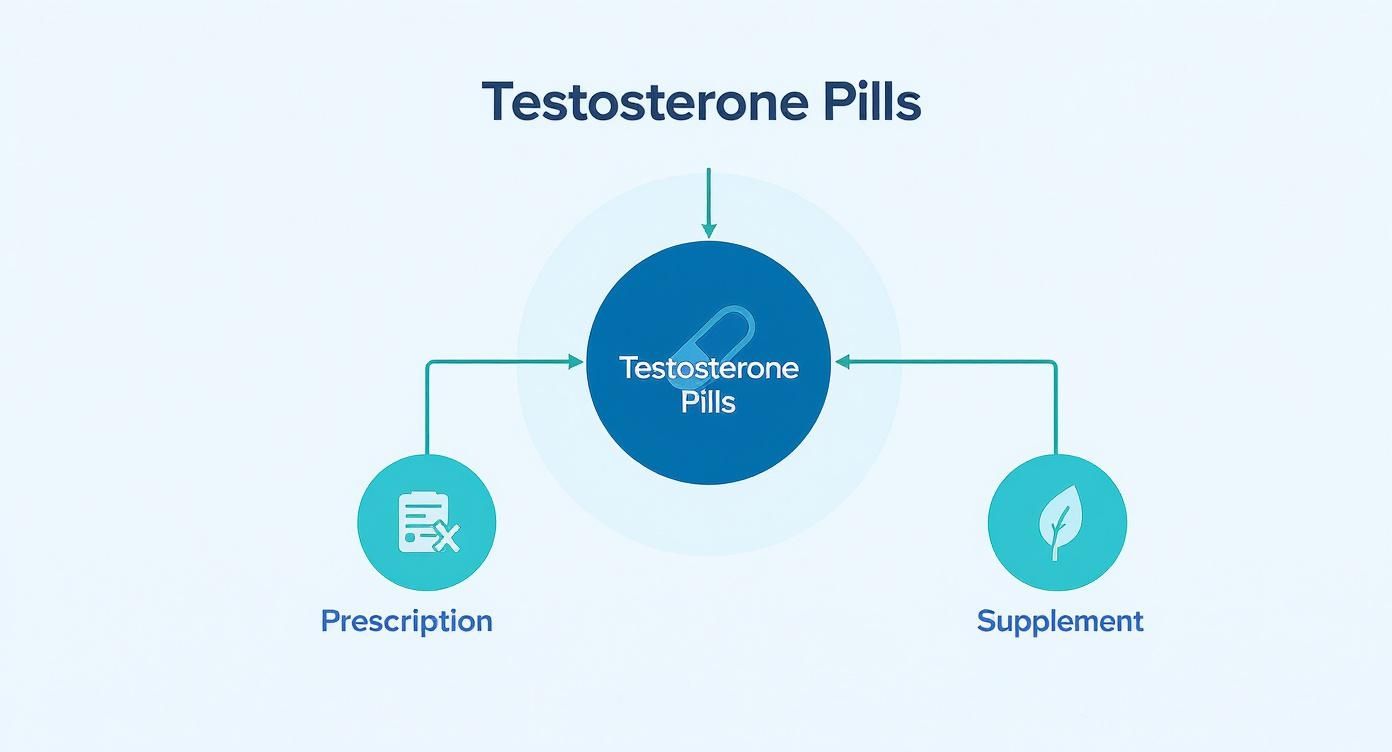
As you can see, there's a clear line between the direct, hormonal action of a prescription and the supportive, nutritional role of a supplement. Grasping this difference is everything.
The Direct Replacement Model of Prescription Pills
Picture your body’s hormone levels as the water in a swimming pool. If a doctor has diagnosed you with low testosterone, it’s like the water level in your pool has dropped critically low. A prescription oral testosterone, like testosterone undecanoate, is the equivalent of grabbing a fire hose and filling that pool back up directly.
Its function is brutally simple: direct replacement. The pill contains a bioidentical or synthetic version of the testosterone molecule your body isn't making enough of.
But it’s not as easy as just swallowing some testosterone. The liver is incredibly good at breaking down and destroying oral testosterone before it ever gets a chance to enter your bloodstream—a roadblock known as the "first-pass effect."
To get around this, modern pharmaceutical versions are cleverly designed. They are engineered to be absorbed through the lymphatic system, essentially taking a detour around the liver on their first trip through the body. This smart delivery system allows the hormone to enter circulation, raise your blood testosterone levels, and directly fix the deficiency.
The core mechanism for prescription testosterone pills is exogenous hormone delivery. It doesn't ask your body to make more testosterone; it is the testosterone, delivered from an outside source to bring your levels back into a healthy range.
The Indirect Support Model of OTC Boosters
Now, let's look at OTC testosterone boosters. They play a completely different game.
If a prescription is the fire hose filling the pool, a booster is more like a maintenance crew. This crew isn't adding any water; instead, they’re checking the pipes for leaks, cleaning the filters, and tuning up the original pump to make sure it runs as well as it possibly can.
These supplements do not contain any actual testosterone. Instead, they're built with a blend of ingredients that are thought to support your body's own testosterone-producing machinery. They work indirectly through a few potential pathways:
-
Signaling the Brain: Some ingredients, like D-Aspartic Acid, are believed to work in the brain centers that act as the command-and-control for hormone production. The theory is they can help trigger the release of luteinizing hormone (LH), the body’s main signal that tells the testes to get to work producing testosterone.
-
Providing Raw Materials: Your body can't build hormones from nothing; it needs specific raw materials. Ingredients like zinc and magnesium are crucial minerals that act as co-factors in the testosterone synthesis process. If you're deficient, production can stall. Supplements aim to ensure the factory is fully stocked.
-
Managing Hormone Balance: Other compounds, like fenugreek or ashwagandha, are often included for their potential to help manage cortisol, the primary stress hormone. Chronically high cortisol is a known testosterone killer, so keeping stress in check can help create a more favorable hormonal environment for T production.
The effectiveness of these ingredients can vary widely because they rely on your body's existing systems to do the heavy lifting. Unlike a prescription, they can't force new testosterone into your system. For those aiming to optimize what their body can do naturally, understanding these compounds is key. To go deeper, you can learn more about how certain supplements contribute to muscle growth in our detailed guide. Their goal is always optimization, not replacement.
Evaluating the Evidence Behind Their Effectiveness
When it comes to testosterone pills, there’s really only one question that matters: do they actually work?
The answer is a tale of two completely different products. We have to separate the clinically proven results of medical testosterone from the often over-hyped promises of over-the-counter supplements.
The Clinical Proof for Prescription TRT
For medically prescribed Testosterone Replacement Therapy (TRT), the evidence is crystal clear. When a doctor diagnoses a man with clinical hypogonadism (medically low testosterone), oral testosterone isn't just a potential option; it's a validated treatment.
Its effectiveness isn’t up for debate—it's a matter of direct, physiological action. By delivering the actual hormone into your bloodstream, prescription pills have been proven time and again in clinical trials to produce measurable, significant results.
Under a doctor's care, TRT is designed to bring your testosterone levels back into a healthy, functional range. This restoration leads to tangible benefits that directly combat the symptoms of low T.
- Increased Muscle Mass and Strength: Study after study shows that TRT helps increase lean body mass and improve physical strength in men with a diagnosed deficiency.
- Improved Bone Density: Testosterone is crucial for bone health. TRT can slow bone loss and even increase bone mineral density, which cuts down the risk of osteoporosis.
- Enhanced Libido and Sexual Function: One of the most well-documented benefits is a major improvement in sex drive and erectile function for men whose issues are rooted in low testosterone.
Bottom line: for the right person—someone with medically confirmed low T—prescription pills are an effective tool. They are built to fix a specific hormonal imbalance, and the evidence backing them up is rock-solid.
The Murky Waters of OTC Boosters
Now, let's switch gears to over-the-counter testosterone boosters. Here, the picture gets a lot less certain.
The market for these supplements is massive and growing at an incredible rate. The global testosterone booster market was recently valued at around $3.78 billion, and projections show it could explode to over $8 billion by 2032. You can dig into these market trends in this analysis of testosterone booster supplements on Grandview Research.
This growth is fueled by some slick marketing, but the science behind many of these products is often thin or just not there. Unlike pharmaceuticals, supplements don't have to go through the FDA's gauntlet of clinical trials to prove they work before they land on store shelves.
The real challenge is looking at the individual ingredients. Some components you'll find in these boosters do have some promising, albeit limited, research behind them.
- Zinc and Magnesium: Being deficient in these minerals is linked to lower testosterone. Supplementing can help get you back to normal if you're deficient, but taking extra won't push your levels beyond your natural baseline.
- D-Aspartic Acid: A few studies suggest it might give a temporary bump to testosterone in sedentary men, but other research found no effect at all, especially in men who already hit the weights.
- Fenugreek: This herb has shown some potential in studies for supporting libido and maintaining healthy testosterone levels, but we still need more extensive human trials to really know for sure.
The problem is that many other ingredients lack strong human evidence. Plus, those "proprietary blends" often hide the exact dosage of each component, making it impossible to know if you're even getting an amount that could work.
While a booster might offer some modest support if you have nutritional gaps, they simply can't replicate the direct hormonal impact of a prescription.
The effectiveness of these pills is highly individual and really depends on what your body is missing. For a broader look at how different supplements interact with your body's systems, you might be interested in our guide to HGH supplements and their functions. When you're exploring the world of OTC boosters, managing your expectations is everything.
Understanding the Real Risks and Side Effects
Let's cut through the noise. Anytime you're considering a pill to influence your hormones, you have to look at the potential downsides with your eyes wide open. This isn't about scaring you off—it's about making a smart, informed decision that puts your long-term health first, whether you’re looking at a doctor-prescribed medication or something from the supplement aisle.
The safety game is completely different for prescription testosterone versus over-the-counter (OTC) boosters. With one, you're dealing with known, manageable risks under a doctor's watch. With the other, you’re stepping into a world of uncertainty with almost no oversight.
Established Risks of Prescription Oral TRT
When a doctor puts you on oral testosterone, it's not like they're just tossing you a bottle of pills. They're starting you on a monitored medical therapy. The risks that come with Testosterone Replacement Therapy (TRT) are well-documented, which is a good thing. It means your doctor knows exactly what to look for and how to manage it.
Here are the big ones they'll be monitoring:
- Increased Red Blood Cell Count: This is probably the most common side effect, known in medical terms as polycythemia. Your red blood cells are crucial for carrying oxygen, but too many can make your blood thicker, which could raise the risk of clots. This is precisely why regular blood tests are a non-negotiable part of TRT.
- Impact on Fertility: Bringing in testosterone from an outside source can send a signal to your body to stop making its own. This shutdown hits sperm production hard, potentially leading to infertility. For guys who might want kids down the road, this is a critical conversation to have with your doctor.
- Prostate Health: Testosterone can make prostate tissue grow. If you already have a condition like benign prostatic hyperplasia (BPH), it might make your symptoms worse. It can also fuel the growth of existing prostate cancer, which is why your doctor will absolutely require screening before you start treatment.
The key here is perspective. With a doctor keeping a close eye on you through regular blood work and check-ins, these side effects are often completely manageable. They are known variables in a controlled medical equation, not random surprises.
The Unregulated World of OTC Booster Risks
The risks tied to OTC testosterone boosters are a lot murkier. Since they're regulated as dietary supplements, they don't go through the same rigorous safety and efficacy testing as real medicine. This opens up a whole different can of worms.
The main worries with these kinds of testosterone pills are:
- Unregulated Formulas: The supplement industry has a bad reputation for a reason. Products often don't contain what the label claims. You might get way less of an ingredient than promised, or worse, none at all.
- Proprietary Blends: You'll see this a lot—a "proprietary blend" that lists a bunch of ingredients but hides the exact amount of each. This makes it impossible to know if you're getting a dose that works or one that could be harmful.
- Potential Contamination: With lax oversight, there's a real risk of contamination with stuff that isn't on the label, like banned stimulants or even actual pharmaceutical drugs. For any competitive athlete subject to anti-doping tests, this is a massive gamble.
Remember this phrase: "natural doesn't automatically mean safe." An herbal extract can still cause a nasty allergic reaction, mess with your prescription medications, or put your liver under serious stress, especially in high doses.
To give you a clearer picture, let's compare the potential issues side-by-side.
Potential Side Effects Comparison
This table breaks down the different risk profiles between a medically supervised treatment and an unregulated supplement.
| Side Effect Category | Prescription Oral TRT | OTC Testosterone Boosters |
|---|---|---|
| Hormonal Imbalance | Managed by a doctor through dose adjustments. | Can cause unpredictable hormonal shifts due to unknown ingredient potency. |
| Cardiovascular Health | Monitored by a clinician; major studies have eased initial concerns. | Unknown effects; potential for issues from hidden stimulants or contaminants. |
| Liver Health | Monitored with blood tests, especially with oral forms. | Risk of liver stress from high doses of certain herbs or contamination. |
| Fertility | Known risk of decreased sperm production; discussed pre-treatment. | Unpredictable; some ingredients may negatively impact reproductive health. |
| Contamination | Extremely low risk; produced under strict pharmaceutical standards. | Higher risk of containing unlisted substances, including banned drugs. |
At the end of the day, one path involves calculated, monitored risks, while the other is a shot in the dark.
Interestingly, cardiovascular health used to be a huge question mark for prescription therapy. That changed in a big way after a major clinical trial showed no increased risk of heart problems in men with hypogonadism. Because of that, the FDA actually removed its broad cardiovascular risk warnings from testosterone product labels. This was a significant shift, and you can learn more about how this regulatory change is reshaping the TRT market and driving new interest.
When You Should Talk to Your Doctor
Navigating the world of testosterone pills and boosters can feel like walking through a minefield. With a mountain of information online, it’s all too easy to self-diagnose from a symptom checklist and grab a quick fix off the shelf. But let's be clear: this approach is a serious gamble with your health.
True hormonal issues demand a professional diagnosis, not just an educated guess. Certain persistent symptoms are your body's way of sending up a flare—a clear signal to stop the online research and start a real conversation with a qualified doctor.
Recognizing the Key Warning Signs
If you're consistently battling a combination of the following issues, it’s a strong sign that something more than just a rough week or a bad night's sleep is going on. These symptoms absolutely warrant a clinical evaluation to get to the bottom of things.
- Persistent, Deep Fatigue: This isn't your typical "I'm tired after a long day" feeling. We're talking about a chronic, bone-deep exhaustion that sleep just doesn't seem to fix.
- Noticeable Drop in Libido: A significant and lasting decrease in your sex drive is one of the most classic signs of a potential hormonal imbalance.
- Unexplained Mood Swings: Finding yourself more irritable? Feeling down or unmotivated for no clear reason? If it feels out of character, pay attention.
- Loss of Muscle Mass or Strength: You’re hitting the gym consistently, but you're finding it harder to maintain muscle or your strength numbers are actually dropping.
- Increased Body Fat: An unexplained uptick in body fat, especially around your midsection, can be directly linked to hormonal shifts.
The tricky part is that these symptoms can overlap with dozens of other health conditions, from thyroid problems to basic vitamin deficiencies. That’s precisely why playing doctor is so risky; only a medical professional can connect the dots and figure out what’s truly happening.
What the Diagnostic Process Really Involves
Seeing a doctor for suspected low T isn't just a vague chat; it's a specific, data-driven process. A proper diagnosis is the only safe and effective launchpad for considering any kind of treatment, especially prescription testosterone.
First, your doctor will do a deep dive into your symptoms and medical history. This conversation gives them crucial context for the most important step of all: blood work.
A diagnosis of low testosterone is never, ever made based on symptoms alone. It requires cold, hard evidence from blood tests measuring your total and free testosterone levels.
And this isn't a one-and-done deal. Your testosterone levels naturally rise and fall throughout the day, so your doctor will likely order at least two separate blood tests. These are almost always done early in the morning when your T levels are at their highest. This ensures the reading is accurate and shows a true deficiency, not just a temporary dip.
This clinical process is more vital than ever. The interest in testosterone therapy has absolutely exploded, with the subscription TRT market growing into a billion-dollar industry. The biggest spike in prescriptions has been among men aged 35 to 44. You can see the full analysis of the TRT market on Technavio to understand just how popular it's become. With so many men seeking treatment, getting a formal diagnosis is your best defense against starting a therapy you don't actually need.
For those looking to support their body's natural production without going the medical route, a dietary supplement like our T-Gains Anabolic Testosterone Booster can be an option. But remember, it is not a replacement for a medical diagnosis or treatment. The right path always begins with a professional conversation.
Your First Line of Defense: Effective Alternatives to Pills

Before even thinking about pills, we need to talk about the foundational pillars that support your body's natural hormone factory. Think of it like building a house—you'd never start hanging pictures on the walls before you've poured the concrete foundation and put up the frame.
These lifestyle habits are that foundation. They’re safe, they’re proven, and you can start implementing them today to create an internal environment where your hormones don't just survive, they thrive. This is always, always the first line of defense for anyone serious about their health, performance, and vitality.
Build Your Base with Resistance Training
Not all exercise is created equal when it comes to jacking up your T-levels. While any movement is good, resistance training is the undisputed king for stimulating natural testosterone production. When you lift heavy weights, you're sending a powerful, primal signal to your body: adapt, get stronger, grow.
This hormonal response is especially potent when you focus on big, compound movements that recruit tons of muscle at once. We're talking about the hormonal powerhouses: squats, deadlifts, bench presses, and overhead presses. The intensity and volume of your sessions are what really crank up the dial on this natural boost.
Prioritize Deep and Restorative Sleep
Sleep is, without a doubt, the most underrated performance enhancer on the planet. Your body does the vast majority of its hormonal repair and production work while you're in a deep slumber. Skimping on sleep is like asking your body's hormone factory to run a full shift with only half the lights on.
Most of your daily testosterone release happens while you're sleeping. It's not an exaggeration to say that sleep deprivation crushes your T-levels. Studies have shown that even a single week of bad sleep can tank testosterone in healthy young men. Getting 7-9 hours of quality, uninterrupted sleep every night isn’t just a nice idea—it's non-negotiable.
A single bad night's sleep can temporarily lower your testosterone as much as aging 10-15 years. Let that sink in. It shows just how critical consistent, restorative rest is for keeping your hormonal engine firing on all cylinders.
Fuel Your Body with Smart Nutrition
Your body can't build hormones out of thin air. It needs the right raw materials, and that's where your diet comes in. A well-designed nutrition plan is absolutely essential for providing the building blocks for testosterone synthesis and maintaining a healthy hormonal balance.
You want to anchor your diet around these key pillars:
- Healthy Fats: Cholesterol is the direct precursor to all steroid hormones, including testosterone. Don't fear the fat! Sources like avocados, olive oil, nuts, and whole eggs give you the essential raw materials your body needs.
- Sufficient Protein: Adequate protein is critical for maintaining muscle mass, which is tightly linked to healthy testosterone levels. It also keeps your overall metabolic health in check.
- Key Micronutrients: Deficiencies in certain vitamins and minerals will sabotage your testosterone. Zinc and Vitamin D are two of the most important players, acting as key cogs in the testosterone production machine.
While a solid diet is your top priority, smart supplementation can help fill in any nutritional gaps. For those looking to optimize their body’s building blocks, you can explore a range of research-backed muscle building supplements in our comprehensive guide.
Manage Your Chronic Stress Levels
Finally, chronic stress is testosterone's mortal enemy. When you're constantly wound up, your body floods your system with cortisol. These two hormones exist on a seesaw—when cortisol is high, testosterone is almost always low.
Finding effective ways to get a handle on your stress is a game-changer. Whether it’s meditation, mindfulness, or just carving out time for a hobby you love, lowering cortisol helps create a much more favorable environment for testosterone to do its job.
Answering Your Questions
Let's cut through the noise and tackle the questions we hear most often about testosterone pills. Here are some straight answers to help you understand the practical side of things.
How Long Until I See Results from Testosterone Pills?
This one is simple: it depends entirely on which type of pill you’re talking about. The timelines aren't even in the same ballpark.
-
Prescription TRT: If you have medically diagnosed low T, you can often start to feel better—more energy, better mood—within 3 to 6 weeks. But the physical stuff, like noticeable gains in muscle mass or improvements in bone density, takes a lot longer. You’re typically looking at 3 to 6 months of consistent, doctor-supervised therapy before those changes really show up.
-
OTC Boosters: With over-the-counter boosters, the effects are way less of a sure thing. If you happen to be correcting a specific nutrient deficiency, like low zinc, you might notice a subtle lift in a few weeks. For most guys, though, any benefit is going to be gradual and modest. These supplements are designed to support your body’s natural production, not add hormones directly.
The bottom line is this: Prescription TRT is about replacement, while boosters are about support. Adding testosterone directly creates predictable, significant changes over time. Helping your body optimize its own production is a much slower, more uncertain game.
Will Testosterone Pills Make Me Lose My Hair?
It's a fair question, and the answer comes down to your genes. Testosterone itself isn’t the bad guy here; the real player is a powerful byproduct called dihydrotestosterone (DHT). Your body naturally converts some of its testosterone into DHT.
For guys who are genetically wired for male pattern baldness, high levels of DHT can put the process into overdrive by shrinking hair follicles.
So, where do the pills fit in?
- Prescription TRT: Yes, it can. By raising your total testosterone, TRT also bumps up your DHT levels. If you have that genetic predisposition, it can definitely accelerate hair loss.
- OTC Boosters: If a booster actually works and nudges your natural testosterone up, it could theoretically do the same thing, but the effect would likely be much, much smaller.
Ultimately, genetics is holding all the cards. If you aren't predisposed to balding in the first place, it's highly unlikely that either option will cause you to start losing your hair.
Are Testosterone Boosters Legal for Athletes to Use?
This is a critical one for anyone competing. While you can legally buy OTC testosterone boosters just about anywhere, using them is a massive gamble for a competitive athlete.
Anti-doping bodies like the World Anti-Doping Agency (WADA) have a very strict list of banned substances. The problem is that the supplement industry has notoriously poor oversight, and cross-contamination is a very real threat. A booster that seems totally harmless could easily be contaminated with unlisted ingredients, like banned prohormones or powerful stimulants.
If you ingest one of these contaminated supplements—even by accident—you could fail a drug test. That could mean a career-ending suspension. For that reason, most sports governing bodies tell their athletes to stay away from supplements that aren't third-party tested and certified. The potential reward just isn't worth that kind of risk.
At Revolution Science, we're all about building a solid foundation. That means relying on research-backed nutrition and completely transparent formulas. Our supplements are engineered to support your body’s systems without the gamble of contamination or hidden ingredients, so you can chase peak performance with confidence.
You can explore our clean, effective formulas at https://rvsci.com.