Your Cart is Empty


Third party tested supplements: How to verify quality and safety
When you see "third-party tested" on a supplement label, it means the product has been put through the wringer by an independent, unbiased lab to confirm its purity, potency, and quality.
This isn't just a marketing gimmick. It's a stamp of verification that proves what's on the label is actually inside the bottle—and just as importantly, that the product is free from nasty contaminants.

What Are Third Party Tested Supplements
Think of it as a rigorous, independent audit for your supplements. While a brand might do its own "in-house" testing, a third-party lab has zero financial stake in the outcome. This separation is critical—it eliminates any conflict of interest and gives you a trustworthy layer of proof.
For anyone serious about their health and performance, this check transforms a supplement from a hopeful guess into a reliable tool. It’s about certainty, not just safety.
The Three Pillars of Verification
Third-party testing isn't a vague, catch-all term. It focuses on confirming three very specific things to ensure the product you're taking is both effective and safe:
- Potency: Does the product contain the exact amount of the active ingredients claimed? This check ensures you're getting the dose you paid for, not some watered-down, ineffective formula.
- Purity: Is the supplement clean? Labs screen for a whole host of unwanted guests, like heavy metals (lead, arsenic, mercury), microbes (bacteria, mold), and other adulterants.
- Identity: Is the ingredient actually what the company says it is? This step verifies the authenticity of the raw materials, preventing shady ingredient swaps or outright misrepresentation.
This level of scrutiny is quickly becoming the gold standard, and for good reason. The global market for dietary supplement testing is projected to explode to USD 3,652.2 million by 2030, growing at a powerful 8.8% annually. That massive growth is being driven by athletes and health-conscious consumers who are tired of mislabeled or contaminated products and are demanding transparency.
In-House vs Third Party Testing At a Glance
The term "lab tested" can be a bit misleading if a company is only checking its own homework. While in-house testing is a vital part of the quality control process, it simply doesn't have the unbiased validation that builds real consumer confidence.
Let's break down the key differences.
| Attribute | In-House Testing (First-Party) | Independent Lab (Third-Party) |
|---|---|---|
| Objectivity | Potential for bias or conflict of interest. | Completely unbiased and independent. |
| Credibility | Limited. Can be seen as a marketing claim. | High. Builds significant consumer trust. |
| Scope | Often focused on basic quality control. | Comprehensive analysis for purity, potency, and identity. |
| Transparency | Results are rarely shared publicly. | Results (COAs) are often available to consumers. |
| Accountability | Internal. No external oversight. | External. The lab's reputation is on the line. |
Independent verification is non-negotiable because the supplement industry isn't pre-approved by the FDA in the same way pharmaceuticals are. This puts the burden of proof squarely on the manufacturer to show their products are safe and effective.
Third-party testing ensures quality by utilizing independent facilities, including specialized laboratories testing products like CBD oil for purity and potency. It serves as an unbiased seal of approval, confirming that a brand has gone the extra mile to guarantee its product's integrity.
At the end of the day, choosing third-party tested supplements means you're prioritizing proof over promises. It ensures the fuel you put in your body is clean, accurately dosed, and—most importantly—safe.
Why Top Performers Demand Third-Party Verification
If you're a serious athlete, you know that success is never an accident. You control every variable you possibly can—from the exact timing of a rest interval to the precise macronutrient breakdown of your post-workout meal. So why would you introduce a massive, unknown risk into that carefully calibrated system with an untested supplement?
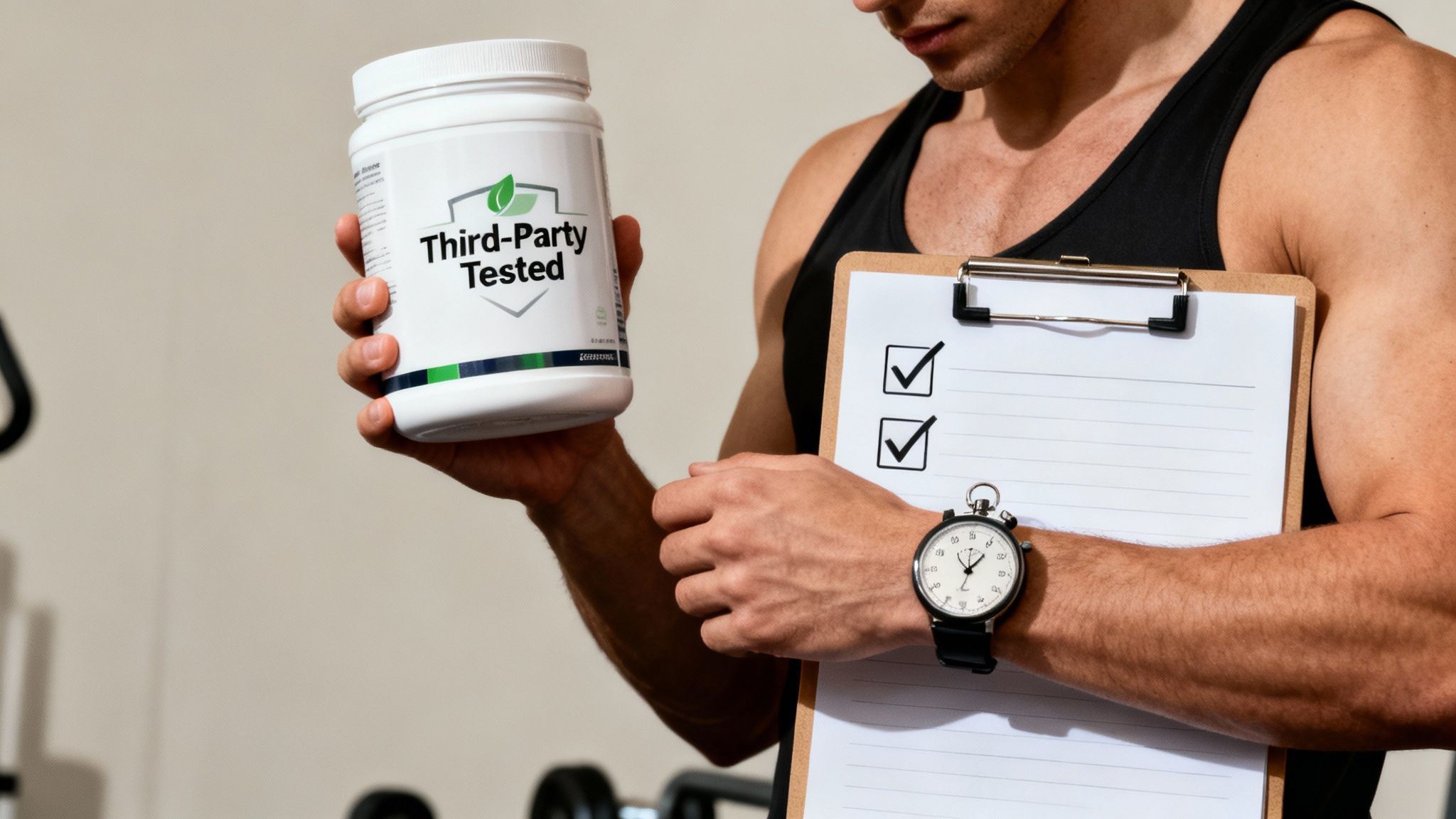
Choosing a third-party tested supplement isn't just about dodging a bullet; it's about guaranteeing your shot hits the target. It makes sure every scoop you take is a strategic tool for pushing your performance forward, not a gamble that could derail months of hard work. For anyone who lives by the mantra "control the controllables," this level of verification isn't a luxury—it's non-negotiable.
The True Cost of an Untested Product
Picture this: a competitive triathlete is six weeks out from a major race. Her training is peaking, her nutrition is dialed in, and every aspect of her recovery is tracked meticulously. She grabs a new pre-workout, trusting the flashy label and its bold claims of enhanced endurance.
What she doesn’t know is that the product is cross-contaminated with a banned substance that isn't listed anywhere on the label. A routine drug test after the race comes back positive, torpedoing her reputation, career, and everything she’s dedicated years to building. This isn't just a bad dream; it's a stark reality for many athletes who unknowingly use tainted supplements.
Even beyond the nightmare of a failed drug test, the performance costs are huge:
- Under-Dosed Ingredients: You pay for 5 grams of creatine but the tub only contains 3 grams per scoop. You’re not getting the full ergogenic benefit, which means you’re leaving strength and power gains on the table.
- Contaminant Exposure: Unseen heavy metals or microbial contaminants can place a massive strain on your body, wrecking your recovery, gut health, and overall well-being.
- Ingredient Misidentification: The label might say "Rhodiola Rosea," but an unverified product could be packed with a cheaper, ineffective botanical, completely wiping out the adaptogenic benefits you were counting on.
Guaranteeing Every Gram Counts
For a top performer, a supplement is an investment in their body. Think about it like an engineer building a high-performance engine—they demand precise specifications for every single component. An athlete has to demand that same exact standard for anything they put into their system. Third-party verification provides that guarantee.
It transforms a supplement from a hopeful guess into a reliable, scientifically-backed tool. You get the confidence that the formula is clean, the dosage is dead-on accurate, and the ingredients are exactly what the label says they are.
This is all about shifting from uncertainty to absolute confidence. It’s no surprise that the global dietary supplements market has exploded to $192.65 billion. Adults, who make up a 63.2% share of that market, are putting safety above everything else. In response, independent third-party labs generated USD 1.91 billion globally by providing the unbiased proof that smart consumers now demand. You can dig deeper by reviewing the in-depth market analysis on supplement testing.
The Performer's Non-Negotiable Checklist
An elite mindset demands elite standards. When you're evaluating a supplement, the checklist goes way beyond just the ingredient list. The number one question has to be: "Where is the proof?"
High-performers look for clear, undeniable evidence of quality assurance, including:
- Accessible Lab Reports: A truly transparent brand will make its Certificates of Analysis (COAs) for every single batch easy to find. This proves they have nothing to hide.
- Recognized Certifications: Look for seals from trusted organizations like NSF Certified for Sport or Informed-Sport. These are instant signals that the product undergoes rigorous, ongoing testing for banned substances.
- Batch-Specific Testing: The ultimate layer of accountability is being able to look up your specific product's batch number and see its test results for yourself.
At the end of the day, demanding third-party tested supplements is about aligning your nutrition strategy with your performance goals. It's an act of taking complete ownership of your health and progress, leaving nothing to chance in the relentless pursuit of your absolute peak.
Decoding Certifications and Lab Reports
Stepping into the world of supplement labels can feel like trying to read a foreign language. You’re met with a wall of acronyms, logos, and technical terms that seem designed to confuse rather than clarify. But these seals and reports are your best tools for verifying that a product is truly one of the elite third party tested supplements.
Think of these certifications as a supplement's resume. Just as you'd check a candidate's credentials before hiring them, you need to know what these logos stand for before you trust a product with your health and performance. They are clear, visual signals that an independent body has put the product through its paces.
The Gold Standard Certifications
Not all certifications are created equal. Some focus on general quality, while others are specifically designed for the stringent demands of competitive athletes. Understanding the differences helps you choose the right product for your specific goals.
Here are the heavy hitters you should look for:
- NSF Certified for Sport: This is the undisputed champion for competitive athletes. It confirms that the product contains what the label says, has been tested for contaminants, and is screened for over 280 substances banned by major athletic organizations like WADA. This isn't a one-time check; it's an ongoing process.
- Informed-Sport: Much like NSF, this certification focuses intensely on banned substance testing. Every single batch of a product must be tested before it can be released to the market, offering a high degree of confidence for athletes subject to drug testing.
- USP Verified: The United States Pharmacopeia (USP) sets federally recognized standards for medicines and supplements. A USP Verified mark means the supplement contains the ingredients listed on the label in the declared potency and amounts, is free from harmful levels of specified contaminants, and will break down and release into the body within a specified amount of time.
These certifications remove the guesswork. Seeing one of these seals is an immediate sign that a brand invests heavily in quality and transparency, putting their formulas under the microscope of a trusted, unbiased organization.
How to Read a Certificate of Analysis
While certifications are a great starting point, the ultimate proof lies in the Certificate of Analysis (COA). This is the direct lab report for a specific batch of a product. A transparent company will make these readily available, allowing you to see the exact results for the tub in your hand.
A COA is the raw data that backs up a brand's claims. It’s the difference between a company telling you their product is clean and showing you the scientific evidence that proves it.
At first glance, a COA can be intimidating, but it's simpler than it looks once you know what to look for. The key sections include:
- Potency/Assay: This confirms the active ingredients meet label claims. If your creatine says 5g per serving, this section verifies it.
- Microbial Limits: This screens for harmful bacteria like E. coli and Salmonella, ensuring the product is safe to consume.
- Heavy Metal Analysis: This tests for dangerous contaminants like lead, arsenic, and mercury, which can accumulate in the body over time.
- Identity: This confirms that the raw material is what it's supposed to be, using scientific identification methods.
You can even find public examples online to get familiar with these reports, like this endotoxin report for a peptide blend, which shows a specific type of purity testing. The principle is the same across the board: providing verifiable data on product safety and quality. For those seeking clean supplements, COAs can confirm the absence of unwanted additives in products like electrolytes without artificial sweeteners.
Learning to scan these documents empowers you to move beyond marketing and make decisions based on hard evidence. It’s the most direct way to confirm a supplement meets your high standards.
How to Verify a Supplement's Testing Claims
A certification seal on a supplement label is a strong start, but it's not the finish line. In an industry where slick marketing can sometimes outpace reality, you need to be your own advocate. Think of yourself as a detective building a case for a product's quality—you have to gather the evidence, follow the paper trail, and confirm the facts for yourself.
This is where you go from being a passive consumer to an empowered athlete. When you learn how to cross-reference claims and read lab reports, you can hold brands accountable. It's how you ensure the third-party tested supplements you choose are backed by proof, not just promises.
Your Step-by-Step Verification Checklist
Legitimate brands don't make you hunt for this information. If you have to dig through obscure web pages or send a dozen emails just to find proof, that's a huge red flag. A transparent company makes it simple.
Here’s a straightforward process to confirm a product’s integrity:
-
Find the Certification Seal: Look for a logo from a reputable certifier (like NSF Certified for Sport or Informed-Sport) right on the product's label or website. If you don't see a recognized seal, proceed with caution.
-
Cross-Reference on the Certifier's Website: This is the most critical step. Never trust a seal at face value. Go directly to the official website of the certifying organization (like NSF's site) and use their search tool to see if the brand and the specific product are listed. This is the only way to confirm the certification is current and not just a stolen graphic.
-
Locate the Certificate of Analysis (COA): The gold standard of transparency is batch-specific testing. Find the batch or lot number printed on your supplement container (usually on the bottom). A trustworthy company will have a section on its website where you can enter this number and pull up the exact lab report for your product.
This simple process turns a brand's claim into a verifiable fact. The infographic below shows the journey a product takes through some of the most rigorous certification bodies out there.

As you can see, each certification represents a distinct, rigorous layer of quality assurance—from NSF's deep-dive auditing to Informed-Sport's specific focus on banned substances.
Red Flags to Watch For
As you get better at this, you'll start spotting the warning signs from a mile away. Knowing what to look for can protect you from wasting money on low-quality or potentially sketchy products.
Be wary of brands that:
- Use Vague Language: Phrases like "lab tested" or "quality assured" are basically meaningless without a third-party COA to back them up. Always ask, "Tested by whom, and where are the results?"
- Refuse to Provide a COA: If a company can't or won't provide a lab report for your specific batch, it's a deal-breaker. A transparent company has nothing to hide and should be proud to show you its results.
- Hide Behind Proprietary Blends: While not a testing issue on its own, a lack of transparency in the formula often goes hand-in-hand with a lack of transparency in testing. You deserve to know the exact dose of every single active ingredient.
- Lack Batch or Lot Numbers: A product without a batch number is untraceable. This is a massive quality control failure, making it impossible to track that product back to its manufacturing date and specific lab tests.
Taking a few extra minutes to verify a supplement's claims is a direct investment in your long-term health and performance. This proactive approach ensures you're fueling your body with clean, effective ingredients. It’s especially critical for targeted formulas like those in the best electrolyte powders for athletes, where purity has a direct impact on hydration and recovery.
Ultimately, this verification process is your personal quality control system. It empowers you to cut through the marketing noise and make decisions based on cold, hard evidence.
Understanding Supplement Regulation Gaps
To really get why independent testing is so critical, you first have to understand the playing field for the entire supplement industry. It’s a world with a lot more freedom—and far fewer guardrails—than most people realize, all thanks to one key piece of legislation.
The law of the land for dietary supplements in the United States is the Dietary Supplement Health and Education Act of 1994 (DSHEA). This is the law that defines what a supplement is and sets the basic rules for making and labeling them. But it also draws a massive line in the sand between supplements and pharmaceutical drugs.
Here’s the single most important thing to know: under DSHEA, the U.S. Food and Drug Administration (FDA) does not approve supplements for safety or effectiveness before they hit the market. Unlike prescription drugs, a brand can cook up a new formula, bottle it, and sell it without ever getting a green light from the FDA.
The Manufacturer's Responsibility
This "market-first, ask-questions-later" approach puts all the responsibility for safety and quality right on the manufacturer's shoulders. The FDA does have rules called Current Good Manufacturing Practices (cGMPs), which dictate things like keeping a facility clean and maintaining equipment.
But cGMPs are just the baseline for the process of making supplements, not a guarantee for the finished product. The FDA’s role is almost entirely reactive. They step in to take action against a bad product only after it’s already on store shelves and people start reporting problems. This creates a huge gap between a product's launch and any real oversight.
Think of it like this: the government sets the basic traffic laws (cGMPs), but it doesn't inspect every single car before it leaves the dealership. Third-party testing is like hiring a master mechanic to do a full, bumper-to-bumper inspection to verify the engine, brakes, and safety features are exactly as advertised—before you ever take it for a drive.
This regulatory gap is precisely where reputable third party tested supplements prove their worth. Getting that independent stamp of approval isn't just a nice-to-have; it's a vital layer of protection that fills the void left by the system itself.
How Third-Party Testing Fills the Void
Because there's no mandatory pre-market approval, the supplement industry can often feel like the Wild West. Without a commitment to proactive testing, a company could—by accident or on purpose—sell you a product that’s under-dosed, contaminated, or simply doesn't contain what the label promises.
This is why third-party testing is the ultimate sign of accountability. It steps in to do the work that the regulations don't require:
- Proactive Safety Checks: Instead of waiting for a problem, independent labs screen for contaminants like heavy metals, pesticides, and microbes before the product gets anywhere near you.
- Potency and Purity Confirmation: Lab testing verifies that the amount of the active ingredients on the label is what's actually in the bottle. This ensures you're getting the dose you paid for, and nothing else.
- Building Real Trust: In a system that basically runs on the honor system, independent verification provides the unbiased proof you need to make a smart, safe choice.
When you choose a brand that voluntarily puts its products through this kind of rigorous inspection, you’re picking one that goes beyond the bare minimum legal requirements. It's your most powerful tool for navigating the supplement world with confidence, ensuring you're investing in a product backed by verifiable proof, not just promises.
Commit to Clean and Verified Performance
At the end of the day, choosing third-party tested supplements is all about trading uncertainty for confidence. It’s the difference between blindly trusting a marketing slogan and actually verifying a scientific fact. Hopefully, this guide has given you the tools to decode labels, check up on claims, and truly understand why independent testing is the only real guarantee of what’s in your bottle.
Your commitment to performance deserves supplements that are held to the same high standard. When you make it a priority to choose brands that embrace this kind of transparency, you’re making a direct investment in your health, your safety, and your results. This is especially critical for foundational products like electrolytes, where purity is non-negotiable. For anyone looking to dial in their hydration, you can check out our guide on the best clean electrolyte powder to see these principles in action.
Make the choice to fuel your goals with products backed by proof, not just promises. When you demand verification, you take complete ownership over your performance, ensuring every single scoop contributes directly to your success.
Frequently Asked Questions About Supplement Testing
Diving into the world of supplement quality can feel like a maze, but getting a handle on testing is the best way to make sure you're buying with confidence. Here are some straight-up answers to the questions we hear most often about third-party tested supplements.
Can I Trust a Brand's In-House Lab Results?
Think of it this way: in-house testing is like a student grading their own homework. It’s a decent first step for a company to check its own work, but it’s missing that crucial, unbiased second opinion. A brand will always have a financial interest in its products passing, which can create a conflict of interest, even if it's unintentional.
Real trust is built on outside proof. When an independent lab with absolutely no financial stake in the outcome signs off on a product's purity and potency, those results mean something. That unbiased verification is what separates a brand that just makes claims from one you can actually trust.
Do All Third-Party Certifications Test for the Same Things?
Nope, and this is a huge deal, especially for competitive athletes. Different certifications look for different things, so you have to know what a particular seal actually represents.
- General Quality Certifications (like USP Verified): These are focused on the basics. They confirm that what's on the label is actually in the bottle, check for a baseline level of common contaminants, and make sure the supplement will break down properly in your body.
- Athlete-Focused Certifications (like NSF Certified for Sport®): This is a whole different level. They do all the general quality checks, but then they screen for over 280 substances that are banned by major sports organizations. For an athlete, this isn't just a quality check—it's a career-saver.
Choosing the right certification comes down to your goals. For general health, a basic purity and potency seal is great. If you’re a competitive athlete, a banned substance certification is non-negotiable.
Are Third-Party Tested Supplements More Expensive?
Sometimes they cost a little more, but it’s better to see it as an investment in quality rather than just an extra cost. That higher price tag covers the serious expense of running detailed lab tests, conducting facility audits, and maintaining the ongoing compliance these certifications demand.
What you're really paying for is peace of mind. That small price difference is your guarantee that the product is safe, accurately dosed, and free from anything harmful or banned. It's the cost of turning a hopeful guess into a verifiable certainty. If you have more questions about how we approach product standards, you can find additional answers on our FAQ page.
What Should I Do If a Supplement Has No Batch Number?
A missing batch or lot number is a massive red flag. It’s a dead giveaway of sloppy quality control. This number is like a product's fingerprint, tying it directly to a specific manufacturing run and its corresponding Certificate of Analysis (COA). Without it, there’s zero traceability.
If you can’t find a batch number, reach out to the company and ask for it. Their response—or their silence—will tell you everything. A transparent, high-quality brand will give you that information without hesitation. If they can’t or won’t, it’s a strong sign their quality control isn't up to par.
At Revolution Science, we believe proof is more powerful than promises. That's why every single batch of our supplements goes through rigorous third-party testing, and we make the results available to you. Fuel your performance with clean, verified formulas you can trust. Explore the REVSCI difference today.