
Your Cart is Empty


How to Improve Athletic Performance A Practical Guide
Improving your athletic performance isn’t some big secret. It’s a process built on four key pillars: intelligent training, precision nutrition, strategic recovery, and smart supplementation. When you dial in each of these, you create a powerful cycle of stress, adaptation, and growth that fuels real, long-term gains.
Your Blueprint for Peak Athletic Performance
Reaching your full potential isn't about finding a magic bullet. It’s about executing a solid plan with relentless consistency, day in and day out. Getting better as an athlete takes more than just hard work—it demands smart work. You have to see the whole system, where every piece affects the others.
This guide cuts through the generic advice to give you a clear roadmap. We’ll break down the essentials that work together to lift your game, whether you're trying to shave minutes off your marathon PB or add another plate to your max lift. The goal is to build a durable, high-performing machine.
The Performance Cycle
To get better, you have to create a cycle of stimulus and adaptation. Training provides the stimulus, nutrition gives you the fuel for the work and the repair afterward, and recovery is when the magic actually happens—when you get stronger, faster, and more resilient.
This isn’t a one-way street; it’s a feedback loop.
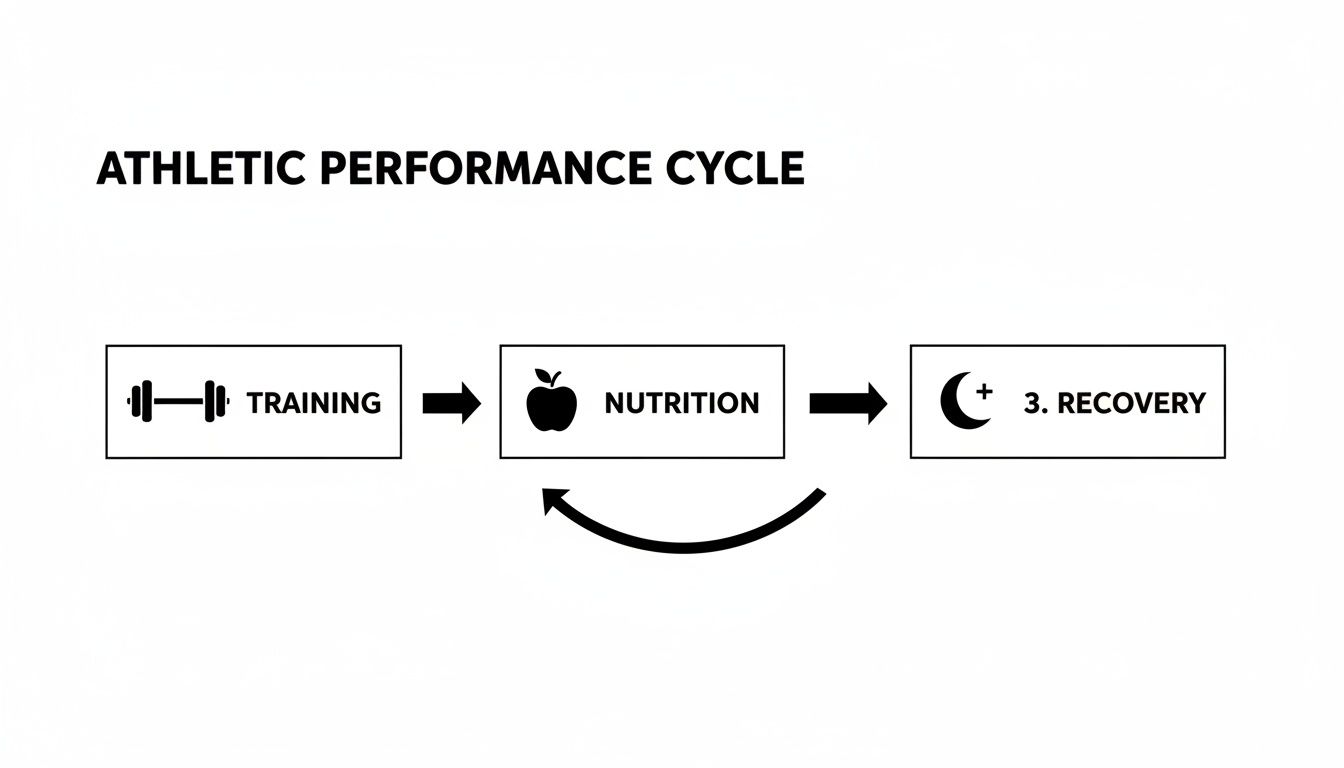
As you can see, these elements are completely interconnected. If one area is weak, it drags down everything else. You can't out-train a bad diet, and you can't recover from a great workout without proper sleep.
The Four Pillars of Athletic Success
To keep things structured, we'll focus on four critical areas. Each one builds on the last, creating a rock-solid foundation for peak performance. Think of them as the legs of a table—if one is shaky, the whole thing is unstable.
The greatest athletes aren't just born with talent; they are masters of process. They understand that excellence is built day by day through deliberate practice in training, fueling, and recovery.
Let's quickly break down the core components we’ll dive into throughout this guide. These four pillars are the foundation of any successful athletic endeavor.
The Four Pillars of Athletic Performance
| Pillar | Key Focus Area | Primary Goal |
|---|---|---|
| Intelligent Training | Periodization, progressive overload, sport-specific drills | Induce specific physiological adaptations to improve strength, speed, and endurance. |
| Precision Nutrition | Macronutrient timing, electrolyte balance, hydration strategy | Fuel workouts, optimize energy systems, and support cellular repair. |
| Strategic Recovery | Sleep quality, active recovery, stress management | Facilitate tissue repair, reduce inflammation, and restore physiological readiness. |
| Smart Supplementation | Targeted use of research-backed supplements | Fill nutritional gaps and enhance specific performance metrics safely. |
By mastering these four pillars, you are essentially creating your own personalized blueprint for success. This overview sets the stage for the actionable strategies to come, giving you the tools to systematically deconstruct your current approach and rebuild it for elite results.
Building Your Foundation with Smart Training
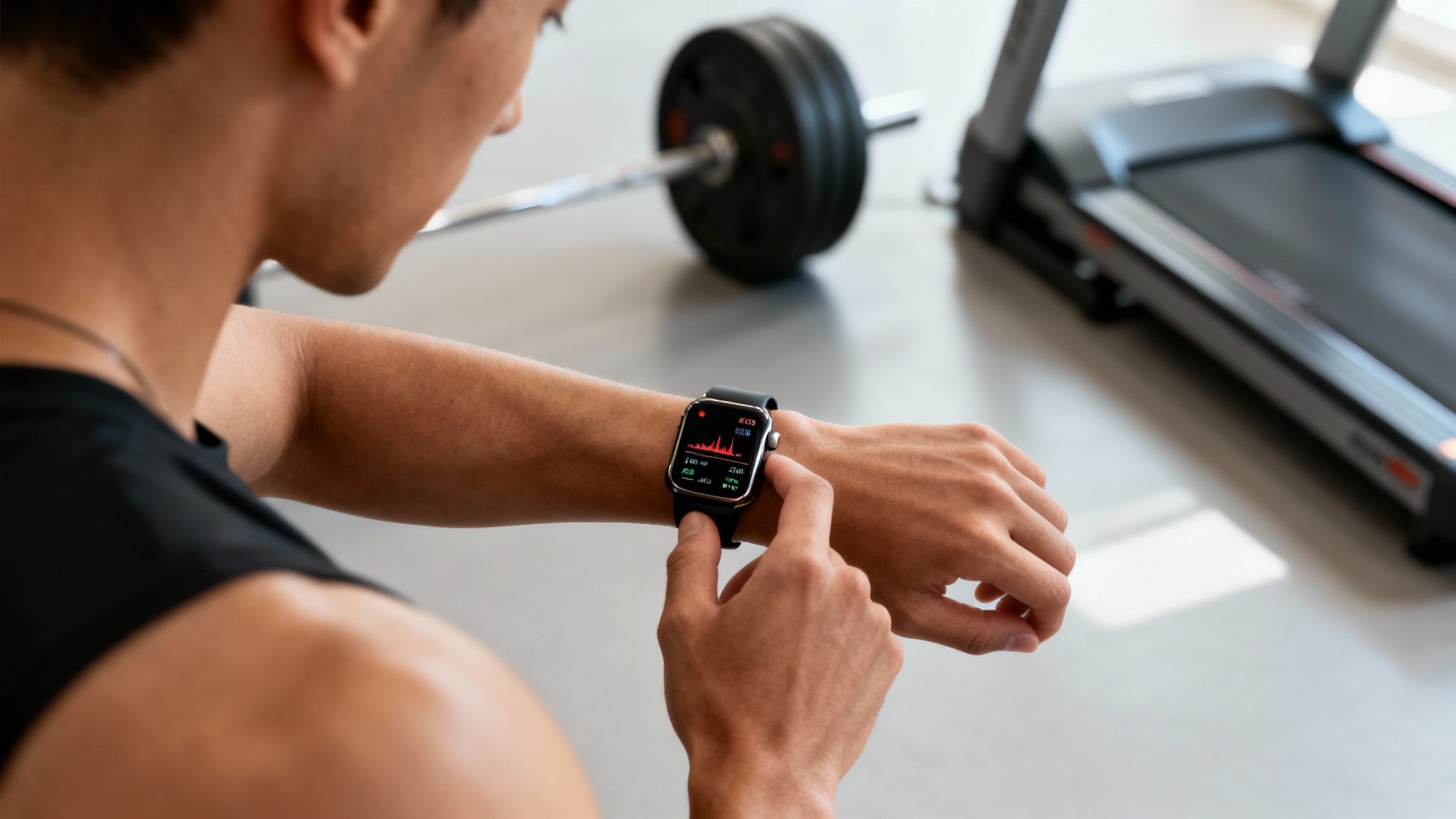
Stop guessing in the gym. If you want to make real, lasting progress, you need to stop training with random effort and start training with purpose. That all begins with establishing a rock-solid foundation built on data, not just feelings.
Before you can map out where you’re going, you have to know exactly where you are right now. This means getting a concrete performance baseline.
For an endurance athlete, that might be your VO2 max (how efficiently your body uses oxygen) or your Functional Threshold Power (FTP) on the bike. For a strength athlete, we’re talking about your one-rep max (1RM) on the big lifts—squat, deadlift, and bench press. These numbers aren’t for showing off; they’re your starting point.
Harnessing Data for Real-Time Feedback
Modern tech makes this easier than ever. The global sports training market was worth a massive $27.8 billion in 2023 and is on track to hit $50.7 billion by 2035, mostly because of technology that delivers measurable results.
It's no surprise that wearables like fitness trackers and smartwatches dominated the market in 2023. They give you instant feedback on heart rate, pace, and fatigue, letting you make adjustments on the fly. This data-driven training personalizes your plan, cuts down on injury risk, and has even been shown to boost VO2 max by up to 15% in some studies.
This real-time feedback loop is a complete game-changer. Is your heart rate spiking during what’s supposed to be a recovery run? Time to slow down. Power output fading halfway through your intervals? Your fueling strategy might be off. This is how you learn to train smarter, not just harder.
Your training log is the most honest coach you'll ever have. It doesn't care about your excuses or how you felt; it only shows what you did. Use it to hold yourself accountable and chart your path forward.
Structuring Your Training with Periodization
Once you have your baseline, you can build a structured plan using periodization. This is simply the art of organizing your training year into specific blocks, or cycles, each with a different focus. It’s how you peak at the right time while avoiding burnout.
Think of it in three main layers:
- Macrocycle: The big picture. This is your entire season or training year, all leading up to a major event like a marathon or championship.
- Mesocycle: These are smaller blocks within that macrocycle, usually lasting 2-6 weeks. Each one has a specific goal, like building your aerobic base, hitting max strength, or developing speed.
- Microcycle: Your weekly plan. This details the daily workouts, intensity, volume, and crucial rest days that all serve the goal of your current mesocycle.
For example, a marathon runner’s 16-week macrocycle could break down into four distinct mesocycles: an 8-week base-building phase (aerobic focus), a 4-week intensity phase (tempo runs and intervals), a 2-week race-specific phase, and a 2-week taper to recover and peak for race day.
Applying Progressive Overload for Continuous Gains
The engine driving all this forward is progressive overload. It’s a simple but powerful principle: to get stronger and faster, you must consistently challenge your body with a stimulus that’s just a little bit greater than what it’s used to. If you do the same thing week after week, you’ll just plateau.
But this isn’t just about slapping more weight on the bar. You can apply it in a few different ways:
- Increase Intensity: Lift heavier, run faster, or push more watts.
- Increase Volume: Do more reps, sets, or add more miles.
- Increase Frequency: Train a muscle group or energy system more often each week.
- Decrease Rest Time: Shorten the rest between sets or intervals.
A strength athlete might go from squatting 225 lbs for 5 sets of 5 one week to 230 lbs for 5 sets of 5 the next. A runner might progress from 4x800m repeats with 90 seconds rest to 5x800m with 75 seconds rest.
The key is making small, sustainable jumps. This forces your body to adapt without getting you injured. And if you’re looking to get the most out of these demanding sessions, check out our guide on choosing the best pre-workout to make sure you’ve got the fuel in the tank to hit those new numbers.
Fueling Your Body for Peak Output
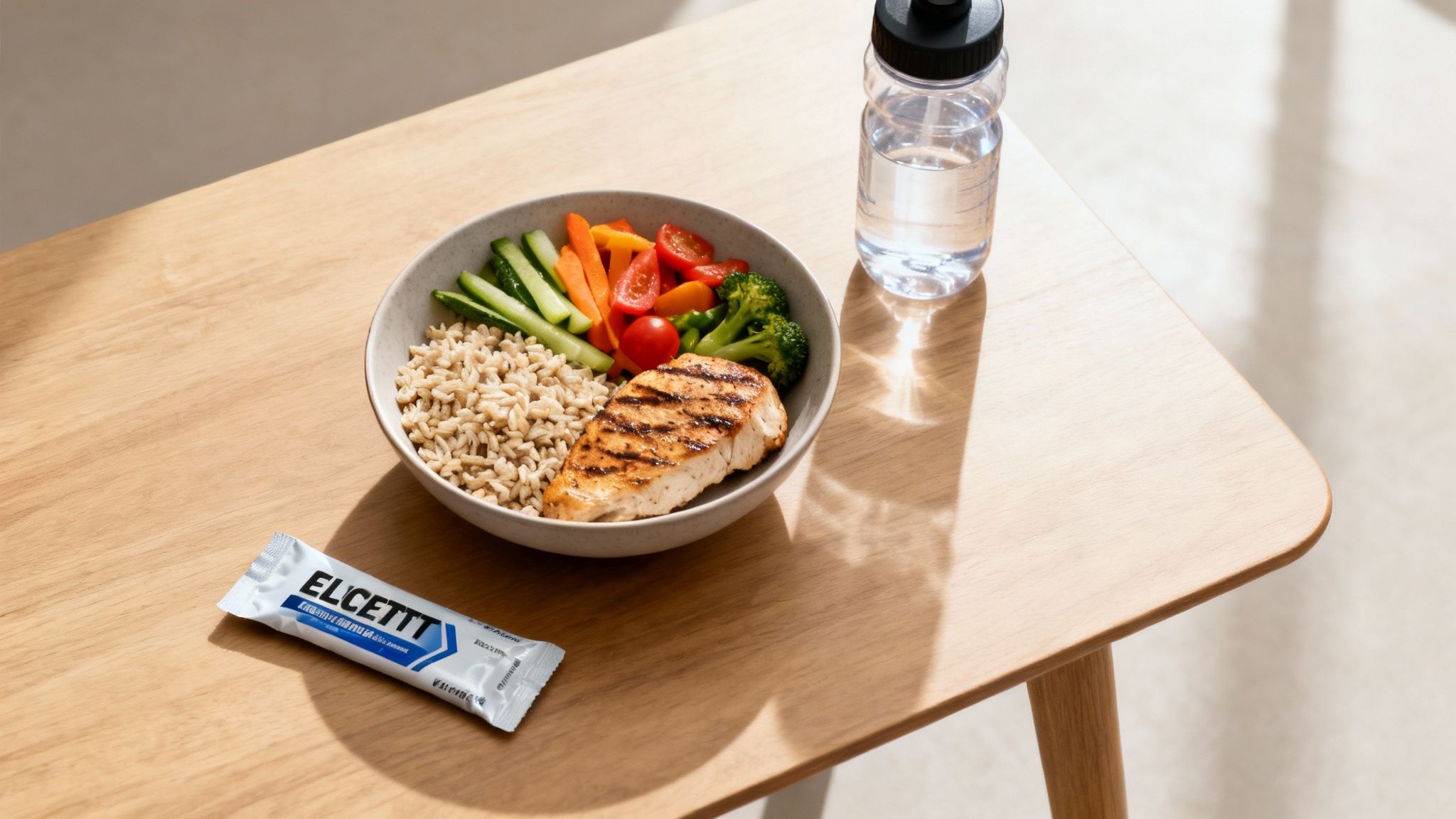
Think of your body as a high-performance engine. Even the most finely tuned machine needs premium fuel to operate at its best. Your training provides the stimulus for improvement, but it’s your nutrition and hydration that actually build you back up, repair damage, and power your next big effort.
Without a smart fueling strategy, even the most dialed-in training plan will fall flat. This isn't about getting bogged down in complicated diets or restrictive rules. It’s about a fundamental shift—understanding what your body needs and when it needs it. Simple changes here can dramatically improve how you feel, perform, and recover.
Timing Your Macronutrients for Maximum Impact
Your macronutrients—carbohydrates, proteins, and fats—are like specialized tools in your toolbox. The real secret is knowing which tool to grab at the right time.
Carbohydrates are your body's go-to source for high-octane fuel, stored as glycogen in your muscles and liver. They are absolutely essential for high-intensity work. A cyclist preparing for a long ride, for example, should load up on easily digestible carbs 1-2 hours beforehand to make sure those glycogen stores are completely topped off.
Protein, on the other hand, is your ultimate recovery tool. After a heavy lifting session, your muscle fibers are literally broken down. Getting a quality protein source in within 30-60 minutes post-workout is like sending in the construction crew; it kickstarts the muscle repair and synthesis process, helping you adapt and come back stronger for the next one.
Mastering Hydration and Electrolyte Balance
Hydration is so much more than just drinking water. It’s a delicate balancing act of fluids and electrolytes, and getting it wrong is one of the fastest ways to sabotage your performance. The numbers don't lie: for every 1% of body weight you lose through sweat, your performance can plummet by 2%.
On the flip side, getting your electrolyte intake right can completely change the game. We've seen studies show that proper hydration can lead to a 7-10% boost in VO2 max and slash muscle cramping by up to 30% in endurance events.
Take marathoners, who can easily lose over a liter of sweat per hour. For them, a clean electrolyte source is critical. It allows them to tailor their intake to the heat and their personal sweat rate, which dramatically cuts down on recovery time.
Simply chugging water during intense or long workouts just doesn't cut it. You're losing critical electrolytes like sodium through sweat, and if you don't replace them, you're setting yourself up for cramps, fatigue, and a serious drop in performance.
To dial this in, you have to get personal.
Calculate Your Personal Sweat Rate
A simple sweat rate calculation can take your hydration strategy from pure guesswork to a precise science. It’s a dead-simple and incredibly effective way to figure out exactly how much fluid you need to replace during your sessions.
Here’s how you do it:
- Weigh yourself naked right before you start your workout.
- Train for one hour without drinking any fluids, if you can manage it safely.
- Weigh yourself naked again immediately after you finish.
- Calculate the difference. Every kilogram you lose is equal to one liter of fluid.
So, if you lost 0.75 kg during a one-hour run, your sweat rate is roughly 750 mL per hour. That number is now your personalized target for fluid intake during similar workouts.
Practical Hydration Protocols
Once you have that sweat rate, building a protocol is the next step. A solid starting point for most intense workouts is to aim for 500-1000mg of sodium per hour of activity, mixed right into your fluids. This is where a clean, unflavored electrolyte powder becomes invaluable, because it lets you adjust the dose without being stuck with a sugary flavor.
Let's walk through a few real-world examples.
The table below offers a practical starting point for tailoring your hydration and electrolyte intake based on different athletic profiles, workout intensities, and environmental conditions.
Example Hydration Protocols by Athlete and Condition
| Athlete Profile | Condition | Hourly Fluid Intake | Hourly Sodium Target |
|---|---|---|---|
| Triathlete | Half-Ironman, hot weather | 1000 mL | 1000 mg |
| Football Lineman | 2-hour practice, summer heat | 750 mL | 700 mg |
| Keto Athlete | Fasted morning cardio | 500-750 mL | 500 mg |
| Endurance Runner | Marathon, cool day | 600-800 mL | 600-800 mg |
| CrossFit Athlete | 1-hour high-intensity WOD | 750 mL | 500-700 mg |
These protocols are a great foundation, but remember to adjust based on your personal sweat rate and how you feel. The goal is to stay ahead of dehydration, not play catch-up.
Understanding these principles is the first step toward unlocking your potential. To go even deeper, check out our complete guide on hydration for athletes, which breaks down these concepts even further.
Mastering Recovery to Unlock Your Gains
You can grind it out in the gym all you want, but the real magic happens when you stop. Training breaks you down; recovery is what builds you back up, stronger than before. It’s easily the most overlooked part of any performance plan, and skipping it doesn't just stall your progress—it sends you backward and opens the door to burnout and injury.
A smart recovery protocol is how you cash in on all that hard work. It's not about being lazy. It’s an intentional process where you dial in your sleep, mobility, and post-workout fuel to create the perfect environment for your body to adapt and grow.

Prioritize Your Sleep for Hormonal Health
Sleep is, without a doubt, your most powerful recovery tool. For any serious athlete, getting 7-9 hours of high-quality sleep every night is completely non-negotiable. It's during those deep sleep cycles that your body releases human growth hormone (HGH), which is absolutely critical for repairing tissue and building muscle.
When you consistently fall short, you throw your hormonal balance out of whack. Cortisol (the stress hormone) skyrockets and your ability to store glycogen tanks. The result? You drag yourself into your next session feeling flat, weak, and totally unmotivated. Think of sleep as the foundation—if it's cracked, everything else you build on top of it will crumble.
Implement Active Recovery and Mobility
Recovery doesn’t mean being a permanent fixture on your couch. Active recovery is all about low-intensity movement that gets blood flowing to your sore muscles, helping to flush out metabolic junk and speed up healing.
Here are a few a go-to methods:
- Light Cardio: A relaxed 20-30 minute spin on the bike, a light swim, or an easy jog on a rest day can do wonders. The trick is to keep your heart rate low, somewhere around 50-60% of your max.
- Mobility Work: Grab a foam roller or a massage ball. Spending just 10-15 minutes a day working on tight spots can release muscle tension, improve your range of motion, and stop nagging issues from turning into chronic problems.
- Contrast Water Therapy: This one sounds intense, but it works. Alternating between hot and cold water immersion helps kickstart circulation and crush inflammation. A simple way to do it is 3 minutes in a hot shower, then 1 minute of cold. Repeat that cycle 3-4 times.
For any athlete, learning effective strategies to relieve chronic back pain is key to staying in the game long-term. Think of these mobility drills as your first line of defense.
Recovery is not a sign of weakness; it is a display of intelligence. The smartest athletes are the ones who listen to their bodies and give them the resources needed to adapt and excel.
Capitalize on the Post-Workout Window
That short period right after a brutal workout is a golden opportunity. Your muscles are like sponges, ready to soak up nutrients and kickstart the repair process. The mission here is twofold: you need to restock your depleted glycogen stores and deliver the protein needed to rebuild muscle fibers.
If you drop the ball on refueling, you’re essentially starting your next workout at a disadvantage. The sweet spot is getting a mix of fast-digesting carbs and protein in your system within 30-60 minutes after you finish. This can be as simple as a shake or a small, well-balanced meal.
A clean, targeted supplement makes hitting this window incredibly easy. A formula like REVSCI's Regains is engineered for this exact moment, delivering what you need to fire up muscle protein synthesis and restock electrolytes, all without useless fillers. This is how you stop just ending a workout and start actively preparing for the next one. Our complete guide shows you exactly how to recover faster after your workout with practical nutrition and lifestyle tips.
Sharpening Your Mental Competitive Edge
Physical talent gets you in the door, but it’s your mental game that wins championships. Look at any dominant athlete, and you’ll find a common thread: an unshakable mindset that lets them execute flawlessly when the pressure is on. Your body, after all, can only go where your mind allows it.
This is exactly where so many athletes get stuck. They log countless hours honing their physical skills but completely neglect the most powerful tool they have. The good news is that mental toughness isn't some mystical force—it's a trainable skill, just like your squat or your sprint. It just requires a deliberate, structured approach.
Visualizing Your Victory Before It Happens
One of the most potent techniques in an athlete's mental toolkit is visualization. This isn't just daydreaming about winning. It's the disciplined practice of creating a vivid, detailed mental rehearsal of your performance, engaging every sense to make it feel absolutely real.
Picture a powerlifter stepping up to a max attempt. They aren't just thinking about lifting the weight. They're feeling the sharp knurling of the bar on their palms, hearing the clang of the plates, and mentally walking through every single part of the lift with perfect form—from the setup to the lockout. This mental run-through forges neural pathways almost as effectively as the physical act, supercharging confidence and making technique second nature.
When the real moment arrives, you’ve already been there and done it a hundred times in your mind. The pressure feels familiar, and your body knows exactly what to do.
Setting Goals That Actually Drive You
Goals like "I want to get better" are useless. They're too vague to offer any real direction. To make genuine progress, you need goals that are crystal clear, motivating, and measurable. The SMART goal-setting framework is a simple but powerful way to structure this.
- Specific: What, exactly, do you want to achieve? Instead of "get faster," try "cut 10 seconds off my 5k time."
- Measurable: How will you track it? This could be a stopwatch, a training log, or performance data.
- Achievable: Is this realistic for you right now? Aim high, but don't set yourself up for failure.
- Relevant: Does this goal line up with your bigger athletic ambitions?
- Time-bound: When will you hit this goal? Set a hard deadline, like "by the end of this 12-week training block."
Breaking a huge goal down into smaller, weekly process goals makes the whole thing feel manageable. For that faster 5k, your weekly goal might be hitting specific paces during interval sessions. This creates a feedback loop of small wins that keeps you fired up and moving forward.
"The mind is the limit. As long as the mind can envision the fact that you can do something, you can do it, as long as you really believe 100 percent." - Arnold Schwarzenegger
Mastering Stress to Maintain Focus
Pressure is a given in sports. The real difference between good and great athletes is how they manage that stress. Instead of letting it derail them, the best use it to sharpen their focus. Two of the most effective tools for this are mindfulness and controlled breathing.
Before a big race or game, it's easy for anxiety to spike your heart rate and send your thoughts racing. A simple box breathing technique can pull you right back to center. Inhale for four seconds, hold for four, exhale for four, and hold again for four. This simple exercise physically calms your nervous system down.
On top of that, incorporating stress-managing adaptogens can support your body's response to both physical and mental demands. Many athletes find that natural compounds help them maintain balance during intense training. For instance, you can explore ashwagandha gummies as an option that fits easily into a daily routine. When you combine these strategies, you gain control right when you need it most, turning stress from a threat into a signal to lock in and perform.
Common Questions About Athletic Performance
Even with the best plan in hand, you're bound to have questions. The world of athletic performance is full of conflicting advice, so let's cut through the noise and answer some of the most common questions I hear from athletes trying to elevate their game.
How Long Does It Take to See Real Improvements?
This is always the first question, and the honest answer is: it depends. How fast you see gains comes down to your starting fitness level, your sport, and—most importantly—your consistency.
If you're brand new to a structured lifting program, you could feel noticeably stronger in as little as 4-8 weeks. This is mostly your nervous system getting more efficient. A new runner might see big cardio improvements in that same window. We often call these "newbie gains," and they happen fast because the training is a brand new shock to the system.
For a seasoned athlete, though, progress is a much slower burn. If you’ve been at this for years, hitting a new PR might take a full 3-6 month training block. The mindset has to shift from huge leaps to small, incremental wins. This is exactly why tracking your progress is so crucial—logging workouts and monitoring how you feel helps you see the small victories that prove you're on the right track.
Patience and consistency are your greatest allies. Progress isn't a straight line. There will be good days and bad days. Trust the process, and the results will come.
What Are the Biggest Mistakes Holding Athletes Back?
More often than not, it's not what you're doing, but what you're doing wrong that kills your progress. Most roadblocks come down to a few common, completely avoidable mistakes. Get these right, and you'll sidestep the injuries and burnout that take others out of the game.
Here are the top three things I see sabotaging athletic goals:
- Overtraining and Under-recovering: The "more is always better" mentality is a trap. Pushing too hard without giving your body the time and fuel to repair itself leads straight to burnout and injury. Sleep is your number one performance-enhancing drug; start treating it that way.
- Ignoring Nutrition and Hydration: You can't out-train a bad diet. Period. Treating food as an afterthought or blowing off your fluid and electrolyte needs is like putting regular gas in a Formula 1 car. It doesn't matter how powerful the engine is—it's going to fail.
- Winging It in the Gym: Just showing up and doing random workouts feels productive, but it doesn't lead to real, long-term adaptation. You need a structured plan built on progressive overload. Without that, you're just exercising, not training.
Are Supplements Actually Important for Performance?
Think of them as the top 5% of your plan. Supplements are there to supplement an already solid foundation of smart training and whole-food nutrition, not replace it. No pill or powder will ever make up for a junk diet or not enough sleep.
That said, for a serious athlete, the right supplements can give you a real edge. The key is being strategic. Prioritize clean, research-backed products from brands that use third-party testing to prove what's on the label is actually in the bottle.
I always tell my athletes to start with the essentials that make the biggest impact:
- Electrolytes: If you sweat, a high-quality electrolyte formula is non-negotiable. It's critical for hydration, cramp prevention, and sustaining power output.
- Post-Workout Recovery: A targeted recovery blend helps you take full advantage of that post-training window, rapidly replenishing glycogen stores and giving your muscles the raw materials they need to repair and grow.
Beyond those two, other supplements can be useful depending on your specific sport, training load, and any gaps in your diet. Just remember: always choose quality over quantity.
Can I Still Get Stronger and Faster as I Get Older?
One hundred percent. You might not bounce back from a brutal session like you did at 20, but athletes over 35 are absolutely capable of making huge performance gains for decades. The secret isn't training harder; it's training smarter.
As you age, the focus has to shift. Recovery, mobility, and injury prevention become top priorities. Strength training becomes even more vital to fight off sarcopenia—the natural age-related loss of muscle. Your nutrition and hydration need to be dialed in with military-grade precision.
By listening to your body, making rest a priority, and being smart about your training volume, many masters athletes are still hitting PRs and outperforming their younger selves. It’s all about optimizing the variables you can control to build a durable, high-performing body for the long haul.
Ready to fuel your performance with clean, research-backed formulas? At Revolution Science, we create transparent supplements designed for athletes who demand the best. Explore our solutions and find the right fuel for your goals.