
Tu carrito está vacío


Elevate hydration for marathon runners: A Runner's Guide
Let's be clear: proper hydration for a marathon isn't just about chugging water. It’s a carefully orchestrated strategy, a delicate dance between timing, fluid volume, and electrolytes. The real goal is to methodically replace a significant chunk of what you sweat out, keeping your performance high without tipping the scales into overhydration.
Why a Personal Hydration Plan Is Your Secret Weapon
Your race day can live or die by your hydration plan. Vague advice like "drink when you're thirsty" just doesn't cut it for the brutal demands of 26.2 miles. The science is pretty clear on this—even a little bit of dehydration sends your heart rate soaring, spikes your core temperature, and can bring your race to a grinding halt.
A personalized strategy is the only way to walk that tightrope between dehydration and its dangerous cousin, hyponatremia. Once you get a handle on your personal sweat rate and electrolyte needs, you can build a predictable, repeatable plan for race day. Of course, hydration is just one piece of the puzzle. For anyone tackling 26.2, fitting this into a bigger picture is key, as you’ll find in this practical guide on how to train for a marathon.
The Big Shift: From Gulping Gallons to Precision Fueling
It wasn’t that long ago that the standard advice for endurance athletes was simply to drink as much as you possibly could. That thinking has been completely turned on its head, largely thanks to what we've seen happen in real-world races.
Back in the 90s, you’d hear recommendations to down 600–1200 mL of fluid every hour to stop any loss in body weight. But by the 2000s, a scary trend emerged: exercise-associated hyponatremia (EAH), a dangerous condition where blood sodium levels plummet from drinking too much plain water. Researchers quickly identified the biggest risk factors—gaining weight during a race, slower finish times, and smaller body size.
The guidelines have since evolved. The new focus is on smarter, individualized strategies that fall somewhere in the 400–800 mL/hour range, using a combination of thirst cues and personal sweat-rate data to dial things in.
A winning hydration strategy turns one of the biggest race-day anxieties into a predictable advantage. It's less about following a rigid formula and more about deeply understanding how your own body performs under pressure.
Dehydration vs. Hyponatremia: Know the Signs
Knowing the difference between too little fluid and too much is non-negotiable. Making the wrong call mid-race can turn a bad situation into a disastrous one. Both can feel vaguely similar at first—nausea, dizziness, general malaise—but they are polar opposites. One requires fluid and salt; the other requires you to stop drinking immediately.
This table breaks down the key distinctions so you can recognize the signs and react appropriately.
Dehydration vs Hyponatremia Key Differences
| Symptom | Dehydration (Too Little Fluid/Sodium) | Hyponatremia (Too Much Fluid) |
|---|---|---|
| Thirst | Intense, often the first sign | Usually absent; not thirsty |
| Nausea/Vomiting | Can occur, especially with heat | Common, feels like "waterlogged" stomach |
| Mental State | Dizziness, irritability, fatigue | Confusion, disorientation, headache |
| Body Sensation | Dry mouth, muscle cramping, sunken eyes | Bloating, swollen hands/feet, puffiness |
| Urine | Dark yellow, low volume | Clear, frequent, high volume |
| Weight | Significant weight loss post-race | Weight gain or no change post-race |
Learning to read your body is a skill you develop in training. Pay attention to these symptoms on your long runs. Recognizing whether you feel crampy and thirsty versus bloated and confused is a critical race-day skill that can save your marathon.
How to Calculate Your Personal Sweat Rate
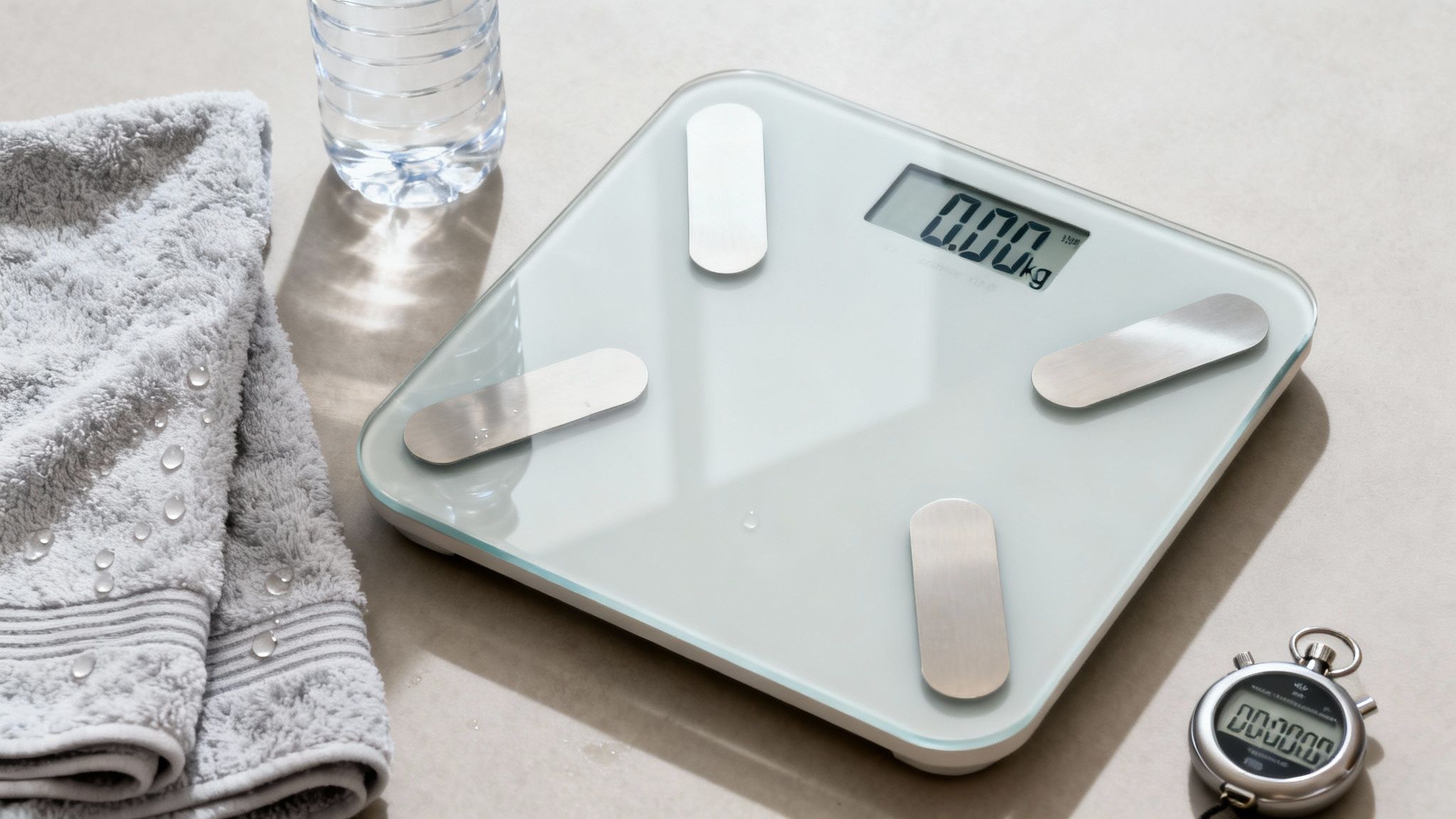
If you’re still guessing how much to drink during a marathon, it’s time for an upgrade. The single most powerful tool in your hydration arsenal is your personal sweat rate—how much fluid you actually lose every hour. Generic advice just doesn't cut it. Your sweat rate is unique to you, shaped by everything from your genetics to your fitness to the day's weather.
The good news? Nailing this number is surprisingly simple, and it completely removes the guesswork from your race-day plan. This is the difference between hoping you're drinking enough and knowing you have a precise, data-backed target. Think of it less as a one-time test and more as a crucial skill for dialing in your strategy for any race, in any conditions.
The Simple One-Hour Sweat Test
To figure out your baseline sweat rate, you only need a few things: a reliable digital scale, your running gear, and a bottle with a measured amount of fluid. The whole point is to capture your weight change over a one-hour run to see exactly how much fluid your body is pushing out.
Here’s the simple, step-by-step process:
- Get Your Pre-Run Weight: Just before your run, hit the restroom. Then, get on a digital scale completely naked and write down that exact number. This is your starting weight.
- Measure Your Drink: Fill your bottle or hydration pack with a known amount of fluid. For example, if you're using a 20-ounce bottle, make a note of it.
- Go for a One-Hour Run: Head out for exactly 60 minutes at a pace that feels like your goal marathon effort. The intensity really matters here, so try to mimic race day as best you can.
- Track Your Intake: Drink as you normally would during the run. The only rule is you have to know exactly how much you consumed.
- Get Your Post-Run Weight: As soon as you finish, towel off all the sweat from your skin and hair. Then, get back on the same scale, again completely naked. This is your ending weight.
- Measure What’s Left: Check how much fluid is left in your bottle. Subtract that from your starting volume, and you'll know precisely how many ounces you drank.
Once you have these numbers, you’re ready to do the math.
Putting the Numbers Together
Now we turn those measurements into your personal sweat rate. The formula might look a little intimidating at first, but it’s really just simple addition and subtraction.
Here’s how you calculate it:
- Calculate Weight Loss: Subtract your ending weight from your starting weight. You’ll want to convert this into ounces (1 pound = 16 ounces).
- Add Fluid Consumed: Take the amount of fluid you drank (in ounces) and add it to your weight loss number.
The final result is your sweat rate in ounces per hour. This number is the total amount of fluid your body lost during that one-hour effort.
Let's walk through a real-world example:
Say a runner weighs 155.0 lbs before their run. They come back an hour later and weigh 153.5 lbs. They started with a 20 oz bottle and drank half of it, which is 10 oz.
- Weight Lost: 155.0 lbs - 153.5 lbs = 1.5 lbs
- Weight Lost in Ounces: 1.5 lbs x 16 oz/lb = 24 oz
- Total Fluid Loss: 24 oz (lost as sweat) + 10 oz (drank) = 34 oz
This runner’s sweat rate for this particular run was 34 ounces per hour. This number becomes the foundation of their hydration plan, giving them a clear, actionable target for fluid replacement.
Why You Must Test in Different Conditions
Here’s the crucial part: your sweat rate isn't a fixed number. It’s a moving target that changes with your environment, which is why a single test just isn’t enough.
A few key variables will have a huge impact:
- Heat and Humidity: Your sweat rate will skyrocket on a hot, humid day compared to a cool, dry one. When sweat can't evaporate easily, your body has to produce more of it to try and cool down.
- Intensity: You’ll sweat a lot more during a hard tempo run than on an easy recovery jog. That’s why testing at your marathon pace is so important for race-day planning.
- Acclimatization: The more you run in the heat, the better your body gets at cooling itself. Over time, this can actually change your sweat rate and how much sodium you lose.
For a truly bulletproof marathon plan, run this test several times under different conditions—a cool morning, a warm afternoon, and ideally, a sticky, humid day. This gives you a powerful set of data, allowing you to build a dynamic hydration plan you can adjust on the fly for whatever race day decides to throw at you.
Building Your Pre-Race Hydration Protocol
Your marathon hydration plan doesn't kick in when the starting gun fires—it starts days before you even pin on your bib. Arriving at the start line properly hydrated is a delicate balancing act. You want your fluid and electrolyte stores completely topped off, but without feeling bloated or waterlogged. This pre-race window is your first chance to set yourself up for a great day.
The 48 hours leading up to your race are absolutely critical. The real goal here is consistent, steady fluid intake, not chugging a gallon of water the night before. Think about sipping fluids throughout the day. This simple habit allows your body to actually absorb and hang onto what it needs instead of just flushing it out.
The Power of Sodium Loading
One of the most effective strategies you can add to your pre-race routine is sodium loading. This just means you're intentionally upping your sodium intake the day before and the morning of the race. Why? It helps boost your plasma volume.
More plasma means more blood circulating through your system, which is a massive advantage for a marathoner. It helps your body manage heat more effectively, deliver oxygen to your working muscles, and ultimately delay the onset of dehydration.
Now, this isn't an excuse to go to town on a mountain of salty chips. It's a much more targeted approach:
- The Day Before: Add an electrolyte drink with a higher sodium concentration—somewhere in the ballpark of 1,000-1,500mg—to your normal fluid intake. Just sip on this throughout the afternoon and evening.
- Race Morning: About 90 minutes to two hours before the start, drink a final 16-20 ounces of a strong electrolyte mix. This last preload is what really primes your system for the work ahead.
This technique essentially helps your body hold onto fluid much more efficiently, creating a crucial buffer against the sweat you're going to start losing from the very first mile.
I see so many runners make the mistake of focusing only on water in the days before a race. Without enough electrolytes, especially sodium, a lot of that water just passes right through you instead of being stored where you actually need it.
Your Race Morning Timeline
Those final hours before the race are all about topping off your stores without causing any gut issues or forcing a last-minute scramble for a porta-potty. The secret is knowing when to stop drinking.
Try to finish that last 16-20 ounce electrolyte drink about 90 minutes before the start. This gives your body plenty of time to absorb the fluids and electrolytes and for you to void any excess before you even have to get into the corral. After that final big drink, you can take tiny sips of water or your sports drink if your mouth feels dry, but avoid any more significant chugging.
Use Urine Color as Your Guide
Honestly, one of the simplest and most reliable ways to check your hydration status is the old-fashioned urine color test. It’s a totally low-tech but incredibly effective biofeedback tool that too many runners ignore.
Your goal is a pale yellow or light straw color. That's the sweet spot, indicating you're well-hydrated. If you see dark yellow or amber, you need to get more fluids in. On the flip side, if it’s completely clear, you might be overdoing it, which can flush out those essential electrolytes you've been working to store. Give it a check the day before and again on race morning just to be sure you're right on track.
Despite its simplicity, this is a crucial check. In fact, optimizing hydration for marathon runners is about so much more than just the quantity of fluid; it's about matching your intake to what your body really needs. It was surprising to see survey research showing that while 70% of marathoners believed their performance had suffered from dehydration in the past, only a tiny 7% actually used urine color to monitor their status.
Your pre-race protocol is a foundational piece of your entire race-day puzzle. For a more detailed breakdown of how to integrate this with your in-race needs, you can check out our complete usage guide for marathons and triathlons. When you nail this phase, you can step up to the start line with confidence, knowing your body is fully prepped for the 26.2 miles ahead.
Executing Your In-Race Fluid and Electrolyte Plan
You’ve done the homework—your sweat rate is calculated and your pre-race hydration is on point. Now it’s time to put that plan into action on the course. This is where all that preparation really starts to pay off, mile after mile.
Forget about frantically chugging water at every aid station. A smart race-day strategy is all about a measured, consistent approach to replacing what you lose. The idea is to stay ahead of the game, not play catch-up when you’re already feeling the effects of dehydration. This means taking small, regular sips to give your body a steady stream of fluids and electrolytes, which is much easier on your stomach and way more effective for absorption.
From Hourly Targets to Actionable Sips
That sweat rate number you figured out is your golden ticket. It tells you exactly how much fluid you’re losing per hour. But you don't need to carry a measuring cup on the course to make it work.
Most marathons set up aid stations every 1-2 miles. Depending on your pace, you’ll likely hit one every 10-20 minutes. This timing is perfect for breaking down your hourly fluid target into manageable chunks.
Let's go back to our example runner who has a sweat rate of 34 ounces per hour.
- They could split that in half and aim for 17 oz every 30 minutes.
- Or, even better, they could divide it by four and aim for about 8.5 oz every 15 minutes.
If aid stations are spaced roughly 15 minutes apart for this runner, the plan becomes incredibly simple: drink one full standard paper cup (which holds about 8 ounces) every time they see a table. Just like that, an abstract number becomes a simple, repeatable action.
This handy infographic breaks down the full hydration timeline, showing how the process really begins long before you even get to the starting line.
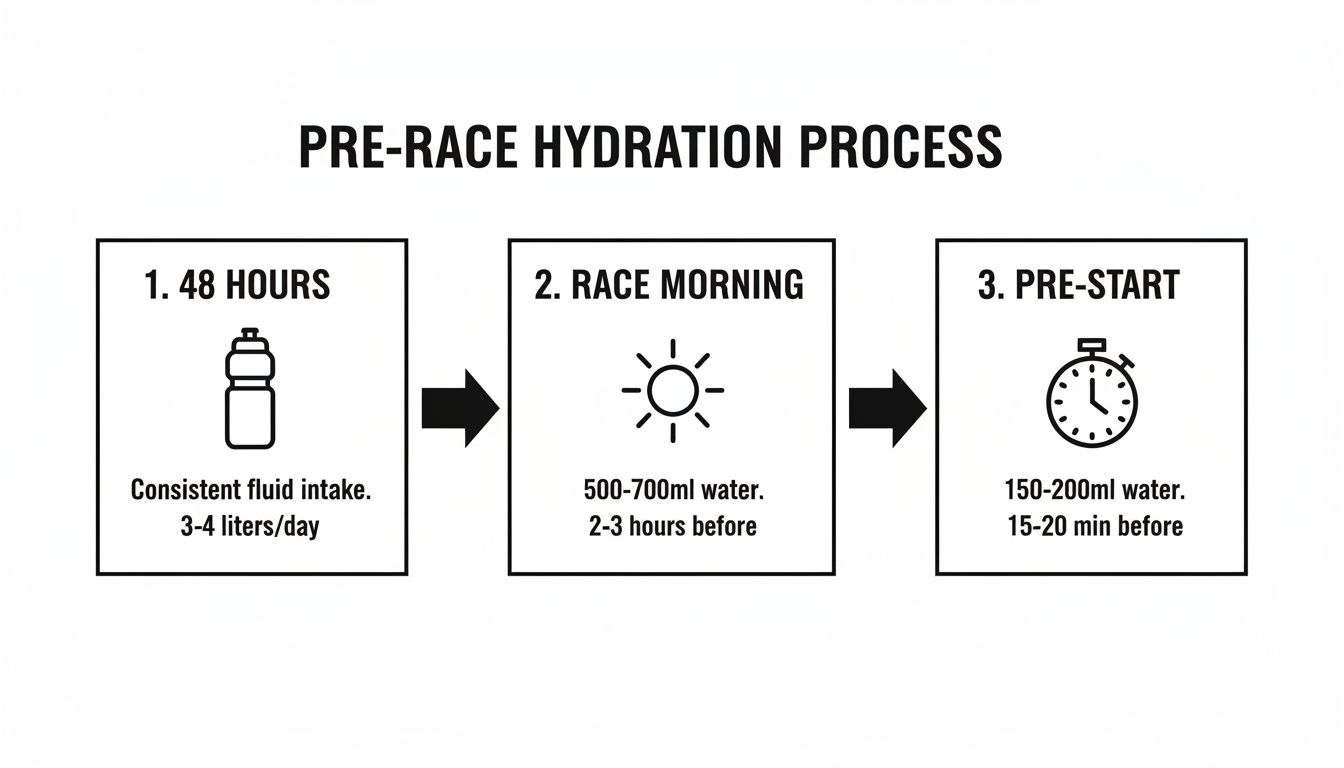
As you can see, great hydration is a multi-day process. It starts 48 hours out, gets fine-tuned on race morning, and carries you right into the corral, setting you up for a strong performance.
The Critical Role of Sodium
Drinking enough fluid is only half the story. When you sweat, you lose crucial electrolytes, and sodium is the most important one to replace during a marathon. It’s absolutely essential for maintaining fluid balance, firing your nerves, and keeping your muscles contracting properly. Run low on sodium, and you’re on a fast track to cramping, or worse.
This is why your in-race drink must contain electrolytes. Just drinking plain water is a classic—and dangerous—rookie mistake. A quality sports drink should provide 300-600mg of sodium per liter (about 33 ounces). If you’re a salty sweater or it's a hot day, you might need to bump that up to 700-1000mg per liter. This is where a concentrated product like an electrolyte powder really shines, letting you customize the dosage to your exact needs. An electrolyte powder comparison can help you find the right fit.
Now, let's talk about how to apply this in real-world scenarios. Your needs will change based on your pace and the weather, so a one-size-fits-all plan just won't cut it. A faster runner might be on the course for less time but have a higher sweat rate, while a mid-pack runner will need to sustain their hydration over a longer duration.
The table below shows a few examples of how you might adjust your plan.
Sample In-Race Hydration Schedules
| Runner Profile | Cool Conditions (55°F / 13°C) | Warm Conditions (70°F / 21°C) |
|---|---|---|
|
3:15 Marathoner (Moderate sweater) |
Drink 6-8 oz of electrolyte drink every 20 minutes. Aim for 500mg sodium/hour. | Drink 8-10 oz of electrolyte drink every 20 minutes. Increase to 700mg sodium/hour. |
|
4:30 Marathoner (Light sweater) |
Drink 4-6 oz of electrolyte drink every 20 minutes. Aim for 400mg sodium/hour. | Drink 6-8 oz of electrolyte drink every 20 minutes. Increase to 600mg sodium/hour. |
|
5:30 Marathoner (Heavy/salty sweater) |
Drink 8 oz of electrolyte drink every 20 minutes. Aim for 600mg sodium/hour. | Drink 10 oz of electrolyte drink every 20 minutes. Increase to 800-1000mg sodium/hour. |
These are just starting points, of course. Your personal sweat rate data is what will ultimately guide you, but this illustrates how you need to think dynamically about your strategy based on the conditions you face on race day.
Practice and Pressure-Test Your Plan
Your long runs are your laboratory. This is where you test, tweak, and perfect every single detail of your race-day plan. I can’t say this enough: never, ever try anything new on race day.
Use your long training runs to dial in everything:
- Gear vs. Aid Stations: Are you carrying your own fluids or relying on the course? Practice with a handheld bottle or hydration vest to get comfortable. If you plan to use what the race offers, find out the brand ahead of time and train with that exact product to make sure your gut can handle it.
- Timing and Volume: Figure out your personal rhythm. Does drinking 6 ounces every 20 minutes feel right? Or is 4 ounces every 15 minutes a better fit? Nail down the specifics.
- Fuel Integration: Your hydration and fueling have to work together. Practice taking gels or chews with your fluids. You might find a gel followed by water works best, or an all-in-one drink is simpler for you.
By the time you step up to that starting line, your hydration plan should feel automatic. It should be so tested and reliable that you don't even have to think about it. This removes a huge piece of race-day anxiety and frees up your mental energy to focus on what matters: your pacing, your effort, and crossing that finish line strong.
Mastering Post-Race Recovery and Rehydration
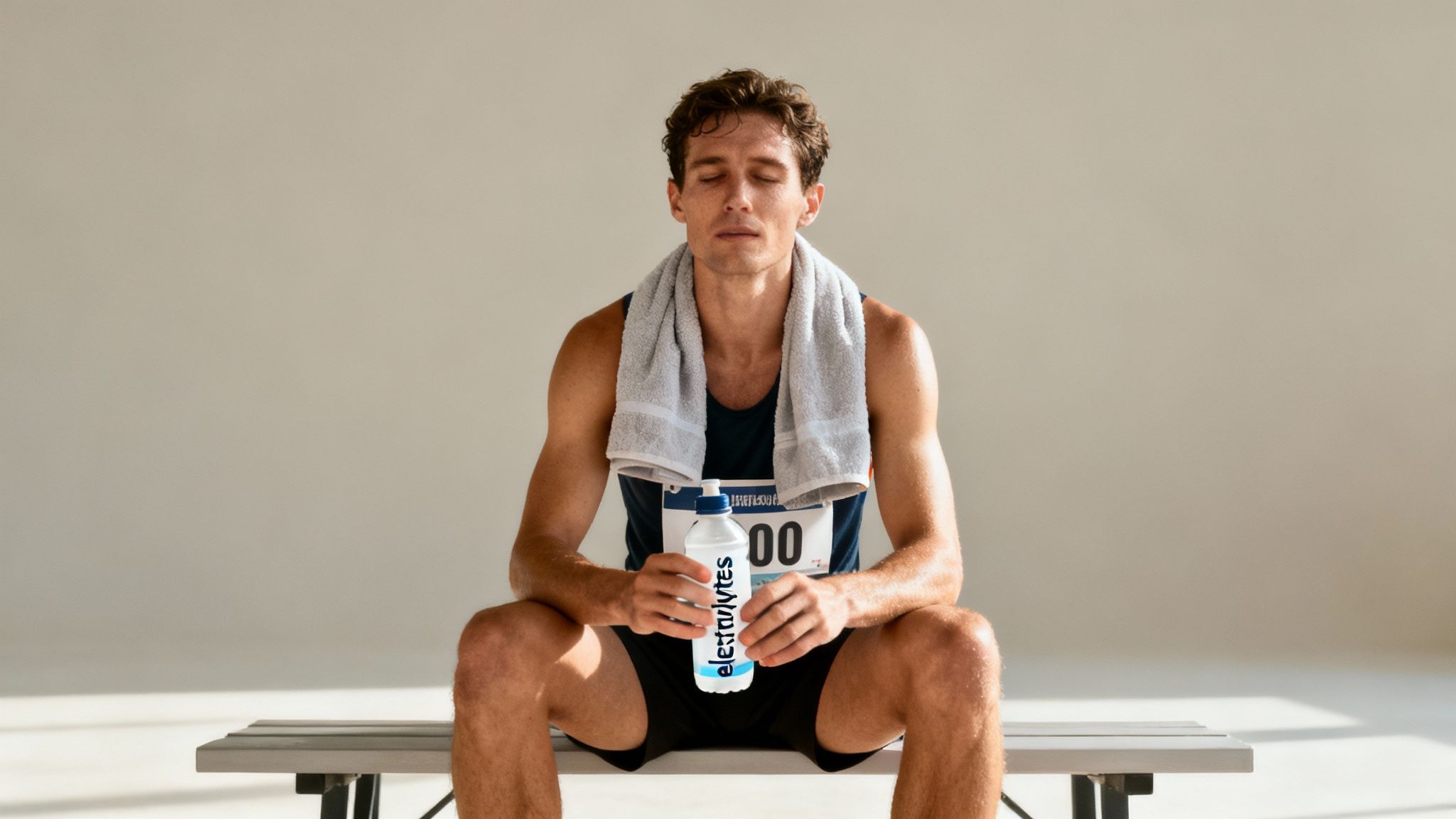
You crossed the finish line. It’s an incredible feeling, but your marathon hydration job isn't quite done. The hours immediately after the race are a critical window for recovery, and what you drink is a huge piece of that puzzle.
This is the time for aggressive, intentional rehydration. Your body is running a serious fluid and electrolyte deficit, and your muscles are desperate for fuel to start rebuilding. Nail this part, and you can seriously cut down on muscle soreness and bounce back much faster.
Calculating Your Total Fluid Deficit
First things first, you need to know exactly how much fluid you lost over those 26.2 miles. This takes all the guesswork out of it. If you can, find a scale soon after you finish. Towel off, and weigh yourself in the same minimal gear you wore for your pre-race weigh-in.
The math is simple: for every one pound (or ~0.45 kg) of body weight you lost, you're down about 16 ounces (or ~475 mL) of fluid. That number becomes your personal rehydration target.
The gold standard for post-race rehydration is to drink 1.5 times the fluid weight you lost. If you lost 3 pounds (48 oz), your goal is to get down 72 ounces (48 x 1.5) over the next few hours.
Why the extra? That accounts for ongoing fluid loss as your kidneys get back to work. This ensures you get back to true fluid balance, which is absolutely essential for cellular repair.
Combining Fluids, Electrolytes, and Carbs
Just like during the race, plain water isn't the best tool for the job now. Your post-race recovery drink needs to be a multitasker, hitting three key components to kick-start your body's repair systems.
Your ideal recovery drink should have:
- Fluids: To restore your overall hydration.
- Electrolytes: Especially sodium, which helps your body hold onto the fluid you're drinking.
- Carbohydrates: To start restocking those depleted muscle glycogen stores—your primary fuel tank.
This trio works together beautifully. The sodium helps pull water into your cells, while the carbs (usually simple sugars) speed up both fluid and glycogen absorption. There's a reason runners have sworn by chocolate milk for years—it's a natural source of this perfect recovery combination.
Practical Tips for Post-Race Rehydration
Knowing what to drink is one thing; actually getting it down is another. Your stomach can be a bit touch-and-go after a marathon, and chugging a huge bottle of anything is often a fast track to nausea.
Instead, think gradual but steady. Sip on your recovery drink consistently over the next two to six hours. This gives your system time to absorb everything without feeling overwhelmed. Spreading it out makes sure all those fluids and nutrients get where they need to go. For a deeper dive into the science behind this, our guide on how to recover faster after a workout has some great insights.
By shifting your focus to a smart rehydration plan the moment you get your medal, you're honoring all the hard work you put in. You didn't just finish a race—you're starting a smart recovery.
Your Marathon Hydration Questions, Answered
Even the most meticulously crafted race plan can leave you with nagging questions. When it comes to something as critical as hydration, getting clear, science-backed answers can be the difference between hitting a wall and smashing a new PR. Let's tackle some of the most common questions runners ask.
"How Do I Know If I'm a Salty Sweater?"
This is a big one. Figuring out if you lose more sodium than the average runner is a game-changer for your race plan. Luckily, you don't need a fancy lab test—your body gives you plenty of clues.
The most obvious sign? That gritty, white, salty crust on your skin, hat, or the collar of your shirt after a run. That’s dried salt, right there. You might also notice that your sweat stings your eyes more than usual or has a distinctly salty taste (we've all been there).
A classic sign of being a salty sweater is persistent muscle cramping, even when you feel like you're drinking plenty of fluids. Those cramps are often your body's alarm bell, signaling that sodium levels have dropped too low for your muscles to function correctly.
If this sounds like you, your hydration strategy needs to focus on electrolyte drinks with higher sodium concentrations. Aiming for 500-1000mg of sodium per liter of fluid is a solid target. This is exactly where customizable electrolyte powders shine, letting you dial in the precise dose you need. For a deeper dive, check out our guide on how to prevent muscle cramps.
"Can't I Just Drink Water?"
For a quick 5k or anything under an hour, sure, water is probably fine. But over the 26.2-mile marathon distance, relying on water alone is a massive performance mistake that can become downright dangerous.
As you sweat for hours, you’re losing both water and crucial electrolytes—and sodium is the most important one. When you chug plain water, you're replacing the fluid but not the sodium. This dilution effect steadily lowers the sodium concentration in your blood, which can lead to a serious condition called exercise-associated hyponatremia (EAH). The symptoms range from bloating and nausea to confusion and, in severe cases, cerebral edema. A non-negotiable part of any marathon plan is including electrolytes to replace what you're sweating out.
"What If I Start Feeling Nauseous or Bloated?"
That sloshing, sick feeling in your stomach is your gut sending up a red flag. If it hits you mid-race, the first thing to do is back off. Slow down your pace and stop taking in any more fluids or fuel for a bit to give your system a chance to recover.
Several things could be going on:
- You've overdone it: Drinking too much, too fast can easily overwhelm your stomach.
- Your drink is too concentrated: A super sugary sports drink or gel without enough water can be tough for your gut to handle.
- Your gut is shutting down: During hard efforts, blood flow is diverted away from your digestive system to your working muscles, which cripples its ability to process anything you put in.
If you think you've just drunk too much, stop for a bit and maybe grab something salty like a salt tab or a few pretzels at the next aid station. If you suspect dehydration is the culprit, start taking very small sips of your electrolyte drink. The absolute best way to avoid this whole mess is to rigorously practice your exact race-day nutrition and hydration plan on your long training runs. No surprises on race day.
"How Do I Adjust for a Hot Race Day?"
Waking up to an unexpectedly hot and humid race morning means your original plan needs an immediate overhaul. The single most important adjustment is to your mindset: slow down. Your body is already working overtime just to stay cool, and trying to force your goal pace is a fast track to a DNF.
Your sweat rate is going to skyrocket, so your fluid intake needs to increase to match. A good starting point is to bump up your planned hourly fluid volume by 20-30%. Your sodium losses will be much higher too, so ensure your electrolyte drink is potent enough. Start drinking early and be disciplined about hitting every aid station.
Don't just rely on what you drink, either. Use every opportunity to cool yourself externally. Dousing your head, neck, and arms with cold water at aid stations can have a huge impact on your core body temperature, taking a massive amount of stress off your system. To learn more about hydration in general, the logowater's official blog is a great resource for related topics.
At Revolution Science, we create clean, research-backed supplements to help you perform at your best. Our Reviver Electrolytes are designed without fillers or flavors, allowing you to build a hydration strategy that is perfectly matched to your body’s unique needs. https://rvsci.com