
Your Cart is Empty


A Practical Guide to Boost for Testosterone Naturally
Looking to naturally boost your testosterone isn't about finding a single quick fix or magic pill. It’s about building a sustainable lifestyle, one that’s founded on four key pillars: precision training, strategic nutrition, deep recovery, and smart stress management. This guide is your evidence-based plan for getting your hormones firing on all cylinders.
Your Blueprint for Natural Optimization
We're going to move past the temporary solutions and lay down a durable roadmap for enhancing your testosterone levels. Real, lasting hormonal health isn't a secret—it’s about building a rock-solid foundation. First, we’ll dig into how to read your body’s signals and make sense of lab results to figure out exactly where you stand.
From there, we get into the nitty-gritty of the four pillars that actually move the needle. You'll learn how to structure your workouts for the best hormonal response, what to eat to give your body the raw materials it needs, and how to master the often-ignored game-changers of sleep and stress. Each piece of the puzzle works with the others, creating an environment where your body can truly thrive.
The Core Pillars of Hormonal Health
The whole process is about creating synergy. You can’t just hammer one area and let the others slide, because you’ll get mediocre results at best. Think about it: an insane training program is worthless if you’re only getting four hours of sleep or your diet is missing the essential building blocks for hormone production.
A winning strategy for boosting testosterone is always holistic. It recognizes that what you do in the gym, in the kitchen, and in your head are all interconnected parts of the same hormonal puzzle.
We'll also cut through all the noise around supplements and show you what the science actually says works. This is your actionable, no-nonsense plan for building a powerful hormonal foundation, whether you're a serious athlete or just want to feel your best for the long haul.
Here's a quick look at the core lifestyle areas that have the biggest impact on your natural testosterone levels.
Core Pillars for Boosting Testosterone
| Pillar | Primary Action | Key Benefit |
|---|---|---|
| Training | Focus on heavy compound lifts and avoid overtraining. | Stimulates anabolic hormones and improves body composition. |
| Nutrition | Eat enough calories, healthy fats, and key micronutrients. | Provides the raw materials needed for hormone synthesis. |
| Sleep & Recovery | Get 7-9 hours of consistent, high-quality sleep. | Essential for nightly hormone production and cellular repair. |
| Stress Management | Use techniques like meditation or hobbies to lower cortisol. | Reduces the hormonal competition from the stress hormone cortisol. |
Nailing these four areas is the foundation of everything we're going to cover. Get these right, and you're well on your way to optimizing your hormones naturally and effectively.
Getting Your Bearings with Real Numbers
Before you can chart a course to higher testosterone, you have to know where you're starting from. Going in blind, based only on a hunch, is like trying to find your way out of the woods without a compass. You might be moving, but you have no idea if it’s in the right direction. The process starts with tuning into what your body is telling you, then getting the hard data to back it up.
The red flags for low T can be sneaky. They often creep in so slowly you barely notice. Maybe it's a constant feeling of being drained, or finding it harder to drag yourself to the gym. Maybe you feel like you're in a mental fog most days. For a lot of guys, it's hitting a wall in the gym—you're putting in the work, but the muscle isn't coming, and you're sore for days afterward. These aren't just "part of getting older." They're clues.
Recognizing the symptoms is step one. But the game-changer is turning those vague feelings into cold, hard numbers.
How to Talk to Your Doctor
Walking into a clinic and saying, "I'm tired a lot," is a fast track to a dead end. You need to take charge of the conversation and be specific. It’s about framing your concerns in a way that’s impossible to ignore.
Forget the vague complaints. Try this instead: "Over the last six months, I've seen a major drop in my energy, my recovery from workouts is slow, and my motivation is shot. I want to look at my hormonal health as a possible cause and get a comprehensive blood panel to see exactly what's going on." An approach like that shows you're serious and proactive.
A single "total testosterone" test won't cut it, either. You need the full picture to understand the moving parts.
Here’s the essential checklist for your blood work request:
- Total Testosterone: This is the big-picture number, the total amount of T in your bloodstream. It's the starting point.
- Free Testosterone: This is the unbound, usable stuff. It’s what your body can actually put to work. Frankly, this number is often more telling than your total T.
- SHBG (Sex Hormone-Binding Globulin): Think of this as a taxi that binds to testosterone, taking it out of commission. High SHBG means less free T is available, even if your total looks okay.
- Estradiol (E2): This is your main estrogen. Men need it, but the ratio of testosterone to estrogen is critical. When it's out of whack, you'll feel it.
- LH (Luteinizing Hormone): This is the signal from your brain (the pituitary gland) telling your testes to get to work. It helps your doctor figure out if the problem is starting upstream or downstream.
Looking Beyond the "Normal" Range
When you get your lab report back, you'll see your number next to a "reference range." Be very skeptical of this. That range is typically massive, representing an average of the general population—which, let's be honest, includes a lot of unhealthy and sedentary people.
Just because you fall "within normal" doesn't mean you're anywhere near optimal. Don't settle. Thriving happens at the upper end of that range, not just inside the lines.
A total T of 350 ng/dL might be considered "normal" for a 70-year-old man, but for an active 35-year-old hitting the gym and feeling run-down? That's a problem. Your goal isn't just to be "not deficient"; it's to be at a level that supports peak performance and vitality.
Blood work is just one part of your baseline, though. The other crucial piece is body composition. You need to accurately measure your body fat percentage, because it tells a story that the scale can't. Higher body fat levels are directly linked to higher activity of the aromatase enzyme, which literally converts your precious testosterone into estrogen.
Once you have your lab results and your body fat numbers, you have a true starting point. Now you're ready to make intelligent, targeted changes.
Building a Pro-Testosterone Training Program

The way you train is a direct conversation with your endocrine system. The right kind of physical stress signals your body to adapt, grow stronger, and ramp up production of the hormones that make it all happen—and testosterone is at the top of that list.
But get it wrong, and you can do the exact opposite.
This isn't about just "working hard." It's about training smart. We're going to structure your workouts to send a powerful anabolic signal without driving you into a state of chronic fatigue where stress hormones like cortisol take over.
Prioritize Heavy Compound Movements
The foundation of any serious testosterone-boosting training plan is built on big, multi-joint exercises. These are the classic, demanding lifts that recruit a massive amount of muscle fiber and put a significant metabolic load on your entire system. They are the primary drivers of your hormonal response.
Your body’s reaction is proportional to the stress you apply. A bicep curl just doesn't create the same systemic demand as a heavy squat. When you pull a heavy deadlift, you're lighting up your legs, back, core, and grip all at once, forcing a much larger hormonal cascade to handle the challenge.
Make these movements the cornerstone of your week:
- Squats: Every variation—barbell back squats, front squats, goblet squats—is fantastic for total-body strength and hormonal impact.
- Deadlifts: The undisputed king of lifts for raw power and total muscle recruitment.
- Bench Press: The fundamental upper-body push, hitting the chest, shoulders, and triceps.
- Overhead Press: A true test of shoulder strength and core stability.
- Rows and Pull-ups: Absolutely essential for building a strong back and balancing out all that pressing work.
These exercises need to come first in your workouts. You’ll tackle them when you're fresh and can move the most weight safely. To get the absolute most from these sessions, you have to fuel your body correctly. For a deep dive, check out our guide on what makes a great pre-workout supplement so you have the energy to perform.
The rule is simple: The more muscle you use and the heavier the weight, the greater the potential hormonal response. Spend your energy on these big lifts before you even think about smaller accessory work.
Manage Intensity and Volume Carefully
The real magic happens in the balance between pushing hard and recovering harder. The goal is to stimulate, not annihilate. Overtraining is the fastest way to send your testosterone levels plummeting while your cortisol skyrockets.
Cortisol, your main stress hormone, has an inverse relationship with testosterone. When one is high, the other tends to be low. Chronic, unrelenting training sessions without enough rest are seen by your body as a constant threat, leading to elevated cortisol that can suppress testicular function.
Here’s how to dial in your training to find that sweet spot:
- Intensity: Aim for a weight that’s challenging for 5-8 reps on your main compound lifts. This range is the sweet spot for building strength and triggering an anabolic response without torching your nervous system.
- Volume: For most guys, 3-4 hard resistance training sessions per week is plenty. More is not better here. Listen to your body—if you're constantly sore, unmotivated, or stuck on the same weights, you need to pull back.
- Rest Periods: Don't rush between sets. For heavy compound lifts, resting 2-3 minutes allows your ATP-PC energy system to recharge so you can maintain strength for the next set.
The Problem with Chronic Cardio
While some cardio is great for your heart and managing body fat, too much long-duration endurance training can be a real testosterone killer. Just picture the physique of an elite marathon runner versus a sprinter. One is built for efficiency over distance, often at the expense of muscle, while the other is pure explosive power.
Long, high-volume cardio sessions can spike cortisol levels significantly. If you're an endurance athlete, it's critical to add strength training to offset these effects. But if your main goal is boosting testosterone, prioritize the weights and use cardio strategically.
Follow these cardio guidelines:
- Keep it short and intense. High-Intensity Interval Training (HIIT) for 15-20 minutes gives you the cardiovascular benefits without the prolonged cortisol spike of a 90-minute jog.
- Use it for recovery. Low-intensity steady-state (LISS) cardio, like a brisk walk, can actually help you recover by increasing blood flow without adding more stress.
- Schedule it wisely. Never do a long cardio session right before a heavy lifting day. It's much better to do it on separate days or after you've already hit the weights.
Fueling Your Body for Hormone Production
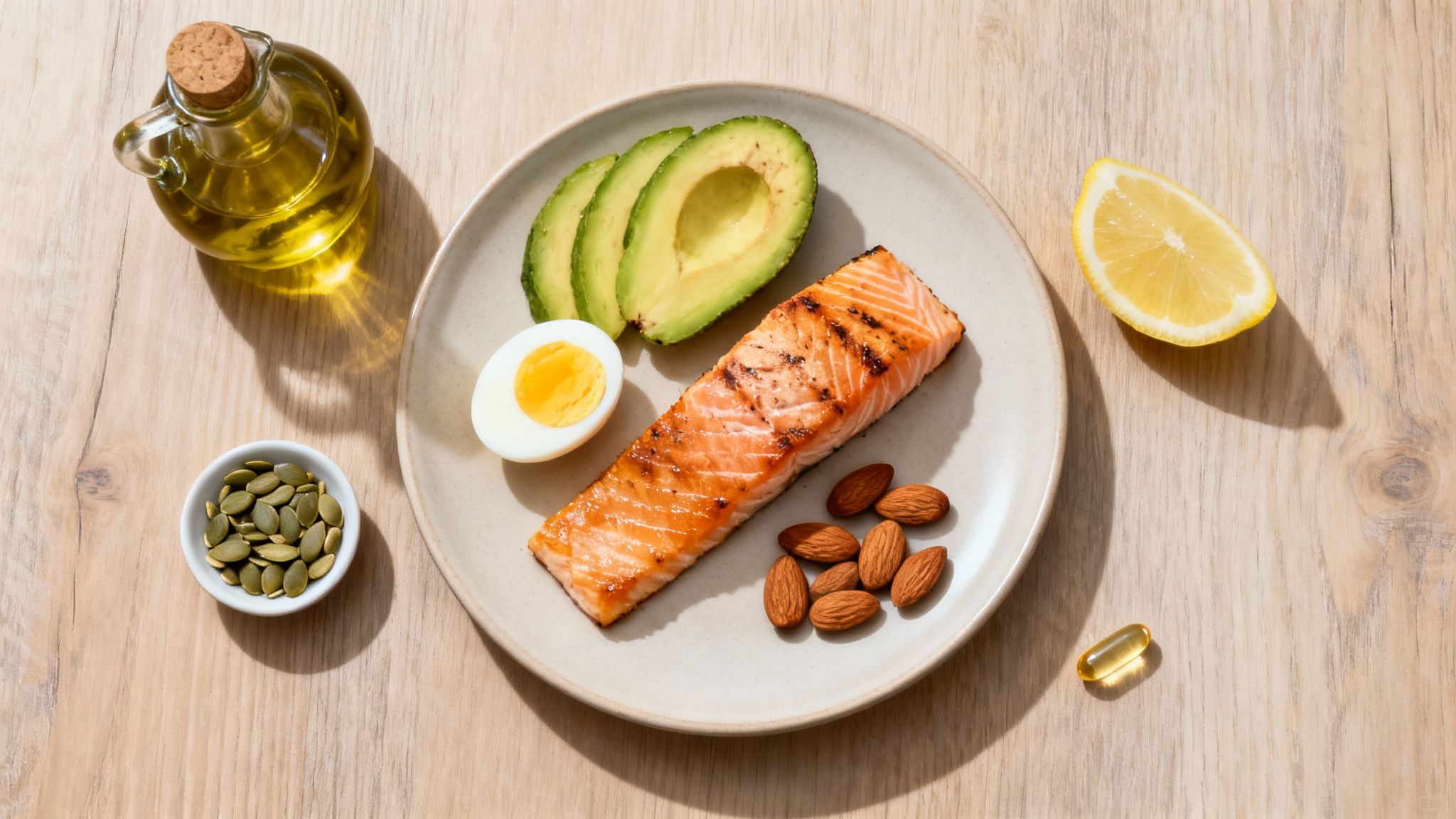
Training provides the stimulus, but nutrition gives you the raw materials. You can’t build a house without bricks and mortar, and your body can't synthesize hormones without the right fuel from your diet. Pairing an aggressive workout plan with a subpar diet is just a recipe for hormonal disaster.
A common mistake I see is men jumping on extreme diets to get lean, slashing calories or fats to almost nothing. This is a critical error. Testosterone is a steroid hormone, meaning it’s literally synthesized from cholesterol. When you go on a chronically low-fat diet, you starve your body of the very substrate it needs for production.
Likewise, staying in a huge caloric deficit puts immense stress on the body. This jacks up cortisol and sends a clear signal that it's a time of famine, not a time to be strong and virile. That hormonal environment is the exact opposite of what you need for a solid boost for testosterone. The goal isn't just weight loss; it's eating for performance and hormonal health.
Getting Your Macros Right
Setting up your macronutrients—protein, carbohydrates, and fats—doesn’t have to be a complex science. The main focus should be providing enough energy for your body to function and the right materials for hormone synthesis.
- Protein: Absolutely essential for muscle repair and general health, but it doesn't directly build testosterone. Make sure you’re getting enough to support your training. A good starting point for active guys is around 1 gram per pound of body weight from sources like lean beef, chicken, fish, and eggs.
- Carbohydrates: Carbs are your performance fuel. They power your workouts and can help keep cortisol from getting out of control. Don't ditch them. Instead, focus on complex sources like sweet potatoes, oats, and rice to support your energy and recovery.
- Fats: This is the real hormonal powerhouse. Healthy dietary fats are completely non-negotiable for anyone serious about optimizing their testosterone. Aim to get at least 25-30% of your total daily calories from fat.
The Critical Role of Healthy Fats
Not all fats are created equal. The types you eat have a direct say in your hormonal profile. Your diet needs to be rich in monounsaturated and saturated fats, as both play key roles in testosterone synthesis.
For instance, men who build their diet around healthy fats often see better cholesterol profiles, which is closely linked to hormonal health. Think about regularly consuming monounsaturated fats from sources like avocados and olive oil.
Make these fat sources a priority:
- Avocados: Loaded with monounsaturated fats.
- Olive Oil: A true staple for any hormone-supportive diet.
- Nuts and Seeds: Almonds, walnuts, and pumpkin seeds are all fantastic choices.
- Whole Eggs: Don’t you dare throw out the yolk! It's packed with the cholesterol and micronutrients essential for hormone production.
- Fatty Fish: Salmon and mackerel provide critical omega-3s, which help keep inflammation in check.
Forget the outdated fear of dietary fat. Consuming enough of the right kinds is one of the most powerful nutritional levers you can pull for a natural testosterone boost. It provides the literal foundation for the hormones you're working so hard to produce.
Key Micronutrients for Production
Beyond the big three macros, certain vitamins and minerals are essential cofactors in the testosterone production line. If you have a deficiency in any of these key areas, it can create a serious bottleneck, no matter how perfect your calories and fats are.
- Zinc: This is arguably the most important mineral for male hormonal health. It plays a direct role in the enzymatic processes that create testosterone. Oysters are the most potent source by far, but red meat and pumpkin seeds are great, too.
- Magnesium: Intense training and stress are notorious for depleting magnesium levels. It’s vital for sleep quality and countless bodily functions, including hormonal regulation. Load up on leafy greens like spinach, almonds, and cashews.
- Vitamin D: Often called the "sunshine vitamin," it really functions more like a hormone in the body. The cells in the testes have Vitamin D receptors, and study after study links higher Vitamin D levels with higher testosterone. Get some regular, safe sun exposure and eat fatty fish like salmon.
For guys who train hard or have dietary restrictions, getting enough of these micronutrients can be a real challenge. If your diet isn't as varied as it should be, exploring high-quality organ supplements can be a fantastic way to get a dense, bioavailable source of these vital nutrients.
Finally, what you don't eat and drink is just as important. Excessive alcohol is a known testosterone killer. It messes with your sleep, can increase the conversion of testosterone to estrogen, and is directly toxic to the testes. Simply limiting your alcohol intake is a simple but powerful step toward creating a pro-testosterone internal environment.
Mastering Sleep and Stress for Hormonal Balance

You can have the most dialed-in training and nutrition plan on the planet, but if your sleep and stress are out of control, you're just spinning your wheels. These two factors are the silent architects of your hormonal environment. They can either amplify all your hard work in the gym and kitchen or completely tear it down.
Think of it this way: training and diet are deposits into your hormonal bank account. Poor sleep and high stress? Those are constant, automatic withdrawals that drain your balance. To actually get ahead, you have to plug these drains first.
Your Nightly Hormonal Reset
Sleep isn’t just downtime; it’s when your body performs its most critical hormonal maintenance. The lion's share of your daily testosterone production happens while you sleep, specifically during those deep REM cycles. Skimping on sleep directly cuts into this vital production window.
It’s not a small effect, either. Getting less than 5 hours of sleep a night can slash your testosterone levels by as much as 15%. That's a massive hit—enough to completely negate the benefits of a perfect week of training. The goal isn't just more sleep, but better, higher-quality sleep.
For a deeper dive into optimizing your rest, check out these strategies to improve sleep quality naturally. It's a cornerstone of recovery and hormonal health.
Treat sleep like a non-negotiable part of your training. Prioritizing 7-9 hours of consistent, quality sleep is one of the most powerful moves you can make for testosterone. It’s the foundation that everything else is built on.
Here’s a simple checklist to lock in your sleep hygiene, starting tonight:
- Make Your Bedroom a Cave: It needs to be cool, dark, and quiet. Think blackout curtains, a lower thermostat, and zero distracting lights or noises.
- Kill the Screens Before Bed: That blue light from your phone and laptop actively messes with melatonin production—the hormone that signals "it's time to sleep." Put all screens away at least an hour before you hit the pillow.
- Set a Consistent Schedule: Going to bed and waking up around the same time every day, even on weekends, regulates your internal body clock (your circadian rhythm).
Taming the Silent Hormone Killer
Chronic stress is the other major saboteur of your T-levels. When you're constantly under pressure, your body pumps out the stress hormone cortisol. The problem is, cortisol and testosterone have an antagonistic relationship; they're built from the same precursor hormone, pregnenolone.
This means your body is essentially forced to choose. When cortisol is high, the raw materials are diverted away from making testosterone to deal with the perceived threat. An occasional cortisol spike is normal, but chronically elevated levels create an internal environment that’s fundamentally anti-testosterone.
Finding ways to manage this stress isn't a "nice to have"—it's a requirement for hormonal balance. For a better grasp on how this all connects, our guide on how to recover faster after your workouts offers key insights that tie directly into stress management.
Practical Stress-Reduction Techniques:
- Schedule Your Downtime: Don't just hope for it to happen. Actively block off time in your calendar for things that let you disconnect, whether it's reading a book, listening to music, or just getting outside.
- Practice Mindful Breathing: When you feel that pressure building, take five minutes. Just focus on slow, deep belly breaths. This simple act can drop your immediate cortisol response significantly.
- De-stress Actively: Engage in a low-intensity activity you actually enjoy, like a walk, some light stretching, or a hobby. It shifts your focus and helps your nervous system unwind without piling on more physical strain.
Navigating Supplements with a Scientific Eye
The supplement aisle can feel like the Wild West, especially when it comes to anything promising a testosterone boost. The marketing claims are loud, but the scientific proof is often quiet, leaving you wondering what actually works.
Before you even think about opening your wallet, you need a solid philosophy: supplements are, at best, a minor addition to a rock-solid foundation of training, nutrition, and lifestyle. They simply can't fix a terrible diet or a chronic lack of sleep.
Still, this industry is absolutely booming. Projections show the global testosterone booster supplement market is on track to nearly double, jumping from about $3.74 billion to $6.75 billion between 2023 and 2030. That explosion is driven by an aging population and a massive interest in health and fitness, which makes being an informed consumer more critical than ever. You can dig into the specifics of this market growth on Grandview Research.
With that reality check in place, let's cut through the hype and look at some of the most talked-about ingredients with a critical eye.
Evaluating Key Ingredients
When you scan a product label, you'll find a cocktail of vitamins, minerals, and herbal extracts. Some of these actually have decent evidence backing their role in hormonal health—especially if you're deficient—while others are on much shakier ground.
Here’s a breakdown of what you’ll commonly see:
- Ashwagandha: This is an adaptogenic herb that's been a staple in Ayurvedic medicine for centuries. Modern research suggests it can help lower cortisol levels. Since cortisol (your primary stress hormone) and testosterone have a see-saw relationship, keeping cortisol in check can indirectly support healthy testosterone production.
- Tongkat Ali (Eurycoma longifolia): A Southeast Asian herb that has shown real promise in studies for increasing free testosterone. It seems to work by reducing levels of Sex Hormone-Binding Globulin (SHBG). When SHBG is lower, more testosterone is bioavailable for your body to actually use.
- D-Aspartic Acid (DAA): This is an amino acid involved in your central nervous and endocrine systems. Some studies have found it can cause a temporary spike in testosterone, but the effect seems to be pretty short-lived. It’s particularly fleeting in men who already have healthy testosterone levels to begin with.
Remember, the goal of a smart supplement strategy isn't to find a magic pill. It's to strategically fill potential gaps or support existing systems—like managing stress—that you're already addressing through your lifestyle.
Supplements like these might give you a slight edge, but they are not the main engine driving your hormonal health. For a much deeper dive into how these compounds fit into a larger strategy, you can explore our detailed guide on the best testosterone booster ingredients and their mechanisms.
At the end of the day, your focus should stay locked on the pillars that do the real work: lifting heavy, eating right, sleeping deep, and keeping stress managed.
Your Questions About Boosting Testosterone, Answered
When you're starting down the path of optimizing your testosterone, a few practical questions always come up. Let's clear the air on some of the most common ones so you can move forward with a solid plan.
How Long Until I Actually See Results?
This is the big one, and the honest answer is: it depends entirely on your starting point and how consistent you are. There's just no universal timeline.
If you’re walking in with a major deficiency in something like Vitamin D or zinc, you might feel a noticeable shift in your energy and mood within a few weeks of correcting it. That's the low-hanging fruit. But the deeper, more sustainable changes that come from building muscle and improving body composition? Those take time.
Realistically, you should give yourself 3 to 6 months of consistent, dedicated effort across training, nutrition, and sleep. That's the window where you'll likely see meaningful shifts, both in how you feel day-to-day and what your lab reports show. You have to be patient. This is a marathon, not a sprint.
This chart shows how to think about adding supplements to your strategy—only after the foundation is solid.
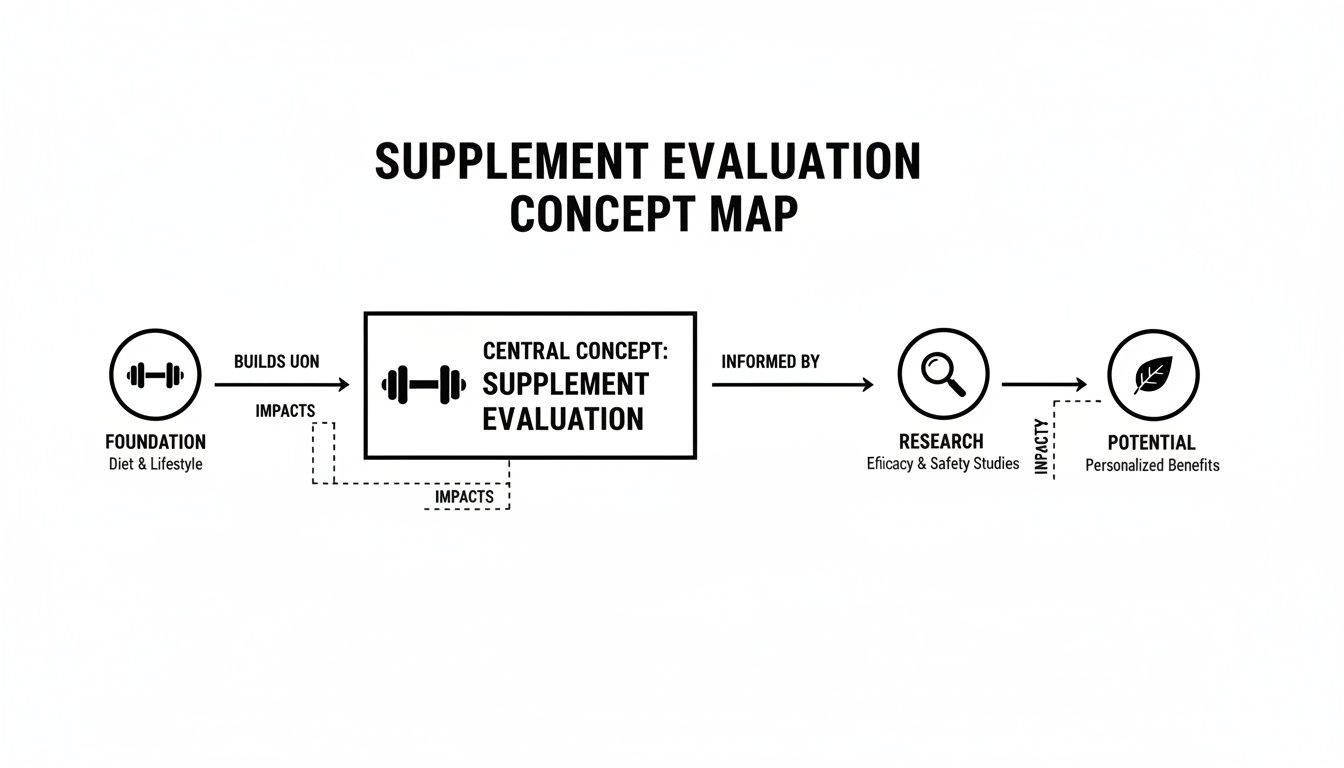
As you can see, supplements are the final piece of the puzzle, not the starting point. They come into play only after your diet and training are locked in, and they should always be backed by solid research.
Do I Have to Give Up Coffee or Alcohol?
Good news first: you absolutely don't need to ditch your morning coffee. In moderation, it can even give your workout performance a nice kick.
The real problem here is excessive alcohol consumption. It’s directly toxic to the Leydig cells in the testes—where testosterone production happens—and throws a wrench in the entire hormonal cascade.
For the best results, try to limit alcohol to just a few drinks per week and steer clear of binge drinking altogether. It’s a simple adjustment, but one that can have a surprisingly powerful impact on your hormonal health.
Prioritizing your hormonal health doesn't mean living a life of total restriction. It's about making smart, consistent choices that compound over time, like choosing another hard training session over a night of heavy drinking.
Think of every smart decision as a deposit into your long-term vitality. You're building a stronger, more resilient version of yourself, one choice at a time.
At Revolution Science, we focus on clean, research-backed supplements that support your performance goals without any of the pseudoscience. Our formulas are built to complement the hard work you put in at the gym and in the kitchen. You can explore our transparent, no-nonsense solutions at https://rvsci.com.