
Your Cart is Empty


Best Test Booster: A Science-Based Guide to the best test booster
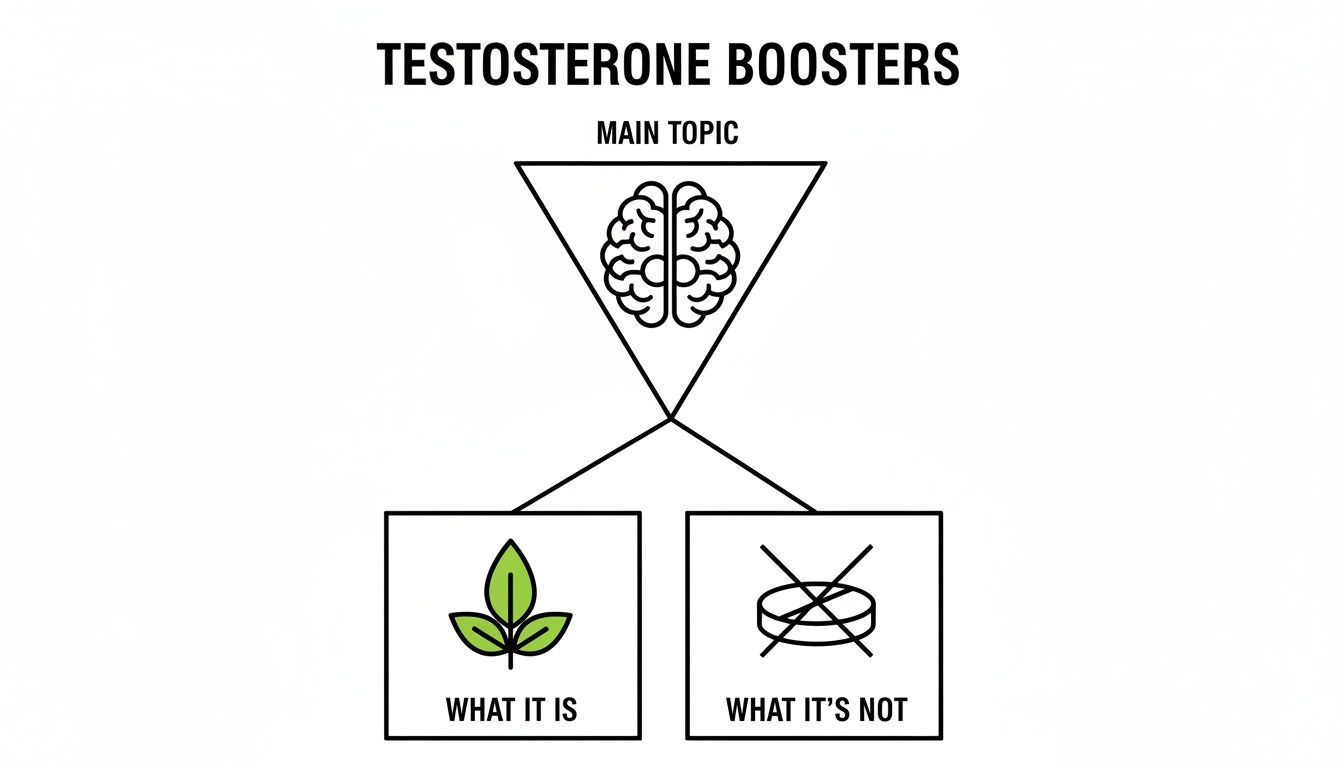
When you're searching for the best test booster, it's critical to know what you're actually looking for. These aren't synthetic steroids. Think of them as nutritional support systems for your body.
A top-tier product pulls together research-backed vitamins, minerals, and herbal extracts. The goal? To help your body optimize its own natural hormone production, working hand-in-hand with your training, diet, and sleep.
What Exactly Is a Test Booster, Anyway?
Let's cut through all the marketing hype and get straight to it. A "test booster" is a dietary supplement built to support and encourage your body’s existing testosterone production pathways.
Don't think of it as a V8 engine swap for your four-cylinder. A better analogy is giving the engine you already have premium fuel, a high-performance oil change, and a tune-up. It simply provides the key nutrients your endocrine system needs to run at its best.
These supplements usually contain a strategic blend of ingredients, including:
- Essential Minerals: Zinc and magnesium are foundational. They’re the literal building blocks for hormone synthesis.
- Key Vitamins: Vitamin D and certain B vitamins play crucial roles in keeping the entire hormonal regulation process running smoothly.
- Herbal Extracts: Things like Ashwagandha, Fenugreek, and D-Aspartic Acid are often included for their researched effects on hormonal balance and, just as importantly, stress reduction.
It’s just as important to understand what a test booster is not. It is not an anabolic steroid. It is not testosterone replacement therapy (TRT). Those are serious pharmaceutical interventions that introduce synthetic or bioidentical hormones directly into your system.
A natural test booster, on the other hand, works from the inside out. It provides the raw materials and signaling support to help your body produce its own hormones more effectively.
Setting Realistic Expectations
The whole point of using a quality test booster is optimization, not a night-and-day transformation. They work best when they're one part of a disciplined lifestyle—one that already includes consistent resistance training, solid sleep, and a nutrient-dense diet. For many guys, they’re a great tool for bridging nutritional gaps or just getting a bit of an extra edge.
A supplement should be exactly that—supplemental. The best test booster can help fine-tune your internal systems, but it can’t undo the damage from poor sleep, a junk food diet, or skipping the gym. Real progress always starts with the fundamentals.
The market for these products is exploding, which tells you a lot about the growing interest in proactive health and performance. The global testosterone booster supplements market is valued at USD 1,050.0 million in 2025 and is projected to nearly double to USD 1,980.0 million by 2035. This growth shows just how popular they’ve become among athletes and aging men looking for a natural way to support their vitality. You can explore more about these market trends and their driving factors to see where the industry is headed.
The Science Behind Effective Ingredients
A supplement is only as good as what’s inside the bottle—not the flashy marketing on the outside. To find the best test booster, you’ve got to get past the hype and understand the science behind the key ingredients.
Let’s dig into how and why specific vitamins, minerals, and herbs actually work to support your body's natural hormonal environment.
Think of your hormone system like a high-performance engine. For it to run at peak horsepower—meaning optimal testosterone levels—every part needs to be clean, lubricated, and fueled correctly. The right ingredients in a booster act like premium fuel and high-grade oil, giving the system exactly what it needs to fire on all cylinders.
This is all about natural support, not artificial replacement.
The whole point is to optimize the systems you already have, not to introduce something foreign. We’re aiming to fine-tune the engine, not drop in a new one.
To get a clearer picture of how these compounds work together, let's break down some of the most researched and effective ingredients you'll find in a quality formula.
Common Test Booster Ingredients and Their Mechanisms
This table breaks down the heavy hitters in the natural testosterone support world—what they are, what they do, and how much you need for them to be effective.
| Ingredient | Primary Mechanism of Action | Effective Dosage Range |
|---|---|---|
| D-Aspartic Acid (DAA) | Stimulates the release of Luteinizing Hormone (LH) in the brain, which signals the testes to produce more testosterone. | 2,000–3,000 mg/day |
| Zinc | Acts as an essential building block for testosterone synthesis. A deficiency can directly impair production. | 15–30 mg/day |
| Magnesium | Aids in sleep quality and may increase free testosterone by reducing its binding to Sex Hormone-Binding Globulin (SHBG). | 200–450 mg/day |
| Fenugreek | May inhibit the enzymes aromatase and 5-alpha reductase, which convert testosterone into estrogen and DHT, respectively. | 500–600 mg/day |
| Ashwagandha | An adaptogen that helps lower the stress hormone cortisol, which has an inverse relationship with testosterone. | 300–600 mg/day |
Each of these ingredients plays a unique role, but they work best as a team. A well-formulated product doesn't just throw everything at the wall to see what sticks; it combines these compounds strategically to create a synergistic effect.
The Brain Signaler: D-Aspartic Acid
One of the most direct-acting players is D-Aspartic Acid (DAA). This amino acid works right at the top of the command chain—in your brain's hypothalamus and pituitary gland.
Think of Luteinizing Hormone (LH) as a text message sent from headquarters (your brain) to the factory floor (your testes) with one simple instruction: "Make more testosterone." DAA essentially hits 'send' on that message, stimulating LH release to kickstart the whole production process.
The Foundational Minerals: Zinc and Magnesium
If DAA sends the signal from the top, minerals like Zinc and Magnesium are the essential raw materials on the factory floor. You can send all the messages you want, but if the workers don't have the parts they need, the assembly line grinds to a halt.
- Zinc is a non-negotiable part of the enzymatic process that turns cholesterol into testosterone. Run low on zinc, and that critical conversion process sputters.
- Magnesium is huge for sleep quality and lowering inflammation, two fundamentals for healthy hormone production. It also appears to help increase free testosterone by preventing it from getting locked up by Sex Hormone-Binding Globulin (SHBG).
You’ll often see these two bundled with Vitamin B6 as "ZMA." It's a classic stack for athletes because hard training and sweat can deplete these minerals, directly impacting recovery and hormonal balance. To see how these core principles are applied, you can learn more about what goes into a top-tier testosterone enhancer.
The Hormone Balancer: Fenugreek
Making more testosterone is only half the battle. You also have to protect it, and that’s where botanicals like Fenugreek come in. This herb contains compounds called furostanolic saponins that are thought to help keep your testosterone levels where they should be.
Its main job seems to be policing the enzymes that convert testosterone into other hormones. By potentially limiting the activity of aromatase (which turns testosterone into estrogen) and 5-alpha reductase (which turns it into DHT), Fenugreek helps ensure more of your testosterone stays in its free, biologically active form.
The Stress Manager: Ashwagandha
Finally, let's talk about the silent killer of testosterone: chronic stress. When you’re constantly under pressure, your body pumps out the stress hormone cortisol.
Cortisol and testosterone are on a seesaw—when one goes up, the other goes down. If stress has its foot on one end of the seesaw, your testosterone levels simply can’t rise.
This is where an adaptogen like Ashwagandha becomes so incredibly valuable. It helps your body adapt to and manage stress more effectively. By helping to blunt chronically high cortisol levels, Ashwagandha essentially takes the foot off the seesaw, clearing the path for testosterone production to normalize.
Is a Test Booster Right for You
Figuring out if you should take a test booster isn't a simple yes or no. It’s about matching a supplement to your specific goals, where you are in life, and what your body actually needs. This is not a one-size-fits-all situation.
What a 25-year-old competitive lifter needs is worlds away from what a 45-year-old guy is looking for to get his edge back.
Think of it like picking tires for a car. A track-day monster needs slicks for grip, but a daily driver needs durable all-seasons. They're both tires, but they serve completely different masters. The right test booster for you depends entirely on the road you're on.
The real key is figuring out which profile you fit. Once you understand your unique situation, you can make a smart call on whether this kind of supplement belongs in your toolkit.
Athletes Seeking a Competitive Edge
For any serious athlete, performance is the name of the game. Whether you’re a powerlifter chasing a new PR or an endurance athlete trying to slash recovery times, your hormonal health is a huge piece of the puzzle. Testosterone is central to muscle protein synthesis, raw strength output, and how well your body bounces back from a brutal workout.
An athlete’s body is constantly under siege from physical stress, which can sometimes put a lid on natural hormone production. In this scenario, a test booster isn't a shortcut—it's a support system. It helps ensure your body has the micronutrients and herbal backup it needs to keep the factory running at full tilt, even when you're deep in a demanding training block.
For this crew, the big wins are:
- Enhanced Recovery: Keeping testosterone levels optimal can help accelerate muscle repair, letting you hit it hard more often.
- Improved Strength and Power: A balanced hormonal profile is the foundation for getting the most out of every single rep in the gym.
- Maintained Anabolic State: The right supplement can help keep you in a muscle-building (anabolic) state, which is absolutely critical for making consistent gains.
For the dedicated athlete, a test booster isn't about creating something from nothing. It's about optimizing the recovery and adaptation processes that are already being driven by hard work in the gym and discipline in the kitchen.
Men Navigating the Effects of Aging
Once you cross the 35 or 40-year-old mark, the conversation changes. It's less about hitting peak performance and more about holding onto vitality and your overall quality of life. It’s a simple biological reality that testosterone levels start to decline with age, typically dropping by about 1-2% every year after you hit 30.
This slow, steady dip can bring on changes you can really feel. You might notice your daily energy just isn't what it used to be, staying lean becomes a battle, or your libido and general drive have taken a hit. This isn't just in your head; it’s often a direct result of that natural hormonal shift.
For this group, a test booster plays a different, but just as vital, role. The goal is supportive—to help buffer the effects of that natural decline. A formula packed with ingredients like Ashwagandha (to manage stress), Vitamin D, and Zinc can give your body the foundational support it’s missing. It’s all about helping your system run as efficiently as possible to promote better energy, mood, and physical well-being as you get older. Our guide on testosterone pills digs deeper into how these supplements are built for different needs.
Making an Informed Decision
At the end of the day, the choice comes down to knowing yourself and your goals. The supplement market definitely reflects a growing interest in this area. Projections show the global test booster market hitting USD 3.5 billion in 2024 and climbing to an expected USD 6.2 billion by 2030, mostly driven by gym-goers and aging men. You can discover more about this market growth on strategicmarketresearch.com.
Before you pull the trigger, ask yourself a few honest questions:
- Are my fundamentals locked in? Are you actually sleeping 7-9 hours a night? Is your diet clean and nutrient-dense? Are you training hard and consistently? A supplement can't patch up a broken foundation.
- What am I really trying to achieve? Are you trying to smash a lifting plateau, or are you just looking to feel more energized and dialed-in day-to-day?
- Have I talked to a professional? A quick chat with your doctor can help rule out any underlying health issues and give you the green light that a supplement is a safe move for you.
A test booster is only right for you if it supports a clear goal and adds to an already healthy lifestyle. It’s a tool—and just like any tool, how well it works depends on the person using it.
How to Choose a Safe and High-Quality Supplement
Walking down the supplement aisle can be overwhelming. Flashy labels and bold promises are everywhere, but how do you separate the genuinely effective formulas from the cleverly marketed duds? It's a skill, and learning it is crucial for protecting both your health and your wallet.
Think of it as becoming a detective for your own well-being. The clues are all there on the bottle; you just have to know how to read them. With a few key things to look for, you can cut through the noise and confidently pick a product that’s both safe and potent.

Look for Third-Party Testing Seals
This is your first—and most important—line of defense. The supplement industry doesn't have the same strict oversight as pharmaceuticals, so third-party testing is the gold standard for verifying quality and safety.
These independent labs do two critical things: they confirm that what's on the label is actually inside the bottle, and they check for nasty contaminants like heavy metals or banned substances.
Keep an eye out for these seals on the packaging:
- NSF Certified for Sport: This is a top-tier certification. They test for over 270 substances banned by major athletic organizations and verify the label's accuracy.
- Informed-Sport: Much like NSF, this program tests every single batch of a product for banned substances before it ever hits the shelves.
- USP Verified: The United States Pharmacopeia (USP) seal is another great sign. It confirms the product’s purity, potency, and that it was made following good manufacturing practices (GMP).
Spotting one of these logos tells you the company actually invests in quality control. For any serious athlete or health-conscious person, it’s a non-negotiable.
Avoid Proprietary Blends at All Costs
You've probably seen it before: an ingredient list with a fancy name like "Performance Matrix" or "Testosterone Support Complex," followed by a single dosage for the whole group. This is a proprietary blend, and it’s a massive red flag.
Why is it such a problem? It lets companies hide how much of each ingredient is in the mix. They can load up the blend with cheap fillers and then add just a "pixie dust" amount of the expensive, effective ingredients to get them on the label.
A proprietary blend is a black box. You have no idea if you're getting clinically effective doses of key compounds like D-Aspartic Acid or Ashwagandha. A transparent brand will list every single ingredient and its exact dosage.
A high-quality company is proud of its formula and has nothing to hide. If a brand is concealing its dosages, you have to wonder what else they aren't telling you.
Scrutinize Marketing Claims and Labels
Finally, just use a little common sense. Trustworthy brands build their claims on solid science and promote realistic results. The shady ones rely on pure hype.
Here’s a quick gut-check list for spotting red flags:
- Outrageous Promises: If a supplement claims you’ll "pack on 20 lbs of muscle in 30 days" or get "steroid-like results," just walk away. Natural supplements support your body; they don't create miracles overnight.
- No Dosing Information: Beyond blends, some products might not list dosages at all. This is an immediate sign of a low-quality, untrustworthy brand.
- Lack of Company Information: Can you easily find the company’s contact info, address, or customer service? A legit business stands behind its product and is easy to reach.
- Auto-Ship Traps: Be very careful with "free trial" offers. They often lock you into expensive monthly subscriptions that are a nightmare to cancel.
Choosing the right test booster comes down to doing your homework. By making third-party testing a priority, demanding a transparent label, and seeing past the marketing hype, you can make a smart, safe investment in your health and performance.
Lifestyle Habits That Naturally Boost Testosterone
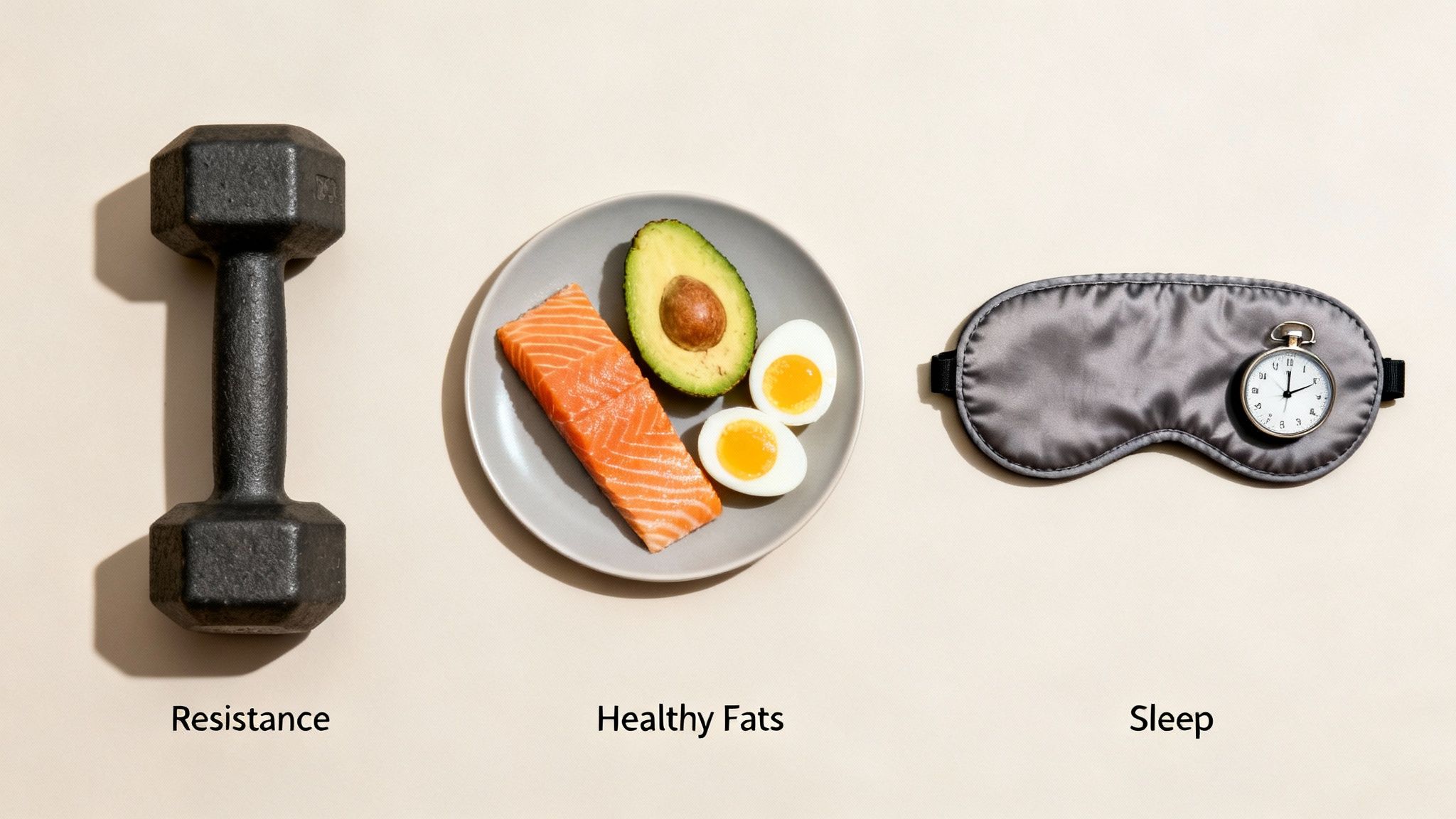
Let’s get one thing straight: supplements are designed to support, not replace. It’s a fundamental truth in performance nutrition that often gets overlooked. No pill or powder, no matter how perfectly formulated, can ever outperform a solid foundation of healthy habits. Before you even think about adding a test booster to your cart, your first job is to dial in the lifestyle pillars that have the biggest, most lasting impact on your natural hormone production.
Think of it like building a high-performance engine. A great supplement might be the high-octane fuel, but it’s useless if the engine itself is poorly maintained. If you’re not getting enough sleep, eating junk, and letting stress run your life, you're essentially trying to fuel a broken machine. The real gains, the ones that stick, come from mastering the fundamentals first.
Prioritize High-Quality Sleep
Sleep isn’t just downtime; it’s when your body gets to work on its most important hormonal processes. This is prime time for repair, recovery, and hormone synthesis. In fact, the majority of your daily testosterone release happens while you’re asleep, making it an absolute non-negotiable for hormonal health.
The data doesn't lie. Just one week of sleeping only five hours a night can slash daytime testosterone levels by 10-15% in healthy young men. That’s a staggering drop—it’s like aging yourself a decade in just seven days.
Aim for a solid 7-9 hours of quality, uninterrupted sleep every single night. Treat your bedtime with the same discipline you bring to the gym. This habit alone is probably the single most powerful natural testosterone booster you have.
Master Your Nutrition
Food is information. It provides the literal raw materials your body needs to build hormones. Testosterone is made from cholesterol, so if your diet is short on healthy fats, you're cutting off the supply chain at the source. The same goes for key micronutrients that act as the spark plugs for your entire endocrine system.
Build your diet around these cornerstones:
- Healthy Fats: Load up on sources like avocados, nuts, seeds, olive oil, and fatty fish like salmon. These provide the essential building blocks for making hormones.
- Crucial Micronutrients: Make sure you’re getting enough zinc (from red meat, shellfish), magnesium (leafy greens, nuts), and Vitamin D (sunlight, fortified foods). Deficiencies here are directly tied to lower T-levels.
- Sufficient Protein and Carbs: Protein is vital for muscle repair, while carbs fuel your workouts and help keep the stress hormone cortisol in check—both are critical for a healthy hormonal balance.
Make Resistance Training a Staple
All exercise is good, but when it comes to optimizing hormones, resistance training is king. Lifting heavy things, especially with big, compound movements like squats, deadlifts, and bench presses, triggers a powerful hormonal response from your body.
This kind of intense training sends a clear signal: "I need to get stronger." In response, your body boosts testosterone and growth hormone right after your workout. This isn't just a temporary blip, either. Consistent, progressive training helps raise your entire hormonal baseline over time. Even small details, like your choice of workout gear, can play a role; some guys even look into things like the best underwear for testicular health to avoid any potential restrictions.
Manage Stress and Limit Alcohol
Finally, you have to play defense. You can do everything else right, but if you let certain factors sabotage your efforts, you’ll just be spinning your wheels. Chronic stress is public enemy number one, as it jacks up your cortisol levels. As we’ve covered, cortisol and testosterone are like a seesaw—when one goes up, the other tends to go down. Simple stress-management tactics like meditation, deep breathing, or just taking a walk outside can make a world of difference.
Excessive alcohol is the other major offender. Heavy drinking can directly damage the cells in the testes that produce testosterone and can also accelerate the conversion of testosterone into estrogen. An occasional drink probably won't hurt, but regular or binge drinking will absolutely derail your progress.
By locking in these four pillars, you create an environment where your body can actually thrive. This holistic approach ensures that if you do add a supplement, it’s just amplifying an already optimized system for the best results possible. Our guide to boost for testosterone breaks down exactly how these habits create the perfect hormonal foundation.
Common Questions About Testosterone Boosters
Jumping into the world of supplements always stirs up a few questions. When it comes to something like a test booster, you want straight answers so you can feel good about your decision. Let’s cut through the noise and tackle some of the most frequent questions head-on.
Think of this as your go-to guide for the practical stuff. We’ll cover everything from how long it takes to feel a difference to potential side effects, giving you the complete picture.
How Long Does It Take to See Results
This is probably the first thing everyone wants to know, but there's no magic, one-size-fits-all timeline. The results you see really come down to your own body chemistry, the specific formula you're using, and how dialed-in your lifestyle habits are.
Generally, you can expect things to happen in phases:
- Weeks 2-4: The first shifts are usually subtle. You might notice more consistent energy throughout the day, a brighter mood, or a little extra drive in the gym.
- Weeks 8-12: This is when the more significant effects tend to kick in. Noticeable strength gains, visible changes in body composition (think less fat and more muscle), and a more pronounced impact on libido often take a bit longer to build up.
Remember, a natural test booster works with your body, not on it. It’s a gradual process that supports the hard work you’re already putting in with your training and diet. It's a slow burn, not a light switch.
Are There Any Side Effects
For most healthy adults, a high-quality natural test booster made with clinically studied ingredients is generally safe when you stick to the recommended dose. Unlike synthetic hormones, these are designed to support your body's own testosterone production, which dramatically lowers the risk.
That said, some people might experience mild side effects like an upset stomach or acne while their body adjusts. This is exactly why it’s so important to choose a product from a reputable brand that’s transparent about its ingredients and purity. It's always a smart move to chat with your doctor before starting any new supplement, especially if you have any pre-existing health conditions.
Do I Need to Cycle Testosterone Boosters
"Cycling" just means taking a supplement for a specific period, then taking a planned break. It’s a common strategy for a lot of supplements, including some test boosters, to help maintain their effectiveness over time.
A typical cycle might look like 8-12 weeks on, followed by a 4-week break. The whole idea is to prevent your body from getting too used to the ingredients. Always check the product label for specific instructions, as the manufacturer will have the best guidance for their unique formula.
As more people take a proactive approach to their health, the demand for these supplements is booming. Grand View Research predicts the testosterone booster market, valued at USD 3,735.4 million in 2023, will climb to an impressive USD 6,750.4 million by 2030. This growth is fueled by men looking for natural ways to support their vitality, a trend you can explore in their comprehensive market analysis. And for those exploring other avenues of hormonal support, our guide on HGH supplements offers more insight.
At Revolution Science, we build supplements based on science, not hype. Our commitment is to clean, effective formulas that support your performance goals. Explore our research-backed solutions and see the difference transparency makes.