
Your Cart is Empty


Building Endurance in Running: A Guide to building endurance in running
Ever wondered what separates someone who can effortlessly clock miles from someone who gets winded after a few blocks? It's not just about mental toughness. The real secret is buried deep in your physiology. Building serious running stamina is all about systematically upgrading your body's energy systems. When you understand the science, you can finally start training smarter, not just harder.
Think of your body as a high-performance engine. To run farther and faster, you need to make that engine more powerful and more fuel-efficient. This all comes down to a few key physiological adaptations that happen over time with the right kind of training.
Your Aerobic Engine: VO2 Max
At the core of all endurance is your VO2 max. This is simply the maximum amount of oxygen your body can take in and use during hard exercise. A higher VO2 max means your heart and lungs can pump more oxygen-rich blood to your muscles when they're screaming for it. It's the ultimate benchmark of your aerobic fitness.
When you're out there pounding the pavement, your muscles need oxygen to turn fuel (like carbs and fat) into the energy that keeps you moving. The better you are at this process, the longer you can go. High-intensity workouts, especially interval training, are one of the best ways to directly challenge and improve your VO2 max.
The Red Line: Your Lactate Threshold
While VO2 max is your engine's absolute peak potential, your lactate threshold (LT) is what determines how much of that power you can actually use for a sustained effort. You know that burning sensation you get in your legs when you're really pushing it? That's tied to lactate, a byproduct that builds up in your blood during hard efforts.
Your lactate threshold is that tipping point—the intensity where lactate accumulates faster than your body can clear it out. Once you cross it, you're forced to slow down. The whole game is about pushing that threshold higher through specific workouts like tempo runs. A higher LT means you can hold a faster pace for much longer before fatigue crashes the party.
By raising your lactate threshold, you're essentially moving your "red line" further up. This is what allows you to hold a tough 10K pace or finish a half marathon strong without hitting the dreaded wall. It's a total game-changer for your race-day performance.
Muscle Fiber Adaptation and Running Economy
Your muscles are made of different fiber types, and endurance training is all about developing your slow-twitch muscle fibers. These guys are the marathoners of your muscular system—they're incredibly resistant to fatigue and are experts at using oxygen to produce energy.
Consistent training, especially long, slow runs, builds more mitochondria (the tiny powerhouses inside your cells) within these fibers. This is a huge factor in improving your running economy, which is just a measure of how much oxygen you burn to run at a certain speed. A more "economical" runner is like a fuel-efficient car; they use less energy to go the same distance, which is key to running farther.
This all happens through a few key adaptations:
- More Capillaries: Training builds a denser network of tiny blood vessels around your muscle fibers, making it easier to deliver oxygen and clear out waste.
- More Mitochondria: Your body literally creates more and bigger cellular power plants, boosting your muscles' ability to produce aerobic energy.
- Better Enzymes: The activity of aerobic enzymes increases, which speeds up the whole process of converting fuel into motion.
Understanding what’s happening on a cellular level gives you the "why" behind every workout. Every run you do sends a specific signal to your body to adapt and get stronger. You're not just logging miles; you're engineering a more resilient, efficient endurance machine. And for runners looking to really dial in their performance, our guide on the best supplements for endurance athletes can offer some next-level insights.
Your Weekly Blueprint for Building Endurance
Knowing the why behind endurance is a great start. But now, we need to get practical and build a smart, week-to-week training structure.
A huge mistake I see runners make is just trying to cram in more miles without a real plan. That's a fast track to a plateau, or worse, burnout. A truly effective endurance plan is all about balance, weaving together three specific types of workouts. Each one sends a different signal to your body, telling it how to adapt and get stronger.
Think of it like this: your body is an engine. It takes in oxygen and fuel and turns it into pure, muscle-powering energy.
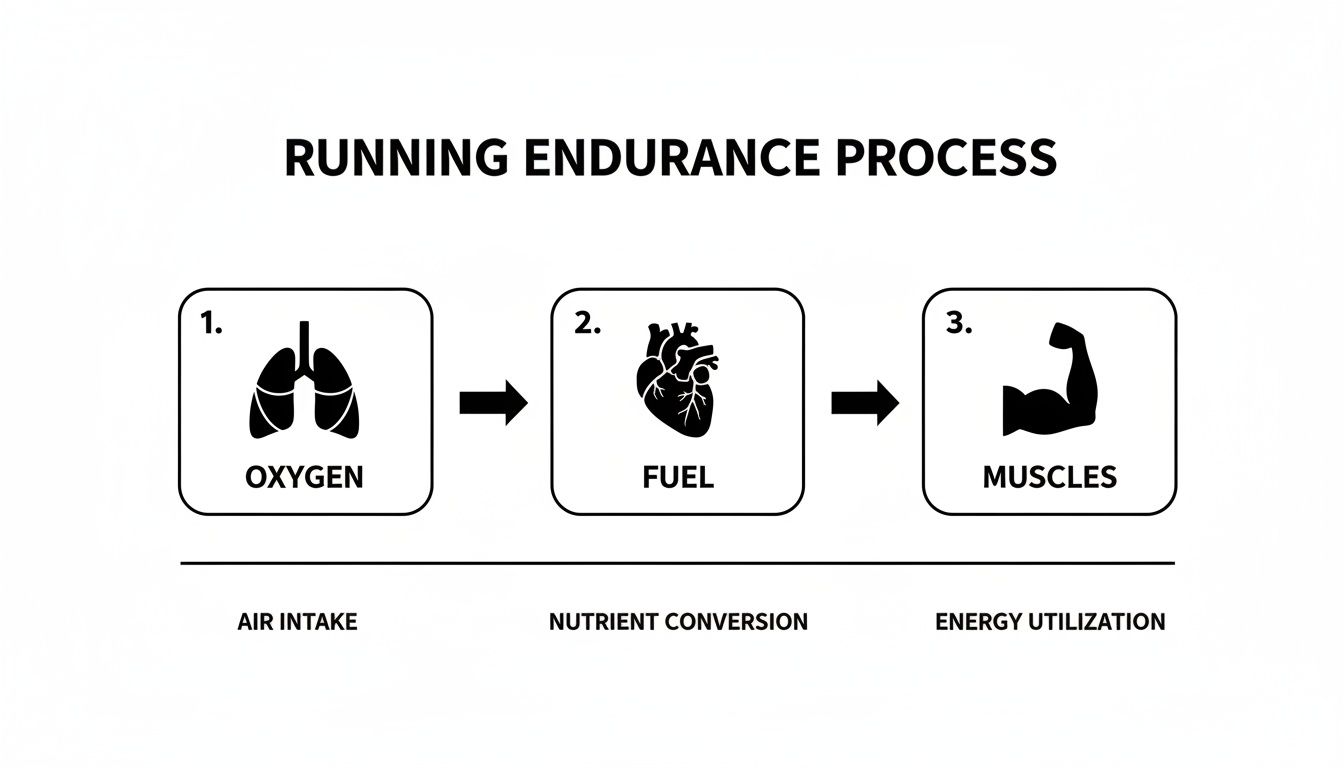
Every single part of that chain—from your lungs to your muscle cells—needs to be trained for peak efficiency. So, let’s get into the workouts that make each link stronger.
The Three Pillars of Endurance Workouts
To build a well-rounded running engine, you need to work on different systems. That’s where the "big three" workouts come in: Long Slow Distance, Tempo Runs, and Intervals. Each one serves a unique purpose in your training week.
This table breaks down the what, why, and how of each key session.
| Workout Type | Primary Goal | Feeling/Intensity (RPE) | Frequency |
|---|---|---|---|
| Long Slow Distance (LSD) | Build aerobic base and muscular endurance. | 3-4 (Easy, Conversational) | Once per week |
| Tempo Run | Increase lactate threshold for sustained speed. | 6-7 (Comfortably Hard) | Once per week |
| Interval Training | Boost VO2 max and top-end speed. | 8-9 (Hard to Very Hard) | Once per week/bi-weekly |
By hitting all three, you ensure you're developing your staying power, your cruising speed, and your top-end gear all at once. Let's dig into what each one actually feels like.
Mastering the Long Slow Distance Run
The Long Slow Distance (LSD) run is the absolute foundation of any good endurance plan. This is your one run a week where the only goal is time on your feet, not speed. The pace should be genuinely conversational. If you can't chat without gasping for air, you're going too fast.
Seriously, don't fall into the trap of pushing the pace here. Going too hard completely misses the point and negates the deep physiological benefits you’re after. A true LSD run is all about building your aerobic engine by:
- Increasing mitochondrial density, which means creating more tiny energy factories in your muscle fibers.
- Strengthening your heart muscle so it can pump more blood with every single beat.
- Training your body to burn fat for fuel more efficiently, saving your precious glycogen stores for when you really need them.
Think of it this way: you can't build a skyscraper on a shaky foundation. Your long run is that solid ground.
Pushing Your Limits with Tempo Runs
While long runs build your base, tempo runs are what raise your performance ceiling. This workout teaches your body to handle running faster for longer by improving your lactate threshold—the point where things start to get really uncomfortable.
The goal is to find that "comfortably hard" sweet spot. It's a pace you feel like you could hold for about an hour if you really had to.
A classic tempo session looks something like a 10-15 minute warm-up, then 20-40 minutes at that tempo pace, followed by a 10-15 minute cool-down. During the main set, you shouldn't be able to hold a full conversation, but you're not seeing stars either. It’s controlled, sustained effort.
A well-executed tempo run trains your body to clear lactate from your blood more effectively. This is the secret sauce that lets you hold a faster pace on race day without hitting the wall. It's probably the single most important workout for crushing your 10K, half marathon, or marathon goals.
Sharpening Your Speed with Interval Training
Finally, we have intervals. This is where you put the final polish on your fitness, sharpening your top-end speed and boosting your VO2 max. These workouts are simple: short, intense bursts of running followed by recovery periods of walking or easy jogging.
That high intensity pushes your heart and lungs to their max, triggering some powerful adaptations. The best part is how versatile they are.
- For 5K/10K Speed: Try 6 x 800 meters at a pace faster than your 5K goal, with a 400-meter jog to recover.
- For Endurance: A great one is 4 x 1 mile repeats at your 10K race pace, with a 3-4 minute jogging recovery.
These are tough workouts, so you only want to do them about once a week, and always on fresh legs. Combining these three sessions is the key to a powerful plan that will help you improve cardiovascular endurance and hit your running goals.
How to Pace Yourself and Track Your Gains
Running without any feedback is like driving blind. To actually get better at running long distances, you need to learn how to interpret what your body is telling you. This is where you graduate from just running to training smart, blending modern tech with good old-fashioned self-awareness.
Two of the most effective tools in your arsenal are Heart Rate (HR) training and the Rate of Perceived Exertion (RPE) scale. When you use them together, you get a complete picture of your effort, ensuring your easy runs are actually easy and your hard workouts are pushing you just the right amount.
Understanding Heart Rate Zones
Think of your heart rate as a direct line to your body's engine. By training in specific heart rate zones, you can precisely target different physiological systems for maximum benefit. Most runners operate on a five-zone system, which you can set up once you know your maximum heart rate.
While the old 220 minus your age formula is a decent starting point, it's not the most accurate. For a much better number, consider a field test or even a lab test. Once you have your max HR, your zones look something like this:
- Zone 1 (50-60% of Max HR): Very light activity. Think warm-ups, cool-downs, and active recovery.
- Zone 2 (60-70% of Max HR): This is the magic zone for building your aerobic base. It's where your long, slow runs should live.
- Zone 3 (70-80% of Max HR): A moderate effort, often called the "gray zone." It's tempting to run here all the time, but it's too hard for recovery and too easy for big performance gains.
- Zone 4 (80-90% of Max HR): Hard work. This is where you'll do tempo runs and lactate threshold work to build speed endurance.
- Zone 5 (90-100% of Max HR): All-out effort. You'll only be in this zone for short, intense intervals designed to boost your VO2 max.
The real discipline in endurance training is forcing yourself to stay in Zone 2 on your easy days. It prevents you from piling on unnecessary fatigue, which means you can hit your key workouts rested and ready to go hard.
The Art of Listening with RPE
Your heart rate monitor gives you the objective data, but the Rate of Perceived Exertion (RPE) scale is all about tuning into your body's subjective feedback. It's a simple 1-10 scale that asks, "How hard does this feel?" Learning to answer that question honestly is what separates good runners from great ones.
Here's a quick guide to how RPE lines up with your training:
- RPE 1-3: Extremely easy. You can hold a full conversation without catching your breath. This is pure recovery.
- RPE 4-6: Easy to moderate. This is your classic long-run pace. You can still chat, but it's becoming a bit more deliberate.
- RPE 7-8: Comfortably hard. Your tempo run effort lives here. You can spit out a few words at a time, but a conversation is off the table.
- RPE 9: Very hard. This is the world of interval training, where speaking is basically impossible.
- RPE 10: A true, all-out sprint that you can only hold for a few seconds.
The beauty of RPE is that it automatically adjusts for all the things your watch can't measure—a stressful day, a bad night's sleep, or brutal humidity. If you feel fantastic, a 7/10 effort might be a blistering pace. On a tired day, that same 7/10 effort will be much slower, but the training stimulus is identical. When you master managing your exertion, you can significantly improve your overall athletic performance and sidestep overtraining.
Mastering the RPE scale turns you into a truly intuitive athlete. It allows you to adjust your training on the fly, ensuring every run delivers the intended benefit without pushing you over the edge. It's about training how you feel, not just what the watch says.
This level of dialed-in training really pays off. Data from elite runners shows they can predict their marathon performance with an accuracy of ±2.5%. They achieve this precision because they’ve mastered tracking their total training load by blending duration with intensity. By combining the hard data from your HR monitor with the intuitive feedback from RPE, you create a powerful system to guide your journey to greater endurance.
Fueling Your Body for the Long Run
Let's be clear: your training plan is only half the battle. You can have the most dialed-in workout schedule on the planet, but it'll fall flat if you don't give your body the high-quality fuel it needs to perform and recover. Think of your nutrition and hydration as an integral part of training, every bit as important as your long runs or interval sessions.

Without the right fuel, you’re just asking to hit the dreaded "wall," suffer from muscle cramps, and drag out your recovery time. A smart fueling plan is your secret weapon for building endurance in running, making sure every mile feels strong and supported.
Pre-Run Fueling for Optimal Energy
What you eat before lacing up has a direct line to your energy levels and performance. The goal here is simple: top off your muscle glycogen stores—your body’s primary, high-octane fuel—without upsetting your stomach.
For most runs, you’ll want to eat a carbohydrate-rich meal or snack 1-3 hours before heading out. The key is to keep it low in fat and fiber, as both can slow digestion and cause problems mid-run.
A few tried-and-true examples:
- A bowl of oatmeal with a sliced banana. This gives you a great mix of complex and simple carbs for steady, sustained energy.
- A plain bagel with a thin layer of jam or honey. This is a classic, easily digestible choice for a quick energy hit.
- A piece of toast with peanut butter. This is best if you have a couple of hours before your run, as the fat takes a bit longer to process.
The closer you get to your run, the smaller and simpler that meal needs to be. For a crack-of-dawn run, sometimes just half a banana or a sports gel is all you need to get going.
Fueling During Long Runs to Avoid the Wall
Once your runs start pushing past the 60-90 minute mark, your body’s stored glycogen begins to dwindle. This is where on-the-run fueling becomes completely non-negotiable. Hitting "the wall" isn't just a saying; it’s a very real physiological event where your glycogen is depleted, forcing your body to slow to a crawl.
To keep that from happening, you have to start taking in carbs while you're still moving. The general guideline is to consume 30-60 grams of carbohydrates per hour after that first hour of running.
You’ve got plenty of options to get those carbs in:
- Energy Gels: Super concentrated, easy to stash in a pocket, and designed for fast absorption.
- Chews or Gummies: A great alternative if you can't stand the texture of gels.
- Sports Drinks: These are a two-for-one, providing both carbs and electrolytes to keep you topped up.
Practice your fueling strategy on your long training runs. Seriously, never try anything new on race day. This is your time to figure out what your stomach can handle and how often you need to refuel to keep your energy consistent.
Post-Run Recovery: Your First Priority
The job isn't done when you stop your watch. That 30-60 minute window right after a hard run is absolutely critical for recovery. Your muscles are like sponges during this time, primed to soak up nutrients to repair damage and restock those empty fuel tanks.
Your recovery meal or snack needs to hit two key components: carbohydrates to replenish glycogen and protein to kickstart muscle repair. A 3:1 or 4:1 ratio of carbs to protein is widely considered the sweet spot.
Some of the most effective recovery options are also the simplest:
- Chocolate milk: It's practically the perfect natural blend of carbs, protein, and fluids.
- A fruit smoothie with a scoop of protein powder. This is easy on the stomach and loaded with nutrients.
- Greek yogurt with berries and a bit of granola. A solid choice for a more substantial post-run meal.
Nailing your recovery nutrition helps slash muscle soreness, rebuilds your strength, and gets your body ready for the next session. For a deeper dive into fueling strategies, explore our guide on sports nutrition for endurance athletes.
Hydration and Electrolytes: The Unsung Heroes
Hydration is way more than just drinking water. When you sweat, you don't just lose water; you lose critical minerals called electrolytes. For runners, the most important one is sodium. These electrolytes are absolutely essential for maintaining fluid balance, nerve function, and muscle contraction.
When they get out of whack, you're looking at problems like muscle cramping, dizziness, and fatigue. This is why chugging plain water on long, hot runs can sometimes make things worse by diluting your body's electrolyte concentration even further. To support both performance and recovery, you might consider the benefits of Chlorella for athletes' endurance and recovery as part of your overall strategy.
For any run lasting longer than an hour, or any workout in the heat, you have to replace these lost minerals. Use an electrolyte drink mix or salt tabs to keep your body in balance, allowing your muscles to fire properly, mile after mile.
Building a Resilient Runner's Body
Let’s be honest: true endurance isn't just about the miles you log. It’s forged in the quiet moments between runs. A resilient runner's body is one that can take the stress of training, repair itself efficiently, and bounce back stronger. This is where strength, mobility, and recovery stop being optional extras and become non-negotiable pillars of your training.

Ignoring these areas is one of the fastest ways to get sidelined by injury or burnout. When you focus on building a robust support system for your running, you actually improve your efficiency and create a body that can handle the demands of increasing mileage, week after week.
Strength Training for Power and Prevention
A lot of runners worry that lifting weights will make them slow or bulky, but the reality is the complete opposite. Runner-specific strength work is your best defense against common injuries and a direct path to a more economical stride. Stronger muscles give you stability, generate more power, and soften the impact on your joints.
You'll want to focus on the key "running muscles"—your glutes, hips, core, and hamstrings. These are the real powerhouse of your stride.
- Glutes and Hips: Strong glutes are critical. They stop your pelvis from dropping with each footstrike, which is a common culprit behind IT band issues and runner's knee. Squats, lunges, and glute bridges are your best friends here.
- Core Stability: Think of your core as a stable platform. A strong one prevents energy leaks and wasted motion. Planks, side planks, and bird-dogs build that deep abdominal strength you need to hold good form when fatigue sets in.
- Single-Leg Strength: At its core, running is just a series of single-leg hops. Exercises like single-leg deadlifts and step-ups build the balance and stability that translate directly to a more powerful, controlled running gait.
Building a resilient body is a concept that has evolved over millennia. From persistence hunting 2 million years ago to the ancient Olympics, humans have continuously refined methods for physical endurance through trial and error. Discover more insights about the historical evolution of endurance training.
Mobility for a Fluid Stride
While strength provides stability, mobility is what allows your body to move through its full range of motion without restriction. If you have tight hips or stiff ankles, it can wreak havoc on your running form, forcing compensation patterns that cause injuries all the way up the chain.
The good news is a simple mobility routine doesn't have to take long, but the payoff is massive.
- Ankle Mobility: Stiff ankles can lead to a whole host of problems—calf strain, Achilles issues, and plantar fasciitis. Simple ankle circles and targeted calf stretches are a fantastic starting point.
- Hip Mobility: Most of us sit too much, leading to tight hip flexors that can shorten your stride and overload your lower back. Work in exercises like the couch stretch and deep lunges to open them up.
- Thoracic Spine (Mid-Back) Mobility: A stiff mid-back can mess with your arm swing and even your breathing. Cat-cow stretches and thoracic rotations can do wonders for your posture and running efficiency.
The Science of Real Recovery
Here’s a crucial fact: you don't get stronger during your runs. You get stronger when you recover from them. Recovery is when all the physiological adaptations you’re working for actually lock in. Skipping it is like putting in all the work and never collecting the reward.
Sleep: The Ultimate Performance Enhancer
Sleep is, without question, the most powerful recovery tool you have. During deep sleep, your body releases human growth hormone (HGH), which is absolutely critical for repairing muscle tissue and building it back stronger. Aiming for 7-9 hours of quality sleep every night isn't a luxury; it's a non-negotiable part of serious endurance training.
Active Recovery and Rest Days
A rest day doesn't always mean you have to be glued to the couch. Active recovery—think light activity like a brisk walk, gentle yoga, or an easy spin on a bike—can be incredibly beneficial. It boosts blood flow to tired muscles, helping to flush out metabolic waste and ease soreness without piling on more training stress.
For more pro tips, you might want to check out our guide on how to recover faster after your workouts.
Your Top Endurance Questions, Answered
Once you start getting serious about building endurance, the questions always follow. It’s a game of nuance, and getting the right answers can be the difference between hitting a new personal best and hitting a wall. Let's dig into some of the most common questions runners have when they’re trying to push further and get faster.
Think of this as your quick-hit guide for navigating the tricky parts of your training.
How Long Until I Actually Feel a Difference?
This is the big one, right? The honest answer is that it varies, but you’ll probably start feeling a change much sooner than you think. You can often notice small improvements—like hills feeling just a bit easier—in as little as 2 to 3 weeks. That initial boost is mostly your nervous system getting more efficient.
But for the deep, lasting physiological changes? Things like building more capillaries to deliver oxygen and increasing the mitochondria in your cells—that’s a longer game. You’re looking at more like 10 to 12 weeks of consistent, structured training to see that kind of major progress. Endurance is built layer by layer, so patience is your best friend here.
Am I Doing Too Much? The Fear of Overtraining
When you’re motivated, it’s easy to push too hard. Overtraining is a very real thing—it’s that state where you’re piling on more stress than your body can bounce back from. The result? Stagnation, burnout, and injury. Your best defense is learning to spot the early warning signs.
Keep an eye out for these red flags:
- Deep, persistent fatigue that a single rest day can't seem to shake.
- Your resting heart rate is higher than normal when you first wake up.
- Weird muscle soreness that just won't go away.
- You’re irritable, moody, or suddenly just don't feel like running anymore.
- You keep catching colds or other minor bugs, a sign your immune system is taking a hit.
If you start ticking these boxes, it's time to ease up. A few extra rest days or some light, active recovery is exactly what you need to get back on track.
Overtraining is just your ambition getting ahead of your recovery. The fix isn't to stop completely, but to get better at listening to what your body is telling you. Real progress happens when you balance the hard work with smart, intentional rest.
How Do I Fit Strength Training in with My Runs?
Juggling lifting and running can feel like a complex puzzle, but a simple framework makes it totally manageable. The whole point is for strength work to support your running, not sabotage it. Aim for two strength sessions a week, making sure you don't do them on back-to-back days.
A good rule of thumb is to pair your lifting with your easier running days. For example, you could do a full-body workout after an easy 3-miler on a Tuesday, and then hit the weights again on a Friday, which might be a rest or cross-training day.
Whatever you do, don't schedule a heavy leg day right before a key run, like your weekend long run or a tough interval session. You want your legs to be fresh and ready to go when it counts the most.
Race Day Fueling vs. Training Fueling: What's the Difference?
Think of your long training runs as the full dress rehearsal for race day nutrition. But while the principles are the same, the execution on race day is a little different. In training, you're teaching your body to be more efficient. On race day, it’s all about pure performance.
This usually means you can be a bit more aggressive with your fueling. For instance, where you might take a gel every 45-60 minutes in training, you might shorten that window to every 30-40 minutes in a race. The goal is to make sure your energy tank never even gets close to empty. You’ll also want to have that pre-race breakfast down to a science, giving yourself plenty of time to digest.
But the golden rule never, ever changes: nothing new on race day. Your entire training cycle is your lab. Use it to experiment and figure out exactly what products, timing, and amounts work for your body.
At Revolution Science, we know that breakthroughs happen when you dial in every detail. Our clean, research-backed supplements are designed to support the hard work you put in—helping you fuel properly, hydrate effectively, and recover completely. Push your limits with nutrition you can trust. Explore our performance solutions.