
Tu carrito está vacío


A Guide to Supplements to Build Muscle Mass
Building muscle is really a science of stress and repair. What you do outside the gym is just as critical as what you do inside. This guide is designed to cut through the hype and show you how strategic supplements to build muscle mass can be a powerful catalyst for all your hard work. Forget 'magic pills'—it's time to think of them as essential tools to amplify your results.
Your Blueprint for Effective Muscle Growth
Building serious muscle isn't just about throwing weights around; it’s a three-part system that has to work in harmony: progressive overload from your training, the right nutrition to fuel recovery, and a smart recovery plan. When you lift, you’re actually creating microscopic tears in your muscle fibers. The real growth happens afterward through a process called muscle protein synthesis (MPS), where your body repairs these fibers, making them stronger and bigger than before.
Think of it like building a house. Your workouts are the demolition crew, tearing down the old structure to make room for something better. Food—especially protein—is the bricks and mortar. But supplements? They're the specialized power tools that make the whole process faster and more efficient. They make sure the construction crew has everything it needs, exactly when it's needed, to rebuild bigger and better.
The Role of Smart Supplementation
Supplements will never replace hard work or a solid diet. Period. What they can do is fill in the gaps and enhance the biological processes that drive real growth. A well-designed supplement plan can help you:
- Accelerate Recovery: By getting key nutrients into your system quickly after a workout, you can kickstart the repair process, cut down on soreness, and get back to training sooner and stronger.
- Improve Performance: Certain ingredients can boost your energy, strength, and endurance during workouts, letting you push harder and create a greater stimulus for growth.
- Optimize Nutrition: Supplements make it easier to consistently hit your targets for crucial compounds like protein, creatine, and amino acids that are non-negotiable for activating MPS.
The goal isn’t to rely on supplements, but to use them as a precision tool. They help turn the potential you create in the gym into tangible, measurable muscle gains.
Beyond what you eat and lift, one of the most overlooked parts of muscle development is high-quality rest. You can optimize muscle growth through the power of sleep and truly maximize the returns on your effort.
Ultimately, your journey is your own. This guide provides an evidence-based playbook, starting by demystifying the core science before laying out a clear roadmap of the most effective, science-backed supplements. For a deeper dive into the specifics, check out our complete guide to muscle growth supplements. With this knowledge, you can start making smart, informed choices that align perfectly with your fitness goals. This is your blueprint for maximizing gains.
The Four Foundational Supplements That Actually Work
Walking down the supplement aisle can feel like navigating a minefield of hype. Every bottle promises the world, but only a handful are truly worth your time and money. Fortunately, decades of hard science and real-world results have shown us which ones consistently move the needle. These are the pillars of any smart supplement plan.
Think of it this way: your hard work in the gym and your dedication to recovery are the engine and chassis of your muscle-building vehicle. Supplements are the high-octane fuel that lets you get the most out of the machine you're building.
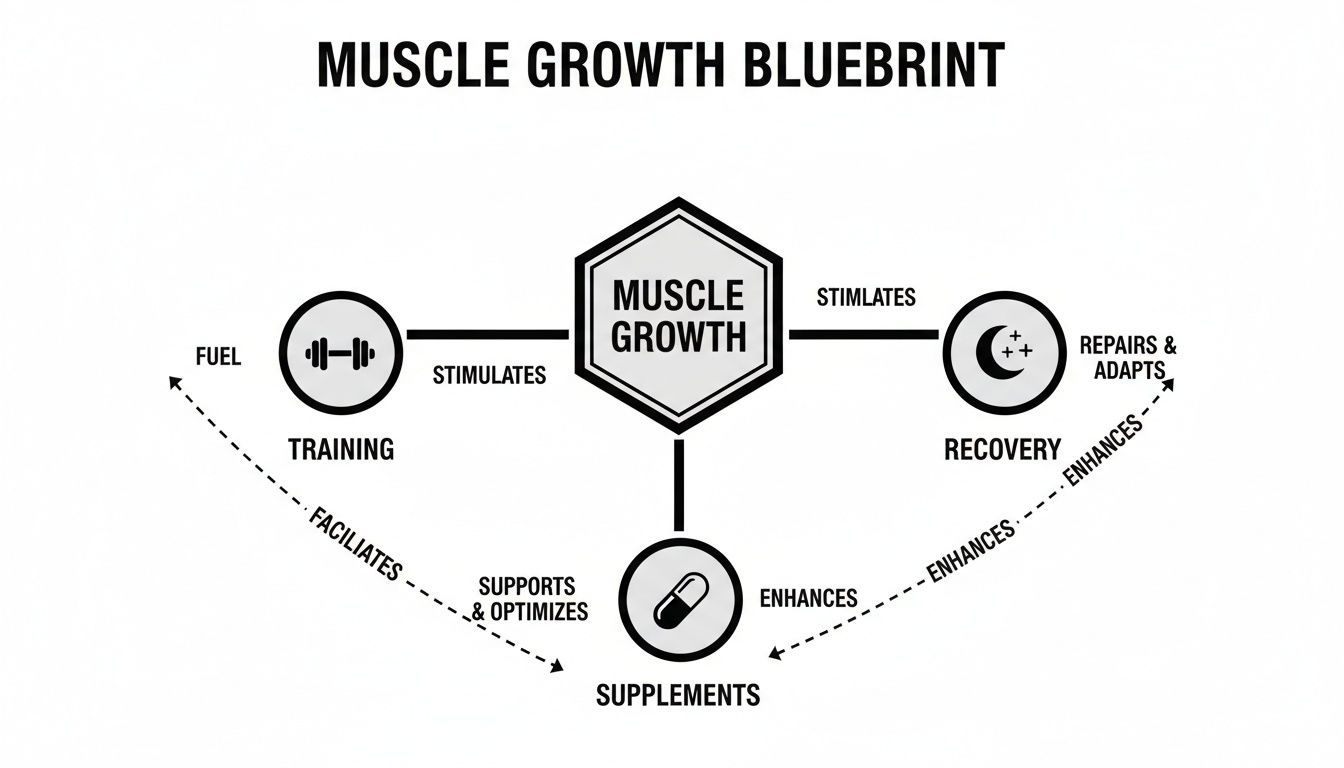
They don't work in a vacuum. Instead, they amplify the results you've already earned through sweat and discipline. Let's break down the core four.
Protein Powder: The Essential Building Blocks
Imagine your muscles are a brick wall. Each workout is a controlled demolition, breaking that wall down. Protein provides the fresh bricks and mortar needed to not only repair the damage but to build the wall back bigger and stronger than before. Without enough raw material, all that hard work is for nothing.
Protein powders are simply a convenient, high-quality, and fast way to get those essential building blocks into your system.
- Whey Protein: This is your rapid-response repair crew. It’s absorbed quickly, flooding your muscles with amino acids right after a workout. This is perfect for kick-starting the muscle repair and growth process (muscle protein synthesis) when your body is primed for it.
- Casein Protein: Think of this as the slow-and-steady overnight team. It digests gradually, releasing a sustained stream of amino acids for hours. This makes it ideal for a pre-bedtime shake to fuel recovery and prevent muscle breakdown while you sleep.
For most people, a serving of 20-40 grams of protein is the sweet spot. Hit the whey within an hour post-workout, and consider casein before bed or between meals. To really understand how these components work, our guide on amino acids supplements is a great next step.
Creatine Monohydrate: The Rapid Energy Recharger
If protein is the raw material, creatine is the power plant for the entire construction site. Your muscles run on a high-energy molecule called adenosine triphosphate (ATP) to fuel short, explosive efforts like a heavy set of squats. When you use ATP, it becomes ADP—essentially a dead battery.
Creatine is the ultimate recharger. It swoops in, donates a phosphate molecule to that "dead" ADP, and instantly turns it back into powerful ATP. This means you can grind out more reps and lift heavier before hitting a wall.
Creatine is one of the most researched supplements on the planet for a reason—it works. It saturates your muscles with phosphocreatine, which directly improves your strength, power, and even muscle size by pulling more water into the cells.
The dosing couldn't be simpler: 3-5 grams of creatine monohydrate daily. Don't overthink the timing; just take it consistently every day to keep your muscle stores topped off and ready for war.
The global market for bodybuilding supplements, projected to hit $47.4 billion by 2032, is built on staples like this. Studies consistently show that athletes using creatine can squeeze out 8-14% more repetitions per set—a massive advantage over time.
Beta-Alanine & Caffeine: The Performance Boosters
While protein and creatine are direct builders, beta-alanine and caffeine are performance enhancers. They let you train harder and longer, creating a more powerful stimulus for growth.
-
Beta-Alanine (The Fatigue Buffer): You know that burning sensation in your muscles that forces you to end a set? That’s acid buildup. Beta-alanine helps your body produce carnosine, a compound that acts like a buffer against that acid. The result? You can push through the burn for a few more crucial reps. A dose of 3.2-6.4 grams per day is effective, often split up to avoid a harmless tingling feeling.
-
Caffeine (The Central Nervous System Igniter): There's a reason it's the world's most popular stimulant. Caffeine sharpens your focus, reduces how hard an exercise feels, and helps you break through mental barriers. It lets you attack your workouts with more intensity from the very first rep. The sweet spot for performance is 3-6 mg per kilogram of body weight, taken about 30-60 minutes before you train.
The Core Four Muscle-Building Supplements at a Glance
To make it easy, here’s a quick-reference table that breaks down these foundational supplements. Think of this as your starting lineup for building a stronger, more muscular physique.
| Supplement | Primary Function | Typical Daily Dose | Best For |
|---|---|---|---|
| Protein Powder | Provides raw materials for muscle repair and growth. | 20-40 grams per serving | Post-workout recovery, meeting daily protein goals. |
| Creatine Monohydrate | Rapidly regenerates ATP for increased strength and power. | 3-5 grams daily | Anyone lifting weights looking for strength and size gains. |
| Beta-Alanine | Buffers muscle acid to delay fatigue and increase reps. | 3.2-6.4 grams daily | Athletes training in the 1-4 minute high-intensity range. |
| Caffeine | Increases focus, energy, and reduces perceived effort. | 3-6 mg/kg of bodyweight | Pre-workout to boost intensity and mental drive. |
These four supplements form a powerful, science-backed stack. They aren't magic, but when combined with consistent training and a solid diet, they provide a clear advantage in your pursuit of muscle growth.
Advanced Supplements for Serious Athletes
Once you've locked down the fundamentals and are consistently using the ‘Core Four’ supplements, you might hit a wall where progress seems to grind to a halt. This is exactly where advanced, Tier Two supplements come in, offering a specific, targeted edge for serious athletes. These aren't magic pills; think of them as precision tools meant to help you smash through stubborn plateaus, but they only work if your training, diet, and recovery are already completely on point.
It's like tuning a high-performance engine. Your foundational supplements are the premium fuel and high-grade oil keeping it running strong. These advanced supplements are the specialized tweaks—fine-tuning the air intake, upgrading the exhaust—that squeeze every last drop of power out of the machine.
HMB for Muscle Preservation
One of the most battle-tested supplements in this tier is HMB (Beta-Hydroxy Beta-Methylbutyrate). HMB is a metabolite of leucine, the undisputed king of amino acids for firing up muscle protein synthesis. But HMB's real talent isn't in building new muscle from scratch; its superpower is preventing the breakdown of the muscle you already have, a process called anti-catabolism.
Think of your muscle mass like a bank account. Your training and diet make deposits, but intense stress—like cutting calories or a brutal workout—forces withdrawals. HMB is the security guard standing watch, preventing those unauthorized withdrawals and protecting your hard-earned gains.
This makes HMB incredibly valuable in a few key situations:
- During Cutting Phases: When you're in a calorie deficit to shed fat, your body is primed to cannibalize muscle tissue for energy. HMB acts as a shield for your lean mass.
- For Masters Athletes: As we get older, our bodies naturally become more prone to muscle loss. HMB can help veteran lifters hold onto their muscle and bounce back faster from training.
- During High-Volume Training: If you’re redlining it with extreme training volume, HMB can help reduce muscle damage and speed up your recovery.
The go-to effective dose is 3 grams per day, which is usually split into three separate 1-gram servings.
Citrulline Malate for Enhanced Performance
Next on the list is Citrulline Malate, a powerhouse compound that serves as a precursor to nitric oxide (NO) production. When you take citrulline, your body converts it into arginine, which then kicks NO levels into high gear.
Picture your blood vessels as highways. Nitric oxide is the traffic controller opening up extra lanes, allowing more blood, oxygen, and nutrients to rush to your working muscles. This enhanced blood flow, known as vasodilation, doesn't just give you a better "pump"—it delivers real performance benefits. It helps flush out metabolic junk like ammonia that brings on fatigue, letting you grind out more reps and push sets harder and longer.
Studies have shown that taking 6-8 grams of citrulline malate about 30-60 minutes before hitting the gym can seriously cut down on muscle soreness and increase the number of reps you can perform to failure.
The Unsung Heroes: Zinc and Vitamin D
Finally, don't sleep on key micronutrients that play a crucial support role. While they might not seem as direct as creatine or HMB, falling short on Zinc and Vitamin D can totally hamstring your muscle-building potential by throwing your hormones out of whack.
Zinc and Vitamin D are like the foundational code running in the background of a software program. You don't always see them working, but if they're missing or corrupted, the entire system can fail to perform its main functions.
Zinc is absolutely critical for countless enzyme reactions in the body, including those that drive protein synthesis and tissue repair. Even more importantly, it plays a massive role in keeping testosterone levels healthy. Hard training can drain your zinc stores, which is why supplementing is a smart move for any dedicated athlete. For a deep dive on this, check out our article on testosterone-boosting strategies.
Vitamin D, often called the "sunshine vitamin," actually acts more like a hormone in the body. It’s essential for bone health and immune function, but for athletes, its role in optimal muscle function and strength is key. A huge number of people are deficient, especially in colder climates, making supplementation a no-brainer for year-round performance.
How Hydration Unlocks Your Muscle-Building Potential
You can spend a fortune on the best supplements to build muscle, but if you’re ignoring the most fundamental nutrient of all—water—you're leaving a massive amount of gains on the table. It’s almost too simple to seem important, but your muscle tissue is made up of over 70% water. That single fact changes everything when it comes to performance and growth.
Think of your muscle cells like tiny water balloons. When they’re full and pressurized from proper hydration, they're firm, strong, and ready to perform. But when they lose water and get dehydrated, they become weak, saggy, and less effective. In fact, a drop in hydration of just 2% of your body weight is enough to tank your strength, crush your endurance, and seriously slow down your body's ability to repair itself after a brutal workout.
This performance crash happens because dehydration literally makes your blood thicker. Your heart has to work much harder to pump oxygen and nutrients to your working muscles. On top of that, it messes with the electrical signals your brain sends to make your muscles contract in the first place.
The Role of Electrolytes in Muscle Function
True hydration isn't just about guzzling plain water; it’s about keeping a precise balance of minerals inside and outside your cells. This is where electrolytes enter the picture. These charged minerals are the master regulators of cellular function, acting as the spark plugs for your entire muscular system.
Three of the most critical electrolytes for any athlete are:
- Sodium: It gets a bad rap, but sodium is non-negotiable for nerve impulses and muscle contractions. You lose a ton of it when you sweat, and it has to be replaced to maintain fluid balance and ward off cramps.
- Potassium: This mineral is sodium’s partner in crime, working alongside it to manage fluid levels and send the nerve signals that tell your muscles it's time to fire.
- Magnesium: As a player in over 300 biochemical reactions, magnesium is a powerhouse. It’s a huge part of energy production and muscle relaxation, which is key for preventing cramps and spasms.
Without the right electrolyte balance, your muscles simply cannot contract with maximum force or recover efficiently. It’s like trying to run a high-performance engine with faulty wiring—the power just isn’t there.
Creating the Optimal Environment for Growth
During intense training, you sweat out these crucial minerals right along with water. Replenishing them is an absolute must if you want to create an internal environment where muscles can actually thrive. A clean, targeted formula like Revolution Science’s Reviver delivers these essential minerals without any of the junk fillers or sugar. If you want to dive deeper, you can see how different formulas stack up in this electrolyte powder comparison guide.
By using electrolytes strategically, you can keep your cells balanced, prevent debilitating cramps, and give your muscles the raw materials they need for repair and hypertrophy. But to get the most from any supplement, you have to understand the bigger picture. It’s critical to nail the basics like hydration while also learning about speeding up muscle recovery and training harder for a truly complete approach.
Ultimately, proper hydration isn't just a background player; it’s a foundational pillar that unlocks the full potential of your training, your diet, and your entire supplement stack.
How to Build Your Ultimate Supplement Stack
Knowing which supplements work is just the first step. The real art is in combining them into a cohesive "stack"—a personalized protocol where every single component works together to amplify your results. Let's be clear: a one-size-fits-all approach is a recipe for wasted money and mediocre gains. A bodybuilder’s needs are a world away from a hybrid athlete's or an older individual just looking to stay strong.
Think of it like building a specialist team for a mission. You wouldn't hire a demolition crew to do a painter's job, right? Your supplement stack should be built with that same level of purpose, tailored to your unique training demands and what you want to achieve. The goal is synergy, not just throwing everything at the wall and hoping something sticks.
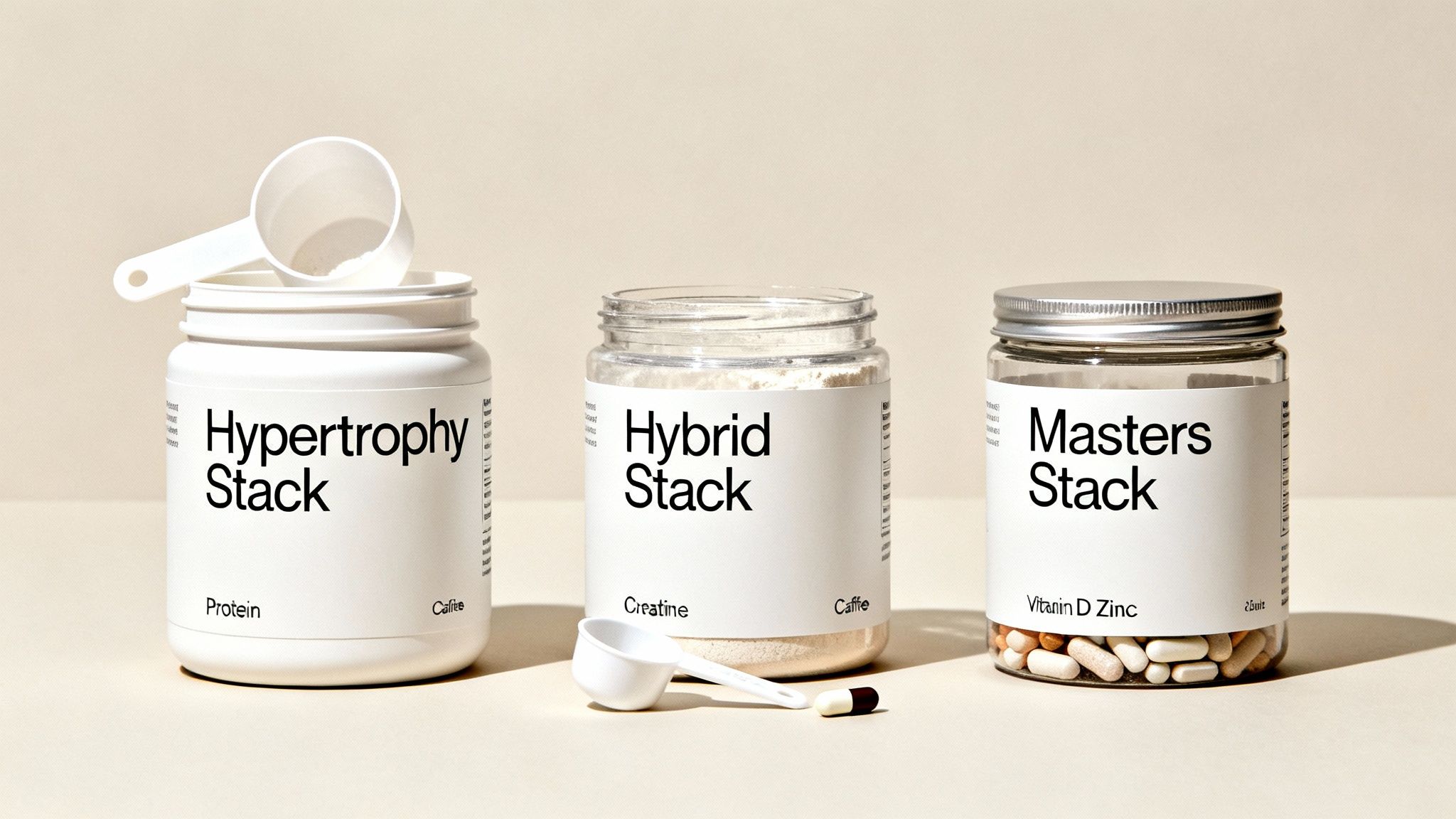
So, let's move from theory to practice and lay out three sample stacks. These aren't rigid prescriptions, but smart templates you can adapt. The non-negotiable cornerstone of any effective plan is a clean, high-quality protein source like REVSCI's Regains protein, which supplies the essential building blocks for muscle repair and growth.
Stack 1: The Hypertrophy Maximizer
This stack is for the dedicated lifter whose primary goal is simple: pack on as much muscle mass as humanly possible. Every ingredient here is chosen to crank up muscle protein synthesis, drive workout performance through the roof, and speed up recovery between those brutal training sessions.
- Protein Powder: A fast-digesting whey isolate like Regains taken right after your workout is crucial. There's a reason the protein supplement market is so massive—valued at USD 30.27 billion in 2025, it's on track to more than double by 2035 because it flat-out works. A good whey shake can spike muscle protein synthesis by up to 20-30% after you train. Read the full research about the protein supplement market.
- Creatine Monohydrate: Take 5g every day. Keeping your muscle stores saturated is key for boosting strength and raw power output.
- Citrulline Malate: Go with 6-8g pre-workout. This will improve blood flow and give you some serious muscle pumps, which helps shuttle more nutrients into the working muscle tissue.
- Beta-Alanine: A daily dose of 3-5g helps buffer the acid that builds up during intense sets, letting you grind out those extra reps where the real growth happens.
Daily Timing Example:
- Pre-Workout (30-60 min before): Citrulline Malate, Beta-Alanine
- Post-Workout (within 60 min): Regains Protein Shake
- Anytime: Creatine Monohydrate
Stack 2: The Hybrid Athlete Protocol
For the athlete who needs to be a jack of all trades—strong, explosive, and conditioned—the stack has to support both ends of the performance spectrum. Think CrossFitters or field sport players. This protocol is all about balancing muscle-building with fatigue resistance and efficient recovery.
The foundation doesn't change much. Protein and creatine are still your non-negotiables. But from there, we'll layer in components that specifically target endurance and hydration, which are absolutely critical for preventing your performance from falling off a cliff during long, grueling WODs or games.
- Foundational Base: Daily Regains protein and 5g of creatine monohydrate form the core.
- Performance Support: 3-5g of beta-alanine daily is your best friend for fighting off fatigue during high-intensity intervals.
- Hydration Cornerstone: Reviver electrolytes taken before and during training will maintain cellular balance, stop cramps in their tracks, and keep your nerve function firing on all cylinders.
This combination gives you the horsepower for heavy lifts and the gas in the tank to finish strong.
Stack 3: The Longevity and Preservation Stack
For older individuals or masters athletes, the game changes. The goal often shifts from maximizing new mass to preserving the hard-earned muscle you already have and promoting bulletproof recovery. This stack is built around anti-catabolism (preventing muscle breakdown) and supporting overall wellness so you can keep training consistently and safely for years to come.
Here, muscle preservation and joint support take center stage.
- Protein Intake: Regains protein becomes even more vital for hitting those higher daily targets that help fight back against age-related muscle loss.
- Creatine Monohydrate: 3-5g daily is a must, not just for muscle function but also for its proven benefits to cognitive health.
- HMB: Taking 3g daily, split into a few smaller doses, can significantly reduce muscle protein breakdown—a major concern for this demographic.
- Vitamin D & Zinc: These are crucial for maintaining healthy hormonal balance and immune function, both of which are essential for staying in the gym consistently.
By tailoring your stack, you stop guessing and start executing a precise plan. You’re giving your body exactly what it needs, when it needs it, to finally match the hard work you’re putting in at the gym and turn that effort into visible, lasting results.
Choosing Supplements You Can Actually Trust
Walking into the supplement aisle—or scrolling online—can feel like stepping into the Wild West. Every bottle makes a bold claim, promising explosive growth and next-level results. So, how do you cut through the noise and find something that actually works?
The key isn't to fall for the flashiest label, but to learn how to spot quality, transparency, and a genuine commitment to results.
It’s a massive industry. The market for muscle-building supplements was valued at a staggering $29.78 billion in 2025 and is only expected to climb. That kind of growth means more options than ever, but it also means a flood of low-quality, ineffective products hitting the shelves. You can dig deeper into the muscle supplement market trends on archivemarketresearch.com.
Look for Third-Party Testing Certifications
Want to know the single best way to verify a supplement’s quality? Look for a third-party certification seal on the label.
These independent organizations act as an unbiased referee. They test products to make sure what’s on the label is actually in the bottle, and that it's free from nasty contaminants or banned substances. Think of it like getting a home inspection before you buy—you don't just take the seller's word for it, you bring in a pro.
Here are the gold standards to look for:
- NSF Certified for Sport: This is the big one. They test for banned substances, verify label claims, and check for contaminants.
- Informed-Sport: This certification also screens every single batch for substances prohibited in sports, making it a must for competitive athletes.
When you see these seals on a product, like those from Revolution Science, you can trust that what you're putting in your body is pure, potent, and safe.
How to Spot Red Flags on a Supplement Label
Beyond certifications, the label itself tells a story. Learning to read it like an expert is your best defense against wasting money on junk.
A trustworthy brand is transparent. They show you exactly what's in their formula and at what dose. A brand that hides behind vague terms is often hiding a weak product.
Keep an eye out for these all-too-common red flags:
- Proprietary Blends: This is a huge warning sign. It’s a trick companies use to hide their formula, listing a bunch of ingredients without telling you how much of each is included. Often, it's just a cheap way to under-dose the important stuff.
- Artificial Fillers and Additives: Scan the "other ingredients" list. If you see a long list of artificial colors, sweeteners, and weird chemical names, it's a sign the focus isn't purely on performance.
- Exaggerated Claims: Be realistic. If a product promises "steroid-like gains" or "instant muscle," it's almost certainly marketing hype, not science. Real progress takes work.
By putting third-party tested products with transparent, honest labels at the top of your list, you can ensure your investment actually supports your goals. You'll be building muscle safely and effectively, without the guesswork.
Your Top Questions About Muscle-Building Supplements, Answered
Jumping into the world of supplements can feel like you're trying to solve a puzzle with a million pieces. Let's cut through the noise and tackle the questions I hear most often, so you can build a smart, effective strategy that actually works.
"How Long Will It Take to See Results?"
This is the big one, isn't it? The honest answer is: it depends. Think of supplements as fuel for the fire you're already building with your training and nutrition. They speed things up, but they don't create the fire themselves.
Some effects are fast. With creatine, you’ll probably feel a difference in your strength and reps within the first week or two. Protein, on the other hand, is a long game. Its real power comes from giving your body the building blocks it needs for recovery, day in and day out, over weeks and months.
The bottom line? Real, visible muscle growth is a process. Give it a solid 8-12 weeks of consistent training and clean eating, and you’ll see how supplements amplify every bit of that hard work.
"Can I Take Supplements and Skip the Gym?"
Let me be blunt: absolutely not. This is one of the most persistent myths out there, and it's critical to understand why it's wrong. Supplements are the support crew, not the main act.
Here’s a simple way to look at it:
- Lifting weights is the wake-up call. It's the signal you send your muscles that they need to get bigger and stronger to handle the stress.
- Supplements are the construction materials—the protein, amino acids, and energy—that your body uses to answer that call and rebuild.
Without the stimulus from training, those raw materials have nothing to build. They just float around with no job to do. The two have to work hand-in-hand.
"Do I Need to Cycle My Supplements?"
For your foundational supplements, consistency is king. There's no reason for a healthy person to cycle off things like protein powder or creatine. In fact, their benefits rely on keeping your body's levels saturated over time. Don't overcomplicate it.
Stimulants are a different story. If you're using a pre-workout with caffeine, cycling is a great idea. Your body gets used to it, and that awesome kick you felt at first starts to fade. A simple 6-8 weeks on, followed by 1-2 weeks off, can reset your tolerance and keep it hitting hard when you need it most.
"Is Plant-Based Protein as Good as Whey?"
It definitely can be, provided you're smart about which one you choose. The game has changed. While a single plant protein source might be lacking in certain amino acids, modern blends are expertly formulated. They combine different sources, like pea and rice protein, to create a complete amino acid profile that rivals whey.
What truly matters for triggering muscle growth is getting enough leucine. As long as your serving delivers around 2.5-3 grams of this key amino acid, you’re giving your muscles the green light to grow, whether it comes from a plant or a cow.
At Revolution Science, we build formulas based on evidence, not hype. We're all about clean, transparent, and research-backed supplements that give you the tools to perform at your peak. No fillers, no pseudoscience—just effective ingredients to help you build muscle the right way. Check out our performance nutrition solutions at https://rvsci.com.