
Tu carrito está vacío


A No-Nonsense Guide to Supplements to Gain Muscle Mass
When it comes to supplements for gaining muscle mass, two titans stand out from the crowd with rock-solid scientific backing: whey protein and creatine monohydrate. For anyone serious about getting the most from their training, these two are the cornerstones, directly fueling muscle repair and on-the-floor energy production.
Your Blueprint for Effective Muscle Gain Supplements
Walking into the supplement aisle can feel like a trap. Shelves are packed with flashy tubs and bottles, each one screaming promises of next-level gains. It's easy to get overwhelmed by the marketing blitz. This guide is your way out—a clear, science-first blueprint to help you ignore the noise and build a smart, effective plan.
Let’s get one thing straight: supplements aren’t magic. Think of them as support tools, designed to amplify the hard work you’re already putting in at the gym and in the kitchen. Their job is to supplement a killer training and nutrition plan, not replace it. They help fill nutritional gaps and give your body’s natural muscle-building machinery an extra push.
First Things First: The Real Foundation
Before you even think about opening a tub of protein, your focus needs to be locked on two things: progressive resistance training and solid nutrition. No supplement on earth can out-work a sloppy diet or lazy gym sessions. Supplements are amplifiers, not creators.
To get the most out of any supplement, you need a strong nutritional base to build upon. If you haven't nailed down your daily protein, carb, and fat intake, that's your first priority. To get that sorted, check out this practical guide on calculating macronutrients.
The massive popularity of these products isn't just hype; it reflects a global shift toward performance and health. The market is exploding because more and more people are turning to proven aids like protein and creatine to maximize their efforts. In fact, the industry is on track to hit nearly $29.78 billion by 2025, proving just how many people are looking for an effective edge.
To give you a bird's-eye view of what truly works, we've put together a quick summary table. This highlights the top-tier supplements that have earned their reputation through solid research.
Quick Guide to Muscle Gain Supplements
This table cuts straight to the point, showing you the heavy hitters in the world of muscle growth, what they do, and who should consider them.
| Supplement | Primary Function | Evidence Level | Best For |
|---|---|---|---|
| Protein Powder | Provides raw materials (amino acids) for muscle repair and growth. | Very Strong | Virtually all athletes and lifters, especially those struggling to meet daily protein goals. |
| Creatine | Increases ATP production for enhanced strength, power, and high-intensity work capacity. | Very Strong | Strength/power athletes, bodybuilders, and anyone looking to improve performance in short bursts. |
| Beta-Alanine | Buffers acid in muscles to delay fatigue during intense exercise lasting 1-4 minutes. | Moderate | Athletes in high-intensity sports (e.g., CrossFit, mid-distance running) and lifters doing high-rep sets. |
| HMB | May reduce muscle breakdown, particularly in untrained individuals or during high-volume periods. | Limited/Mixed | Beginners starting a new, intense program or advanced athletes in a cutting phase to preserve muscle. |
This isn't an exhaustive list, but it covers the supplements that consistently deliver results when paired with proper training and nutrition. We'll dive deeper into each one.
How to Use This Guide
We’re going to build your supplement stack like a high-performance engine. We'll start with the essential, non-negotiable parts and then bolt on the specialized components for that extra horsepower. Everything is based on real-world evidence, not marketing claims.
Here’s our game plan:
- The Foundation: We’ll kick things off with the A-listers—the supplements with overwhelming scientific proof that they help you pack on muscle.
- The Power Players: Next, we’ll get into the performance boosters that directly impact how hard you can push in your workouts.
- The Supporting Cast: Finally, we’ll look at other popular options and give you the real story on what you can actually expect from them.
Consider this your personal roadmap. It’s here to help you make smart choices so that every dollar you spend and every scoop you take is actually moving the needle, helping you build real, measurable strength and size. Let's get to it.
Protein Powder: The Unshakeable Foundation of Muscle Growth

Let’s be clear: a solid diet built on whole foods is, and always will be, the king of nutrition. But when you’re serious about building muscle, protein powder is the indispensable tool that makes hitting your goals both realistic and consistent. Its job is simple but absolutely critical—to supply the raw materials your body needs to repair and grow muscle after you’ve put it through the wringer.
Think of Muscle Protein Synthesis (MPS) as the construction crew that shows up to rebuild your muscles after a tough workout. They're ready to build bigger and stronger. Protein powder is like a high-speed delivery of premium-grade lumber, getting the crew everything it needs, right when they need it, to get the job done right.
If those materials don't show up, the project stalls. It’s that simple. That's why protein supplements are a non-negotiable cornerstone for anyone truly committed to gaining mass.
Whey vs. Casein: The Fast and Slow Crews
Not all protein is created equal. The two most common dairy-based powders, whey and casein, play very different roles because of how fast your body can break them down. Once you get the difference, you can use them strategically to maximize your results.
- Whey Protein: This is your fast-acting, emergency repair crew. It’s loaded with essential amino acids—especially the muscle-building powerhouse, leucine—and gets absorbed almost instantly. This makes whey the undisputed champion for your post-workout shake, kicking MPS into overdrive to jump-start the recovery process.
- Casein Protein: Think of casein as the slow-and-steady night shift. It forms a gel in your stomach, which means it releases amino acids at a slow, sustained pace over several hours. This makes it perfect for a shake before bed, feeding your muscles and preventing breakdown while you sleep.
The demand for these products speaks for itself. Protein supplements are the undisputed kings in the quest for muscle, powering a market valued at $30.27 billion in 2025 and forecasted to explode to $67.19 billion by 2035. While animal-based proteins still dominate, plant-based options are quickly closing the gap, showing a major shift in how people approach their nutrition.
Key Takeaway: Hit your muscles with whey right after a workout for an immediate repair signal. Use casein before bed for a steady supply of building blocks that fuels growth all night long. Together, they create a powerful 24/7 recovery system.
How Much Protein Do You Actually Need?
Figuring out your daily protein target is way simpler than most people think. You can forget the overly complicated formulas. For most people actively trying to pack on muscle, a straightforward, evidence-backed range is all you need.
The sweet spot for muscle growth is between 1.6 to 2.2 grams of protein per kilogram of body weight per day. That’s roughly 0.7 to 1.0 grams per pound.
Let’s break that down for a 180-pound (about 82 kg) person:
- Low End: 180 lbs x 0.7 g/lb = 126 grams of protein daily.
- High End: 180 lbs x 1.0 g/lb = 180 grams of protein daily.
Aim for a number somewhere in that window, and you’ll know you’re giving your body more than enough fuel for repair and growth. Remember, protein powder is just one tool in your toolbox. The foundation of your diet should always be whole food sources like chicken, fish, eggs, and legumes. These foods provide the full spectrum of essential building blocks. To learn more about how these components work, check out our guide on amino acids supplements.
And if you’re following a vegan diet, you can absolutely hit these numbers. It's entirely possible to see serious gains with plant-based protein for muscle building from sources like soy, pea, and rice protein.
Creatine and Beta-Alanine: The Power Players
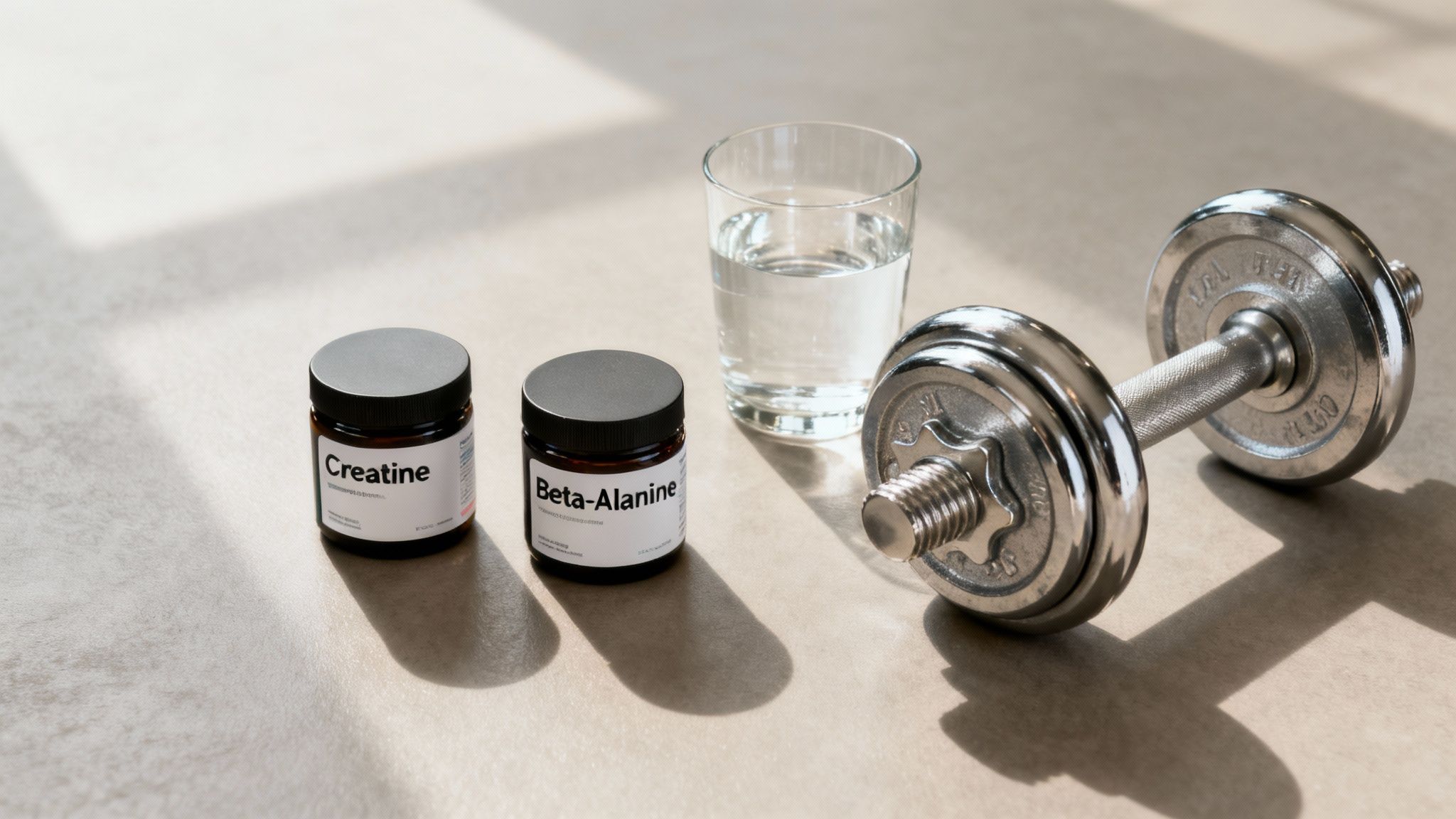
Once you’ve locked in your protein intake, you can start exploring true performance enhancers. When it comes to supplements to gain muscle mass, creatine and beta-alanine are the undisputed heavyweights, backed by decades of solid scientific research.
This isn’t about hype. These are powerful tools that directly fuel your ability to perform the high-intensity work that actually triggers muscle growth.
Think of creatine and beta-alanine as the one-two punch for your muscles. Creatine is your raw strength booster, giving you the power to lift heavier for short, explosive bursts. Beta-alanine is your endurance specialist, helping you sustain that effort for longer before fatigue forces you to quit.
Creatine: The Express Energy System
Imagine your muscles run on tiny, rechargeable batteries. This energy currency is called ATP (adenosine triphosphate), and during an intense set of squats, you burn through it incredibly fast. That’s what leads to muscle failure.
Creatine acts like a rapid-recharge power bank. It saturates your muscles with phosphocreatine, a molecule that can instantly regenerate ATP. This immediate energy surge is what allows you to squeeze out those last one or two reps that truly break down muscle and signal it to grow back stronger.
It’s no surprise creatine is a market leader in a bodybuilding supplement industry projected to hit $27.48 billion in 2025 and rocket towards $47.4 billion by 2032.
Getting the benefits is straightforward:
- Daily Dose: A simple 3-5 grams of creatine monohydrate daily is all you need.
- Timing: Don't overthink it—consistency is key. Taking it post-workout with some carbs and protein can offer a slight edge in absorption, but the most important thing is to take it every day.
- Loading Phase (Optional): You can fast-track muscle saturation by taking 20 grams per day (split into four 5-gram doses) for 5-7 days. It's not mandatory, though; the standard 3-5 gram dose will get you to the same place in about a month.
Contrary to old myths, modern research confirms creatine monohydrate is exceptionally safe for healthy individuals and does not cause kidney damage. The slight water retention it causes is primarily intracellular (inside the muscle), which is actually beneficial for performance and muscle fullness.
Beta-Alanine: The Burn Buffer
Let’s talk about that deep, searing burn you feel when you’re pushing a high-rep set to its limit. That sensation comes from a buildup of hydrogen ions, which makes your muscles more acidic and shuts down performance.
Beta-alanine works by increasing your muscles' stores of carnosine, a compound that acts like a sponge for these acidic ions. By soaking them up, it helps keep your muscle pH in a more optimal range, effectively pushing back the burn. This lets you sustain that high-intensity effort for longer.
- Daily Dose: Aim for the clinically effective dose of 3.2-6.4 grams per day.
- Timing: It's best to split the dose into smaller servings (e.g., 1.6-3.2 grams) taken a few hours apart. This helps minimize the harmless tingling sensation known as paresthesia.
- Loading: Like creatine, beta-alanine needs time to work. You'll need to take it consistently for at least four weeks to build up effective carnosine levels in your muscles.
The synergy here is what makes this stack so effective. Creatine boosts your strength for the first few reps, and beta-alanine helps you maintain that power through the entire set. This combination creates the perfect environment for muscle growth by letting you train with more intensity, for more reps.
To see how these compounds fit into a wider performance strategy, check out our guide on supplements for athletic performance.
Evaluating The Supporting Cast of Supplements
Beyond the big hitters like protein and creatine, a second tier of supplements can offer some really valuable, specialized support. Think of them as the role players on a championship team. They aren't the superstars racking up all the points, but they're specialists who come in and do a specific job exceptionally well.
While they may not be essential for every single person, they can provide a distinct advantage when used at the right time. These compounds often work through more subtle pathways than the raw power boost you get from creatine, helping to fine-tune your recovery, crank up your training intensity, and optimize your body's internal muscle-building environment.
HMB: The Muscle Preservation Specialist
Imagine you’re starting a massive new construction project—your training program. When you're new to the job, it's easy to make mistakes and waste valuable building materials. HMB (beta-hydroxy beta-methylbutyrate) is like the expert site foreman who steps in to make sure nothing goes to waste.
HMB is a byproduct of the amino acid leucine, and its real claim to fame is its anti-catabolic effect, which is a fancy way of saying it helps stop muscle protein breakdown. The debate is still out on its direct muscle-building effects in seasoned lifters, but the evidence shows it really shines in a couple of key situations:
- For Beginners: When you first start slinging weights, your body isn't very efficient, and that new stress causes a ton of muscle damage. HMB can help put the brakes on this initial breakdown, letting you hold onto more of your hard-earned gains.
- During Intense Dieting or Layoffs: When you're in a steep calorie deficit or coming back from a break, your body is primed to start breaking down muscle for energy. HMB acts as a bodyguard for your lean mass.
A standard dose is 3 grams per day, usually split into three separate 1-gram servings. It's not a magic growth formula, but it’s a smart defensive play to protect what you’ve built.
Leucine: The Master Ignition Switch
If muscle protein synthesis (MPS) is the engine that drives muscle growth, then leucine is the key that fires up the ignition. It’s hands-down the most powerful of the three branched-chain amino acids (BCAAs) for directly signaling your muscles to kickstart the repair and building process.
This is exactly why you see leucine plastered all over BCAA and EAA (Essential Amino Acid) formulas. But context is everything here.
Leucine is the spark, but you still need all the other amino acids—the fuel and engine parts—to actually build the car. Taking leucine by itself is like turning the key in a car with an empty gas tank. You get the initial spark, but the engine isn't going anywhere.
Because of this, you’re almost always better off getting your leucine from whole, high-quality protein sources like whey, chicken, or eggs. A single scoop of whey protein will give you 2-3 grams of leucine, which is plenty to max out that muscle-building signal after your workout.
Citrulline Malate and Caffeine: The Intensity Boosters
Finally, we have a couple of players designed to help you go harder in the gym, which is the ultimate key to gaining muscle over time.
- Citrulline Malate: This stuff is all about the "pump." It boosts nitric oxide production, which helps your blood vessels relax and widen. The result is better blood flow to your muscles, shuttling in more oxygen and nutrients while you train. This can lead to better endurance and less muscle soreness. Aim for 6-8 grams about 30-60 minutes before you train.
- Caffeine: No surprise here. The world’s favorite stimulant is also a rock-solid performance enhancer. It sharpens your focus, makes tough sets feel a little easier, and can give you a real boost in power, letting you lift heavier for more reps. The sweet spot for most people is 3-6 mg per kilogram of body weight.
Comparing Key Muscle Gain Supplements
To help you see how these pieces fit together, here's a quick comparison of the primary and secondary supplements we've discussed.
| Supplement | Mechanism of Action | Typical Daily Dose | Primary Benefit |
|---|---|---|---|
| Protein Powder | Provides essential amino acids (building blocks) for muscle repair and growth. | 20-40g post-workout | Muscle Repair & Growth |
| Creatine | Increases ATP (energy) production for high-intensity efforts. | 3-5g | Strength & Power Output |
| HMB | Reduces muscle protein breakdown (anti-catabolic). | 3g | Muscle Preservation |
| Leucine | Directly stimulates Muscle Protein Synthesis (MPS). | 2-3g per meal | Anabolic Signaling |
| Citrulline Malate | Increases nitric oxide for enhanced blood flow. | 6-8g pre-workout | Endurance & Pump |
| Caffeine | Central nervous system stimulant. | 3-6mg/kg pre-workout | Focus & Performance |
This table lays out the core function of each supplement, from the foundational builders like protein to the performance specialists like caffeine. Understanding their unique roles helps you make smarter decisions about what you actually need to reach your goals.
Fueling Performance with Carbs and Electrolytes
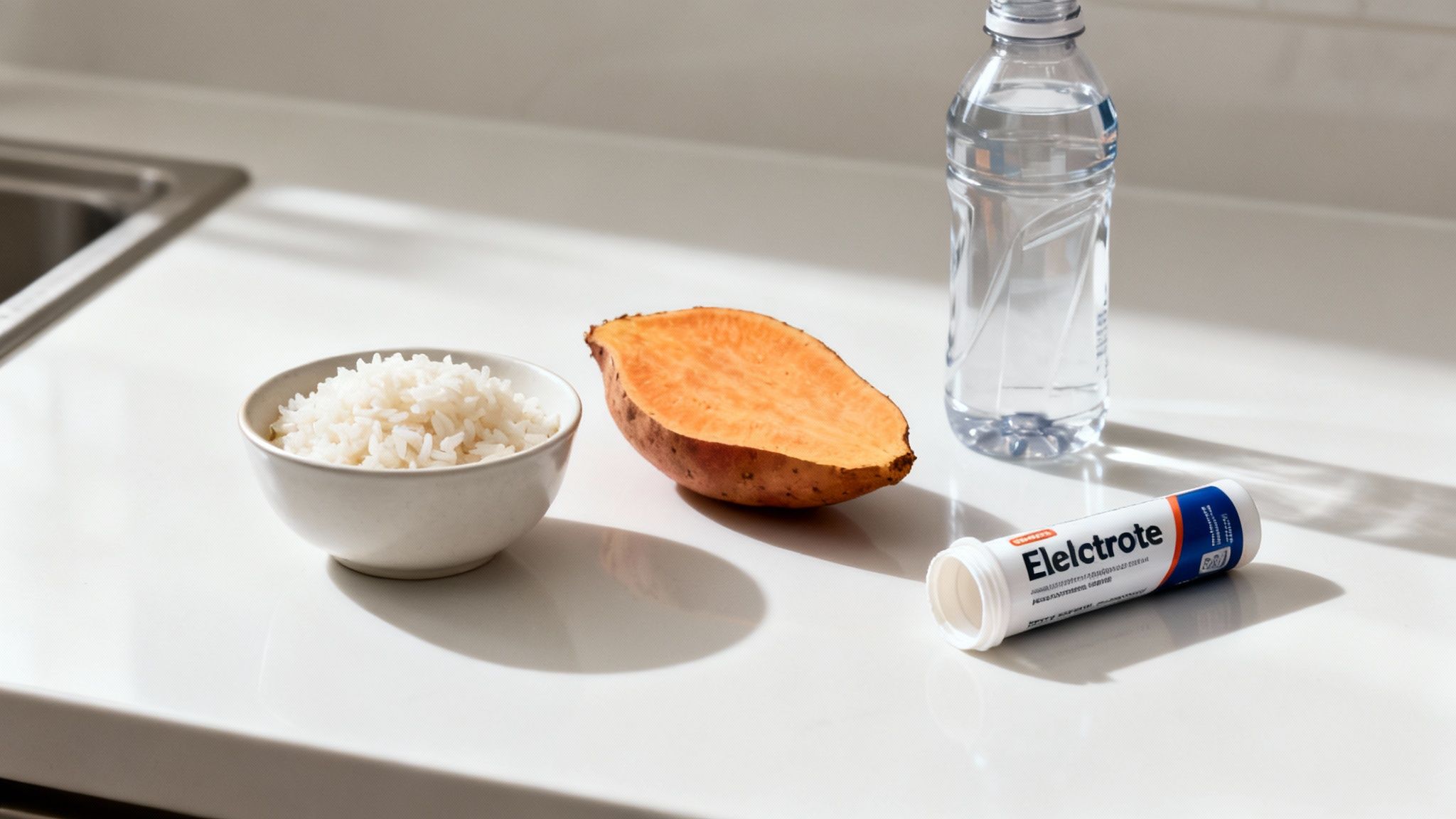
While protein and creatine are busy building the house, you still need electricity and fuel to run the construction site. That’s where carbohydrates and electrolytes come in—they provide the non-negotiable energy and function needed to actually do the hard work.
Gaining muscle isn't just about recovery; it’s about the quality of work you put in, session after session. If you don't have the right fuel in the tank, your performance hits a brick wall, and muscle growth grinds to a halt.
Think of your body as a high-performance engine. Protein is the raw metal used to forge bigger pistons. But carbohydrates are the high-octane racing fuel. Without enough, you can’t redline it in the gym, which means you can't generate the intensity required to signal real growth. This is a massive piece of the puzzle that too many people overlook.
Carbohydrates: Your Primary Performance Fuel
Your muscles and liver store carbohydrates as glycogen, which is the body's go-to, easily accessible energy source for intense exercise like weightlifting. When you lift heavy, you're rapidly draining those glycogen tanks. If you don't top them off, your next workout will suffer—plain and simple. You'll feel weaker, less powerful, and burn out faster.
Here's why carbs are so critical for your training:
- Fueling Your Lifts: They directly power muscle contractions, letting you lift heavier for more reps.
- Protecting Your Muscle: Having enough carbs on board stops your body from cannibalizing precious muscle tissue for energy (a process called gluconeogenesis).
- Supercharging Recovery: Taking in carbs post-workout kicks off a rapid glycogen refill and triggers an insulin response that helps shuttle nutrients like amino acids straight into your muscles.
For times when whole food isn't practical, like during or immediately after a workout, simple and fast-digesting carb powders can be a game-changer. They deliver energy quickly without sitting heavy in your stomach.
The Overlooked Importance of Electrolytes
Just as important as your fuel source are the tiny components that make your muscles fire correctly. Every single muscle contraction is an electrochemical event, and electrolytes are the minerals—like sodium, potassium, and magnesium—that carry the electrical charge.
When you train hard and sweat, you’re not just losing water. You’re losing these essential minerals, and that loss can cause a noticeable drop in performance almost immediately.
Dehydration and electrolyte imbalance are silent workout killers. They show up as muscle cramps, early fatigue, and a serious dip in power output, cutting your session short and blunting the stimulus for growth.
Proper hydration is more than just chugging plain water. During intense training, replacing lost electrolytes is a non-negotiable tool for peak performance. It ensures your muscular and nervous systems are firing on all cylinders. For a closer look at what makes a great formula, check out this detailed electrolyte powder comparison.
By strategically using carb and electrolyte supplements, you can dramatically upgrade the quality of your training. They ensure you have the raw energy to push your limits and the electrochemical firepower to make every single rep count—directly fueling your goal to pack on more muscle.
How to Build Your Supplement Stack
Now that you know the key players, it’s time to assemble your team. Building a supplement stack isn't about just grabbing whatever looks good and hoping for the best. It’s a strategic process. The goal is to make targeted choices that match your experience level and what you're trying to achieve in the gym.
Think of it like building a high-performance engine. You have to start with the core components—the engine block and pistons (your training and nutrition). Only then can you add specialized parts like a turbocharger (creatine) or an intercooler (beta-alanine) to really crank up the horsepower where it counts. A well-designed stack works the same way, with each part amplifying the others for better results.
Designing Your Ideal Stack
The right supplement combination is all about you. A beginner who's just learning the ropes has completely different needs than an advanced lifter fighting for a new one-rep max. To give you a practical starting point, here are a couple of sample stacks.
Beginner's Foundation Stack This stack is all about simplicity and effectiveness. It focuses purely on the essentials that give you the most bang for your buck without overcomplicating things.
- Whey Protein: One scoop (20-30g) within an hour after your workout is perfect for kicking off muscle repair.
- Creatine Monohydrate: Take 5 grams daily. Don't stress about the timing—just take it consistently every single day.
Strength & Power Stack This one’s for the more seasoned lifters out there—those looking to squeeze every last drop of performance out of each set and smash through plateaus.
- Whey Protein: Take one scoop (20-30g) post-workout.
- Creatine Monohydrate: Take 5 grams daily.
- Beta-Alanine: A daily dose of 3.2-6.4 grams is the sweet spot. Split it into two smaller doses to avoid that tingling feeling. Taking one of those doses with a pre-workout meal works great.
If you're running a strength stack, combining beta-alanine with other performance enhancers can be a game-changer. To get a better handle on mixing up the perfect pre-training cocktail, you can learn about building the best pre-workout.
Quality Control: Finding Safe and Effective Products
Let's be real: the supplement industry can feel like the Wild West. Flashy labels and big promises don't mean a thing if the product inside is junk. That's why being a smart, skeptical consumer is your best defense. Your number one job is to verify what's actually in the tub.
Look for products that have been put through the wringer by a third-party testing organization. These are independent labs that confirm a product has what the label claims and isn't contaminated with junk or banned substances.
Always look for these seals on the label:
- NSF Certified for Sport®
- Informed-Sport
- BSCG (Banned Substances Control Group)
These certifications are the gold standard for safety and purity. They’re your assurance that you’re getting a high-quality product that’s both effective and safe, especially if you compete.
Another huge tip: avoid proprietary blends. These are just mystery cocktails of ingredients where the company lists what’s inside but not how much of each. It’s a common trick to hide weak, under-dosed formulas. Always stick with products that have fully transparent labels so you know exactly what you’re putting into your body.
By prioritizing transparent labels and third-party validation, you can confidently invest in supplements to gain muscle mass that will actually help you reach your goals.
Common Questions About Muscle Gain Supplements
Diving into the world of supplements to gain muscle mass can feel like navigating a minefield of conflicting advice. It's completely normal to have questions and feel a bit lost. Let's cut through that noise and tackle some of the most common things people ask.
Think of this as your quick-hit guide to building a smarter, safer, and more effective supplement strategy. We're here to clear up the confusion so you can focus on what actually moves the needle.
Do I Need to Cycle My Supplements?
This question comes up all the time, especially with creatine. The short answer for most of the foundational stuff? No.
- Creatine: Forget the old advice about "cycling" to give your body a break. Modern science shows that consistent, continuous use is the way to go. A daily dose of 3-5 grams keeps your muscles saturated and ready to perform, day in and day out.
- Protein & Beta-Alanine: These are staples, not temporary boosts. You don't need to cycle them. Consistent use is key to supporting your daily recovery and performance needs.
- Stimulants (like Caffeine): Here's the big exception. Your body is smart and adapts, building a tolerance to caffeine that reduces its kick over time. Taking a one- to two-week break every couple of months is a good way to reset your sensitivity. When you bring it back, you'll feel that energizing effect much more.
Can Supplements Replace a Good Diet?
In a word: no. This is the absolute golden rule of sports nutrition, and it’s non-negotiable. Supplements are exactly what the name implies—they supplement a well-thought-out, whole-food-based diet.
Think of supplements as the turbocharger on an engine. They can provide a serious boost, but the engine itself still needs high-quality fuel to run. For your body, that fuel is real food, which provides a complex mix of vitamins, minerals, and fiber that no powder can ever truly replicate.
How Do I Know if a Supplement is Working?
This one comes down to two things: patience and tracking. You won't see a dramatic change overnight. The only real way to know if something is working is to track your performance in the gym over several weeks.
- Are you getting stronger on your main lifts?
- Are you able to squeeze out an extra rep or two?
- Do you feel like you're bouncing back better between sessions?
Keep a training log. Cold, hard data is way more reliable than just "feeling" like something is working. Your logbook will tell you the real story of what impact your supplements are having.
This decision tree gives you a simple, visual way to think about structuring your supplement stack based on where you are in your lifting journey.
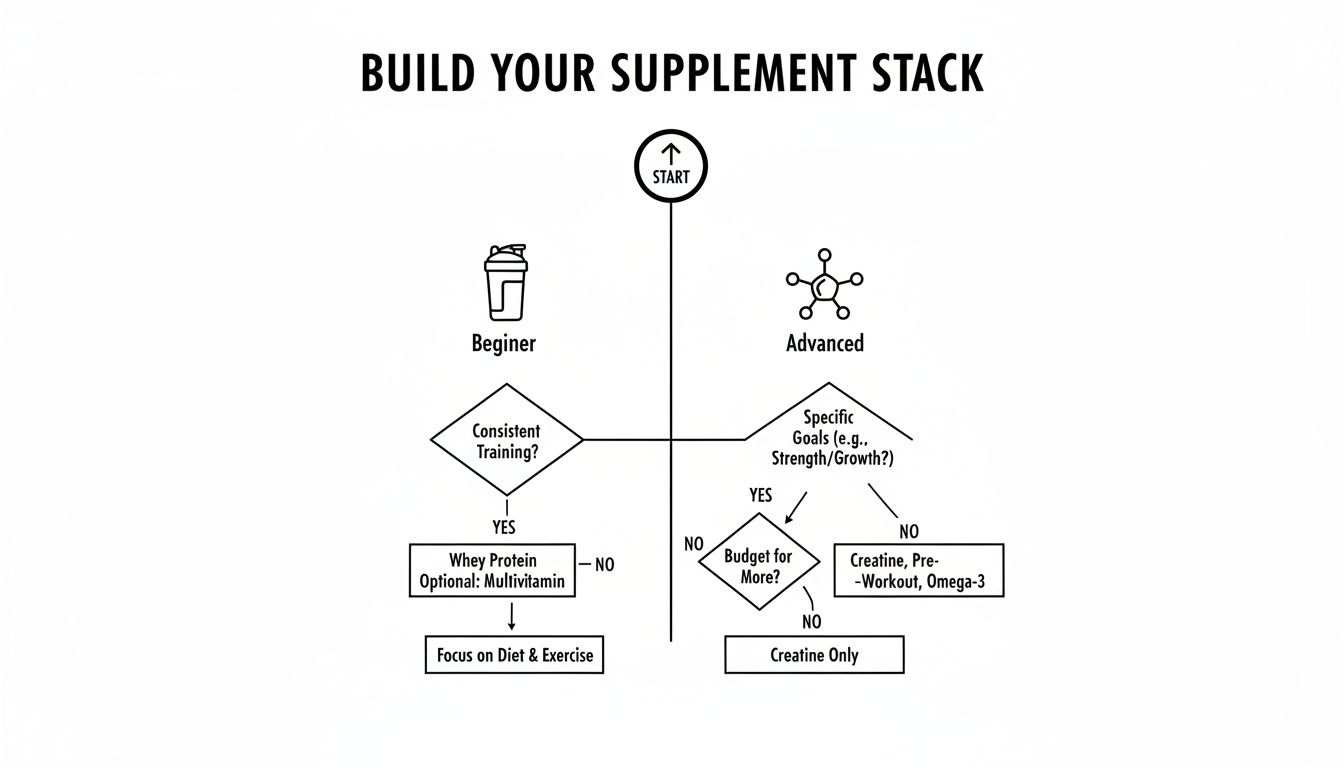
As you can see, if you're just starting out, nailing the fundamentals like protein is your first priority. More advanced lifters can then start layering in proven performers like creatine to chase those extra gains.
At Revolution Science, we create clean, transparent, and research-backed supplements to help you perform at your best. Explore our no-nonsense formulas engineered without fillers or pseudoscience at https://rvsci.com.