
Your Cart is Empty


Your Ultimate Guide to Pre-Workout Supplements
A pre-workout is a supplement you take before training to crank up your energy, dial in your focus, and stretch your endurance. Think of it as a strategic tool to get more out of every single session, helping you lift a little heavier, run a little longer, or just smash through the mental barriers that tell you to quit.
What Is Pre-Workout and Why Does It Matter
Picture your body as a high-performance engine. On most days, it runs just fine. But on the days you need to perform—to really open it up—you want the best possible fuel to unlock its true potential. A pre-workout supplement does just that. It primes your body and mind for peak output, making sure you walk into your workout ready to dominate.
The goal here isn't just a caffeine buzz. A well-designed pre-workout creates a very specific physiological state that directly supports your training goals. It does this by zeroing in on three key areas:
- Igniting Energy: This is what pre-workouts are famous for. Ingredients like caffeine fire up your central nervous system, making you feel more alert, awake, and ready to tackle whatever your workout throws at you.
- Sharpening Mental Focus: The mind-muscle connection is everything. Certain compounds help lower your perceived effort and sharpen your concentration, keeping you locked in on your form and intensity from the first rep to the very last.
- Boosting Physical Endurance: Other ingredients get to work delaying muscle fatigue and improving blood flow. This is what lets you push through that final, brutal set or hold your pace for one more mile.
Let's quickly break down how these benefits are delivered by specific ingredient categories.
Pre-Workout Benefits at a Glance
A well-formulated pre-workout delivers a multi-pronged attack to enhance performance. The table below shows the primary benefits you can expect and the types of ingredients responsible for them.
| Benefit | Primary Ingredient Category | What It Does |
|---|---|---|
| Increased Energy | Stimulants | Boosts alertness and fights fatigue (e.g., Caffeine). |
| Enhanced Endurance | Fatigue Buffers & Nootropics | Delays muscle burn and improves mental stamina (e.g., Beta-Alanine). |
| Improved Blood Flow | Nitric Oxide Boosters | Increases nutrient delivery to muscles for better pumps (e.g., Citrulline). |
| Greater Strength & Power | Ergogenic Aids | Supports explosive energy production for heavy lifts (e.g., Creatine). |
| Sharper Mental Focus | Nootropics & Adaptogens | Improves concentration and the mind-muscle connection (e.g., Alpha-GPC). |
Understanding this synergy is key. It's not just about one ingredient, but how they work together to prepare your body for the work ahead.
The Rise of Performance Fuel
The popularity of these supplements has absolutely exploded, riding the wave of a global shift towards health and fitness. This stuff isn't just for pro bodybuilders anymore.
The global pre-workout market, valued at around $21.7 billion in 2025, is on track to nearly double by 2035. That growth is being fueled by everyone from elite athletes to weekend warriors who just want to get a better workout.
A pre-workout is more than just a scoop of powder; it's a strategic part of a comprehensive training plan. When used correctly, it prepares your body to handle greater stress, adapt more effectively, and ultimately achieve better results over time.
With this massive growth comes a market flooded with options. That makes understanding what's actually inside the tub more important than ever for both your safety and your results. Knowing which ingredients work—and at what doses—is what separates a powerful tool from a waste of money.
While a pre-workout is a fantastic place to start, it's just one piece of the puzzle. For a complete picture of how to support your performance, check out our guide on the best supplements for athletes to see how it all fits together. In the next sections, we’ll break down exactly what you need to look for.
Decoding the Label: Key Pre-Workout Ingredients
Walking down the supplement aisle can feel like trying to read a foreign language. The labels on pre-workout tubs are often a crowded mess of scientific names and proprietary blends. But here’s the thing: understanding what’s in the tub is the single most important step to finding a product that actually works for your goals.
Think of a pre-workout formula as a team of specialists. Each ingredient has a very specific job, whether it's delivering raw energy, sharpening your mental focus, or fighting off that mid-set burnout. Once you know what to look for, you can see past the flashy marketing and choose a formula built on solid science and effective doses.
Let's break down the all-stars of the pre-workout world—what they do, how they work, and how much you really need to feel a difference.
This is a simple way to think about the core benefits, breaking them down into the key performance pillars: energy, focus, and endurance.
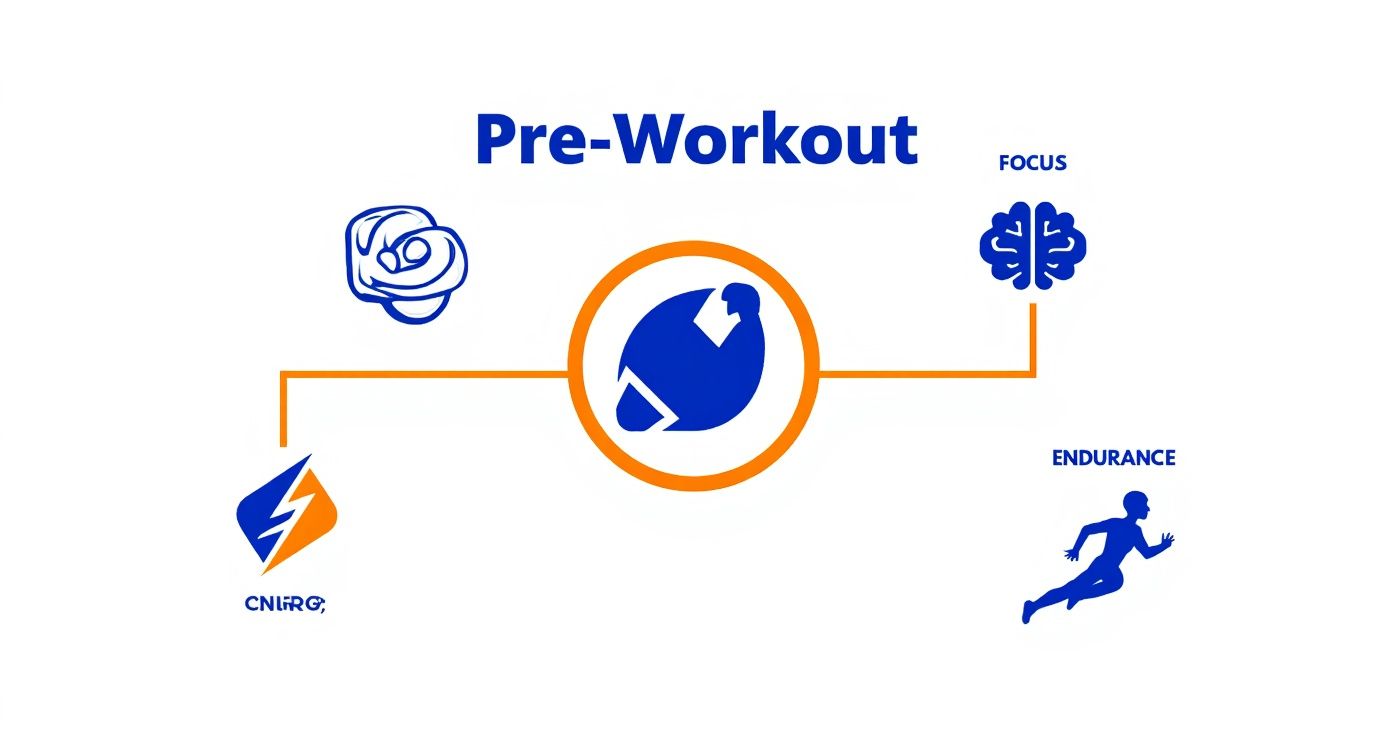
A quality pre-workout is designed to be a multi-faceted tool, targeting both your brain and your body to get you ready for peak performance.
Caffeine: The Energy Powerhouse
Caffeine is the undisputed king of pre-workout ingredients, and for good reason. It’s a powerful central nervous system stimulant that works by blocking adenosine—a neurotransmitter that signals tiredness to your brain. At the same time, it amps up adrenaline production. The result? A surge of alertness, sharper focus, and a much lower perception of effort, making those grueling sets feel a whole lot more manageable.
This effect is so reliable that caffeine has become the cornerstone of the industry. Powdered supplements remain the top dog globally, expected to hold over 40% of the market share by 2035. This isn't surprising when you consider that over 65% of people already use caffeine as a daily stimulant.
For a real performance kick, an effective dose is typically between 3-6 milligrams per kilogram of body weight. So, for a 180-pound (82kg) person, that’s about 245-490 mg. If you're new to it, always start on the lower end to see how you react.
Beta-Alanine: The Fatigue Fighter
Ever felt that tingly, pins-and-needles sensation after taking a pre-workout? That’s paresthesia, a totally harmless side effect from Beta-Alanine. This non-essential amino acid works by cranking up your muscles' carnosine stores. Carnosine is like a bouncer for lactic acid, buffering the burn that builds up during intense exercise and forces you to quit.
By pushing back that muscle fatigue, Beta-Alanine helps you squeeze out more reps and hold your intensity for longer. It’s a game-changer for activities lasting between one and four minutes, like high-rep lifting sets, CrossFit WODs, or all-out sprints.
The real secret to Beta-Alanine is consistency. Its benefits build up over time as you saturate your muscles with carnosine. Think of it as a long-term investment, not just a one-time boost.
For the best results, aim for a daily dose of 3.2 to 6.4 grams. Many athletes split this into smaller doses throughout the day to keep the tingles to a minimum.
L-Citrulline: The Pump Amplifier
That "pump" you feel isn't just for show; it's a sign that blood is flooding your muscles, delivering a fresh supply of oxygen and nutrients. L-Citrulline is a master at making this happen. In the body, this amino acid converts to L-arginine, which then gets to work producing nitric oxide (NO). NO is a vasodilator, meaning it tells your blood vessels to relax and widen.
This process, vasodilation, kicks off a cascade of benefits:
- Better Nutrient Delivery: More blood flow means more fuel and oxygen get to your muscles right when they need it.
- Faster Waste Removal: It helps shuttle out metabolic junk like ammonia that contributes to fatigue.
- Less Muscle Soreness: Some studies suggest that improved circulation can speed up recovery and ease post-workout aches.
To get a noticeable effect on your pumps and performance, research points to a clinical dose of 6-8 grams of L-Citrulline or 8-10 grams of Citrulline Malate (a version bonded with malic acid). If you want to dive deeper into how these compounds work, our guide on the benefits of amino acids supplements is a great place to start.
Creatine: The Explosive Power Source
If there's one supplement that's been studied to death and come out on top every time, it's creatine. Its main job is to help your body rapidly regenerate ATP (adenosine triphosphate), which is the primary fuel for your cells. This is absolutely critical for short, explosive movements like heavy lifts, sprints, and jumps.
By topping off your ATP stores, creatine directly helps you:
- Increase Strength and Power: You'll be able to lift heavier for more reps. Simple as that.
- Boost Muscle Growth: It pulls water into muscle cells, creating a "cell-volumizing" effect that can kickstart protein synthesis.
- Improve Anaerobic Performance: It benefits any activity that demands short, all-out bursts of effort.
A standard, effective dose is 3-5 grams per day. While many pre-workouts throw in some creatine, it’s often a smaller, under-dosed amount. Because of this, many serious athletes choose to supplement with it separately to make sure they get the full clinical dose every single day.
Electrolytes and Adaptogens: The Support Crew
While stimulants and pump-enhancers grab all the headlines, a truly well-rounded pre-workout also includes ingredients that support your body's overall balance and resilience.
- Electrolytes: These are essential minerals like sodium, potassium, and magnesium that you lose through sweat. They are crucial for hydration, nerve function, and muscle contractions. A shortage can lead to cramping and a sudden drop in performance, so having them onboard from the start is a smart move.
- Adaptogens: These are natural compounds, often from herbs like Ashwagandha or Rhodiola, that help your body adapt to and manage stress. Intense training is a major physical stressor. Adaptogens can help regulate your cortisol response, which may improve recovery and help you stay locked in when the pressure is on.
Mastering Your Timing and Dosage for Peak Results

Just scooping and chugging your pre-workout 30 minutes before hitting the gym is a decent start, but it’s far from the whole picture. If you really want to get the most out of it, you need to tailor your timing and dosage to your specific workout, your body, and what you’re trying to achieve. This is how you turn a simple energy boost into a precision performance tool.
Think of it this way: a drag racer and a Formula 1 car both run on high-octane fuel, but their engines and race strategies are completely different. The same idea applies here. A powerlifter getting under a heavy squat has totally different needs than a marathon runner heading out for a 10-miler.
The real goal is to hit that sweet spot where the key ingredients reach their peak levels in your system right when your workout intensity is at its highest. It takes a little trial and error, but the payoff is unlocking every bit of potential your pre-workout has to offer.
Assessing Your Personal Tolerance
Before you even start thinking about the clock, you absolutely have to figure out your personal tolerance. Diving headfirst into a full, high-stimulant scoop can be a rough ride, leading to jitters, anxiety, and a workout that ends before it really begins.
The golden rule here is to start with a half-scoop. This is the safest way to gauge how your body reacts to the specific blend, especially the stimulants. Pay close attention to your energy, focus, and any side effects like an upset stomach or that tingling feeling.
Only after you’ve had a good experience with a smaller dose should you even consider moving up to a full serving. This careful approach makes sure your pre-workout is helping you, not holding you back.
Timing Strategies for Strength Versus Endurance
The kind of training you’re doing should be the number one factor dictating your pre-workout strategy. Power and endurance place very different demands on your body, and your supplement timing needs to reflect that.
For a deeper dive into how stimulants play into this, our guide on choosing a pre-workout with caffeine can help you dial in your choice based on your sensitivity and training schedule.
Key Takeaway: Optimal timing isn't just about a clock; it's about syncing the supplement's peak effect with your workout's peak demand. A lifter needs an immediate explosion of power, while a runner needs sustained energy over a long duration.
The right approach for a strength athlete is quite different from an endurance athlete. Here's a look at how to adjust your strategy based on your goals.
Pre-Workout Strategy Strength vs Endurance
| Consideration | Strength Athlete (e.g., Weightlifter) | Endurance Athlete (e.g., Runner) |
|---|---|---|
| Primary Goal | Maximize power output, focus, and muscle pumps for short, intense bursts of effort. | Sustain energy levels, delay fatigue, and maintain hydration over a prolonged period. |
| Optimal Timing | 20-30 minutes before the first working set to ensure peak stimulant and nitric oxide effects. | 30-45 minutes before starting to allow for smoother digestion and a more gradual energy release. |
| Key Ingredients | L-Citrulline for pumps, Creatine for power, Beta-Alanine for rep endurance, high-dose Caffeine. | Moderate Caffeine for alertness, Electrolytes for hydration, Beta-Alanine for sustained effort. |
| Dosage Tip | Full, clinically effective doses are prioritized to support maximal strength and intensity. | Start with a half or three-quarter dose to avoid mid-run crashes or digestive issues. |
As you can see, a one-size-fits-all approach just doesn't cut it. Fine-tuning your pre-workout protocol to your specific sport is essential for getting the results you’re after.
The Importance of Cycling Your Pre-Workout
Your body is an incredible adaptation machine. If you constantly throw stimulants like caffeine at it, it will eventually build up a tolerance. That means the same scoop that once felt like rocket fuel will start to feel more like flavored water.
To keep this from happening, you need to cycle your pre-workout. This just means taking planned breaks from stimulant-based formulas to let your body’s receptors reset and regain their sensitivity. A common and effective way to do this is:
- Usage Period: 4-6 weeks of consistent pre-workout use on your training days.
- Washout Period: 1-2 weeks completely off all high-stimulant products (this includes coffee and energy drinks!).
This simple discipline makes sure your pre-workout continues to be a powerful tool in your training arsenal. It keeps the effects potent and stops you from needing bigger and bigger doses to feel the same kick, which is crucial for your long-term health and performance.
Navigating Safety and Potential Side Effects
While a solid pre-workout can be a powerful tool in your performance arsenal, it’s a tool that demands respect and responsible use. Thinking about potential side effects isn't meant to scare you off—it’s about giving you the knowledge to use these supplements safely and get the results you want.
Most of the time, any side effects are mild and easy to manage once you know what's causing them. The most common reactions are tied directly to the high-performance ingredients doing their jobs. The caffeine rush, for example, can sometimes tip into jitters or anxiety if you're sensitive to stimulants.
Knowing what to expect puts you in the driver's seat. You can adjust your dose or timing to make sure your pre-workout experience is a positive one from start to finish.
Common Side Effects and How to Manage Them
Let's break down the most common things you might feel. These aren’t usually red flags, but simply your body responding to potent, performance-driving compounds.
- The Jitters or Anxiety: This is almost always a caffeine thing. If you feel a bit too wired, the fix is simple: dial back your dose. Start with a half-scoop to see how you feel, and make sure you're not taking it too late in the day, which can mess with your sleep.
- Digestive Upset: Some ingredients can be a little harsh on an empty stomach. If you run into this, try having a small, easy-to-digest snack like a banana about an hour before you take your pre-workout.
- The Beta-Alanine Tingles: That "pins-and-needles" sensation on your skin has a technical name—paresthesia—and it's a completely harmless and temporary side effect of Beta-Alanine. It usually fades within an hour and often becomes less noticeable as your body gets used to the ingredient.
Listening to your body is the number one rule here. Most of these issues are easily solved by tweaking your dosage.
Who Should Avoid Pre-Workouts
Pre-workout supplements aren't for everybody. Because of their potent stimulant content and effects on the cardiovascular system, some people should be extremely cautious or avoid them completely.
It is highly recommended that you talk to your doctor before using a pre-workout if any of these apply to you:
- You have a pre-existing heart condition, high blood pressure, or arrhythmia.
- You are pregnant or nursing.
- You know you're sensitive to caffeine or other stimulants.
- You're on certain prescription medications that could interact with the ingredients.
Your health is the top priority. A healthcare professional can help you weigh the risks and benefits based on your unique health profile.
When it comes to supplements, transparency is non-negotiable. If a brand won't tell you exactly what's in their product and at what dose, you shouldn't trust them with your health or performance.
Red Flags on the Label
The supplement world is huge, and quality can vary wildly from one product to the next. Learning to spot the red flags on a label is a critical skill for any serious athlete.
One of the biggest warning signs is a "proprietary blend." This is a tactic where a company hides the specific amounts of each ingredient behind a branded name. This shady practice makes it impossible to know if you're getting an effective dose—or even a safe one.
Always look for products with a fully transparent label that clearly lists every single ingredient and its exact dosage. Even better, look for third-party certifications like NSF Certified for Sport or Informed-Sport. These seals are your guarantee that the product has been tested for banned substances and that what's on the label is exactly what's in the bottle.
Advanced Pre-Workout Stacking and Diet Strategies
Once you've got the basics of timing and dosage dialed in, you can start getting more granular with your pre-workout protocol. This is where you begin tailoring things to your specific goals and dietary needs, using more advanced tactics like supplement stacking or aligning your pre-workout with strategies like intermittent fasting or keto.
This level of precision is all about making sure every single part of your routine is pulling in the same direction.
Think of a good pre-workout as a high-performance car straight off the factory line—it's powerful and effective right out of the box. Stacking is like taking that car to a custom shop to bolt on specific upgrades. You’re strategically adding single-ingredient supplements to your base pre-workout to turn up the dial on a particular effect.
This approach puts you in the driver's seat, letting you build a formula perfectly suited for whatever you're hitting in the gym that day.
Strategic Pre-Workout Stacking
Stacking is all about creating synergy. The trick is to add ingredients that complement what’s already in your pre-workout, not just dump in more stimulants.
Here are a few smart and effective stacking ideas:
- For a Massive Pump: Add an extra 2-4 grams of L-Citrulline to a pre-workout that already has a decent base dose. This can seriously ramp up nitric oxide production, driving more blood flow for an incredible muscle pump.
- For Enhanced Focus: If your pre-workout is a bit light on nootropics, adding 300-600 mg of Alpha-GPC can sharpen your mind-muscle connection and keep you locked in during those complex, heavy lifts.
- For Sustained Power: If your formula is missing creatine or has a low dose, adding a daily 5-gram scoop of creatine monohydrate is a non-negotiable stack for anyone serious about strength. To get the full picture on what pairs well, check out our comprehensive guide to muscle-building supplements.
The art of stacking is precision. It's not about throwing more stimulants into the mix; it's about identifying a specific performance goal—like a better pump or sharper focus—and adding a targeted ingredient to achieve it.
Pre-Workout and Intermittent Fasting
Training while fasted is a popular strategy, but it comes with a challenge: how do you get an energy boost without breaking your fast?
The answer is a zero-calorie or near-zero-calorie pre-workout. To stay in a fasted state, you have to avoid anything with carbs, sugars, or certain amino acids in amounts large enough to spike your insulin.
Look for clean, simple formulas that rely on caffeine, electrolytes, and other non-caloric ingredients. This way, you get all the performance benefits without the calories, keeping you squarely in your fasting window.
Keto-Friendly Pre-Workout Protocols
It's a similar story for anyone on a ketogenic diet. You have to be a hawk when it comes to reading pre-workout labels. A keto-friendly pre-workout has to be virtually free of carbs and completely free of sugar, otherwise you risk getting kicked out of ketosis.
When you're checking the label, here's what to look for:
- Zero Sugar: This one is non-negotiable.
- Minimal Carbs: Make sure there are no sneaky carb-based fillers.
- Inclusion of BHB Salts: Some more advanced formulas include exogenous ketones (Beta-Hydroxybutyrate), which provide a direct fuel source for a keto-adapted brain and body.
The market has definitely caught on to these dietary needs. While powdered pre-workouts still own over 60% of the global market share, there's a clear and growing demand for clean-label products that fit these kinds of specific nutritional plans.
Your Pre-Workout Questions Answered
Once you’ve got a handle on the ingredients and timing, a few practical questions almost always pop up. This section is a rapid-fire Q&A, designed to give you clear, straight-up answers to the most common things people ask about pre-workout. My goal here is to cut through the confusion and give you the confidence to make these powerful supplements work for you.
Let’s tackle the questions that come up time and time again in gyms everywhere, from daily use to how it fits into your diet.
Can I Take Pre-Workout on an Empty Stomach?
This is one of the big ones, and the answer is a classic "it depends." Downing a pre-workout without any food in your system means the active ingredients—especially stimulants like caffeine—are going to hit you faster and, potentially, a lot harder. For some people, that's exactly what they want; the energy kicks in almost instantly, and they're ready to go.
For others, though, that rapid absorption can be a one-way ticket to digestive issues. Ingredients like caffeine and beta-alanine can irritate an empty stomach, leading to that dreaded nausea or cramping that can kill a workout before it even starts.
The smartest way to figure this out is to experiment carefully. If you want to try it, start with a half-dose and see how your body reacts. A great middle-ground is to have a small, easy-to-digest snack like a banana or a few rice cakes about 30-60 minutes before your dose. This gives your stomach a bit of a buffer without really slowing down the absorption.
Will Pre-Workout Make Me Lose Weight?
It’s absolutely critical to understand where a pre-workout fits into your body composition goals. A pre-workout supplement is not a fat burner. It doesn't have ingredients that magically melt away body fat on their own. Think of it as a performance tool, designed to help you train with more intensity, for longer, and with better focus.
The connection to weight loss is indirect, but it’s still significant. By helping you push out more reps, lift heavier, or hold a faster pace on the treadmill, a pre-workout lets you burn more calories during your training sessions.
Think of it like this: A pre-workout is a force multiplier for your own effort. It won’t do the work for you, but it can dramatically improve the quality of the work you put in, which contributes to a bigger calorie deficit over time.
So while it can definitely support a weight loss plan by fueling better workouts, it's just one piece of the puzzle. The foundation will always be consistent training and solid nutrition.
How Long Do the Effects of a Pre-Workout Last?
The duration of a pre-workout's kick is mostly dictated by the half-life of its main ingredients—and caffeine is the one you really need to pay attention to. The half-life of a substance is simply the time it takes for your body to metabolize and clear out half of the amount you consumed.
For caffeine, the half-life for most people is somewhere between three to five hours. That means if you take a pre-workout with 200 mg of caffeine, you'll still have around 100 mg of it circulating in your system three to five hours later.
Here's a general timeline of what you can expect:
- The Kick-In (15-45 minutes): You'll start feeling that initial wave of energy and focus as the stimulants hit their peak levels in your bloodstream.
- Peak Performance (45-90 minutes): This is your prime window. The effects will feel strongest here, making it the perfect time for the toughest part of your workout.
- The Taper (2-5 hours): The intense feeling of being "wired" will gradually fade, but the ingredients are still active in your system for hours.
This is exactly why taking a high-stimulant pre-workout late in the afternoon or evening is a terrible idea. Even if you don't feel buzzed anymore, that leftover caffeine can seriously disrupt your sleep, which is non-negotiable for recovery and growth.
Should I Take Pre-Workout Every Day?
It might be tempting to rely on that pre-workout buzz before every single session, but that’s not a great long-term strategy. The biggest issue is stimulant tolerance. When you consistently feed your body caffeine, its adrenergic receptors become less sensitive to it. Over time, you'll notice you need more and more of it just to feel that same initial kick.
This is where cycling your pre-workout becomes so important. By taking planned breaks, you give those receptors a chance to reset, making sure the supplement is still effective when you need it for your most demanding workouts.
A much better approach is to save your pre-workout for your hardest training days—think heavy leg day, a max-effort lifting session, or a brutal conditioning workout. On your lighter days, like active recovery or low-intensity cardio, try going without it or using a stimulant-free formula. This strategic approach keeps your tolerance down and ensures every scoop packs a punch when it matters most.
At Revolution Science, we formulate our supplements based on clean, transparent, and research-backed principles. Our products are designed to support your performance without the unnecessary fillers or pseudoscience.
Discover the REVSCI difference and fuel your next workout with confidence.