
Your Cart is Empty


Your Ultimate Guide to Muscle Gaining Supplements
When you’re putting in the work at the gym, you want every rep to count. Muscle-gaining supplements are tools designed to help you do just that—they can accelerate muscle repair, ramp up your energy, and boost your strength, but only when they're paired with solid training and nutrition.
Think of heavy hitters like protein, creatine, and beta-alanine. These aren't magic powders; they simply provide the essential building blocks and fuel your body needs to recover and grow stronger after a tough workout. They act as catalysts, making your body's natural muscle-building process more efficient.
The Blueprint for Muscle Growth with Supplements
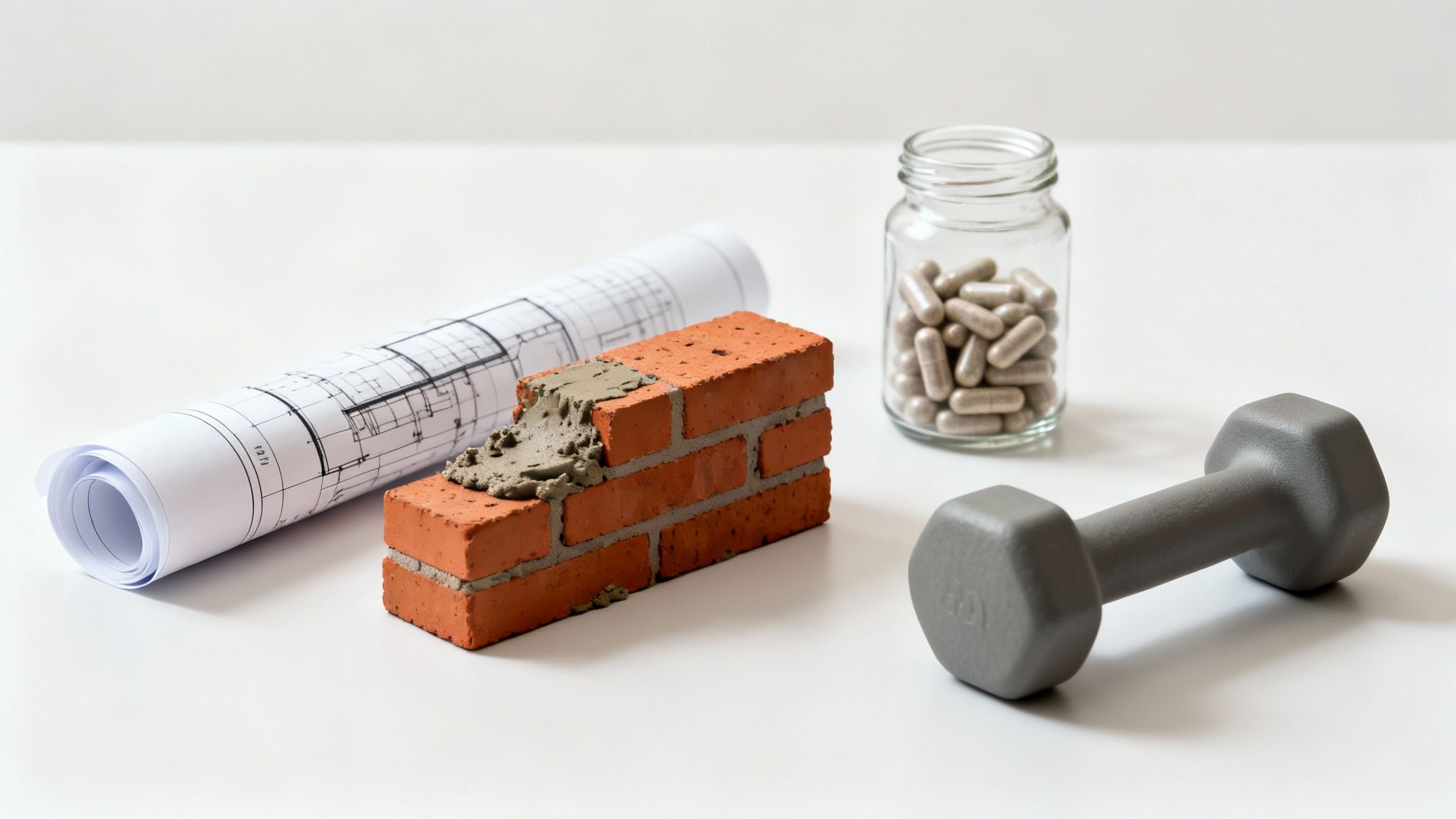
Walking down the supplement aisle can be completely overwhelming. To cut through the noise, it helps to remember one simple principle: you build muscle by creating a stimulus (training) and providing the raw materials for repair (nutrition). Supplements don’t replace this process—they just optimize it.
Let's imagine you're building a house. Your training is the construction crew laying the bricks, and your daily nutrition is the mortar holding it all together. Muscle gaining supplements are the high-grade power tools that make the whole job go faster, ensuring the final structure is stronger and more resilient.
The Construction Analogy for Supplements
Let's break this down a bit more to see where the most popular supplements fit into our construction site:
- Protein Powder: This is your pallet of high-quality bricks. Sure, you can get bricks from whole foods, but a protein shake delivers them to the job site almost instantly. This ensures your crew never has to stop working because they’ve run out of materials.
- Creatine: Consider this the high-powered generator on site. It provides that immediate, explosive energy needed to lift heavier bricks and work longer before the crew gets tired. The result is a bigger, better structure built in less time.
- Supporting Cast (Beta-Alanine, HMB): These are the specialized tools—the precision level and the protective scaffolding. They help your crew work harder for longer (beta-alanine) and prevent the structure from degrading during bad weather or tough phases (HMB).
This framework makes one thing crystal clear: power tools are useless without the workers (your training) and the basic materials (your nutrition).
No supplement can outwork a bad diet. Before you even think about optimizing with supplements, you need a solid nutritional foundation. For a deeper look at that, check out a smart eater's guide to macros for muscle gain.
It's no surprise that the global market for these supplements is exploding. It reflects a massive shift in how we approach fitness. Projections show the market rocketing from a $5 billion valuation in 2025 toward $9 billion by 2033, a surge driven by everyone from elite athletes to everyday gym-goers looking for a science-backed edge.
Top Tier Muscle Gaining Supplements at a Glance
To give you a bird's-eye view before we dive into the details, here’s a quick-reference table of the heavy hitters—the most effective, research-backed supplements you should know about.
| Supplement | Primary Mechanism | Key Benefit | Ideal For |
|---|---|---|---|
| Protein | Provides amino acids | Muscle repair & growth | All athletes needing recovery |
| Creatine | Boosts ATP regeneration | Increased strength & power | Strength & power athletes |
| Beta-Alanine | Buffers muscle acid | Delays fatigue, more reps | Athletes in high-intensity sports |
| HMB | Reduces protein breakdown | Muscle preservation | Intense training or calorie deficits |
This table covers the "A-Team" of muscle-building aids. Each one works differently, but they all support the same goal: helping you get more out of the effort you're already putting in.
Protein: The Cornerstone of Muscle Repair and Growth
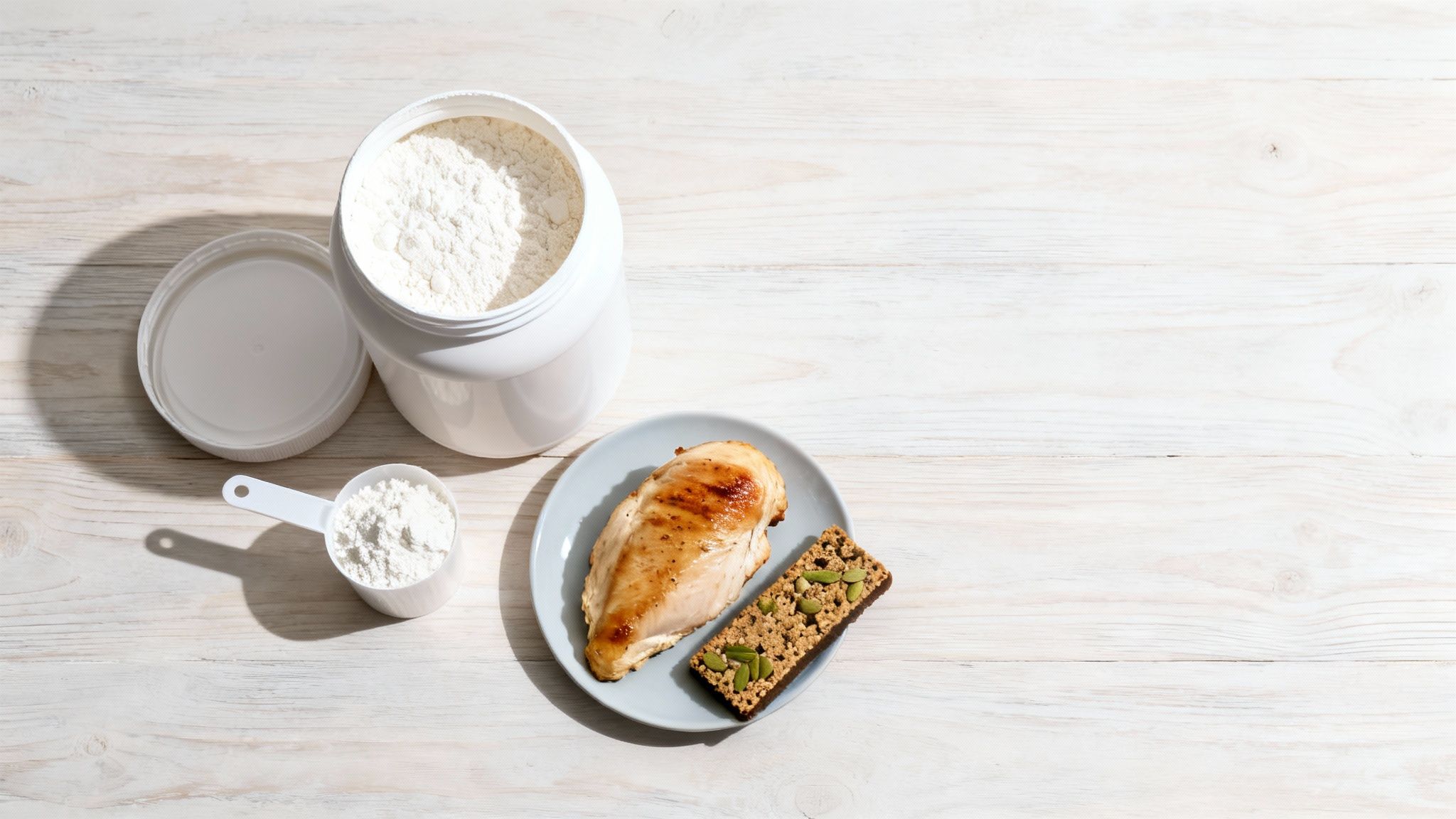
Let’s get one thing straight: protein isn't just another supplement on the shelf. It’s the absolute bedrock of muscle tissue. Every time you crush a workout, you’re creating microscopic tears in your muscle fibers. Protein delivers the essential building blocks—amino acids—to patch up that damage, rebuilding the fibers bigger and stronger than before.
This whole cycle of repair and growth is called Muscle Protein Synthesis (MPS). Picture it like a construction crew showing up after a demolition. If you don't give them a steady supply of bricks (amino acids from protein), they can't rebuild anything. That’s why a consistent, high-protein diet is non-negotiable for anyone serious about building muscle.
The protein supplements market is set to rocket from $30.14 billion in 2025 to a whopping $54.10 billion by 2032. Research from the International Society of Sports Nutrition shows a 20-40g dose of protein post-workout can spike muscle protein synthesis by 50-100% in the critical 24-hour window, a figure that highlights its massive impact on recovery and growth.
The Different Types of Protein Explained
Not all protein is created equal. The biggest differences come down to digestion speed and amino acid profiles, which makes each type suited for different jobs. Knowing the difference helps you pick the right tool at the right time.
- Whey Protein: This is the fast-acting superstar. Derived from milk, whey digests in a flash, rushing amino acids straight to your muscles. This makes it the go-to for a post-workout recovery shake. It’s also packed with leucine, the key amino acid that basically flips the "on" switch for muscle growth.
- Casein Protein: Also from milk, casein is the slow-and-steady yin to whey's yang. It forms a gel in your stomach, which means it releases amino acids gradually over several hours. It's the perfect choice right before bed to drip-feed your muscles all night and keep muscle breakdown at bay.
- Plant-Based Proteins: Options like soy, pea, and rice protein are fantastic for vegans or anyone with dairy issues. While a single plant source might be low in certain amino acids, you can easily create a complete profile by combining them—think rice and pea protein—to get results comparable to whey.
Of all the components in protein, one amino acid stands out. Leucine is the primary trigger for kicking off MPS. It's the foreman on the construction site, shouting at the crew to get to work. This is why high-leucine proteins, like whey, are so prized for post-workout recovery. For a deeper dive, check out our guide on the critical roles of amino acids in supplements.
Nailing Your Protein Timing and Dosage
Forget the old myth about a rigid 30-minute "anabolic window." While getting protein in after you train is definitely a good move, the bigger picture is your total daily intake. Your body stays primed for muscle repair for up to 24 hours after a workout.
For active people looking to build muscle, the science points to a daily target of 1.6 to 2.2 grams of protein per kilogram of body weight. If you weigh 180 pounds (about 82kg), that’s roughly 131-180 grams of protein every single day.
Trying to hit that number with just whole foods like chicken, fish, and eggs is the ideal, but let's be real—it can be a serious challenge. That’s where supplements shine. A good protein shake gives you a convenient, clean, and cost-effective way to hit your daily goals without spending your life in the kitchen. When picking a powder, it pays to know the top whey protein powders for muscle gain.
Creatine: The Undisputed King of Strength and Power
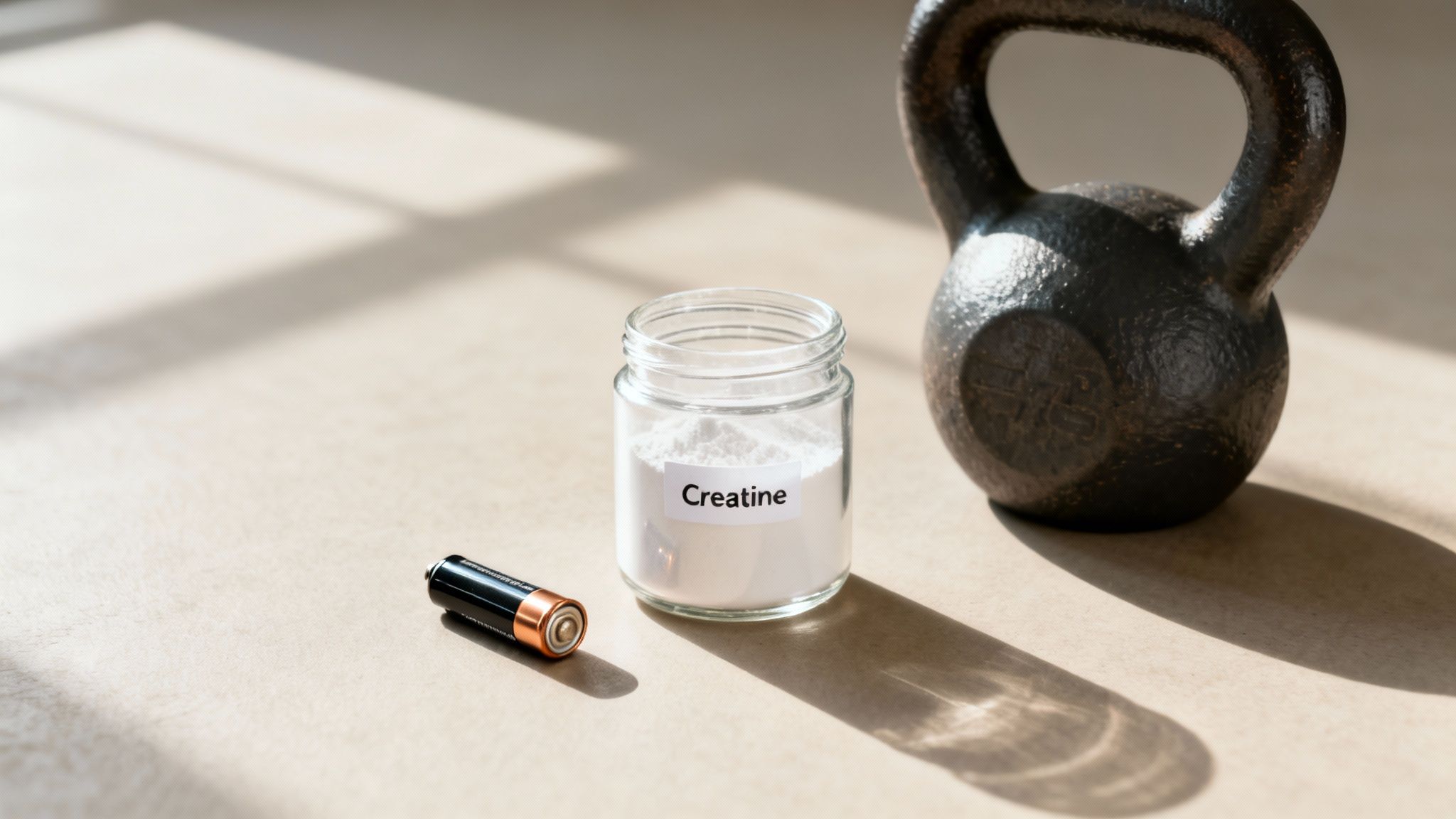
If protein is the raw material for building muscle, think of creatine as the high-octane fuel powering the machinery. It's easily one of the most researched and validated muscle gaining supplements out there, celebrated for its direct and undeniable impact on strength, power output, and lean mass.
Imagine your muscles have a tiny, rechargeable battery for explosive movements like a heavy squat or a full-out sprint. This battery runs on a molecule called Adenosine Triphosphate (ATP). The catch? You only have enough juice for a few seconds of peak effort before that battery dies.
This is where creatine steps in, acting like a rapid-recharging station. It hands over a phosphate molecule to quickly rebuild ATP, effectively topping off your muscle's energy stores. This lets you grind out an extra rep or two, add a little more weight to the bar, and ultimately get more high-quality work done in every single session.
How Creatine Delivers Real-World Gains
This energy-recycling ability isn't just a cool science fact; it produces concrete, measurable results in the gym. Doing more work over time is the fundamental trigger for muscle growth, and creatine lets you do just that.
It's no surprise that creatine is a non-negotiable staple for anyone serious about getting stronger. The body of research consistently shows it delivers big wins:
- Increased Maximal Strength: The ability to move heavier weights for low reps.
- Enhanced Power Output: Moving weight faster, a game-changer for explosive sports.
- Greater Muscular Endurance: Pushing out more reps before you hit that wall of fatigue.
- Accelerated Muscle Growth: Directly supports building lean mass when combined with hard training.
The scientific backing is overwhelming. With over 500 studies since 1992, creatine has been shown to deliver 8-20% strength gains and help athletes pack on an extra 1-2kg of muscle in just 4-12 weeks. In fact, a 2023 meta-analysis found that 70% of users saw significant muscle growth compared to a placebo.
Busting Common Creatine Myths
Despite its proven track record, a few stubborn myths about creatine just won't die. Let's clear the air and set the record straight.
Myth 1: You must do a "loading phase."
A loading phase (taking 20 grams daily for a week) just gets you to full saturation faster. A standard 3-5 gram daily dose will get you to the exact same point in about three to four weeks. Loading is an option, not a requirement.
Myth 2: Creatine causes bloating.
Creatine draws water into the muscle cell, a process called cellular hydration. This is a good thing—it's part of the anabolic signal that helps your muscles grow. It does not cause the "puffy" look of subcutaneous water retention that people worry about.
Myth 3: You need a fancy, expensive form of creatine.
Over and over, studies have put different forms of creatine head-to-head. The verdict is always the same: creatine monohydrate is the undisputed champion. It’s the most researched, most effective, and most affordable version on the market. There is simply no need to pay more for other forms.
For more on building a complete supplement plan, check out our guide on the best supplements for athletic performance.
The bottom line is simple: a daily dose of 3-5 grams of pure creatine monohydrate is a safe, effective, and scientifically-backed strategy to boost your strength and muscle-building results. Just make sure you choose a product that's been tested for purity to ensure you’re getting the real deal.
Exploring Essential Supporting Supplements
Once you've got your foundation of protein and creatine locked in, it's time to look at the next level of muscle-gaining supplements. These aren’t the absolute pillars, but they're more like specialized tools designed to fine-tune your performance, push back fatigue, and protect the muscle you’ve fought so hard to build.
Think of them as the supporting cast that makes the lead actors—your training and core supplements—shine even brighter. The whole point of these secondary supplements is to help you break past your usual barriers. By tackling specific issues like muscle acidity or protein breakdown, they let you stack up more high-quality training volume over time, which is what really drives muscle growth.
Beta-Alanine: Your Fatigue Buffer
You know that feeling. You're deep into a tough set of squats, and that all-too-familiar burn starts to blaze in your quads. That burn is from a buildup of hydrogen ions, which makes your muscles more acidic and eventually forces you to rack the weight. Beta-alanine is a unique amino acid that goes to war with this exact process.
It works by boosting your muscles' supply of carnosine, a compound that acts like a sponge for those acid-producing ions. By soaking up the acid, carnosine helps keep your muscle pH from dropping too quickly, letting you fight off fatigue for longer.
Think of beta-alanine as an anti-fatigue mat for your muscles. It won't make your first rep stronger, but it gives you the stamina to keep working, helping you grind out those last few growth-stimulating reps that make all the difference.
For beta-alanine to really work, it needs to build up in your muscles over time. A daily dose of 3.2 to 6.4 grams is the standard, often split into smaller doses to avoid a harmless but sometimes annoying tingling sensation called paresthesia. It’s a staple in many performance blends, and you can learn more about its role in our guide to understanding pre-workout formulas.
HMB: The Muscle Protector
While most supplements are all about building muscle, Beta-Hydroxy Beta-Methylbutyrate (HMB) plays a different game—it’s a powerful defender. As a metabolite of the amino acid leucine, HMB's main job is to act as an anti-catabolic agent, which is a fancy way of saying it slows down muscle protein breakdown.
This defensive strategy is a game-changer in a couple of key situations:
- During Brutal Training Blocks: When you're redlining your body with intense, high-volume training, muscle breakdown naturally skyrockets. HMB acts like a shield, helping you preserve that hard-earned muscle tissue.
- During a Calorie Deficit: Dieting to shed fat puts you at risk of losing muscle along with it. HMB can help protect your muscle mass, making sure the weight you drop is fat, not muscle.
The go-to dosage for HMB is typically 3 grams per day, broken up into three separate 1-gram servings. It's a smart, strategic play for athletes in the middle of a grueling training phase or anyone trying to get leaner without sacrificing muscle.
Essential Amino Acids: The Complete Building Crew
To build muscle, your body needs a full roster of twenty amino acids. Nine of them, however, are called Essential Amino Acids (EAAs) because your body can't make them on its own—they have to come from your food or supplements.
Even though whey protein gives you the full spectrum of EAAs, a standalone EAA supplement can be incredibly useful. For plant-based athletes, getting a complete amino acid profile from food alone can be a real headache. An EAA supplement fills in any gaps, ensuring no building blocks are missing from the construction site.
EAAs are also absorbed incredibly fast, kicking muscle protein synthesis into gear almost immediately. This makes them a perfect choice to sip on during your workout to keep muscle breakdown at bay and fuel your performance, giving you a powerful tool to optimize your body's muscle-building environment.
How to Build Your Personal Supplement Stack
When it comes to muscle-gaining supplements, a one-size-fits-all approach just doesn't cut it. Your body, your training style, and your goals are unique, and your supplement strategy should be too. Building a "stack" isn't about blindly dumping every popular powder into your shaker cup; it's about making smart, synergistic choices that actually support the hard work you're putting in.
Think of it like building a specialized toolkit. A carpenter and a plumber both need a hammer, but the rest of their tools are going to look very different. For almost any athlete, protein and creatine are the foundational "hammers." But the other tools you add will depend entirely on whether you're training for a powerlifting meet or a marathon.
Let's move beyond the generic advice and build a stack that’s perfectly matched to your athletic profile. We’ll break down four common athlete types and map out a clear, actionable supplement plan for each one.
The Pure Strength Athlete Stack
For the athlete whose life revolves around the squat rack, bench, and deadlift platform, every supplement has one job: maximize force production. This stack is lean, powerful, and built for explosive strength and rapid recovery between heavy, soul-crushing sessions.
The core of this stack is non-negotiable. It starts with 3-5 grams of creatine monohydrate daily to keep your ATP stores topped off for maximal power. This gets paired with a high-quality protein powder—whey is a fantastic post-workout choice to quickly get your muscles the building blocks they need to repair and grow.
- Primary Goal: Maximize raw strength and power output.
- Core Supplements: Creatine Monohydrate, Whey or Casein Protein.
- Optional Add-On: Beta-Alanine is a smart addition. It helps you grind out those extra, growth-stimulating reps on your high-volume assistance work.
The Endurance Athlete Stack
Endurance athletes, like long-distance runners and cyclists, are fighting a different battle. Their main concerns are pushing back fatigue, staying hydrated, and preventing their bodies from breaking down muscle during those long, grueling efforts. This stack is all about stamina and recovery.
Protein is still a must-have for post-session repair, but here beta-alanine becomes a central player. By buffering the acid that builds up in your muscles, it directly fights that burn that tells you to slow down. Electrolytes are also non-negotiable for replacing what you lose in sweat and keeping your muscles firing correctly.
For endurance athletes, supplements are less about raw power and more about sustaining performance. The real goal is to extend the time to exhaustion, which lets you bank higher quality training volume and bounce back faster for the next session.
The Aging Athlete Stack
For athletes over 35, the game starts to change. The focus shifts to preserving the lean muscle you've built, fighting off age-related muscle loss (sarcopenia), and supporting joint health. It’s all about longevity and staying in the game.
This stack calls for a higher daily protein intake, often around 2.0-2.2 grams per kilogram of body weight, to overcome the body's blunted muscle-building response. HMB becomes incredibly valuable here, acting as a powerful shield that helps protect your existing muscle from being broken down. Creatine also remains a key player for holding onto strength.
This decision tree gives you a great visual for how to add supporting supplements based on specific goals like delaying fatigue or preserving muscle.
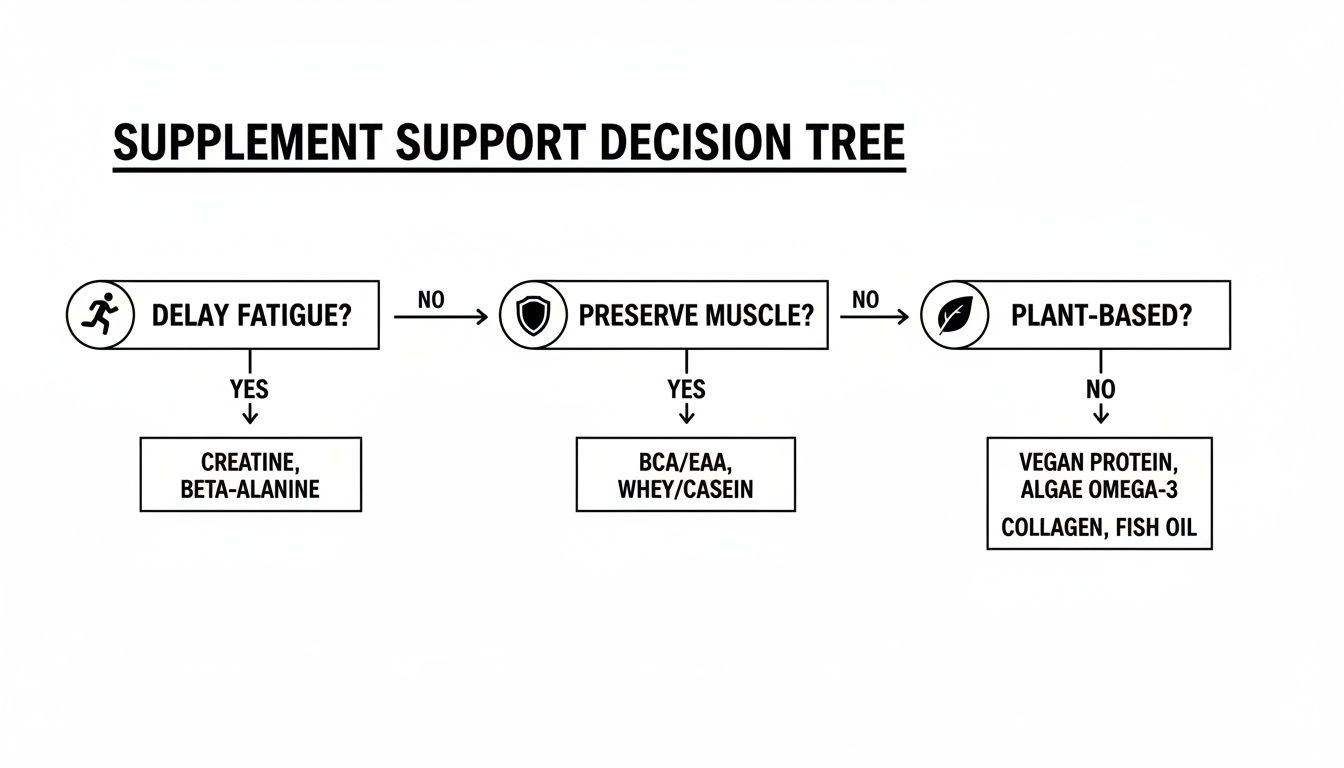
The flow is simple: once your foundation is set, your next choice should directly attack your biggest performance barrier.
The Hybrid Athlete Stack
The hybrid athlete—your CrossFitters, MMA fighters, and OCR racers—needs it all. They have to be a jack-of-all-trades, possessing both brute strength and relentless stamina. Their supplement stack needs to be just as versatile, supporting explosive power one minute and grueling endurance the next.
This stack is a true combination of the best of both worlds. Creatine is there to fuel the strength and power work. Beta-alanine helps them push through the pain cave during high-intensity conditioning. And a well-timed protein shake is the cornerstone that allows them to recover from the dual demands of heavy lifting and intense cardio.
Sample Supplement Stacks by Athlete Profile
To bring it all together, let’s look at these stacks side-by-side. Seeing the recommendations laid out this way makes it easy to see how the core principles apply across different goals, with specific tweaks to support the unique demands of each sport.
| Athlete Profile | Primary Goal | Core Supplements | Optional Add-Ons |
|---|---|---|---|
| Strength | Maximize Force | Creatine, Protein | Beta-Alanine |
| Endurance | Delay Fatigue | Protein, Beta-Alanine | Electrolytes, EAAs |
| Aging | Preserve Muscle | Protein, HMB, Creatine | Vitamin D, Omega-3s |
| Hybrid | Strength & Stamina | Creatine, Protein, Beta-Alanine | EAAs |
By taking a moment to identify which profile fits you best, you can stop guessing and start building a targeted, effective supplement stack. You’ll have a plan that works with your training, not against it, and helps you get to your goals that much faster.
Choosing High-Quality and Safe Supplements
Let's be honest, the world of muscle-gaining supplements can feel like the wild west. Countless brands are screaming bold claims from the rooftops, and it’s tough to know which products are actually effective and, more importantly, safe.
Investing in a high-quality supplement isn't just about getting better results. It's about protecting your body from contaminants, unlisted junk, or doses so low they might as well not be there. A cheap, untested product might save you a few bucks now, but it could cost you your progress—or worse, your health—down the line. Making quality a non-negotiable is step one in building a smart supplement strategy.
Decoding the Supplement Label
Your first line of defense is the label itself. A reputable company isn't afraid to show you exactly what's inside their product; in fact, they're proud of it. Hiding details is always a major red flag.
Here's exactly what to look for to separate the good from the garbage:
- Third-Party Certifications: Keep an eye out for seals from independent organizations like NSF Certified for Sport or Informed-Sport. These certifications mean an unbiased group has verified that the product contains what the label says and is free from banned substances—a must-have for any competitive athlete.
- cGMP Manufacturing: Make sure the product is made in a facility that follows Current Good Manufacturing Practices (cGMP). This is a quality standard set by the FDA, ensuring every batch is produced with consistency and purity.
The biggest warning sign you can find on a label is a "proprietary blend." This is a sneaky tactic some companies use to hide the exact dosage of each ingredient. Without knowing the precise amounts, you have no way of knowing if you’re getting a clinically effective dose or just a worthless sprinkle.
Red Flags to Watch Out For
Beyond the certifications, you need to be wary of certain marketing tricks and formulation shortcuts designed to mislead you. A trustworthy brand lets the science do the talking, not the hype.
Avoid products loaded with unnecessary fillers, artificial colors, or a ton of sweeteners. These add zero value and can sometimes just lead to stomach issues. Be equally skeptical of products that lean on celebrity endorsements instead of real scientific evidence to prove their worth. A great supplement stands on the strength of its formulation, not its marketing budget.
The conversation around supplementation often touches on hormonal support, and you can learn more about this in our detailed guide on HGH supplements and their role in performance.
Ultimately, picking safe and effective supplements just comes down to doing a little homework. By sticking with brands that embrace transparency, invest in third-party testing, and steer clear of deceptive tricks like proprietary blends, you can fuel your body with products that actually support your goals and protect your health.
Your Questions on Muscle Gaining Supplements Answered
Jumping into the world of supplements can feel like navigating a minefield of conflicting information. Getting straight, science-backed answers is the only way to build a smart strategy that actually delivers results without burning a hole in your wallet. Let's clear the air and tackle some of the most common questions athletes ask.
Do I Need to Cycle My Supplements?
This is a big one, but for foundational players like creatine, the answer is no—cycling is old-school thinking. The real magic of creatine happens when you keep your muscles fully saturated, and the best way to do that is with a consistent, daily dose of 3-5 grams. We have a mountain of long-term studies showing this approach is both safe and incredibly effective.
The same logic applies to beta-alanine. It works by slowly building up carnosine levels in your muscles, and you need to take it consistently to keep those levels high and reap the fatigue-fighting benefits. Cycling is really a strategy for stimulants, like those in some pre-workouts, not for these core muscle-building allies.
Can I Get Everything from Food Alone?
A "food first" philosophy should always be your bedrock. Nothing beats a solid nutrition plan. But let's be realistic—the nutritional demands of hard training can be tough, if not impossible, to meet with whole foods alone.
Think about it this way: to get a proven 5-gram dose of creatine, you'd have to choke down over two pounds of red meat. Every. Single. Day. And after a grueling workout, slamming a 30-gram protein shake is a whole lot more practical than cooking up a chicken breast.
Supplements aren't meant to replace good food. They're precision tools, designed to efficiently fill the gaps and make sure your body has exactly what it needs, right when it needs it, to recover and grow.
When Is the Best Time to Take Supplements?
Timing can be critical for some supplements, but for others, it's less of a big deal. Here’s a quick rundown of what really matters:
- Protein: Getting a shake in within a couple of hours after your workout is a great way to kickstart recovery. But the real king here is your total daily protein intake. Hitting your overall daily goal is what truly drives muscle growth.
- Creatine: With creatine, consistency is king. Just take it at the same time every day. Morning, afternoon, post-workout—it doesn't matter. The goal is simply to keep your muscle stores topped off and ready for action.
- Beta-Alanine: You can take this one whenever it’s convenient. Some people find splitting the dose helps minimize that harmless tingling sensation (paresthesia) it can cause.
At Revolution Science, we're obsessed with formulating clean, research-backed supplements to help you push past your limits safely. Our formulas are transparent and no-nonsense, built to support your biggest performance goals. Explore our full range of products at Revolution Science and start fueling your progress.