
Your Cart is Empty


A Guide to Muscle Mass Growth Supplements That Work
Let's be clear: the best muscle mass growth supplements aren't magic. They're strategic tools, designed to amplify what your body already knows how to do. Think of them as reinforcements, providing the exact resources your muscles are screaming for after a tough workout—from the basic building blocks of protein to the high-octane energy of creatine.
How Supplements Fuel Your Muscle Growth
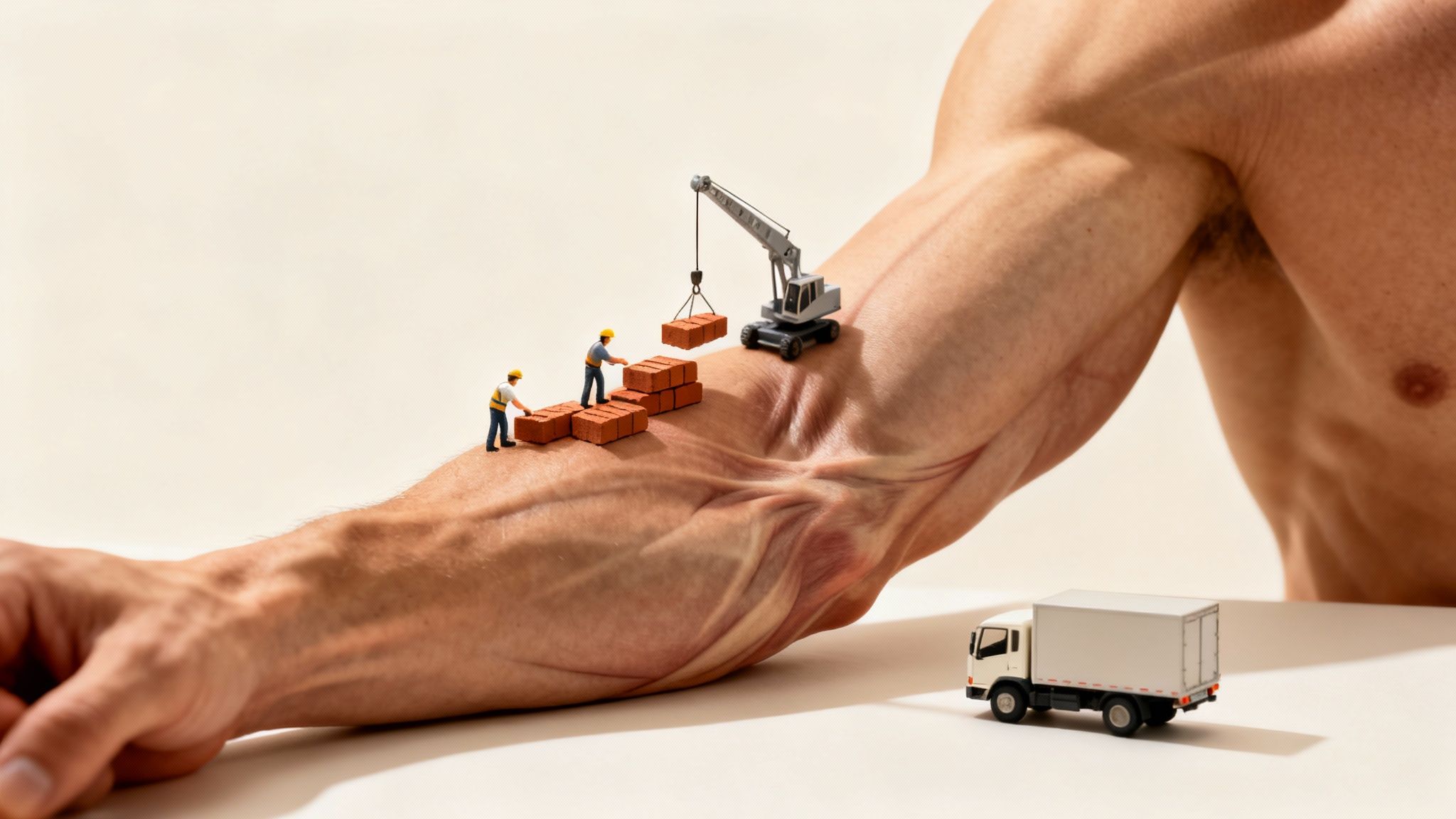
Building serious muscle is a lot like a major construction project. Your workouts are the architects and the demolition crew, creating the demand for a bigger, stronger structure. But the real building—the process of muscle hypertrophy—only kicks off when you deliver the right materials to the job site.
That's where your nutrition and supplementation come in.
- Workouts send the signal. The stress you put on your muscles creates micro-tears, essentially telling your body, "This isn't strong enough. We need to rebuild, bigger and better."
- Nutrition provides the raw materials. Protein is your bricks and mortar, carbs are the fuel for the work crew, and healthy fats help maintain the hormonal environment needed to keep the project running smoothly.
Supplements are the specialized gear and high-grade materials that make the entire process faster and more efficient. They don't replace hard work or a solid diet, but they can absolutely help you get the job done ahead of schedule.
The Construction Site Analogy for Muscle Growth
Let's stick with this construction analogy for a minute. Imagine your body is a bustling job site right after you've crushed a workout.
- Protein Powders: These are like pallets of premium, pre-mixed concrete delivered right where you need them, exactly when you need them. They supply the essential amino acids required to patch up the damage and lay the foundation for new muscle.
- Creatine: This is the high-efficiency power generator for your work crew. It helps your muscles crank out energy (ATP) more rapidly, letting you squeeze out those last few, growth-triggering reps that really count.
- Amino Acids (BCAAs/EAAs): Think of these as the project foremen and specialized couriers. They help direct the "concrete" to the right spots and speed up the entire repair process. It's a perfect example of why smart supplements for muscle recovery are non-negotiable for growth.
This is the key takeaway: muscle growth supplements are amplifiers, not initiators. They work best when they have something to work with—a process your training and diet have already set in motion. To really dial things in, many athletes even use specialized meal prep bodybuilding services to ensure their nutritional foundation is perfectly aligned with their supplement strategy.
The global market for muscle-building supplements is absolutely exploding. It was valued at around $34.8 billion in 2025 and is projected to climb to a staggering $52.1 billion by 2032, growing at a solid 5.8% each year.
This boom isn't just hype; it's a reflection of a massive shift toward science-backed nutrition among athletes who want real results. This guide will help you sort through the noise and build the perfect supplement stack for your own goals.
The Foundational Supplements for Building Mass
When you walk into the world of muscle mass growth supplements, it's easy to get overwhelmed. But amidst all the noise, two undisputed champions stand tall, backed by decades of rigorous science and real-world results in the trenches.
These aren't trendy, flash-in-the-pan products. They're the absolute bedrock of any smart supplement strategy. We're talking about protein powders and creatine monohydrate.
Think of these two as the non-negotiables in your muscle-building toolkit. Before you even think about more specialized formulas, getting these foundational pillars locked in is the single most powerful step you can take to amplify what you’re doing in the gym and kitchen.
Protein Powder: The Essential Building Material
If your muscles are a construction project, protein is the shipment of high-quality bricks and mortar. It’s not just important—it’s the literal raw material your body uses to repair the micro-damage from training and build new, stronger muscle tissue.
Without enough protein, all your hard work is like a construction crew showing up to an empty site. There’s simply nothing to build with.
This is why protein supplements are so popular. They offer a convenient, efficient, and cost-effective way to hit your daily protein goals, which can be a real challenge with whole foods alone. The market reflects this, with protein supplements projected to hit a value of $30.3 billion in 2025 and soar to $67.2 billion by 2035. Animal-based proteins like whey still dominate with a 61.5% market share, mostly because their complete amino acid profiles are proven to kickstart muscle repair after a tough workout.
There are two main types of milk-derived protein every athlete should know:
- Whey Protein: This is your fast-acting "first responder." It digests and absorbs quickly, flooding your muscles with essential amino acids right when they need them most—typically post-workout. This rapid delivery helps kickstart the muscle protein synthesis (MPS) process.
- Casein Protein: Think of this as the slow-and-steady "overnight crew." Casein forms a gel in the stomach, which leads to a much slower, sustained release of amino acids over several hours. This makes it a perfect choice before bed to help prevent muscle breakdown while you sleep.
A common myth is the "anabolic window"—the idea that you have to slam a protein shake within 30 minutes of your workout or you'll miss your chance for growth. While post-workout nutrition is definitely important, research now shows this window is much larger, likely several hours. The most critical factor is hitting your total daily protein goal, day in and day out.
For most athletes serious about growth, a target of 1.6 to 2.2 grams of protein per kilogram of body weight is the sweet spot. A simple but powerful strategy is a scoop of whey post-workout and a scoop of casein before bed to help you hit that number consistently.
Creatine Monohydrate: The Cellular Power Plant
If protein provides the building blocks, creatine monohydrate is the high-performance energy generator that powers the entire construction site. It's one of the most heavily researched and validated supplements on the planet. Hundreds of studies confirm its safety and effectiveness for boosting strength, power output, and ultimately, muscle mass.
Here’s a simple breakdown of how it works: Your muscles use a molecule called adenosine triphosphate (ATP) for short, explosive bursts of energy. When you lift heavy, you burn through your ATP stores in just a few seconds. Creatine steps in and rapidly regenerates that ATP, allowing you to grind out those extra one or two reps that truly force your muscles to adapt and grow.
It's like having a backup battery for your muscle cells. That extra energy capacity translates directly into more volume and intensity in your training, which is the primary driver of long-term muscle gain.
Effective Dosing and Strategy
The most proven method for taking creatine is dead simple:
- Loading Phase (Optional): Take 20 grams per day for 5-7 days, split into four 5-gram doses. This is the fastest way to fully saturate your muscles.
- Maintenance Phase: After loading, drop down to a daily dose of 3-5 grams to keep those levels topped off.
You don't have to do a loading phase; you can just start with the 3-5 gram maintenance dose. It will just take a bit longer (around 3-4 weeks) for your muscles to become fully saturated. Timing isn't critical, but taking it with a meal that has some carbs might improve absorption slightly.
The real key is consistency. Take it every single day, even on rest days. When combined with other critical nutrients, creatine forms a powerful core for muscle development. You can delve deeper into the building blocks of protein by exploring our complete guide on amino acids supplements.
Performance Boosters for Advanced Gains
Once you’ve got your foundation of protein and creatine locked in, you can start looking at performance boosters to truly shatter those training plateaus. These aren't a substitute for the basics; think of them as specialized tools for when you need a distinct advantage during your most intense workouts.
They’re like high-performance upgrades for your engine—the kind that help you squeeze out those extra, growth-stimulating reps that separate good results from great ones.
We’re going to zero in on three heavily researched compounds that deliver real-world benefits: Branched-Chain Amino Acids (BCAAs), Beta-Alanine, and Citrulline Malate. Each one has a unique job, from speeding up recovery and fighting off fatigue to jacking up blood flow.
BCAAs: Your Recovery Ally
Branched-Chain Amino Acids—leucine, isoleucine, and valine—are a special trio of essential amino acids that dive straight into muscle repair. While any high-protein diet will give you all the amino acids you need, supplementing with BCAAs is a strategic move during brutal training blocks or a cutting phase.
Picture your muscle fibers as a brick wall that gets a little beat up after every workout. Leucine, the most powerful of the three, is the master foreman on site, signaling the repair crew to start rebuilding that wall stronger than it was before. Isoleucine and valine are the trusted assistants, helping supply the energy for the whole reconstruction project.
Key Insight: BCAAs really shine when it comes to reducing delayed onset muscle soreness (DOMS) and preventing muscle breakdown (catabolism). This is especially true if you train fasted or are in a calorie deficit where preserving every last ounce of hard-earned muscle is the name of the game.
Beta-Alanine: The Fatigue Buffer
You know that point mid-set where your muscles start burning and you have to stop, even though you feel like you could do more? That burn is from a buildup of hydrogen ions, which makes your muscles more acidic. Beta-Alanine is your direct counter-attack.
It works by boosting your body’s supply of carnosine, a compound that acts like a sponge for those acid-producing ions. It’s essentially a lactic acid buffer. By soaking up the junk that causes fatigue, Beta-Alanine lets you sustain high-intensity effort for longer.
This means you can grind out those last 2-3 reps in the 8-15 rep range—the absolute sweet spot for muscle growth. Over weeks and months, those extra reps add up to a huge increase in training volume and, ultimately, more muscle. An effective dose is typically 3.2 to 6.4 grams per day.
Citrulline Malate: The Pump and Nutrient Delivery Agent
Citrulline Malate is famous for creating a monster muscle "pump," but its benefits go way beyond just looking good in the gym mirror. This compound is a precursor to arginine, which then gets converted into nitric oxide (NO) in your body. Nitric oxide is a vasodilator, meaning it relaxes and opens up your blood vessels.
This increased blood flow turns your circulatory system into a superhighway for nutrient delivery. It rushes more oxygen, amino acids, and glucose right to your working muscles while simultaneously flushing out waste products like ammonia. It’s a dual-action punch that helps you perform better during your workout and recover faster after. Many athletes hunt for this ingredient, and you can learn more about how these compounds stack in our guide on what to look for in a pre-workout supplement.
For the best results, a clinically effective dose of Citrulline Malate is 6-8 grams, taken about 30-60 minutes before you train.
The demand for these targeted supplements is exactly why the bodybuilding supplements market is projected to hit $27.48 billion in 2025 and skyrocket to $47.4 billion by 2032. This explosive growth is fueled by a surge in gym culture and the proven effectiveness of stacks combining BCAAs and pre-workout ingredients to boost strength and performance.
Of course, these performance boosters are just one piece of the puzzle. Holistic recovery strategies are just as important for maximizing growth. For example, many athletes are now using science-backed approaches like sauna for muscle recovery to complement their supplement routine and further crush inflammation.
Building Your Personalized Supplement Stack
There's no such thing as a one-size-fits-all supplement strategy. The perfect plan is a personal blueprint, designed around your specific training, your body's needs, and what you’re ultimately trying to achieve in the gym.
What works for a powerlifter chasing a new one-rep max is worlds apart from what a bodybuilder needs to get stage-ready. It's like building a toolkit. A carpenter and a plumber might be working on the same house, but they need completely different tools to get the job done right. Your supplement stack is your toolkit—it has to be built for your unique discipline.
For the Powerlifter: Raw Strength and Power
A powerlifter’s universe revolves around a single, explosive goal: move the most weight possible. This kind of training is brutal, hammering the central nervous system and demanding instant energy regeneration for that peak power output. Your supplements have to meet these demands head-on.
- Tier 1 Priority - Creatine Monohydrate: This is the undisputed king for anyone serious about strength. By keeping your muscle's phosphocreatine stores topped off, it directly fuels the explosive energy you need for heavy squats, benches, and deadlifts. A consistent 5 grams daily is the gold standard.
- Tier 2 Add-On - Beta-Alanine: Often pigeonholed as an endurance supplement, beta-alanine is a secret weapon for powerlifters. It’s perfect for those high-volume accessory days or when you’re grinding through multiple heavy sets. It works by buffering the acid that causes that deep muscle burn, helping you squeeze out more quality reps that drive long-term strength gains. Aim for 3.2-6.4 grams daily.
For the Bodybuilder: Muscle Fullness and Recovery
Bodybuilders are playing a different game entirely. Here, it’s all about hypertrophy, symmetry, and definition. Training is high-volume and intense, designed to create maximum muscle damage and metabolic stress—the very triggers for growth. The right supplement stack has to speed up recovery and amplify that muscle "pump."
- Tier 1 Priority - Whey and Casein Protein: It's all about timing your protein. Fast-digesting whey protein is perfect post-workout to kickstart muscle repair and synthesis. Then, a slow-digesting casein before bed provides a steady drip of amino acids overnight, preventing your body from breaking down hard-earned muscle. This one-two punch ensures you're always in an anabolic state.
- Tier 2 Add-On - Citrulline Malate: For a bodybuilder, the pump isn't just a feeling—it’s a sign that blood is flooding your muscles, delivering nutrients and oxygen. Citrulline malate is a powerful nitric oxide booster that cranks up this effect, improving nutrient delivery, workout performance, and recovery. Take 6-8 grams before you train to feel the difference.
This decision tree helps you visualize how to layer in more advanced supplements based on what you need right now.
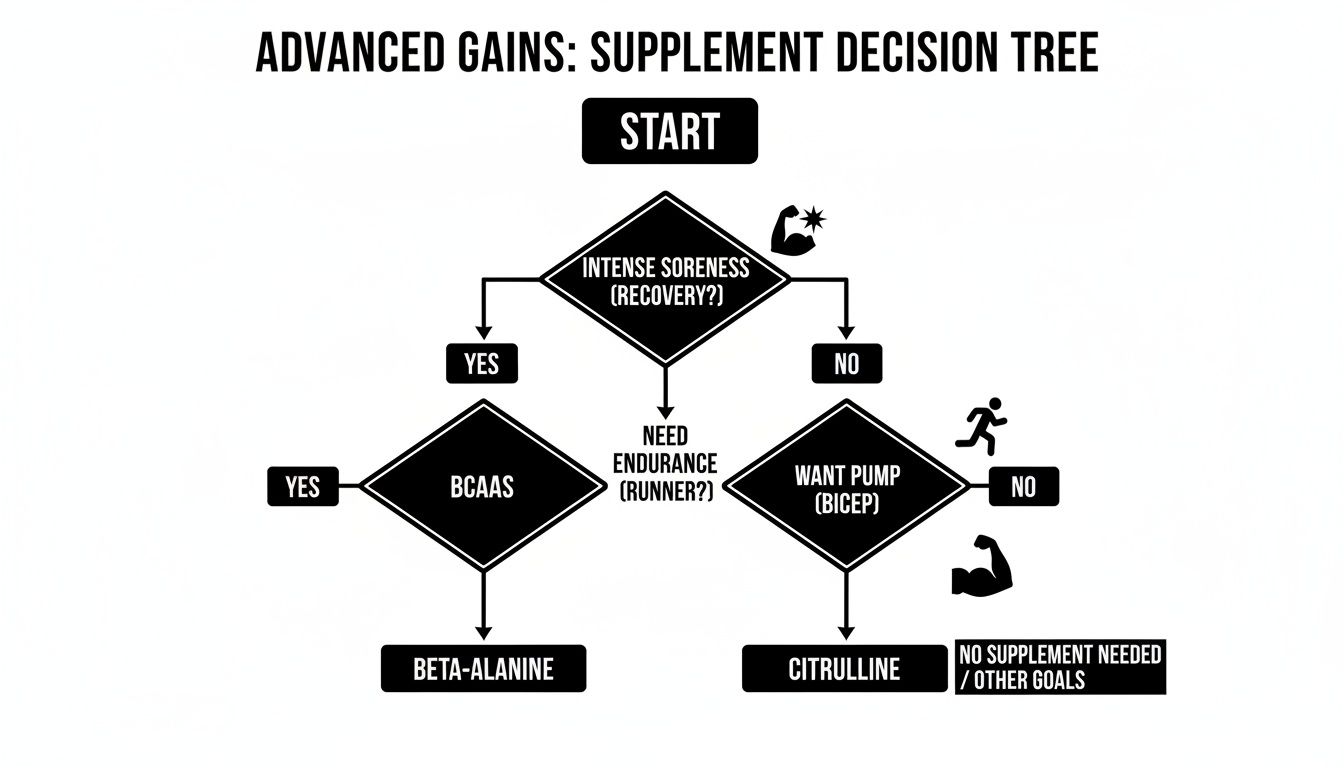
As you can see, your choice for a secondary supplement should directly attack a specific weakness, whether that’s soreness, a lack of endurance, or just wanting a better pump.
For the Hybrid and Aging Athlete
Not everyone fits neatly into one category. The hybrid athlete is trying to be strong and have endurance, while the aging athlete is fighting an uphill battle against age-related muscle loss (sarcopenia) and shifting hormones.
- Hybrid Athlete Stack: The key here is versatility. A combination of creatine for strength, beta-alanine for muscular endurance, and a solid whey protein for all-around recovery creates a powerful foundation. This stack supports you whether you're lifting heavy or hitting the pavement.
- Aging Athlete Stack: For the masters athlete, the priority shifts. You need to ramp up your protein intake, often to 2.0-2.2 grams per kilogram of body weight, to overcome what’s known as anabolic resistance. Just as important is supporting healthy hormone levels to maintain muscle and vitality. For men looking to get an edge here, understanding the role of a quality testosterone booster for men's health and vitality can make a real difference in the fight against sarcopenia.
Key Takeaway: Building your stack starts with one question: What's my main goal? Once you know if you're chasing strength, size, or endurance, you can lock in the Tier 1 and Tier 2 supplements that give you the most direct, science-backed support to get you there.
Crafting the perfect supplement stack is about synergy—choosing compounds that work together to amplify your results based on your specific athletic demands. Below is a quick guide to help you match your goals with the most effective supplement combinations.
Athlete-Specific Supplement Stacks
| Athlete Type | Primary Goal | Tier 1 Priority | Recommended Tier 2 Add-on | REVSCI Synergy |
|---|---|---|---|---|
| Powerlifter | Max Strength & Power | Creatine | Beta-Alanine | Fuels explosive lifts and buffers fatigue for high-volume accessory work. |
| Bodybuilder | Hypertrophy & Fullness | Whey & Casein Protein | Citrulline Malate | Ensures 24/7 amino acid supply and enhances nutrient delivery via the pump. |
| Endurance Athlete | Stamina & Recovery | Beta-Alanine | Electrolytes & Carbs | Delays muscle fatigue while maintaining hydration and glycogen stores. |
| Hybrid Athlete | Strength & Endurance | Creatine | Beta-Alanine | A versatile foundation supporting both anaerobic power and aerobic capacity. |
| Aging Athlete | Muscle Maintenance | High-Dose Protein | Testosterone Support | Fights sarcopenia by overcoming anabolic resistance and optimizing hormones. |
This table provides a starting point. The best stacks are always personalized through careful trial and observation of how your body responds to training and supplementation.
How to Read a Supplement Label Like an Expert
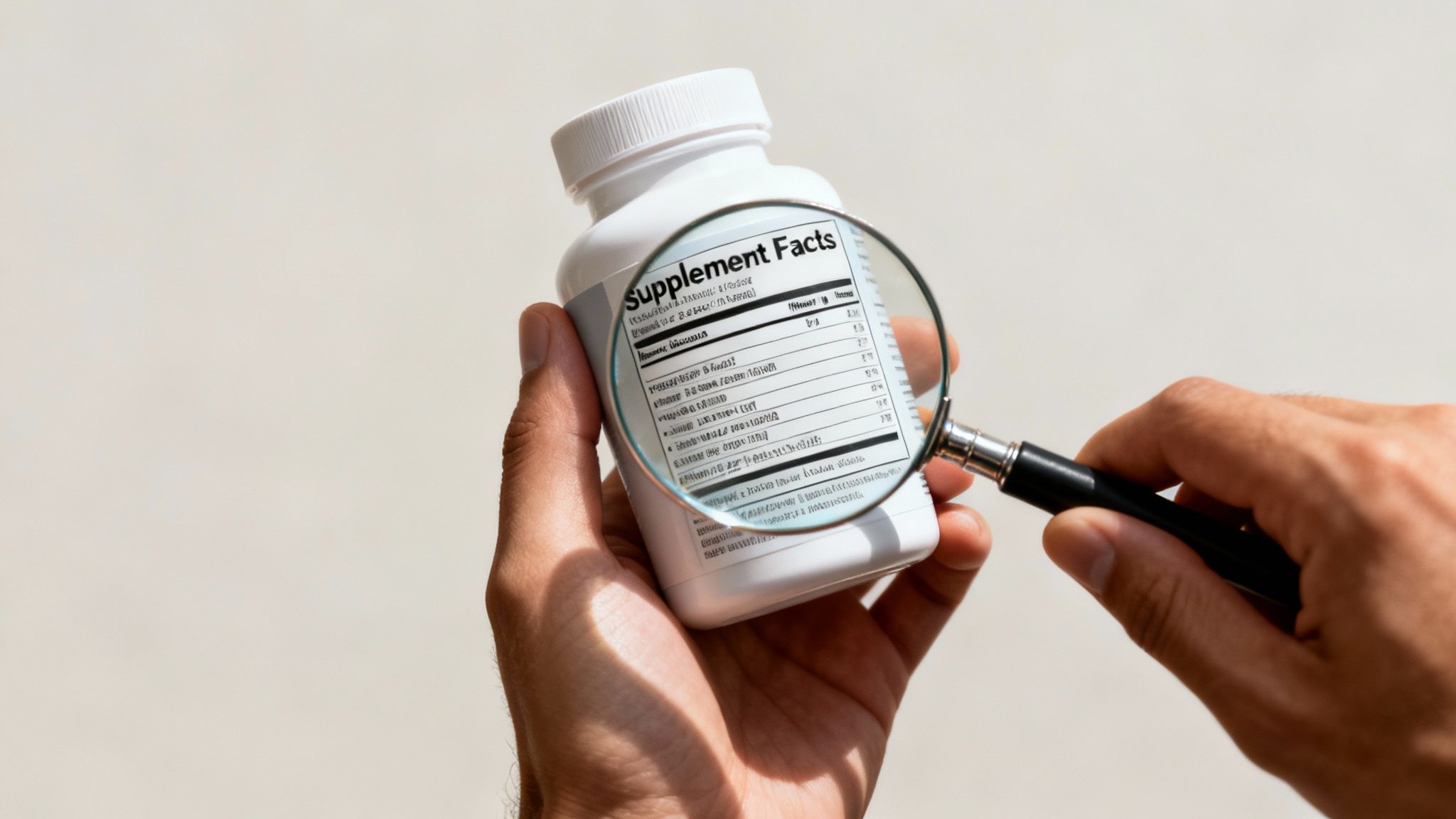
Stepping into the world of muscle mass growth supplements can feel like you're trying to crack a code. With a sea of flashy claims and mysterious ingredients, it's easy to get lost. But your best tool isn't the marketing on the front—it's knowing how to dissect the label on the back.
Learning to read the "Supplement Facts" panel is the single most powerful skill you can develop. It’s what separates the truly effective, science-driven products from the underdosed, filler-stuffed disappointments. This is how you make smart, safe, and effective investments in your body and your performance.
Decoding the Supplement Facts Panel
Think of the "Supplement Facts" panel as the product’s honest resume, stripped of all the hype. The first place your eyes should go is the Serving Size and Servings Per Container. This immediately tells you how much you need to take to get the listed doses and, just as importantly, how long a tub will actually last you.
Next, you'll scan the ingredients and their specific amounts, typically in milligrams (mg) or grams (g). This is the moment of truth. Here, you'll confirm if key compounds like creatine or citrulline are dosed for real-world results. For instance, if a pre-workout promises a massive pump but only has 2g of citrulline malate, that’s a red flag—it falls way short of the 6-8g backed by clinical research.
The Problem with Proprietary Blends
One of the biggest giveaways of a subpar formula is the proprietary blend. You’ll see this when a company hides a list of ingredients under a cool-sounding name like "Muscle Matrix," giving you only the total weight of the blend. They show you the ingredients, but not how much of each is in there.
Proprietary blends are often a tactic to hide underdosed formulas. A brand can highlight premium ingredients like beta-alanine and citrulline, but the blend could be 95% cheap fillers with just a sprinkle of the stuff that actually works.
You should always demand products with fully transparent labels that disclose the exact dose of every single ingredient. A transparent label, like you’ll find on all Revolution Science formulas, means you know precisely what you’re putting into your body. It’s a commitment to clarity that guarantees you’re getting effective doses, not hidden junk.
The Gold Standard: Third-Party Testing
Even with a transparent label, how can you be sure what's listed is actually in the bottle? That’s where third-party certifications come in. These independent labs test supplements to verify their purity and potency, confirming that the product is clean, accurately dosed, and free from harmful contaminants or banned substances.
Keep an eye out for these key certifications:
- NSF Certified for Sport: This is the absolute gold standard for competitive athletes. It confirms label claims and screens for over 270 substances banned by major sports organizations.
- Informed-Sport: This certification program tests every single batch of a product before it ever hits the shelf, making sure it’s free from banned substances.
- USP (U.S. Pharmacopeia): This verification ensures a product meets incredibly high standards for quality, purity, and potency.
By following this checklist—checking serving sizes, insisting on transparent labels without proprietary blends, and looking for third-party seals—you can cut through the noise and confidently choose high-quality supplements that are both safe and effective for reaching your goals.
Of course. Here is the rewritten section, crafted to sound like it was written by an experienced human expert.
Your Top Questions About Muscle Building Supplements, Answered
If you’re trying to build a smart supplement plan, you probably have questions. That’s a good thing. It means you’re thinking critically about what you’re putting in your body.
From when to take something to what to expect, getting straight answers is the first step. Let's clear up some of the most common questions so you can build your stack with confidence.
Do I Need to Take My Supplements on Rest Days?
Yes, for certain ones, it's non-negotiable. Don't think of them as "off days"—think of them as "growth days." The hard work in the gym is the stimulus, but the real muscle rebuilding happens during recovery.
Consistency is everything for supplements that need to build up in your system to work. Creatine is the classic example here.
- Creatine: To keep your muscles fully saturated, that daily 3-5 gram dose is a must, training day or not. Missing a day won't kill your progress, but daily intake is what keeps those cellular energy tanks full and ready for your next session.
- Protein: Your muscles are still repairing and growing for 24-48 hours after a tough workout. Hitting your daily protein goal is just as critical on rest days to feed that process and make sure the rebuilding continues without interruption.
Now, for something like a stimulant-based pre-workout, that’s different. You should only take those on training days. There’s no point in taking caffeine or pump ingredients when you're not about to put them to work in the gym.
How Long Until I Actually See Results?
This is the big one, and the honest answer is: it depends. The specific supplement, how dialed-in your training and nutrition are, and even your own genetics all play a massive role. But we can set some realistic timelines.
With creatine, you’ll likely feel a difference in strength and power within the first 1-2 weeks, especially if you start with a loading phase. You might start to see a change in muscle fullness around 4-6 weeks in, once your muscles are holding more water and are fully saturated.
Protein is a different animal. Its results are quieter and woven into your overall progress. It's not a direct performance booster like creatine; it's the raw material for growth. You’ll see its benefits in the slow, steady muscle gain you achieve over months of consistent effort.
The Bottom Line: Supplements are accelerators, not magic bullets. They make the hard work you’re already doing in the gym and the kitchen count for more, but they can't replace it.
Are These Supplements Safe?
When you’re using them correctly and buying from brands you trust, the most common muscle-building supplements have a stellar safety record. Ingredients like creatine monohydrate and whey protein have been put under the microscope in countless studies over decades and are consistently shown to be safe for healthy people.
That said, safety really boils down to three key habits:
- Demand Quality: Always go with brands that use third-party testing. This is your only guarantee that what’s on the label is actually in the bottle, without any junk or contaminants.
- Follow the Science on Dosing: More is rarely better. Sticking to the clinically proven dosages ensures you get the benefits without running into potential side effects.
- Listen to Your Body: Pay attention to how you feel. Everyone is different. If something feels off, stop taking it and talk to a doctor or a qualified professional.
When Is the Best Time to Take Everything?
For some supplements, timing can give you a slight edge. For others, just taking it consistently is what truly matters.
Here’s a simple schedule for your stack:
- Pre-Workout (30-60 minutes before you train): This is for your immediate performance enhancers. Things like Citrulline Malate for blood flow and Beta-Alanine for muscular endurance need a little time to kick in.
- Post-Workout (Within 1-2 hours after): This is the prime window to get in a fast-acting Whey Protein shake to kickstart the recovery process. Taking your Creatine here with some carbs can also give its absorption a small boost.
- Anytime: For your daily maintenance dose of creatine, the specific time of day doesn't really matter. Just get it in. Consistency beats timing here.
- Before Bed: A slow-digesting Casein Protein is perfect before you sleep. It drips a steady stream of amino acids to your muscles overnight, helping you stay in an anabolic state while you rest.
At Revolution Science, we build our formulas on a foundation of transparency and clinical evidence, so you know exactly what you're putting into your body. Ready to build a smarter, more effective supplement stack? Explore our clean, research-backed performance formulas at rvsci.com.