
Your Cart is Empty


Finding the Best Supplement for Growth Hormone Production
Let's get one thing straight from the start: can a supplement actually increase your growth hormone levels? The answer isn’t a simple yes or no. While no over-the-counter product contains synthetic hormones, certain ingredients can give your body’s own production a serious nudge in the right direction. Think of them less as a replacement and more as a support crew, helping your internal systems run at peak efficiency.
Your Evidence-Based Guide to Growth Hormone Supplements
This isn't about finding a magic pill. This is about understanding the intricate system your body already has for producing growth hormone (GH) and learning how smart, targeted nutritional strategies can support it. The goal here is to optimize your natural potential, not to override it.
We’re going to cut through the marketing fluff, bust some common myths, and set realistic, science-backed expectations. You'll see exactly how specific amino acids and other natural compounds can encourage your pituitary gland to do its job, helping you amplify what your body already does best.
The Growing Demand for GH Optimization
Interest in maintaining optimal growth hormone levels isn't just a niche topic for biohackers anymore; it's gone mainstream. This shift is fueling a massive market expansion. The human growth hormone (HGH) market hit a valuation of around USD 5.64 billion in 2024, and it’s projected to climb to a staggering USD 12.75 billion by 2034.
What’s driving this? A combination of factors, really. There's a growing awareness of growth hormone deficiency (GHD), but there's also a huge demand from athletes and high-performers looking for an edge in performance and a way to push back against age-related decline.
This guide is your roadmap to the supplemental side of this trend. We're focused on helping you:
- Finally understand the mechanics behind natural GH production.
- Judge ingredients based on real scientific evidence, not just flashy claims.
- Make informed, safe choices that align with your performance and recovery goals.
Consider this your playbook for enhancing your body's built-in capabilities. We’re not just listing products; we’re giving you the tools to read a label with a critical eye. Our comprehensive HGH supplement guide offers even more detail on navigating this complex landscape, empowering you to build a strategy that truly works for your goals. Every choice you make should be a deliberate step toward sustainable progress.
When you're looking at your options, it's crucial to understand the massive difference between supplements that support your body's natural production and pharmaceutical, synthetic HGH. They are not the same thing, and they don't work the same way.
Here’s a quick breakdown to clear up any confusion.
HGH Support Supplements vs Pharmaceutical HGH at a Glance
| Attribute | Dietary Supplements (Secretagogues) | Pharmaceutical HGH (Somatropin) |
|---|---|---|
| Mechanism | Stimulates the pituitary gland to release more of your own natural GH. | Directly introduces a synthetic version of growth hormone into the body. |
| Regulation | Sold over-the-counter as dietary supplements under FDA guidelines. | A controlled substance, available only by prescription and for specific medical conditions. |
| Legality | Legal for adults to purchase and use. | Illegal to use without a valid prescription from a doctor. |
| Application | Used for optimizing natural hormone levels for performance, recovery, and aging. | Primarily used to treat diagnosed growth hormone deficiencies in children and adults. |
| Dosing | Follows recommended dosages on the product label. | Dosing is determined and monitored by a physician based on medical need. |
| Side Effects | Generally well-tolerated with a low risk of side effects when used as directed. | Can have significant side effects, including joint pain, insulin resistance, and carpal tunnel syndrome. |
The takeaway is simple: supplements work with your body, while pharmaceutical HGH is a powerful medical intervention that replaces a natural process. For athletes and anyone focused on performance optimization, supporting your body's own systems is the smarter, safer, and legal path forward.
How Your Body Naturally Produces Growth Hormone
Before we even talk about supplements, we need to get one thing straight: your body already has a brilliant system for making growth hormone. It’s not some random, chaotic process. It's an elegant and powerful cycle run by your brain, and understanding it is the key to unlocking your real potential.
Think of your brain as the mission control for this whole operation. Deep inside, a few key players are locked in a perfectly timed dance to manage when growth hormone (GH) gets released.
The Brain's Command Center
It all starts in a small but mighty part of your brain called the hypothalamus. This little region is the master regulator, constantly keeping tabs on your body’s needs. It’s like an air traffic controller, deciding when hormone signals should take off and when they should stay grounded.
The hypothalamus sends its orders down the line to the pituitary gland, a pea-sized gland at the base of your brain. The pituitary is the factory floor where GH is made and stored, just waiting for the green light to hit your bloodstream.
But this isn't a one-way street. It’s a finely tuned system of checks and balances, driven by two opposing hormones that create a natural rhythm.
The Gas and Brake Pedals: Your Key Hormonal Signals
To control GH release, your hypothalamus uses two hormones that act just like a gas pedal and a brake. Getting a feel for this dynamic is everything, because it’s the exact system that supplements and lifestyle changes try to influence.
-
Growth Hormone-Releasing Hormone (GHRH): This is your gas pedal. When the hypothalamus releases GHRH, it sends a clear message straight to the pituitary: "Go! Release growth hormone now." This kicks off a pulse of GH into your system.
-
Somatostatin: This is your brake pedal. When your body has enough GH, or when something like high blood sugar signals a shutdown, the hypothalamus releases somatostatin. This hormone tells the pituitary, "Stop! Hold back on the GH."
This constant back-and-forth between "go" and "stop" is why GH is released in pulses, not a steady drip. Your body doesn't just turn on a faucet; it sends out strategic bursts of GH right when they’ll do the most good.
This pulsing release is the hallmark of a healthy hormonal system. The biggest and most important of these pulses happen at very specific times—times that are critical for recovery and growth.
When Your Body Hits the Gas
So, when does your body naturally slam on the gas pedal? It releases its biggest surges of growth hormone under very specific conditions. For an athlete, these are the golden opportunities you want to capitalize on.
The two most powerful triggers are:
- During Deep Sleep: A massive 70% of your daily GH is released during the deep, slow-wave stages of sleep. This is primetime for cellular repair, building muscle, and regenerating tissue.
- After Intense Exercise: High-intensity training, especially lifting heavy and sprinting, triggers a major GHRH release. That post-workout pulse is what kicks your recovery and adaptation process into high gear.
Once you understand this natural rhythm of gas, brakes, and pulses, the path forward becomes clear. The goal isn’t to reinvent the wheel, but to work with the incredible system you already have. Every effective strategy—from picking the right supplements to dialing in your sleep—is really just about helping your body push the gas harder and ease off the brakes at exactly the right moments.
Evaluating Ingredients in a Growth Hormone Supplement
When you're looking at a supplement for growth hormone, you have to cut through the marketing noise. A label might promise the world—faster recovery, more vitality, better everything—but the real story is in the ingredients list and the science (or lack thereof) behind it. To make a smart choice, you need to understand how these compounds are supposed to work and what the research actually says.
Most of these supplements work by trying to game your body's natural "gas" and "brake" system for hormone production. Some ingredients aim to step on the gas—stimulating Growth Hormone-Releasing Hormone (GHRH)—while others try to ease up on the brake, a hormone called Somatostatin. Let's take a hard look at the most common ingredients and see which ones actually hold up.
The whole process is a top-down cascade starting in your brain.
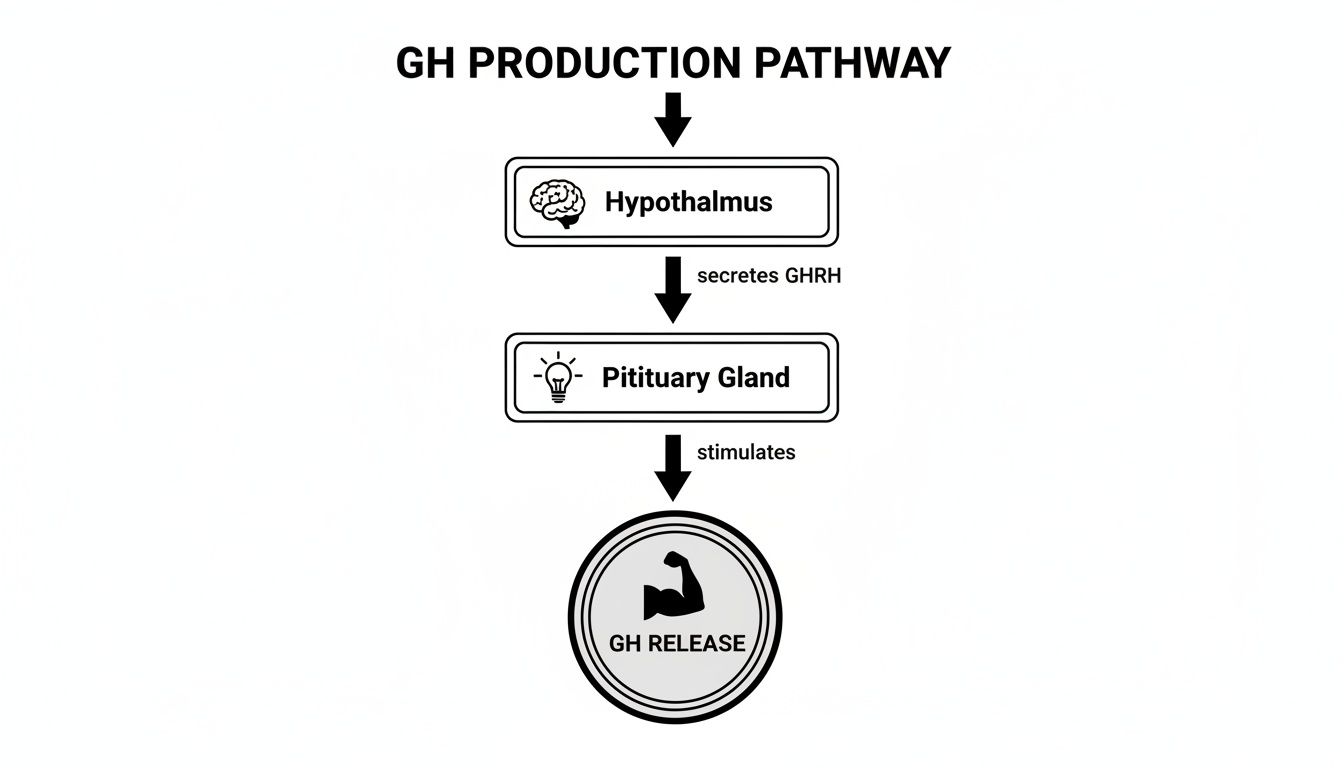
This simple diagram shows the hypothalamus telling the pituitary gland what to do. It’s at these control points where supplements try to exert their influence.
Amino Acids: The Building Blocks of GH Support
Amino acids are almost always the star players in these formulas. As the fundamental units of protein, they have their hands in everything, including hormone regulation. But when it comes to GH, not all aminos are created equal.
L-Arginine is probably the one you've heard of most. The theory is that it inhibits Somatostatin, our body’s natural brake on GH release. By taking the pressure off that brake, arginine might allow for a bigger GH pulse, especially when you’re resting. In fact, studies show that oral doses of 5-9 grams can create a temporary spike in resting GH.
But here’s the catch for athletes: that effect seems to vanish when arginine is taken before a workout. Intense training is already a massive stimulus for GH, and adding arginine into the mix doesn't appear to give you any extra bang for your buck. This is a perfect example of why context matters—what works at rest doesn't always translate to performance.
GABA: A Neurotransmitter with Hormonal Clout
Gamma-Aminobutyric Acid, or GABA, is another heavy hitter. It’s the main inhibitory neurotransmitter in your brain, which is a fancy way of saying it helps calm things down. Think of it as a dimmer switch for your nervous system that promotes relaxation and sleep.
Its link to growth hormone is two-fold. Research suggests GABA can directly stimulate GHRH release while also improving your sleep cycles. Since your body’s biggest natural GH release happens during deep sleep, anything that helps you sleep better is a win for hormone optimization.
Studies have shown a single 3-gram dose of GABA can jack up growth hormone levels significantly, both at rest and after exercise. The effect was especially huge at rest, with reported increases of up to 400%.
This one-two punch—directly nudging the pituitary gland and dialing in your sleep quality—makes GABA a very interesting ingredient. It works through a different pathway than arginine, offering a complementary strategy.
Melatonin: More Than Just a Sleep Aid
Everyone knows melatonin as the "sleep hormone" that governs our internal clock. Its main job is to tell your body it's time to wind down, making it a go-to for getting to sleep faster and improving sleep quality.
Like GABA, its biggest benefit for GH comes from that powerful effect on sleep. By helping you get more deep, restorative slow-wave sleep, melatonin sets the stage perfectly for your body's major nightly GH pulse. You simply can't optimize your hormones without quality sleep.
There’s also some evidence suggesting melatonin might directly suppress Somatostatin, just like arginine. While the science on that direct effect is still developing, its proven ability to lock in better sleep makes it a valuable part of any comprehensive GH support plan, especially for anyone whose rest is less than perfect.
Evidence Scorecard for Common GH-Supporting Ingredients
To cut through the clutter, let’s break down the evidence for these ingredients. This scorecard gives you a quick snapshot of what the science says so you can see what’s promising and what’s mostly hype.
| Ingredient | Proposed Mechanism | Effective Dose Range (in studies) | Strength of Evidence |
|---|---|---|---|
| L-Arginine | Inhibits Somatostatin (the "brake") | 5–9 grams | Moderate (at rest only) |
| GABA | Stimulates GHRH (the "gas"); improves sleep | 3 grams | Strong |
| Melatonin | Improves deep sleep quality; may inhibit Somatostatin | 0.5–5 mg | Strong (for sleep) |
This table makes it clear that while several ingredients show potential, their effectiveness is highly dependent on timing, dose, and your own activity levels.
The market for this stuff is blowing up for a reason. Projections show the global HGH market soaring from USD 7.65 billion in 2024 to USD 24.62 billion by 2034. A big part of that is the aging population—over 20% of adults aged 40+ have low levels of IGF-1, a key marker of GH activity. People are actively looking for ways to push back against age-related decline, and that goal lines up perfectly with athletes trying to maximize their longevity in their sport. You can see more on these trends over at BioSpace.com.
Becoming a savvy consumer means you stop reading the front of the bottle and start analyzing the back. When you understand the mechanisms and the context—rest vs. exercise, sleep support vs. direct stimulation—you can read a label with confidence. That knowledge is what empowers you to pick a supplement with real data behind it, ensuring your investment actually supports your goals.
Lifestyle Strategies to Naturally Amplify GH Levels

Think of any GH-supporting supplement as a valuable co-pilot on your journey. But make no mistake—your lifestyle is the engine that actually drives results. No pill or powder can ever replace the powerful, hormone-optimizing effects of smart daily habits. If you really want to unlock your body’s potential, you have to create an environment where natural GH production can truly thrive.
This comes down to mastering the three pillars that work in perfect harmony with any supplement strategy: intense training, deep sleep, and dialed-in nutrition. By getting these right, you build a complete system where every part supports the others, leading to far better outcomes.
Train for a Hormonal Response
Not all exercise is created equal when it comes to triggering growth hormone release. While steady-state cardio has its place, it’s high-intensity training that really flips the switch. This kind of intense effort creates a huge amount of metabolic stress, which is the signal your brain needs to unleash a significant pulse of GH.
To get this effect, your training needs to include:
- Heavy Resistance Training: Compound lifts are king. Squats, deadlifts, and presses, especially when performed in the 6-12 rep range, generate the metabolic demand necessary to kickstart the process.
- High-Intensity Interval Training (HIIT): Think all-out sprints or battle rope slams followed by short rests. This style of training has been shown to cause a dramatic spike in GH levels right after your workout.
Intensity is the name of the game. Pushing your body to its limits for short periods creates the perfect hormonal storm for growth and repair. For more ideas on maximizing your workouts and bounce-back, check out our guide on how to recover faster after a workout.
Master Your Sleep for Peak GH Release
Sleep isn't just downtime; it’s prime time for your hormonal system. The single largest and most important pulse of growth hormone—accounting for up to 70% of your entire daily total—happens during the deepest stages of sleep. Skimping here directly sabotages your body's natural repair cycle.
Learning how to naturally improve sleep quality is a non-negotiable for anyone serious about performance. Prioritizing 7-9 hours of solid, uninterrupted sleep every night is one of the most powerful things you can do.
Fine-Tune Your Nutrition
What you eat—and when you eat it—has an immediate and direct impact on your GH levels. The biggest player to manage is insulin, which acts as a powerful brake on growth hormone secretion. Simply put, when insulin is high, GH is low.
To manage this relationship, you need to be strategic:
- Avoid Large, High-Carb Meals Before Bed: A big insulin spike from carbs right before you sleep can crush that critical nighttime GH pulse. Keep your last meal of the day focused on protein and healthy fats.
- Ensure You're Getting Enough Protein: Your body needs a steady supply of amino acids to fuel the muscle repair and growth that GH supports. Don't fall short on your daily protein intake.
- Think About Nutrient Timing: Taking certain amino-acid-based supplements away from meals—like right before bed or pre-workout on an empty stomach—can help you get the full GH-releasing effect without insulin getting in the way.
When you combine intense training, deep sleep, and smart nutrition, you create a powerful synergistic effect. This complete approach ensures that any supplement you use is working within a system that's already primed for success, letting you truly amplify your body's natural capabilities.
Practical Applications for Different Athlete Goals
Knowing the science behind a growth hormone supplement is one thing, but making real progress means applying that knowledge to your specific, real-world goals. The best strategy isn't one-size-fits-all. It has to change based on whether you're chasing strength, pushing your endurance, or simply aiming for lifelong vitality.
An athlete’s training demands and what they want to achieve create a completely unique biological backdrop. This means the way you time your nutrition, combine certain ingredients, and sync up your supplement routine with your lifestyle can make a huge difference in your results.
Let’s break down how different types of athletes can fine-tune their approach to get the most out of their efforts.
The Strength Athlete Building Muscle Mass
If your world revolves around hypertrophy and power, the goal is simple: maximize muscle protein synthesis and speed up tissue repair between those brutal training sessions. Growth hormone is a major player in this recovery process, and a smart supplement strategy can give it the support it needs.
It all comes down to timing. Your body’s biggest natural GH pulse happens during deep sleep, making that the golden window for supplementation. Taking specific amino acids or compounds like GABA about an hour before bed can help support this natural peak.
Here’s a practical way to think about it:
- Your Pre-Bed Protocol: Take GH-supporting amino acids like Arginine or a compound such as GABA on an empty stomach right before you go to sleep. This helps you sidestep any potential blunting from insulin and works with your body's natural circadian rhythm, not against it.
- Post-Workout Reinforcement: While intense training is a powerful GH stimulus on its own, getting enough protein after your workout is non-negotiable. This gives GH the raw materials it needs to get to work on repairs.
The goal isn’t to force a hormonal response out of thin air. It’s to enhance the one your body is already trying to create. By clearing the path for that nighttime GH pulse, you’re creating a better environment for recovery and growth.
This approach makes sure your hard work in the gym gets the full support it needs during that critical overnight recovery phase, leading to better adaptations and more muscle over time.
The Endurance Athlete Focused on Recovery
Endurance athletes—think marathoners, cyclists, and triathletes—put their bodies under immense and prolonged stress. Their main concern isn't necessarily packing on massive muscle but rather enhancing tissue repair, tamping down inflammation, and improving sleep quality so they can bounce back for the next day.
For this crew, the focus shifts from pure muscle building to systemic, whole-body recovery. Poor sleep and chronic stress are notorious for suppressing natural GH production, which can trap you in a vicious cycle of fatigue and under-recovery. A growth hormone supplement here is really a recovery tool.
Here are a few strategic considerations:
- Make Sleep Quality a Priority: Using ingredients known to improve deep sleep, like a low dose of Melatonin or GABA, can be incredibly effective. Better sleep directly translates to a more robust nightly GH release, which is absolutely essential for repairing micro-tears in muscles and connective tissues.
- Time Your Nutrients Around Training: Endurance training can be catabolic, so managing nutrition is key to supporting recovery. Your post-workout meal or shake should focus on replenishing glycogen stores and providing enough protein to slam the brakes on muscle breakdown.
For a deeper look at overall nutritional support, our guide on the best supplements for athletes covers a much wider range of needs beyond just hormone optimization, giving you a more complete picture of performance nutrition.
The Masters Athlete Seeking Vitality
For athletes over 35, the game often shifts to counteracting the natural, age-related decline in hormone production. The top priorities become maintaining muscle mass, preserving bone density, and keeping metabolic health in check to sustain performance and vitality for the long haul.
Here, a GH support strategy is all about consistency and synergy. It's about combining smart supplementation with lifestyle habits that are proven to preserve anabolic hormone levels. The focus is less on chasing extreme peaks and more on maintaining a healthy, solid baseline.
Actionable steps for the masters athlete include:
- Consistent Resistance Training: This is absolutely non-negotiable. Lifting heavy is one of the most powerful natural signals for GH release and is critical for fighting off age-related muscle loss, or sarcopenia.
- Strategic Supplementation: A nightly protocol can help optimize the sleep-related GH pulse, which can naturally start to diminish with age. This makes that pre-bed supplement window particularly valuable.
- Insulin Management: Keeping your body sensitive to insulin through a balanced diet is key. Why? Because chronically high insulin levels are known to suppress GH release.
By tailoring your approach, you move beyond just taking a supplement. You start building an intelligent system that aligns perfectly with your specific athletic journey, no matter what your goal is.
Choosing a Safe and Transparent Supplement
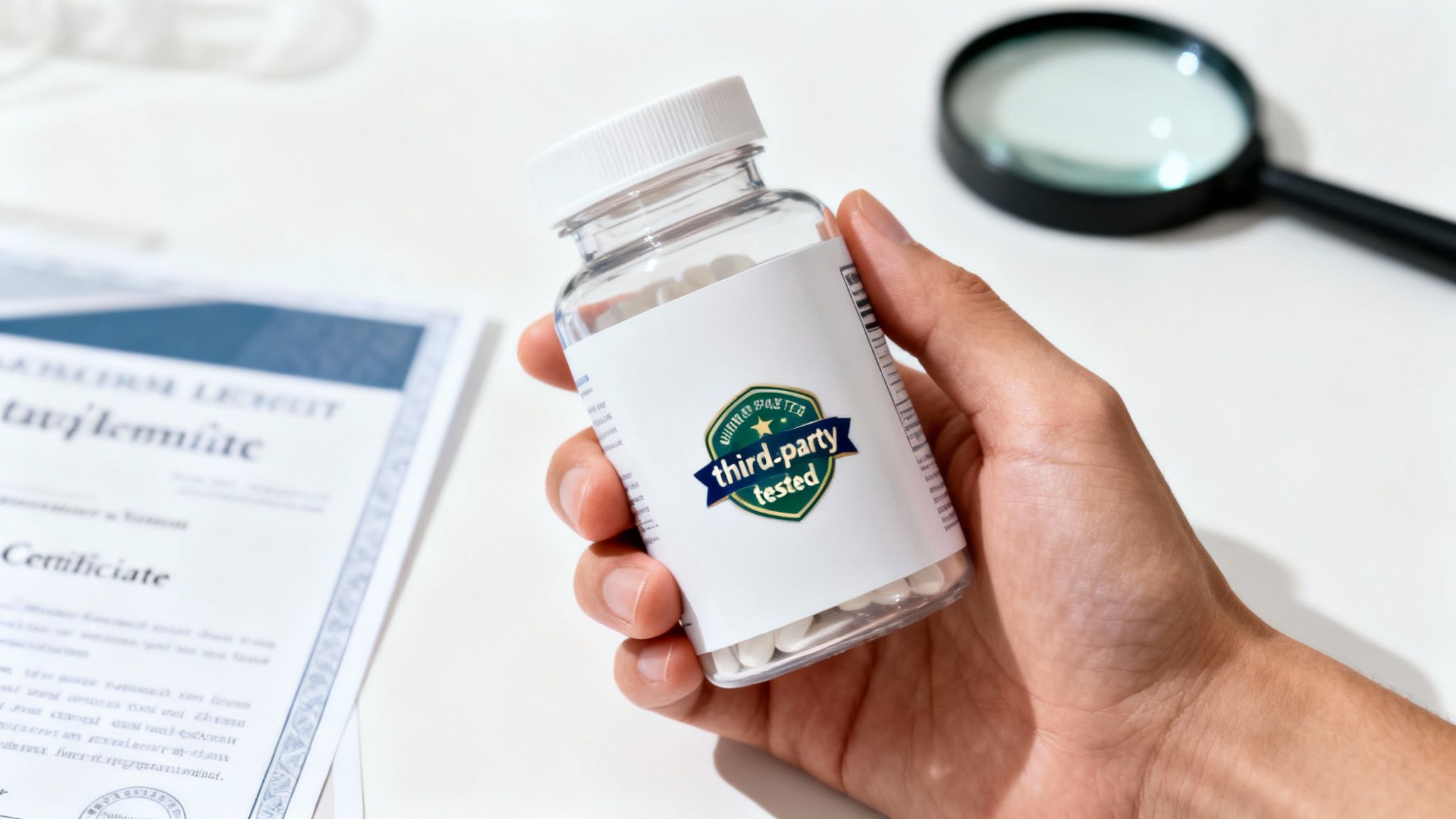
When it comes to dietary supplements, what's not in the bottle is just as critical as what is. The industry is notoriously under-regulated, which puts the burden of quality control squarely on your shoulders as the athlete.
Messing with your body's natural hormone production is serious business. A contaminated or poorly formulated supplement for growth hormone could set you back, doing far more harm than good. This is where a brand’s commitment to transparency isn't just nice to have—it's everything.
A trustworthy company won't hide behind confusing labels or vague promises. They’ll be upfront about every ingredient, its exact dosage, and why it's there. Your mission is to find a product that works with your body to support your long-term health and performance goals.
Decoding the Supplement Label
You shouldn't need a chemistry degree to understand what you're buying. There are a few clear, non-negotiable markers of quality that separate the serious products from the junk.
Here’s what to look for on any label worth your time:
- Third-Party Testing: This is the absolute gold standard. It means an independent, unbiased lab has verified the product’s contents and confirmed it’s free from harmful contaminants. Look for seals from respected organizations like NSF or Informed-Sport.
- No Proprietary Blends: A "proprietary blend" is a massive red flag. This tactic lets companies hide the exact amount of each ingredient, making it impossible to know if you're getting a proven dose or just a sprinkle of pixie dust.
- Clinically-Effective Dosages: Reputable brands build their formulas on solid science, using ingredient amounts shown to be effective in actual human studies. If you see a key ingredient at a dose far below what research supports, it's just window dressing.
When a brand invests in third-party testing and lays everything bare on the label, they're showing you they have nothing to hide. This isn't a bonus feature; it's the bare minimum for any supplement you trust with your health and performance.
Common Questions About Growth Hormone Supplements
When you start digging into supplements for growth hormone, you're bound to have questions. It’s only natural. Getting straight answers is the only way to set realistic expectations and build a smart strategy that actually fits your goals. Let's tackle some of the most common questions head-on.
Is There a Single Best Supplement?
Honestly, there's no magic bullet here. No single ingredient works perfectly for everyone, every time. The most powerful approach is always a synergistic one, combining the non-negotiable pillars of intense training and deep sleep with a well-formulated supplement. Formulas built around proven ingredients like specific amino acids, GABA, or melatonin can offer great support, but how well they work comes down to you and the rest of your routine.
The goal isn't to find a single ingredient that replaces your body's natural processes, but to optimize them. A holistic strategy that locks in your diet, training, sleep, and supplementation will always deliver the best results, period.
How Long Until I See Results?
This is a big one, and managing expectations is key. Natural supplements aren't a quick fix; they work by supporting your body’s own production pathways, and that’s a gradual process.
You'll likely notice better sleep quality and faster recovery within the first few weeks. But for the bigger changes—the shifts in body composition and athletic performance—you need to think in terms of months of consistent use, paired with dedicated training and solid nutrition.
Can I Use These Supplements with Intermittent Fasting?
Absolutely, and the timing is what makes it work so well. Fasting itself can naturally increase the frequency of your body's GH pulses. To take advantage of this, you can time your amino acid-based supplements to be taken either during your eating window or, even better, right before you go to bed. This approach avoids breaking your fast while still piggybacking on the body's natural hormonal rhythm for an optimal effect. You're essentially stacking the benefits of fasting with targeted nutritional support.
At Revolution Science, we build our formulas on a foundation of transparency and hard evidence. We're committed to ensuring you get clinically-supported ingredients at doses that actually work. Our entire focus is on providing clean, tested supplements that help you safely and effectively chase down your performance goals. Explore our dedication to quality and see how we can support your journey at https://rvsci.com.