
Your Cart is Empty


A Guide to Supplements to Prevent Muscle Cramps
The best supplements for preventing muscle cramps are all about restoring what you lose through sweat—mostly key minerals like sodium, potassium, and magnesium. These electrolytes are the backbone of your body's fluid balance and nerve-to-muscle communication. Get them right, and you can stop those involuntary contractions before they ever start.
Why Do Muscles Cramp in the First Place?

Think of your body's network of nerves and muscles as a high-tech electrical grid. A muscle cramp is like a sudden, painful power surge—an involuntary, white-hot contraction that seizes a muscle and stops you in your tracks.
It doesn't matter if you're a marathoner hitting the wall or a lifter feeling a muscle lock up mid-rep. The experience is always frustrating and agonizing.
But these power surges aren't random. They're usually triggered by specific things that throw off the delicate balance needed for smooth muscle function. Getting to the root of these causes is the first real step toward preventing them.
The Primary Triggers of Muscle Cramps
The leading theory pins the blame on something called altered neuromuscular control, where muscle fatigue essentially scrambles the signals between your nerves and muscles. But a few key physiological factors make that breakdown far more likely.
Here are the main culprits that contribute to muscle cramps:
- Electrolyte Imbalance: When you sweat, you're not just losing water; you're draining your body of essential minerals like sodium, potassium, calcium, and magnesium. These electrolytes are the "spark plugs" that transmit nerve impulses. When they run low, communication goes haywire, leading to misfires and cramps. You can dive deeper into just how critical these minerals are in our guide on what electrolytes are good for.
- Deep Muscle Fatigue: Pushing your muscles to their absolute limit without proper conditioning or fuel can simply overwhelm them. This level of exhaustion can make the nerves controlling the muscle hyper-excitable, cranking up the risk of an uncontrolled contraction.
- Dehydration: When you don't drink enough, your blood volume drops. This makes your heart work harder to pump oxygen and nutrients to your muscles, which speeds up fatigue and makes cramps almost inevitable.
This growing understanding of muscle health has ignited a massive market. In fact, the global demand for muscle health and recovery supplements hit a whopping USD 1,538.5 million in 2024. Projections show it soaring to USD 3,294.4 million by 2033, all thanks to athletes and active people looking to optimize performance and sidestep issues like cramping.
Once you understand these physiological triggers, it’s clear that using supplements to prevent muscle cramps isn't just a band-aid. It’s a proactive strategy to keep your body's internal grid running smoothly, making sure your muscles have everything they need to perform under pressure.
Your Guide to the Best Cramp-Fighting Supplements
Walk down the supplement aisle and you'll be buried in options. But when it comes to stopping a muscle cramp dead in its tracks, the science is actually pretty clear. You don't need a miracle pill. You just need to give your muscles the specific tools they need to contract and relax properly.
Forget the one-size-fits-all approach. Think of this as building a high-performance team for your muscles. Each player has a critical, specific job to do, and when they work together, your system runs smoothly.
We'll start with the "Big Four" electrolytes—your first line of defense—before bringing in some key specialists that make the whole team better.
The Big Four Core Electrolytes
Electrolytes are the undisputed MVPs of cramp prevention. These are simply minerals that carry an electric charge, and they run the show when it comes to hydration, nerve signals, and the actual firing of your muscles. When you sweat, you lose them. That's when things go sideways.
Here are the essential players you need on your roster:
- Sodium: It gets a bad rap, but sodium is the single most important electrolyte for maintaining fluid balance. It’s what helps your body actually hold onto water, fighting off the dehydration that leads directly to fatigue and cramps. If you're a heavy sweater, this is non-negotiable.
- Potassium: This mineral works as sodium's partner, regulating the fluid inside your cells. It’s directly involved in sending nerve signals and making muscles contract, making it a cornerstone of any smart anti-cramp strategy.
- Calcium: Most people think of bones, but calcium is the spark plug for muscle contractions. It's the molecule that screams "GO!" to your muscle fibers, telling them to shorten. If your calcium levels are off, that signal gets scrambled, leading to those involuntary spasms we all dread.
- Magnesium: If calcium is the "go" signal, magnesium is the "stop" signal. It’s a natural muscle relaxant, calming the entire system down. It counteracts calcium, preventing the kind of hyper-excitable state that sets the stage for a cramp.
The Power of Magnesium for Muscle Relaxation
While they’re all crucial, magnesium really deserves its own spotlight for how it calms down overactive muscles. Picture it this way: calcium tells your muscle to tighten up, and magnesium tells it to let go. When you're low on magnesium, that "tighten up" signal can get stuck in the 'on' position, leaving your muscles tense and ready to seize.
This isn't just theory. Magnesium is a heavy hitter in the world of cramp supplements, commanding a 21.3% value share in 2024. We're seeing this trend explode in the broader market for period cramp relief, which is projected to grow at a 6.3% CAGR, from USD 902.5 million to USD 1,658.4 million by 2034. Why? Because magnesium directly helps regulate the intensity of muscle contractions, providing real relief for everyone from cyclists and lifters to older athletes fighting off fatigue.
Key Takeaway: Balancing electrolytes isn't just about dumping fluids back in. It's about maintaining the precise mineral ratios that let your muscles fire hard when you need them to and—just as critically—relax completely when you don't.
Supporting Nutrients Beyond the Basics
With the Big Four as your foundation, a few other nutrients act as powerful backups, working behind the scenes to keep you on the field.
Taurine is an amino acid that acts like a bouncer for your muscle cells, helping regulate the flow of fluids and minerals. It makes sure electrolytes get where they need to be, which directly supports cellular hydration and makes the primary electrolytes even more effective.
B-Vitamins are the crew that works in the power plant. They don't stop a cramp in the moment, but they're essential for converting your food into fuel. A deficiency in B1, B6, or B12 can mess with nerve function and accelerate the kind of muscle fatigue that often triggers a cramp.
While targeting these specific nutrients is key, it’s also smart to consider the role of various supplements for overall health that can create a more resilient system from the ground up.
Comparing the Top Supplements for Cramp Prevention
To pull this all together, let’s look at the evidence for the most effective cramp-fighting supplements in a simple, straightforward way. The table below breaks down what each one does, how strong the science is behind it, and the best places to find it.
Evidence-Based Supplements for Cramp Prevention
| Supplement | Primary Role in Cramp Prevention | Strength of Evidence | Best Found In |
|---|---|---|---|
| Sodium | Maintains fluid balance and nerve function; critical for hydration. | Strong | Electrolyte powders, salty foods, table salt. |
| Potassium | Regulates intracellular fluid and aids nerve signal transmission. | Strong | Bananas, potatoes, spinach, avocados, electrolyte drinks. |
| Magnesium | Acts as a natural muscle relaxant, calming neuromuscular excitability. | Moderate to Strong | Nuts, seeds, leafy greens, dark chocolate, supplements. |
| Calcium | Initiates muscle contractions; balance is key for smooth function. | Moderate | Dairy products, fortified foods, leafy greens, supplements. |
| B-Vitamins | Support energy metabolism and nerve health, reducing fatigue. | Moderate (Indirect) | Whole grains, meat, eggs, legumes, fortified supplements. |
| Taurine | Aids in cellular hydration and electrolyte transport. | Emerging | Meat, fish, dairy, and specialized performance supplements. |
Knowing the players is step one. The real art is learning how to combine them for your body and your sport. To take the next step, check out our guide on finding the best electrolyte supplement for your unique needs. That’s how you build a prevention plan that actually works.
How to Stop Nighttime Leg Cramps
Getting hit with a leg cramp in the middle of the night is a totally different animal than one that strikes mid-workout. Instead of being a byproduct of intense effort, these cramps ambush you at rest, jolting you awake with a sharp, searing pain that torpedoes your sleep and recovery.
These nocturnal attacks are often triggered by their own unique set of circumstances. While daytime cramps are usually tied to immediate fatigue and sweat loss, the ones that strike at night are frequently linked to more subtle, chronic issues that only surface when your body is trying to shut down.
What Triggers Cramps at Night
Figuring out why these cramps happen is the first step to stopping them. It's less about what you did in the last hour and more about your body's underlying state of balance.
A few common culprits are:
- Mineral Deficiencies: Even a small, nagging shortage of minerals like magnesium, potassium, or calcium can make your nerves more excitable. During the day, constant movement and brain activity keep this in check, but at night, that excitability can misfire and trigger a full-blown muscle contraction.
- Subtle Dehydration: You might not feel thirsty, but going to bed even slightly dehydrated can concentrate electrolytes in your system and disrupt normal muscle and nerve function.
- Neuromuscular Changes: It’s a simple fact of aging—our nerve signaling can become a little less precise over time. This makes random misfires that lead to cramps more common.
This isn't a small problem. The treatment market for nocturnal leg cramps is expected to balloon from $2.2 billion in 2024 to $3.03 billion by 2029. That staggering number shows just how many people are desperately looking for a solution and opens the door for effective supplement strategies.
Using Supplements for Better Sleep and Fewer Cramps
Since nighttime cramps are so often rooted in mineral balance, supplements can be an incredibly effective tool. The goal is simple: calm the nervous system and give your muscles the resources they need to fully relax while you sleep.
Magnesium is the undisputed star of this show. Think of it as a natural muscle relaxant that works by quieting down neuromuscular signals. A consistent, daily intake helps build up your body's reserves, making sure your muscles have what they need to stay chill all night long.
This visual breaks down how the key players work together to fight cramps.
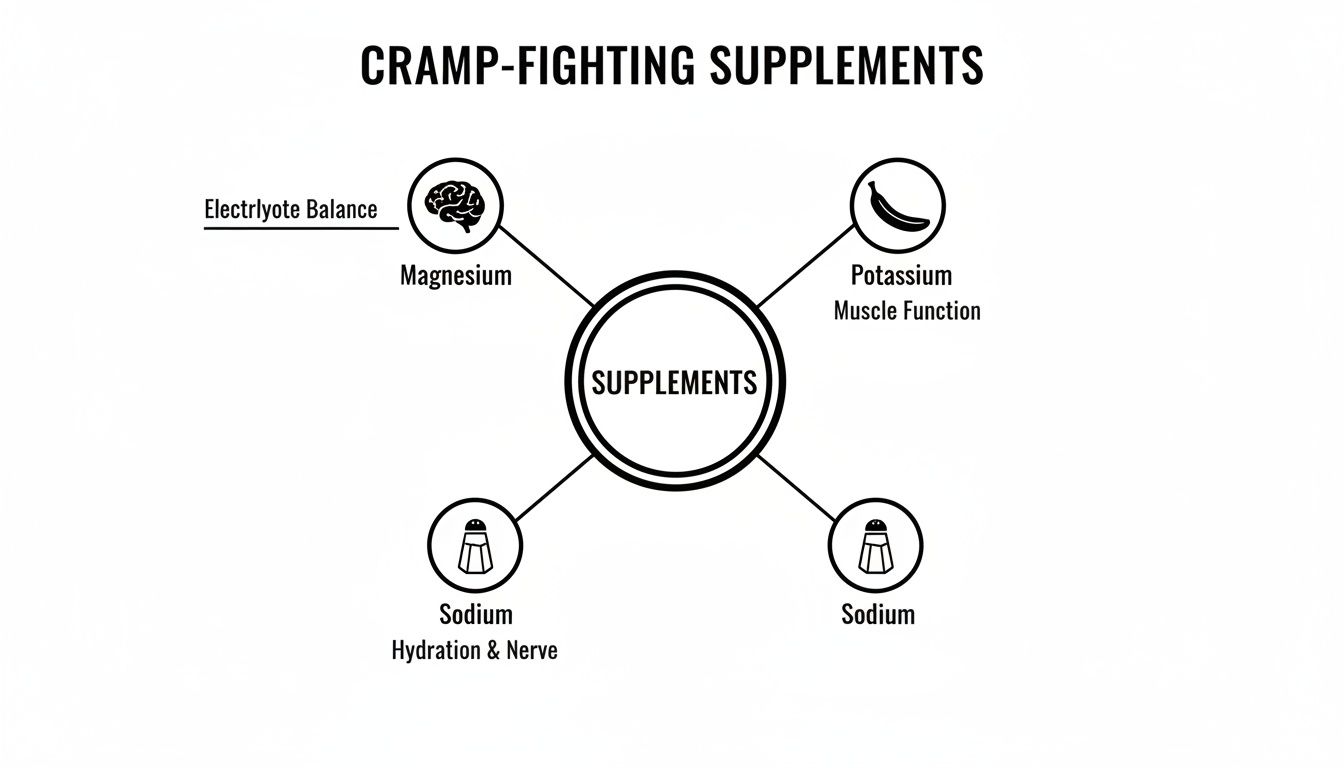
As you can see, minerals like magnesium, potassium, and sodium each have a distinct but interconnected role in keeping your muscles and nerves healthy and communicating properly.
By topping off potential deficiencies with targeted supplements, you can shift your neuromuscular system from a state of high alert to one of deep relaxation. This allows for the uninterrupted, restorative sleep your body needs to recover.
Of course, supplements are only one piece of the puzzle. Solid sleep habits are also absolutely crucial for managing nighttime leg cramps. For a deeper dive, check out these 10 refined sleep hygiene tips for optimal wellness.
Combining a smart sleep routine with the right mineral support gives you a powerful, two-pronged attack to finally put an end to those painful nighttime interruptions.
Creating Your Supplement Dosing and Timing Plan

Knowing which supplements to take is only half the battle. The real secret to stopping cramps dead in their tracks lies in the execution—the when and the how much.
A generic, one-size-fits-all approach just won't cut it when your performance is on the line. You need to think like a strategist, building a personalized plan that accounts for your sport, your body, and your environment. This is about turning complex science into a simple, repeatable routine that keeps your muscles firing on all cylinders.
Tailoring Your Plan to Your Athletic Demands
The needs of an endurance runner grinding out miles for hours are worlds apart from a powerlifter focused on short, explosive bursts of effort. Your sport has to dictate your strategy.
-
For Endurance Athletes (Runners, Cyclists, Triathletes): Your biggest enemy is prolonged sweat loss. The game plan is to pre-load before you start and then consistently replenish on the go. Start your electrolyte intake 60-90 minutes before your race or long training session, and keep topping off with small, regular doses every 45-60 minutes.
-
For Strength and Power Athletes (Lifters, Sprinters): You're less concerned with massive fluid loss and more focused on maintaining the mineral balance needed for peak neuromuscular function during those intense, fatiguing sets. A daily maintenance dose of magnesium is a great idea, while intra-workout electrolytes become critical during long, high-volume sessions, especially when it's hot.
It’s not just about what you do, but how hard you do it. A light recovery jog and an all-out race day demand completely different game plans.
Adjusting Intake for Key Variables
Once you’ve got a baseline for your sport, it's time to fine-tune it based on the conditions of the day. These three factors are non-negotiable for anyone serious about preventing cramps.
1. Workout Duration and Intensity The longer and harder you push, the more you lose. A quick 30-minute workout probably doesn't require any mid-session fueling. But for any activity lasting over 90 minutes, a structured electrolyte plan becomes absolutely essential. As the intensity ramps up, so does your sweat rate, which just accelerates mineral loss.
2. Heat and Humidity Training in hot, humid weather can easily double your sweat rate. That means you need to seriously ramp up both your fluid and electrolyte intake to keep up. On those really brutal days, you might need to double your usual sodium and potassium intake just to stay ahead of depletion and keep cramps away.
3. Personal Sweat Rate Are you a heavy sweater? Do you finish workouts looking like a salted pretzel, with white stains on your clothes? If so, you're a "salty sweater" and your need for sodium replacement is much higher than average. A simple way to get a rough idea is to weigh yourself before and after a one-hour workout (with no drinking). Every pound you lose is roughly 16 ounces of fluid you need to replace.
Your supplement plan should be dynamic, not static. Think of it as adjusting the sails on a boat. You set a general course, but you have to constantly adapt to the changing wind and weather to stay on track and perform your best.
Practical Dosing and Timing Protocols
Let's turn all this theory into some hard numbers. While everyone's needs are a bit different, these evidence-based starting points will help you build a solid foundation. You can also dive deeper into dialing in your schedule by exploring the best time to take electrolytes for maximum benefit.
Pre-Workout or Pre-Race (60-90 Minutes Before)
- Goal: Top off your stores so you start fully hydrated and balanced.
- Protocol: Drink 16-20 ounces of an electrolyte drink containing about 300-500 mg of sodium and 100-200 mg of potassium. This pre-loading phase is absolutely critical for endurance events.
Intra-Workout (For Sessions > 90 Minutes)
- Goal: Replace what you're losing in real-time to fight off fatigue and prevent cramps from starting.
- Protocol: Aim for 200-400 mg of sodium and 50-150 mg of potassium per hour, mixed in 20-24 ounces of fluid. Sip this mix consistently throughout the hour—don't chug it all at once.
Daily Maintenance and Recovery
- Goal: Support overall muscle health and set yourself up for the next session, especially if you're prone to nighttime cramps.
- Protocol: A daily magnesium supplement of 200-400 mg is a great move. Taking it in the evening can also promote muscle relaxation and help you get better quality sleep.
Start with these guidelines, then listen to your body and adjust based on intensity, the weather, and how you feel. This proactive, personalized system is the most reliable way to make sure a painful muscle cramp never sabotages your performance again.
Building Your Cramp-Proof Supplement Stack
Knowing the science behind why you cramp is one thing, but actually doing something about it is what separates the prepared from the sidelined. This is where we stop talking theory and start building a smart supplement strategy that gives your body exactly what it needs when you’re pushing it to the limit.
A good supplement stack isn't just a random mix of powders. It's a precision tool for performance, turning all that complex physiology around hydration and mineral balance into a dead-simple, scoop-and-mix routine. The key is trusting a formula that’s built on solid research and is completely transparent about what’s in the bottle.
The REVSCI Difference: Precision and Purity
When you’re deep in the pain cave, the last thing you should be worried about is the quality of your supplements. That's why at REVSCI, our entire focus is on creating products with exact, research-backed electrolyte ratios. You won't find any murky proprietary blends, artificial junk, or useless fillers—just the clean, effective ingredients your muscles are screaming for.
This commitment to purity and performance is why top-tier operators trust us. We’re in the business of providing tools, not hype, so you can just focus on your training.
- Clean Formulas: We deliver the active ingredients without the fluff. Our Reviver Electrolytes, for instance, are totally tasteless and dissolve instantly. You can add them to anything without messing with the flavor.
- Transparent Dosing: We list every single ingredient and its exact amount right on the label. This gives you the power to dial in your intake for your specific needs, whether that’s a humid marathon or a brutal leg day.
- Third-Party Tested: Every single batch is sent out for rigorous testing to verify its purity and potency. You get a guarantee that what’s on the label is exactly what’s in your shaker cup, giving you absolute confidence in your stack.
This no-nonsense approach takes all the guesswork out of the equation so you can build a reliable cramp-prevention strategy that just works.
From the Lab to the Field: Real-World Performance
The real proof of any supplement is how it holds up under pressure—out in the real world where it actually counts. We’ve seen firsthand how the right formulation can be the critical difference-maker in some of the most demanding environments on the planet.
For elite endurance athletes and tactical professionals, managing electrolytes isn't a "nice-to-have." It’s mission-critical. A single muscle cramp can be the difference between a podium finish and a DNF, or between mission success and a catastrophic error.
Picture a triathlete battling through a race in scorching heat. They can be shedding over 1,000 mg of sodium per hour in sweat. Your average neon-colored sports drink isn't going to touch that. They need a concentrated, precise dose of electrolytes to replace exactly what they're losing. That’s where a product like Reviver becomes an essential piece of their gear.
It's the same story for tactical athletes, who operate in high-stress situations for hours on end and need sustained hydration and flawless neuromuscular function. They can't just call a timeout for a debilitating cramp. Their protocols demand clean, efficient supplements that work seamlessly without blowing up their gut or causing an energy crash.
These high-stakes scenarios reveal a simple truth: when your body is under serious duress, it needs specific, targeted support. By adding a research-backed product like REVSCI's Reviver to your protocol, you’re not just taking a supplement. You’re adopting a proven strategy used by the best in the world to stay hydrated, energized, and completely cramp-free.
Common Questions About Cramp Prevention Supplements
Diving into the world of supplements to stop muscle cramps can feel like navigating a minefield of information. It's easy to get overwhelmed or feel unsure about the best way forward. Let's cut through the noise and tackle the most common questions athletes have when building their anti-cramp strategy.
This section gives you clear, science-backed answers to help you dial in your supplement plan with confidence and get the results you're after.
Can I Prevent Cramps Through Diet Alone?
While a nutrient-dense diet is the absolute bedrock of your health, trying to rely on food alone to stop cramps during intense training is a losing battle. It’s like trying to fill a bucket with a leaky faucet while someone is bailing water out with a shovel.
Intense exercise places demands on your body that are often impossible to meet with just your last meal. An athlete can sweat out huge amounts of key electrolytes like sodium and potassium in a single hard session. Supplements offer a practical, efficient, and precise way to slam those critical minerals back into your system, ensuring your muscles have exactly what they need to fire correctly under load.
How Quickly Will Supplements for Cramps Work?
The real answer? It depends entirely on why you're cramping. The timeline for relief falls into two distinct categories, and knowing the difference is critical for setting the right expectations.
-
For Acute, Exercise-Related Cramps: When a cramp seizes you mid-workout because of sweat loss and fatigue, a fast-acting electrolyte supplement can start to restore balance within minutes. This is why you see pros chugging their electrolyte drinks mid-race—it’s an immediate intervention.
-
For Chronic or Nocturnal Cramps: If your cramps stem from a deeper, long-term deficiency—like low magnesium levels triggering nightly leg cramps—it's not an instant fix. It can take several days, or even weeks, of consistent daily supplementation to build your body's stores back up and see a real drop in how often and how badly you cramp.
Key Takeaway: For in-the-moment relief during training, fast-acting electrolytes are your best bet. For chronic issues, consistency over time is what drives lasting change.
Are There Side Effects to Taking These Supplements?
When you stick to the recommended dosages, the supplements we've covered are generally very safe for healthy people. But as with anything in performance nutrition, more is not always better. Going overboard can definitely cause problems.
For example, taking too much magnesium at once is notorious for causing digestive issues or diarrhea. Likewise, megadosing potassium can be dangerous, especially for anyone with kidney conditions. It is absolutely crucial to follow the product's guidelines and talk to a healthcare professional if you have any pre-existing health issues or take other medications. It's also vital to use products from a source you trust; you can learn more about the importance of third-party tested supplements to guarantee you're getting a pure and safe formula.
What Else Should I Do to Prevent Muscle Cramps?
Supplements are a powerful tool, but they work best as part of a complete, intelligent strategy. Think of them as one piece of a much larger performance puzzle.
To build the most bulletproof defense against cramps, you need to lock in these essential habits:
- Proper Hydration: This is non-negotiable. Sip on water and electrolyte drinks consistently all day, not just when you're working out.
- Dynamic Warm-Ups: Get your muscles ready for the work ahead with active movements, not lazy static stretching.
- Regular Mobility Work: Make time for stretching, foam rolling, or other mobility exercises to keep your muscles healthy and pliable.
- Smart Training Progression: Don't make huge, sudden jumps in your training volume or intensity. That’s just asking for your system to get overloaded.
Combining these foundational practices with a targeted supplement plan gives you the most comprehensive and effective defense against muscle cramps.
A proactive and precise supplement strategy is your best defense against performance-killing cramps. With clean, filler-free formulas, Revolution Science provides the tools you need to stay hydrated, balanced, and ready for whatever your training demands. Build your cramp-proof stack and take control of your performance at https://rvsci.com.