
Your Cart is Empty


The Best Supplements for Marathon Training An Evidence-Based Guide
When you boil it down, the best supplements for marathon training aren't complicated. They tackle three fundamental areas: electrolytes for hydration, carbohydrates for fuel, and protein for recovery. A winning strategy isn't about some magic pill; it's about strategically using these basics to handle the massive stress of high-mileage training.
Your Foundational Marathon Supplement Stack
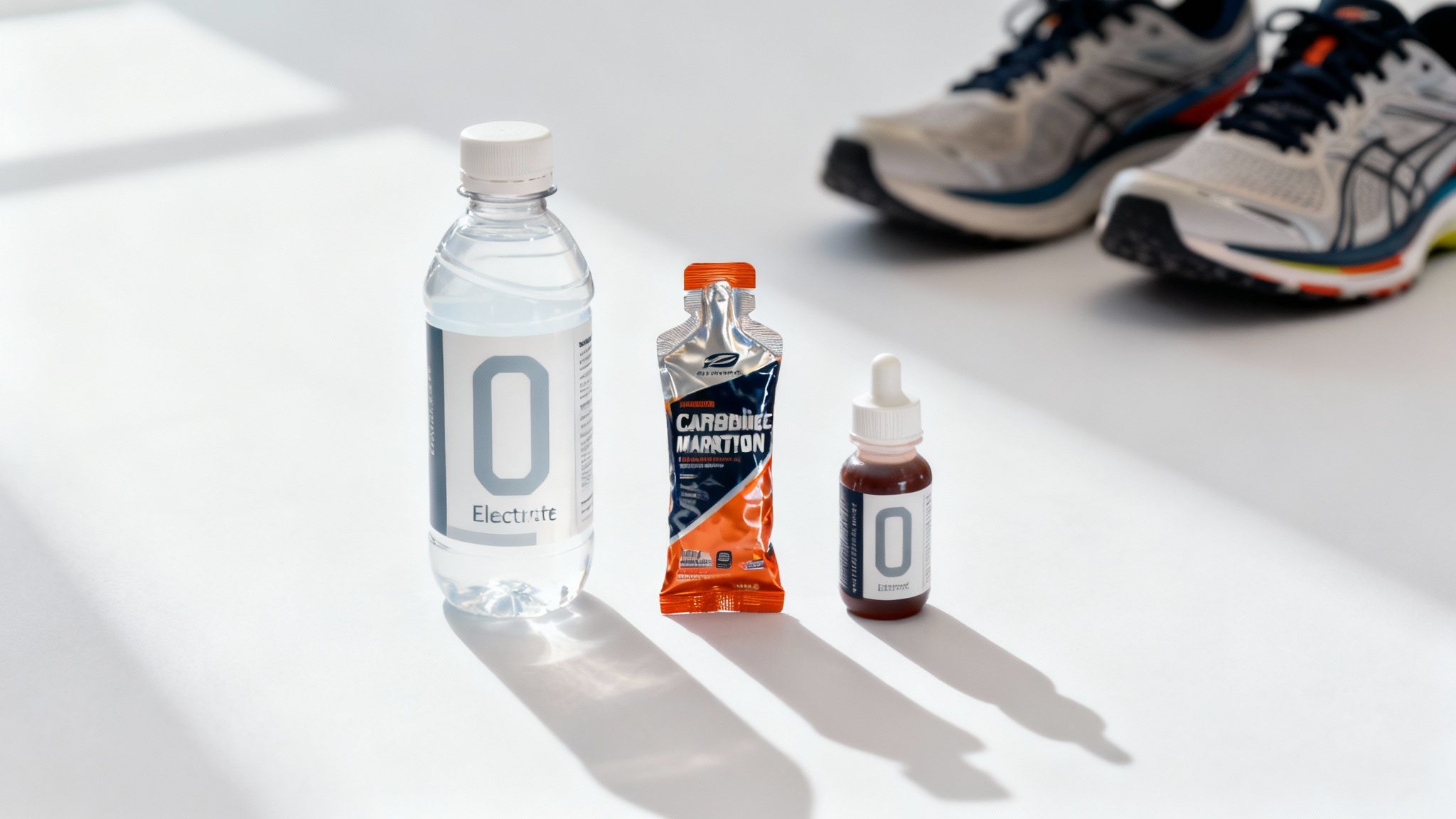
The world of sports nutrition can feel like a maze, but building an effective supplement plan is actually pretty straightforward. It all starts with a "food-first" mindset. Your daily diet should always be the primary source of your nutrition.
Supplements are just that—supplemental. They step in to fill the very specific, high-demand gaps that intense marathon training inevitably creates.
Think of it like building a house. You can't hang pictures before you've laid the foundation and put up the walls. For a runner, that foundation rests on three non-negotiable pillars that work together to keep you healthy, energized, and getting stronger.
The Three Pillars of Marathon Supplementation
Your body needs a systematic approach to fuel, hydration, and repair. If you drop the ball on any one of these, you're undermining your training and risking a rough race day.
Here are the core components every single runner needs to dial in:
- Carbohydrates for Energy: Carbs are your body's high-octane fuel, stored as glycogen in your muscles and liver. During long runs, these tanks get drained, which is what leads to the dreaded "wall." Supplemental carbs from gels, chews, or drinks give you a quick, accessible energy source to keep you moving forward.
- Electrolytes for Hydration: When you sweat, you lose way more than just water. You're also losing essential minerals like sodium and potassium—your electrolytes. These are critical for muscle function and fluid balance. Topping them up is how you prevent cramping, fatigue, and the performance-killing effects of dehydration.
- Protein for Muscle Repair: Every single run creates microscopic tears in your muscle fibers. That’s how you get stronger. Protein provides the amino acid building blocks to repair that damage, helping you recover faster, feel less sore, and adapt to the increasing training load.
When putting your stack together, it helps to understand the full landscape of what's out there. Exploring different types of nutrition supplements for runners will give you the knowledge to make smart choices that fit your body's specific needs.
A smart supplement plan doesn’t replace hard work; it amplifies it. By supporting your body’s core needs for fuel and recovery, you enable yourself to train more consistently and unlock your true potential on race day.
The goal is to weave these elements into your routine so they become second nature. For a deeper look at how these concepts apply across different sports, our complete guide on the best supplements for endurance athletes is a great resource.
To help you visualize how these three pillars work together, here’s a quick-reference table.
Core Supplements for Marathon Runners
This table breaks down the essential supplements, their primary function, and when you should be thinking about using them.
| Supplement Category | Primary Role | When to Use | Key Benefit |
|---|---|---|---|
| Carbohydrates | Fueling Muscles | Before, during, and after long runs | Sustains energy, prevents "bonking" |
| Electrolytes | Hydration & Muscle Function | During and after runs, especially in heat | Prevents cramps, maintains fluid balance |
| Protein | Muscle Repair & Recovery | Post-run (within 30-60 minutes) | Reduces soreness, rebuilds muscle tissue |
Think of these three as your non-negotiables. Getting them right forms the bedrock of a successful marathon training cycle.
Mastering Hydration with Essential Electrolytes

During a long run, think of your body as a high-performance engine. Water is the coolant, absolutely essential for preventing overheating. But the engine’s delicate electrical system? That’s run by electrolytes. Without them, the whole system sputters and stalls, no matter how much coolant you pour in.
This is exactly why just chugging plain water during marathon training often falls short. As you sweat, you’re not just losing water; you’re losing critical minerals like sodium, potassium, and magnesium. These aren't just buzzwords on a sports drink label—they are the literal conductors carrying nerve signals all over your body.
Those electrical signals dictate everything from your heart rate to, most importantly for a runner, your muscle contractions. When your electrolyte levels drop, that communication network starts to fail, leading to all the classic signs of trouble on a long run.
The Science of Cramps and Fatigue
Did you know that losing just 2-3% of your body weight in sweat can seriously tank your performance? This isn't just a matter of feeling thirsty; it’s a systemic breakdown in progress. An electrolyte imbalance, particularly low sodium, is one of the main culprits behind those race-ending muscle cramps.
Without enough sodium, your body struggles to regulate the fluid balance inside and outside of your cells. This breakdown in communication can cause muscles to fire erratically and lock up without warning.
Proper hydration is more than just replacing water; it's about maintaining the precise mineral balance that allows your muscles to fire correctly and your brain to stay sharp, mile after mile.
On top of that, dehydration makes your blood thicker. This forces your heart to work overtime just to pump oxygen to your hard-working muscles. That extra strain is a fast track to premature fatigue, turning what should be a strong run into a miserable shuffle. This is where a good electrolyte supplement proves its worth, transforming a potential weak point into a real source of strength.
Dialing in Your Hydration Strategy
Every runner’s needs are different. Your personal sweat rate, the heat and humidity on a given day, and your run's intensity all influence how much fluid and how many electrolytes you’re losing.
A smart hydration plan is a multi-step process:
- Pre-Hydrate: Start sipping an electrolyte drink an hour or two before a big run. You want to start with a full tank.
- Sip Consistently: During the run, aim for small, frequent sips of an electrolyte-rich fluid every 15-20 minutes. This is much better for absorption than chugging a huge amount all at once, and it prevents that awful stomach sloshing.
- Replenish Post-Run: The work isn’t over when you stop your watch. Keep drinking fluids with electrolytes after your run to replace everything you lost and kickstart your body’s recovery.
Once you understand how these essential minerals work, you can start to fine-tune your own approach. For a complete breakdown, check out our in-depth guide on hydration for marathon runners. Nailing your electrolyte intake is a fundamental step toward preventing cramps, sustaining your energy, and making sure you can perform at your absolute best on race day.
Fueling Your Engine with Carbohydrates
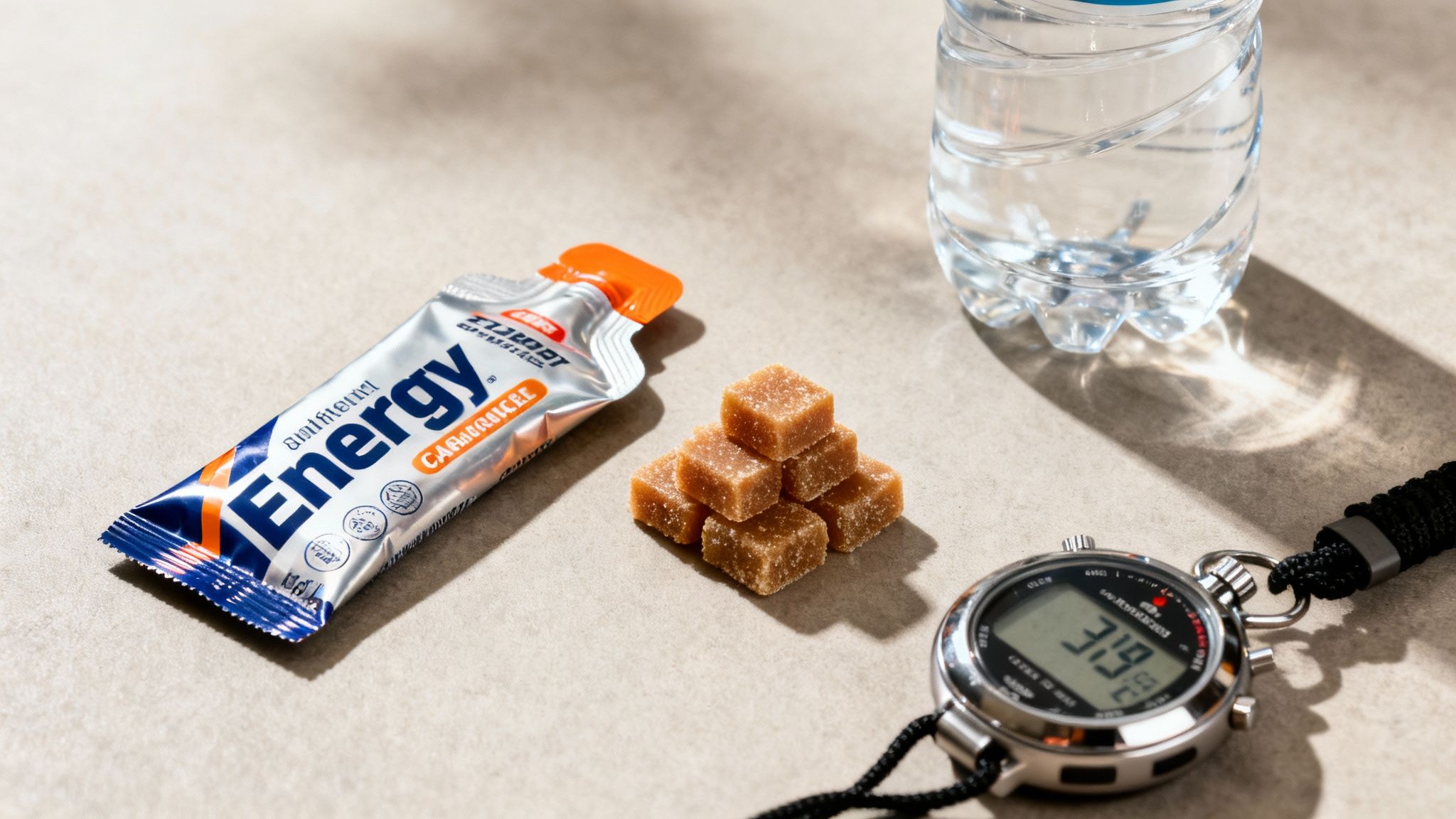
If electrolytes are the electrical grid, then carbohydrates are the high-octane fuel powering your marathon engine. Your muscles have a finite fuel tank for carbs, known as glycogen. With every mile you log on a long run, you're draining that tank. When it runs empty, you slam into the dreaded "wall."
Hitting the wall isn’t a moral failing or a sign of weakness—it's simple physiology. Your glycogen stores have been depleted. Your pace grinds to a halt, your legs feel like they’re filled with cement, and every single step becomes a battle. The key to avoiding this is strategic carbohydrate supplementation, keeping that fuel tank topped off so your engine runs smoothly from the starting gun to the finish line.
This is where the real science of fueling comes into play, both before and during your runs. It’s absolutely central to finding the best supplements for marathon training.
Pre-Race Carb-Loading Done Right
We’ve all heard of "carb-loading," but it's a concept that’s often misunderstood and poorly executed. It’s not an excuse to gorge on a mountain of pasta the night before your race.
Proper carb-loading is a systematic process designed to maximize your muscle glycogen stores in the 2-3 days leading up to the marathon. In this window, you’ll be tapering your running mileage while methodically increasing the percentage of carbohydrates in your daily diet. The goal is to supersaturate your muscles with stored energy, ensuring you start the race with a completely full tank.
To dial in your numbers and make sure you're getting it right, using a macro calculator can be a massive help in planning your intake.
Fueling on the Move: The 30-90 Gram Rule
As soon as the race begins, your body starts burning through that precious glycogen. The entire point of mid-run fueling is to slow this process down by giving your body a steady stream of easy-to-digest carbs. This keeps your blood sugar stable and gives your working muscles an immediate energy source to pull from.
The research is overwhelmingly clear on this: runners should aim to consume 30-90 grams of carbohydrates per hour during any sustained endurance event.
- For runs lasting 60-90 minutes, you can stick to the lower end, around 30 grams per hour.
- For efforts over 2.5 hours (hello, marathon), most runners will perform best with 60-90 grams per hour.
This is precisely why products like energy gels, chews, and specialized sports drinks exist. They’re engineered for rapid absorption and are far more practical than trying to choke down solid food while running at race pace.
Hitting your hourly carbohydrate target is non-negotiable for marathon success. It’s the single most effective strategy for preventing the wall and maintaining a strong, consistent pace in the later miles of the race.
Despite how clear the science is, a surprising number of runners don’t fuel enough. A study of runners at the 2023 Seville Marathon revealed that the average carb intake was a meager 35 grams per hour—way below the optimal range. This common gap between knowledge and execution can absolutely tank your race day performance.
Train Your Gut to Avoid Disaster
Here’s a critical piece of advice: just like you train your legs, you must train your gut.
Suddenly introducing a high volume of carbohydrates during intense exercise is a recipe for GI distress—think cramping, bloating, and nausea. If your stomach isn't used to it, it will rebel.
The golden rule is ironclad: never try anything new on race day.
Use your long training runs as dress rehearsals for your race-day fueling plan. Test different gels, chews, and drinks to see what works for your stomach and what flavors you can actually tolerate after two hours of running. By practicing your fueling strategy over and over, you build up your gut's tolerance, making sure it’s just as ready for 26.2 miles as your legs are.
Accelerating Recovery with Protein and Amino Acids
Marathon training is a demanding cycle of stress and adaptation. Every single run, from the short and sharp to the long and grueling, creates microscopic tears in your muscle fibers. This isn't a bad thing—in fact, it's the whole point. The real magic happens when you rest, and your body repairs this damage, rebuilding your muscles just a little bit stronger and more resilient than before.
But this rebuilding process flat-out cannot happen without the right raw materials. Protein is the key nutrient that supplies the amino acids your body needs to patch up that muscle damage. If you don't get enough protein at the right times, you're essentially short-changing your recovery. You'll stay sore, feel fatigued, and won't get the full benefit from all that hard work you're putting in.
Think of it like a construction crew rebuilding a wall. Your training run is what knocks a few bricks loose. The protein you eat provides the new bricks and mortar for the crew to build it all back up, reinforcing it to be stronger than it was before.
Optimizing Your Protein Intake
It's not just about slamming a protein shake whenever you remember. To really move the needle, you need to be strategic to maximize muscle protein synthesis—the scientific name for that rebuilding process. Your body can only handle so much protein at once. Downing a massive 50-gram shake once a day just isn't as effective as a more measured, consistent approach.
The research is pretty clear on this one: aim for about 20 grams of high-quality protein every three to four hours. This approach creates a steady drip of amino acids into your bloodstream, making sure your internal "construction crew" always has the materials it needs to get the job done all day long. There's a reason elite nutrition protocols are built around this principle.
While carbs are your main fuel source during a race, protein is the undisputed champ of recovery. Studies even show that combining a carb-loading plan with this timed 20g protein intake can dramatically reduce performance decline by hitting both glycogen replenishment and muscle repair. You can see the data yourself in this study on nutrient timing for marathon performance.
Protein is your recovery insurance policy. Consuming it at the right times ensures you're not just recovering from your last run but actively preparing your body to handle the demands of the next one.
Beyond Protein: The Role of Amino Acids and Other Aids
Whole protein sources like whey, casein, or quality plant-based blends are fantastic foundations. But sometimes, a more targeted tool is exactly what you need. Specific amino acids, the individual building blocks of protein, can offer some unique advantages.
- Branched-Chain Amino Acids (BCAAs): Leucine, isoleucine, and valine are the big three for kicking off muscle protein synthesis. They can be especially helpful for taking the edge off muscle soreness when you take them before or during a long, tough run.
- Essential Amino Acids (EAAs): Your body can’t make these nine essential amino acids on its own, meaning they have to come from your diet. An EAA supplement ensures you have the complete set of building blocks for the best possible recovery. To learn more, check out our guide on how amino acids supplements work.
Other natural compounds can also give your recovery a boost. Tart cherry juice, for instance, is loaded with antioxidants and anti-inflammatory compounds that have been shown to significantly dial down post-run muscle soreness. Adding it to your routine can help you bounce back faster and feel fresher for your next session. A complete, thoughtful approach is what separates good recovery from great recovery.
Gaining an Edge with Performance Boosters
Once you've nailed down your core fueling, hydration, and recovery, you can start looking at supplements that give you a direct performance kick. These are often called ergogenic aids—substances proven to help with energy, either by producing more of it, using it better, or recovering from its expenditure.
Think of these boosters as the final 5% of your performance equation. They aren't a shortcut around a solid training foundation, but they can give you that measurable edge when it really counts. They’re the fine-tuning that helps you hammer through a tough mile, lock into a faster pace, or just make a grueling effort feel a bit more manageable.
This is especially true for the pros. One study found a striking 85.85% usage rate of sports supplements among elite middle-distance and marathon runners, with the numbers climbing for those competing on the world stage. Unsurprisingly, caffeine is the king of the list, a staple recommended by top coaches and nutritionists. If you're curious about how the best of the best approach their supplementation, you can see how they make their informed choices here.
Caffeine: The Ultimate Perceived Exertion Blocker
Caffeine is, without a doubt, one of the most studied and effective performance enhancers a runner can use. Its real magic isn't about making your muscles physically stronger; it's about making the effort feel easier. It works by blocking adenosine receptors in the brain, essentially pulling a fast one on your mind so you don't feel as tired.
This drop in your rate of perceived exertion (RPE) is a complete game-changer during a marathon. When mile 20 feels more like mile 18, you're far more likely to stay mentally in the fight and hold on to your goal pace.
- Dosing: The research-backed sweet spot is 3-6 milligrams of caffeine per kilogram of body weight.
- Timing: Take it about 60 minutes before the gun goes off. This gives it time to reach peak concentration in your bloodstream right when you need it.
The goal isn't to feel wired or jittery. The right dose of caffeine is more of a subtle lift—it sharpens your focus and dials down the feeling of fatigue without any unwanted side effects.
Other Science-Backed Performance Aids
Beyond caffeine, a couple of other supplements have some serious science behind them for endurance sports. These work through different pathways in the body to help you push back fatigue and run more efficiently.
Beta-Alanine
Think of beta-alanine as a buffer against muscle fatigue. As you run hard, that familiar burning sensation comes from hydrogen ions building up in your muscles. Beta-alanine helps your body create more carnosine, a compound that literally soaks up these ions. This pushes back the burn, letting you hold a tough pace for longer. Just know that it's not a one-and-done supplement; it requires a "loading phase" of a few weeks to build up in your system.
Beetroot Juice
Beetroot juice is packed with nitrates, which your body converts into nitric oxide. This molecule is fantastic for runners because it helps relax your blood vessels, boosting blood flow and oxygen delivery to your working muscles. The result? A big improvement in your running economy. You essentially use less oxygen to run at the same pace, which makes you a far more efficient machine.
A word of caution: you absolutely must test every single one of these performance aids during training. What works wonders for your friend might send you running for a porta-potty. Use your long runs as a dress rehearsal to dial in your timing, dosage, and specific products so there are zero surprises on race day.
Building Your Personal Race Day Fueling Plan
Knowing the science behind supplements is one thing, but actually putting it all together on race day? That's a completely different ballgame. A successful marathon finish doesn't just happen; it’s built on a detailed, personalized blueprint that leaves nothing to chance.
Think of it like a pilot’s flight plan. You wouldn't just take off without mapping your route, knowing your fuel stops, and having a plan for turbulence. This is your flight plan for those 26.2 miles, turning all that knowledge into a concrete strategy that will get you across the finish line strong.
Differentiating Training Day Nutrition
Not every run is created equal, and your fueling shouldn't be either. A short, easy jog has vastly different demands than a grueling 20-miler, so your supplement strategy needs to adapt.
- Easy Runs (Under 60 Minutes): On these shorter, less intense days, your main focus should just be hydration. An electrolyte drink is a great idea, especially when it's warm out, but you can leave the heavy-duty carb-loading and gels at home.
- Long Runs (Over 60 Minutes): Treat these like a full dress rehearsal for race day. This is your chance to dial in your entire fueling and hydration strategy, from the pre-run meal to the post-run recovery shake. You’ll need a steady supply of both electrolytes and carbohydrates to practice maintaining your energy and fluid balance over the long haul.
This is the time to experiment and figure out exactly what your body responds to best. No surprises on race day, remember?
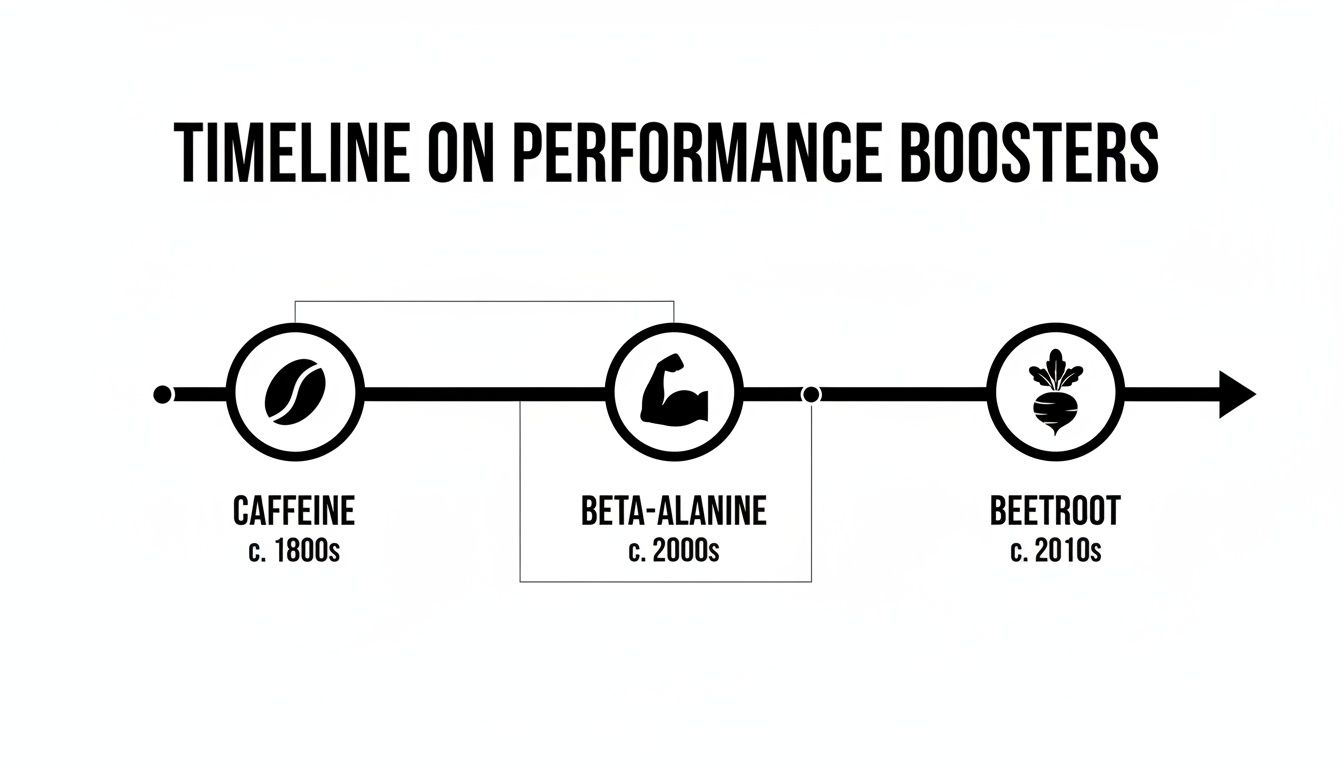
The image above really drives home the importance of timing. Different compounds work on different schedules to get your body primed for peak performance, so you have to plan accordingly.
Crafting Your Race Day Timeline
Your race day plan is the final exam. The golden rule is simple: nothing new on race day. Every single thing you consume should be something you've tested and practiced during your long training runs.
A well-executed fueling plan is a form of self-care on the course. It prevents the highs and lows of energy crashes, keeps your mind sharp, and empowers you to run the race you trained for.
To give you a head start, here’s a sample timeline you can use as a foundation. Remember, this is just a starting point—tweak the quantities and timing based on what you learned works for your body during training.
Sample Race Day Supplement Timeline
A successful race day starts hours before the gun goes off. This table lays out a step-by-step protocol to keep you fueled, hydrated, and focused from start to finish.
| Time Relative to Race Start | Action/Supplement | Purpose |
|---|---|---|
| 3 Hours Before | Breakfast (Carb-rich, low-fiber) | Top off liver glycogen stores |
| 60 Minutes Before | 100-200mg Caffeine + Electrolyte Drink | Boost focus, pre-hydrate, and reduce perceived effort |
| 15 Minutes Before | 1 Energy Gel with Water | Provide readily available energy for the start |
| Every 45 Minutes During | 1 Energy Gel + Water/Electrolytes | Maintain blood sugar and prevent bonking |
| Within 30 Mins Post-Race | Protein Shake + Carbs + Electrolytes | Kickstart muscle repair and glycogen replenishment |
This template provides a solid framework, but true mastery comes from making it your own. For a much deeper dive into the specifics, check out our complete guide on how to fuel for a marathon.
Finding Safe and Effective Products
Finally, let's talk about quality. The supplement market is absolutely flooded with options, and frankly, not all of them are created equal.
To protect your health and your performance, always look for products with third-party testing certifications. Seals of approval from organizations like NSF Certified for Sport or Informed-Sport are your guarantee that what’s on the label is actually in the bottle and that the product is free from any banned substances. Stick with transparent, research-backed brands you can trust.
Common Questions About Marathon Supplements
It’s totally normal to have questions when you're figuring out your marathon nutrition. Even with a solid plan, a few doubts can creep in. This section is all about giving you direct, no-nonsense answers to the most common questions runners have.
Let’s cut through the noise so you can get back to what matters: your training.
Do I Really Need Supplements, or Can I Just Use Real Food?
Look, a "food-first" approach is always the right place to start. A solid diet is the foundation of any great athlete. But the sheer energy and nutrient demands of marathon training create gaps that are tough, if not impossible, to fill with whole foods alone—especially when you’re mid-run.
That’s where supplements come in. They provide a concentrated, convenient, and easy-to-digest shot of specific nutrients right when your body is screaming for them. Think of supplements as the specialized pit crew for your body during a long, grueling effort. They aren’t a replacement for your diet; they’re a tool to support it.
How Do I Keep from Getting an Upset Stomach from Gels on Race Day?
Stomach issues are a runner's worst nightmare, but they're almost always preventable with one simple rule: practice. You have to "train your gut" just like you train your legs and lungs. Start incorporating your chosen race-day gels, drinks, and electrolytes into your long training runs, weeks and months ahead of time.
This is your chance to experiment. Try different brands, play with the timing, and see what flavors your stomach actually agrees with after 15 miles.
The golden rule of marathon fueling is this: Never, ever try anything new on race day. Seriously. It’s also critical to take in enough water with your fuel, which helps your body absorb the nutrients and keeps your stomach happy.
By rehearsing your entire fueling strategy over and over, you’re building your gut’s tolerance. You're ensuring it’s just as ready for 26.2 miles as your legs are.
What Should I Look for in a High-Quality Supplement?
When you’re picking out supplements, it all comes down to two things: transparency and third-party verification. The market is flooded with options, so you need to know how to spot the good stuff.
Keep an eye out for certifications like NSF Certified for Sport or Informed-Sport. These seals are your guarantee that a product is free from banned substances and that the label is actually accurate. A quality supplement will have a clean, simple ingredient list—no weird fillers, artificial junk, or "proprietary blends" that hide the real dosages. Brands that are open about the science behind their formulas and are obsessed with purity are always the ones to trust.
At Revolution Science, we make clean, research-backed supplements without the fillers or pseudoscience. Our products are built to support your performance safely and effectively. You can check out our complete line of endurance solutions at https://rvsci.com.