
Your Cart is Empty


A Practical Guide on How to Increase Grip Strength
If you're serious about getting stronger, learning how to increase grip strength is non-negotiable. This isn't just about squeezing a hand gripper a few times a week. It's about a dedicated approach that targets the three core types of grip: crush, pinch, and support.
Building a truly powerful grip means integrating specific movements—like farmer's walks, plate pinches, and dead hangs—into a smart, progressive plan. The result? Functional power that pays off everywhere, from bigger lifts in the gym to better overall athletic performance.
Why Grip Strength Is Your Ultimate Performance Metric
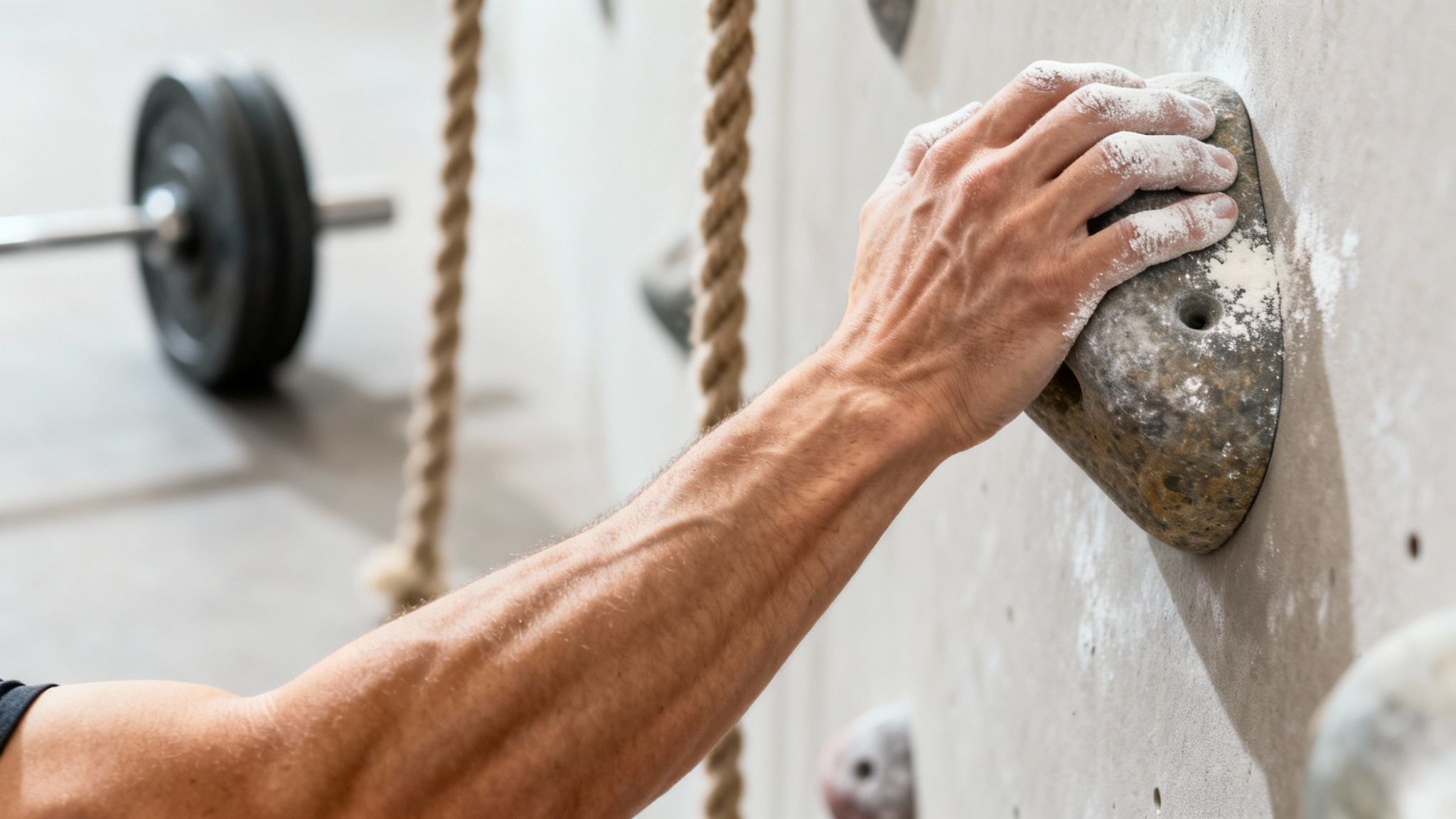
It’s easy to overlook, but your grip is far more than just a firm handshake. It’s the critical link between you and whatever you’re trying to lift, hold, or move.
For a powerlifter, a rock-solid grip is what lets you pull a new deadlift PR without having to rely on straps. For a climber, it’s the make-or-break factor between sticking a tough move and peeling off the wall.
This raw, functional power is a direct reflection of your ability to apply force, which makes it one of the best indicators of your true athletic potential. You can see how this fits into the bigger picture in our guide on how to improve athletic performance. When your hands and forearms are iron-clad, you stay in control, lift heavier, and move with more confidence.
The Three Faces of a Powerful Grip
To build a truly well-rounded grip, you have to understand its different components. Each one plays a distinct role, and a smart program will hit all three.
- Crush Grip: This is the force you can generate when you close your hand around something. Think about squeezing a barbell on a heavy bench press or crushing a friend's hand in a handshake.
- Pinch Grip: This is all about squeezing an object between your thumb and fingertips, without it touching your palm. A perfect real-world example is carrying a weight plate by its edge.
- Support Grip: This is your endurance—the ability to hold on for a long time. It’s what you need for farmer's walks, dead hangs, or hauling all the grocery bags inside in one go.
Beyond the gym, grip strength is a surprisingly accurate predictor of your long-term health. A strong grip isn't just for athletes; it's a vital sign for everyone.
More Than Muscle: A Link to Longevity
The benefits of a strong grip go way beyond just athletic performance. It’s also a powerful predictor of your cardiovascular health and overall lifespan.
In fact, some compelling research has shown that for every 5-kilogram increase in hand grip strength, there's an associated 14% reduction in all-cause mortality risk. The PURE study drove this point home, revealing that every 5-kg decrease in grip strength correlated with a 16% higher risk of mortality.
It makes sense when you think about it. A strong grip usually means you’re living a more active life with better overall muscle fitness—both of which are crucial for staying independent and resilient as you get older. By working on your grip strength now, you're making a direct investment in your future.
The Three Pillars of Building an Elite Grip
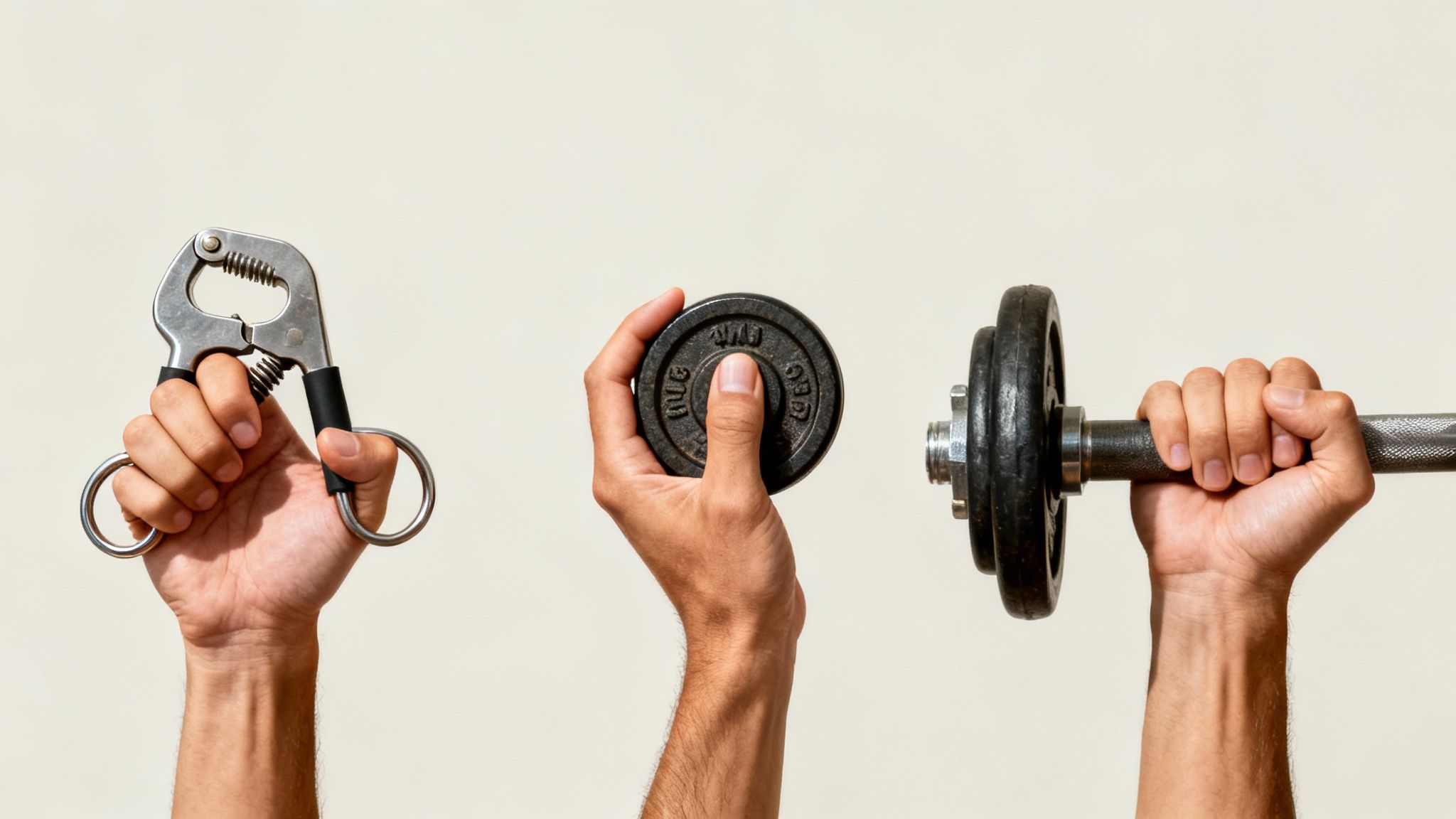
If you want to build a truly monstrous grip, you need to think beyond just mindlessly squeezing a gripper. The best approach is a structured one that targets the three distinct types of grip strength. Each plays a totally unique role, and if you neglect one, you're leaving a massive hole in your strength potential.
Think of these as the three pillars holding up your grip. Once you understand them, you can pick the right exercises and build a well-rounded program that gives you real-world power, whether you're ripping a barbell off the floor or just carrying in the groceries.
Crush Grip: The Classic Squeeze
When you think of a bone-crushing handshake or squeezing the life out of a bar during a heavy press, you're thinking of crush grip. This is simply the force your fingers can generate as they close toward your palm.
It’s the most common type of grip people train, usually with hand grippers. But its real-world application is so much broader. This is the grip that locks you onto a dumbbell during rows, secures you to a pull-up bar, and helps you finally open that stubborn pickle jar.
A few classic ways to build your crush grip include:
- Hand Grippers: Perfect for using calibrated tools to measure real progress.
- Towel Pull-ups: Forces your hands to squeeze like crazy just to hold on.
- Barbell Finger Rolls: A great way to isolate the fingers and build raw crushing power.
Pinch Grip: The Power of the Thumb
Next up is the pinch grip, which is all about the force you can apply between your thumb and your fingertips. Unlike the crush grip, the object you’re holding never actually touches your palm.
This is the type of strength that often gets overlooked, but it's critical for a ton of functional tasks. Imagine carrying a heavy weight plate by its edge or holding a thick book with one hand—that’s your pinch grip putting in the work. A strong pinch is a dead giveaway of well-developed thumb and finger adductors.
A common mistake is getting so focused on crushing movements that you forget the thumb. This leads to a big imbalance where the thumb, a critical part of hand strength, gets left behind.
Training your pinch grip builds a more complete and functional hand. You can hit it directly with movements like Plate Pinches, where you squeeze two smooth weight plates together, or by holding the head of a heavy hex dumbbell.
Support Grip: The Endurance to Hold On
Finally, there’s support grip. This is your ability to just hold onto an object for a long time. It’s an isometric, or static, kind of strength. It’s less about a quick, powerful squeeze and more about pure muscular endurance.
Your support grip is what fails you on Farmer's Walks, Dead Hangs, and holding a deadlift at the top. If your hands give out before your back or legs on a heavy pull, it's a clear sign your support grip needs serious work. Building this pillar is non-negotiable for improving your work capacity and lifting heavier for longer.
To build an elite grip, it's crucial to continuously challenge traditional wisdom. For instance, you might want to consider re-evaluating nutrition and weightlifting strategies that go against the grain.
The Principle of Progressive Overload
Look, just doing a few grip exercises here and there isn't going to cut it. The real key to getting stronger is progressive overload. The principle is simple: for a muscle to grow, you have to force it to adapt to a tension that’s greater than what it’s used to.
This means you can't just squeeze a stress ball and hope for the best. You need a plan that systematically increases the demand on your hands and forearms. You can do this by:
- Increasing the weight you’re holding.
- Decreasing the rest time between your sets.
- Increasing the hold time for support work.
- Increasing your reps or sets.
- Using a harder tool, like a tougher hand gripper or a thicker bar.
Without a methodical approach to progressive overload, your gains will stall out fast. Tracking your workouts—what you lifted, for how long, for how many reps—is the only way to guarantee you're consistently pushing your limits and building a truly elite grip. For more ideas on fueling your training, check out our guide to performance supplements for athletes.
Your Ultimate Grip Strengthening Exercise Library
Alright, let's get our hands dirty. You understand the "why," so now it's time for the "how." This is your playbook for building a grip that's as functional as it is powerful. We’ll break down the best exercises for each type of grip, with options whether you're in a fully-stocked gym or working with what you've got at home.
The name of the game is proper form and progressive overload. Always be chasing that "little bit more" than last time.
Master Your Support Grip
Think of support grip as your foundation. It's your staying power—the ability to hold on for dear life, whether you're pulling a max deadlift or hauling groceries. When this grip goes, the whole lift crumbles. These moves build the raw endurance to make sure your hands are the last thing to give out.
Farmer's Walks
This is the undisputed king of support grip exercises. It’s brutally simple and ridiculously effective. The goal is to grab some serious weight and go for a walk.
- How to do it: Stand between two heavy dumbbells, kettlebells, or farmer's walk handles. Hinge at the hips with a flat back and get a solid grip. Stand tall, brace your core, and start walking with deliberate, controlled steps. Keep your chest up and shoulders pulled back.
- Pro Tip: Don't just be a passive coat rack for the weights. Actively squeeze the handles as hard as you can for the entire walk. This one tweak dials up the intensity on your hands and forearms tenfold.
- Common Mistake: Rounding your back or letting your shoulders slump forward. You’ll just put your spine at risk and take the tension off your grip. Stay upright.
Dead Hangs
Another beautifully simple movement. All it involves is you, a pull-up bar, and gravity. Dead hangs directly attack the muscles responsible for holding on, forging both strength and stamina in your hands.
- How to do it: Grab a pull-up bar with a standard overhand grip, just outside your shoulders. Let your body hang completely, arms fully extended. The only goal? Hold on for as long as you possibly can.
- Pro Tip: Ready to level up? Drape a towel over the bar and grip the ends, or find a thicker bar. This makes your hands work exponentially harder just to maintain your grip.
- Common Mistake: Shrugging your shoulders up toward your ears. Keep them packed down and engaged. This protects the joint and keeps the focus where it belongs: on your grip.
Develop a Vise-Like Crush Grip
This is your power grip—the ability to clamp down and apply serious force. It’s what you use to lock out a heavy bench press, crush a handshake, or finally beat that stubborn jar of pickles. Training your crush grip builds the raw, bone-deep strength that gives you total control.
Advanced Hand Gripper Techniques
A good set of calibrated grippers, like the famous Captains of Crush, are incredible tools for building and measuring pure crush strength. But you have to move beyond just mindlessly repping them out.
- How to do it: Get a good "set" by placing the handle high in your palm. Squeeze with everything you've got, trying to make the handles touch.
- Pro Tip: Introduce negative reps. Use your other hand or your body to help you close a gripper that's too tough for you, then fight the opening force with just the one hand. It’s a fantastic way to shatter plateaus.
- Common Mistake: Sticking to one rep range. You need to mix it up. Work in heavy singles, standard sets of 5-8 reps, and even high-rep burnout sets with an easier gripper. This builds every facet of crushing strength.
Towel Pull-Ups
This variation takes a standard pull-up and turns it into a medieval torture device for your grip. The thick, unstable surface of the towel forces your crushing muscles into overdrive just to keep from falling.
- How to do it: Throw two towels over a pull-up bar. Grab a towel in each hand and perform a pull-up, squeezing for dear life. If a full pull-up is out of reach, just hanging from the towels is an incredible exercise in itself.
- Pro Tip: You can easily adjust the difficulty. Gripping lower on the towels is easier; choking up closer to the bar is much, much harder.
- Common Mistake: Letting your grip slide as you get tired. The whole point is to maintain that death grip through the entire set. Fight for it.
One of the biggest mistakes I see is athletes focusing only on crushing and holding. They completely forget about the thumb. Without dedicated pinch work, you're leaving a massive, functional hole in your hand strength.
Build a Powerful Pinch Grip
The pinch grip is the unsung hero of hand strength. It’s the power between your thumb and your fingertips, and it’s a true measure of functional, real-world strength. From rock climbing to just carrying a stack of books, a strong pinch is non-negotiable.
Plate Pinches
This is the classic, old-school lift for building a monster pinch. You simply squeeze two smooth weight plates together and see how long you can hold on.
- How to do it: Slap two plates together, smooth sides out. Grip them with your fingers on one side and your thumb pressing hard on the other. Lift them off the floor and hold for time. Two 10-pound plates is a great starting point for most people.
- Pro Tip: If you're training solo and want to work each hand, you can do a single-plate pinch. Just grab a plate by its edge (like you're holding a vinyl record) and hold it.
- Common Mistake: Bending your wrist. Keep it as neutral and straight as possible. This forces your fingers and thumb to do all the work, which is exactly what we want.
Hex Dumbbell Holds
Grabbing a hex dumbbell by its head is another fantastic way to hammer your pinch grip. The shape forces your thumb into opposition with your fingers to stop the weight from slipping.
- How to do it: Stand a hex dumbbell on its end. Grip the head of the dumbbell—fingers on one flat side, thumb on the other. Pick it up and hold for as long as you can.
- Pro Tip: Once you get good at this, try "walking the dumbbell" by slowly moving your fingers up and down the head of the dumbbell while holding it in the air.
- Common Mistake: Going too big, too soon. Using a dumbbell that’s too large can strain your thumb. Start with a size you can securely get your hand around.
To put it all together, you need a plan. Choosing the right exercises is about targeting these different types of grip strength to build a complete, well-rounded foundation.
Exercise Selection for Targeted Grip Development
Building a truly powerful grip isn't about doing one or two things; it's about systematically attacking your weaknesses. This table breaks down my go-to exercises for each type of grip strength, giving you a clear path from beginner to advanced. Use this as a menu to construct a routine that addresses all aspects of hand and forearm strength.
| Grip Type | Primary Exercise | Secondary Exercise | Advanced Variation |
|---|---|---|---|
| Support | Farmer's Walks | Dead Hangs | Suitcase Carries (one-sided) |
| Crush | Captains of Crush Grippers | Plate Curls | Towel Pull-Ups / Hangs |
| Pinch | Two-Hand Plate Pinch | Hex Dumbbell Holds | Hub Lifts |
| Wrist | Wrist Roller | Levering (with a mace or sledgehammer) | Zottman Curls |
Don't just stick to the "Primary" column. The secondary and advanced movements are where you'll find the secret sauce to bust through plateaus and develop the kind of grip that turns heads. Mix and match these over your training cycle to ensure no stone is left unturned.
Programming Grip Training Into Your Routine
Having a list of effective exercises is a great start, but the real secret to unlocking next-level grip strength is smart, consistent programming. Just randomly throwing in a few sets of gripper squeezes won't build the kind of functional power you're after. You need a structured plan that respects both progressive overload and recovery.
The smaller muscles and connective tissues in your hands and forearms are resilient, but they're not invincible. Overtraining is a very real risk here and often leads to nagging injuries like tendonitis, which can sideline you for weeks or even months. We're trying to stimulate growth, not obliterate your ability to recover.
There are two primary, battle-tested methods for weaving grip work into your existing schedule. The one you choose really depends on your goals, your current training split, and how much time you can realistically dedicate.
Method 1: The Dedicated Grip Day
For the true grip enthusiast or the athlete whose sport absolutely demands it—think strongman competitors or serious rock climbers—a separate grip training day can be a game-changer. This approach lets you attack your grip work with maximum intensity and focus when you're completely fresh.
A dedicated day allows you to hammer all three pillars of grip strength—support, crush, and pinch—with enough volume to really drive adaptation. This is where you can dive deep into specialized exercises without worrying about it kneecapping your main lifts.
Here’s what a sample dedicated grip day could look like:
- Warm-up: Start with light wrist rolls, finger extensions, and a few easy sets on a light gripper.
- Main Support Work: Heavy Farmer's Walks (3 sets of 50 feet).
- Main Crush Work: Captains of Crush Grippers (Work up to 2-3 heavy sets of 1-5 reps).
- Main Pinch Work: Two-Hand Plate Pinch (3 sets, holding for max time).
- Accessory/Finisher: Wrist Roller (2 sets to failure).
This structure ensures you hit the most demanding movements first while your energy is highest. It’s an incredibly effective method, but dedicating an entire training day isn't feasible for everyone.
Method 2: Integrating Grip Work
A more common and practical approach for most lifters is to sprinkle grip-specific exercises into their existing workouts. The key is to add them at the end of your session. This way, you don't pre-fatigue your hands and compromise your main lifts, like heavy deadlifts or rows.
You can pair grip exercises logically with the muscle groups you're already training. For instance, since your grip is heavily involved in back training, adding support grip work at the end of a back day just makes sense.
Here’s a sample weekly integration:
- Back Day Finisher (Support Grip): After your last set of rows, perform 3 sets of Dead Hangs to failure.
- Arm Day Finisher (Crush & Wrist): Following bicep and tricep work, do 3 sets of Plate Curls and 3 sets of heavy gripper holds.
- Leg Day Finisher (Pinch Grip): After squats and lunges, finish with 3 sets of Hex Dumbbell Holds for time.
A common mistake I see is people using lifting straps for everything. While straps have their place for overloading your back on the absolute heaviest sets, relying on them too often is a crutch that prevents your support grip from ever catching up.
This simple visual breaks down how to target the three core types of grip strength.
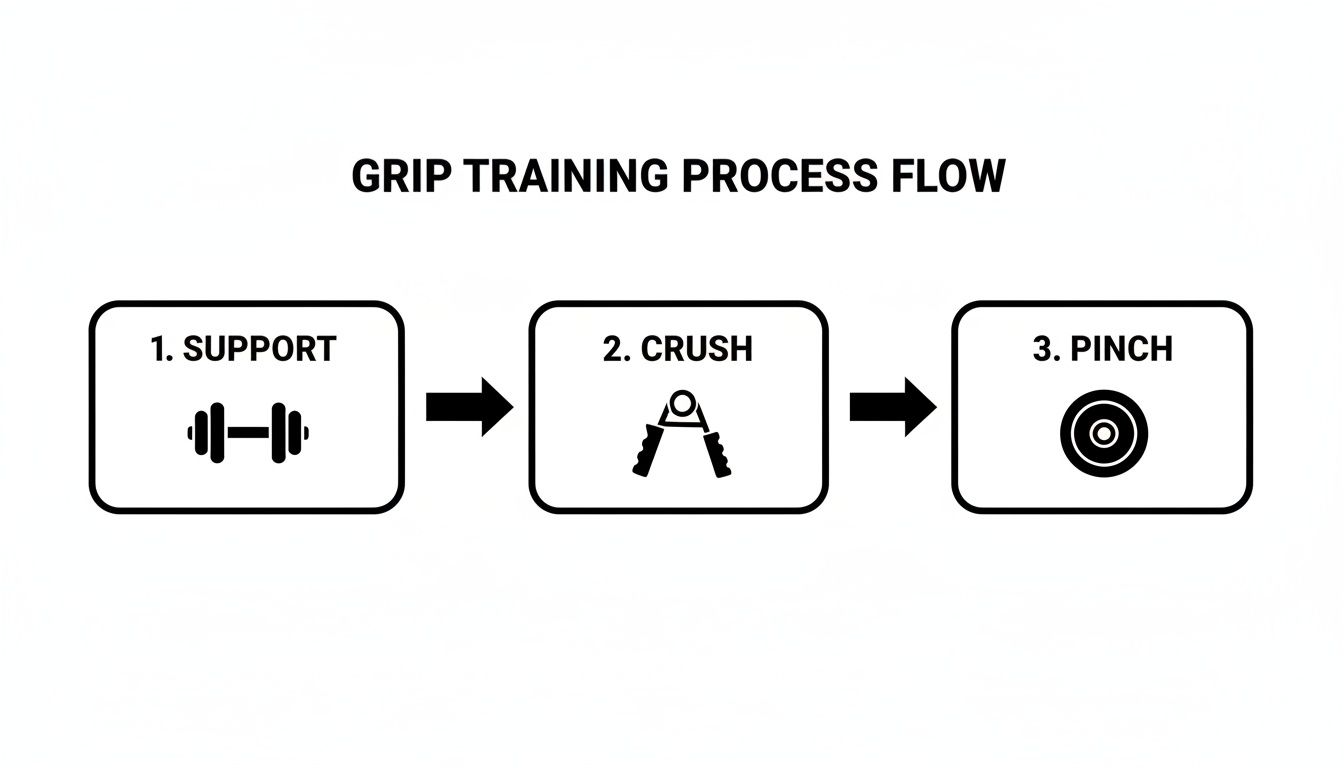
This flow highlights how a balanced program should cycle through exercises that build endurance (support), raw power (crush), and thumb strength (pinch).
Frequency, Volume, and Intensity
Regardless of which method you choose, a few universal principles apply. For most people, 2-3 dedicated grip sessions per week is the sweet spot. This provides enough stimulus for growth while allowing adequate time to recover faster after your workouts.
For volume, aim for 2-3 exercises per session, with 2-4 working sets each. You’ll want to vary your intensity. Be sure to include heavy, low-rep work for building maximal strength (like near-max gripper closes) alongside higher-rep sets or longer-duration holds to build endurance.
Interestingly, research shows that grip strength naturally peaks for most people between the ages of 30-39. A study of over 9,400 participants found that during this decade, males averaged 51.3 kg (113 lbs) and females averaged 32.3 kg (71 lbs). While that’s a useful benchmark, a smart training program allows athletes of any age to work toward and maintain impressive levels of strength for life.
Fuel and Recover for a Stronger Grip
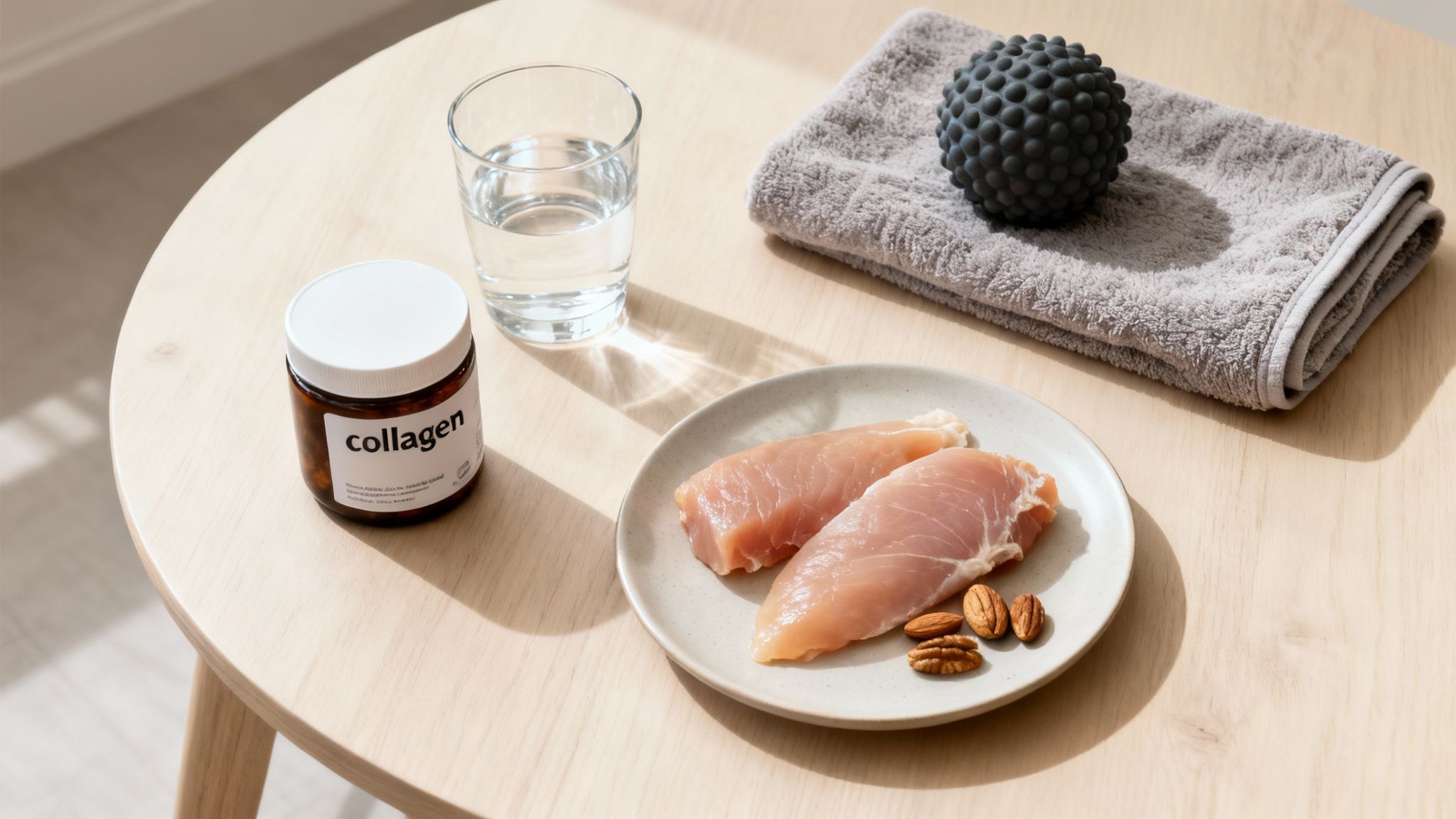
Hard training sessions are what kickstart the process, but real strength is built while you rest. The small muscles and tough connective tissues in your hands and forearms really take a beating from all that heavy grip work. If you don't give them the right fuel and rest, you’re just spinning your wheels and setting yourself up for injury.
Think of it this way: your workout is the demolition crew, breaking down muscle fibers. Nutrition and recovery are the construction team that rebuilds everything to be bigger and stronger than before. Skimp on this phase, and you're just asking for chronic soreness, nagging tendonitis, and a progress plateau that will kill your motivation.
Key Nutrients for Building a Vise Grip
A solid, balanced diet is always the baseline, but a few key nutrients do the heavy lifting when it comes to repairing the specific tissues involved in your grip. Zeroing in on these can make a huge difference in how fast you adapt and how healthy your hands feel.
-
Protein: This is non-negotiable. As the primary building block for muscle, protein provides the essential amino acids your body needs to repair and grow your forearms after those brutal hangs and heavy carries. You can use a protein intake calculator to figure out exactly how much you need to support effective muscle repair.
-
Collagen: Your tendons and ligaments are made mostly of collagen. Adding a supplement can help support the health and resilience of these tissues, which are under a ton of strain during intense grip training.
-
Hydration & Electrolytes: Getting dehydrated is a fast track to muscle cramps and a serious drop in performance. Water is critical, but when you're sweating hard, you lose electrolytes, too. Keeping that balance in check is key to preventing your grip from failing you mid-set.
-
Magnesium: This mineral is a workhorse, involved in hundreds of bodily functions, including how your muscles contract and relax. Getting enough magnesium can help prevent cramping and support overall muscle health.
To dive deeper, you can learn more about choosing the right supplements for muscle recovery to round out your diet.
Smart Recovery Techniques for Your Hands
Nutrition is only half the battle. Active recovery is what keeps inflammation in check, gets blood flowing, and maintains mobility in your hands and forearms. A few minutes of dedicated work here can have a massive impact on how you feel and perform next time you train.
Recovery isn't passive; it's an active process. You have to be as intentional with your rest and mobility work as you are with your training sets. This is what separates those who make steady progress from those who are always dealing with aches and pains.
Some of the most effective methods are surprisingly simple:
-
Forearm Stretching: After a workout, gently stretch your forearm extensors (top side) and flexors (underside). Hold each stretch for 20-30 seconds. You're looking for a gentle pull, not sharp pain.
-
Self-Myofascial Release: Grab a lacrosse ball or a firm massage ball to work out knots in your forearms. Just put the ball on a table, press your forearm into it, and slowly roll back and forth, focusing on any tender spots.
-
Contrast Water Therapy: This is a classic for a reason—it boosts circulation like crazy. Submerge your hands and forearms in hot water for 2-3 minutes, then immediately switch to cold water for 1 minute. Repeat this cycle 3-4 times, and always finish on cold.
Common Questions About Increasing Grip Strength
When you first dive into serious grip training, you’re bound to have questions. It’s a niche world, and getting the details right is what separates incredible progress from a frustrating plateau.
Let’s tackle some of the most common things that come up. We'll clear the air on everything from realistic timelines to why your hands give out on a heavy deadlift way before your back does.
How Long Does It Take to See Results?
This is always the first question, and the honest answer is: it depends on your starting point and how consistent you are.
Generally, you can expect to feel a real difference in your grip within 4 to 8 weeks of starting a dedicated program. A lot of these initial gains are neurological—your brain is just getting better at firing up all the muscle fibers in your hands and forearms.
True muscle growth, the kind that adds serious size to your forearms, takes a bit longer. For measurable gains that let you smash a new PR or finally close that next-level hand gripper, you need to think in months, not weeks.
The real secret to staying motivated is tracking your progress. Don't just go by feel. Log your dead hang times, the weight you're using for farmer's walks, or which gripper you're closing. Seeing those numbers climb is the ultimate proof that your work is paying off.
Are Hand Grippers the Best Training Tool?
Hand grippers are an incredible tool, but they're not the whole story. They are king for developing one specific thing: crush strength. That's the power you feel in a firm handshake.
But a truly strong, functional grip is about more than just crushing. If you only use grippers, you're leaving huge gaps in your strength and creating imbalances. You're ignoring two other critical pillars of grip:
- Support Strength: This is your ability to just hold onto something heavy for a long time. Think farmer's walks and dead hangs.
- Pinch Strength: This is the force between your thumb and fingertips, which you build with exercises like plate pinches.
Think of grippers as one key player on the team, not the entire team itself. A well-rounded routine that hits all three pillars will build real-world strength that shows up everywhere.
Can I Train My Grip Every Day?
It’s tempting to think more is better, but hammering your grip with high intensity every single day is a fast track to burnout and injury.
The muscles in your hands and forearms need time to recover. More importantly, the tendons do. Overtraining is a huge risk here and can quickly lead to painful issues like tendonitis, which will bring your progress to a screeching halt.
Instead of daily beatdowns, aim for 2-3 focused, intense grip workouts per week, making sure to schedule them on non-consecutive days. On your off days, some light mobility work or gentle stretching is fine, but stay away from any heavy or high-volume training.
My Grip Fails on Deadlifts First
This is probably the most common roadblock for any serious lifter. Your back and legs have more in the tank, but your hands just can't hang on. The culprit is almost always an underdeveloped support grip.
First things first: stop using lifting straps for anything other than your absolute heaviest, one-rep-max attempts. Using them too often is a crutch that prevents your grip from ever getting the stimulus it needs to catch up.
To fix the problem, you need to add specific support grip work to your routine.
- Heavy Static Holds: After your last deadlift set, drop the weight a bit, pick it up, and just stand there holding the barbell for as long as you possibly can.
- Farmer's Walks: These are non-negotiable for building the endurance your hands are screaming for.
- Dead Hangs: Simple, brutal, and incredibly effective for building raw holding power.
Make a point to use a double overhand grip during your deadlift warm-ups for as long as possible before switching to a mixed or hook grip. This focused effort will build the grit and endurance your hands need to finally match the strength of your posterior chain.
Ready to fuel your performance and recovery? The clean, research-backed supplements from Revolution Science are designed to help you push your limits and recover faster. Explore our range of products, including Reviver Electrolytes, to support your training and unlock your full potential. Learn more about our supplements.