
Your Cart is Empty


The Best Supplements for Triathletes to Boost Performance
Alright, let's get right to it. When we talk about the best supplements for triathletes, we can boil it down to three essentials that are absolutely non-negotiable: electrolytes for hydration, carbohydrates for fuel, and protein for muscle repair. If you can dial in these three, you're already way ahead of the game and well on your way to dodging that dreaded "bonk" on race day.
Your Blueprint for Triathlon Supplement Success
Training for a triathlon is a massive undertaking. It pushes your body right to the edge, day after day. You’ve probably got your swim, bike, and run sessions planned down to the minute, but so many athletes completely miss the fourth discipline: nutrition.
A solid diet built on real, whole foods is always your foundation. But strategic supplementation? That’s the game-changer that turns all that grinding and hard work into real results.
Think of your body like a high-performance race car. Whole foods are the premium fuel you put in the tank. Supplements are the specialized additives—the engine coolant, the high-octane booster—that keep everything running smoothly when you're redlining. They aren't magic pills. They are specific tools designed to solve the very real physiological problems that pop up during hours of intense training.
Why Supplements Matter for Triathletes
There’s this common myth that supplements are just for the pros. The truth is, the sheer volume of triathlon training creates nutritional gaps that are incredibly hard to fill with food alone, especially when you're juggling workouts with work, family, and life.
This guide is your strategic blueprint. We’re going to cut through the noise and get into the science-backed reasons for a smart supplement plan. You'll learn not just what to take, but why it works, when to take it, and how to make it work for you.
We'll break down how to:
- Stay Hydrated: Sidestep those performance-killing cramps by getting your electrolyte balance right. This is where clean, effective formulas like REVSCI’s Reviver Electrolytes make all the difference.
- Fuel Your Engine: Learn how to keep your glycogen stores topped off with the right kind of carbs to power through those long brick workouts and finish your race feeling strong.
- Speed Up Recovery: Use protein to effectively repair muscle damage, slash soreness, and help your body adapt to the training load so you can come back stronger for the next session.
A well-designed supplement strategy doesn't replace your training; it amplifies it. By addressing the specific metabolic demands of swimming, cycling, and running, you create a physiological advantage that allows your body to perform better and recover stronger.
By the time you're done here, you’ll have a clear, actionable plan to build your own supplement stack. You'll know how to read a label, spot a quality product, and confidently put a protocol in place that supports your goals. Let's turn your nutrition from a source of stress into your secret weapon.
Triathlete's Core Supplement Cheat Sheet
To keep things simple, here’s a quick-reference guide to the foundational supplements every triathlete should have in their arsenal. Think of this as your starting line—the absolute essentials for performance and recovery.
| Supplement | Primary Role | When to Use |
|---|---|---|
| Electrolytes | Hydration & Cramp Prevention | Before, during, and after training/racing, especially in the heat. |
| Carbohydrates | Sustained Energy & Fuel | Before and during long workouts (>60-90 min) and on race day. |
| Protein | Muscle Repair & Recovery | Within 30-60 minutes post-workout to kickstart recovery. |
This table covers the "big three" you need to master. As you dial these in, you'll build a solid nutritional base that will support even the most demanding training blocks.
Mastering Hydration and Preventing Cramps
Proper hydration is about so much more than just drinking water. For a triathlete, it's about maintaining your body’s delicate electrical balance. Think of your muscles as a complex electrical grid—water is the infrastructure, but electrolytes are the actual electricity that tells your muscles to contract and relax.
When you run low on electrolytes, especially sodium, those crucial signals get crossed. This is what leads to those race-ending muscle cramps every triathlete dreads. Your body is trying to fire on all cylinders, but the communication lines are down, causing misfires and shutdowns.
This is exactly why just chugging plain water during a long race can do more harm than good. It actually dilutes the electrolytes you have left, making the problem worse and raising the risk of hyponatremia, a dangerous condition where your sodium levels plummet. For triathletes, managing electrolytes isn't just a good idea; it's a fundamental part of a successful race plan.
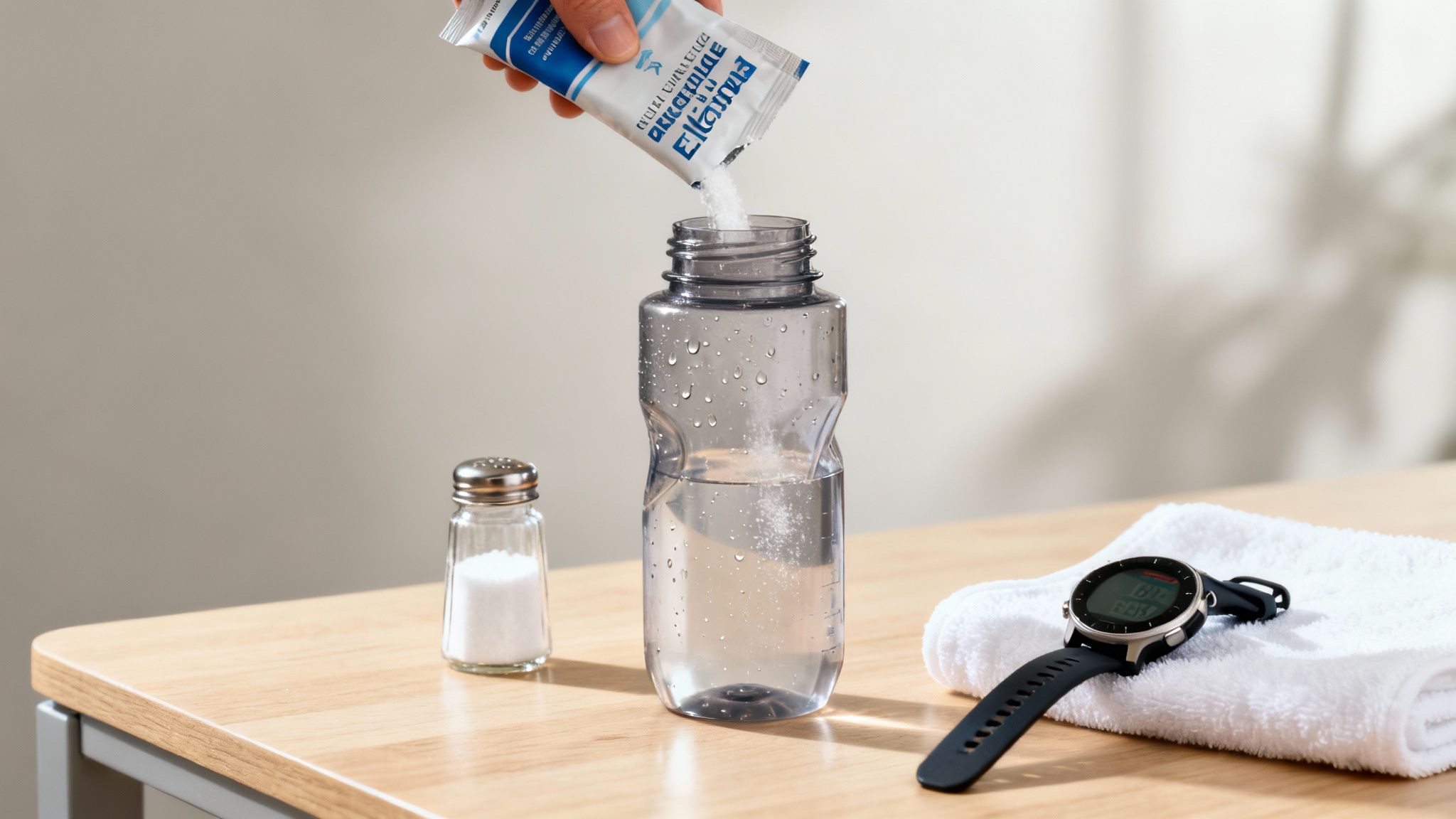
Sodium: The Master Electrolyte
While several minerals make up the electrolyte family—potassium, magnesium, and calcium included—sodium is the undisputed king for endurance athletes. It’s the main electrolyte you lose in sweat, and it plays the biggest role in regulating your fluid balance and muscle function.
In the high-stakes world of triathlons, a solid hydration strategy is non-negotiable. Athletes can lose a shocking 2-3 liters of sweat per hour in the heat, and if sodium levels dip below 135 mmol/L, performance can drop by a staggering 10-20%. On the flip side, research shows that triathletes who supplement with sodium-rich electrolytes can cut down on gut issues by 45% and even improve finish times by an average of 7 minutes in ultra-endurance events.
Key Takeaway: If you want to prevent cramps and maintain performance, focus on your sodium intake. Potassium and magnesium are important, but sodium loss is the primary driver of hydration-related problems in a triathlon.
To really nail down your strategy, you have to understand your own body. Things like your genetics, how well you're acclimated to the heat, and your race intensity all impact how much you sweat and how salty that sweat is. This is where calculating your personal sweat rate becomes an incredibly powerful tool. We dive deeper into this in our guide on how to prevent muscle cramps.
Calculating Your Needs and Choosing Wisely
So, how much do you actually need? A solid starting point for most triathletes is to aim for 500-1000 mg of sodium per hour of exercise. But remember, that's just a baseline. Calculating your personal sweat rate will give you a much more precise target.
Simple Sweat Rate Test:
- Weigh yourself nude right before a one-hour training session.
- Do your workout, and keep track of exactly how much fluid you drink (e.g., 500 ml).
- After the session, towel off completely and weigh yourself nude again.
- Do the math: (Pre-workout weight - Post-workout weight) + Fluid consumed = Your total fluid loss.
That number gives you a personalized target for how much fluid you need to replace each hour. From there, you can fine-tune your sodium intake based on the conditions. On a hot and humid race day, you’ll want to be on the higher end of that 500-1000 mg range, while a cool morning ride might require a bit less.
When you’re picking a supplement, look for clean, effective formulas. So many popular sports drinks are just loaded with sugar and artificial fillers, which can cause major stomach problems—the last thing you need on the bike or run. A pure electrolyte powder like REVSCI’s Reviver Electrolytes delivers the sodium and other key minerals you need without the junk, ensuring your stomach stays happy while your muscles keep firing.
Fueling Your Engine for Sustained Energy
If hydration is your engine's coolant, then fuel is the high-octane gas that keeps you from grinding to a halt. For any triathlete, hitting the wall—or "bonking," as we call it—isn't just a possibility; it's a certainty if your fueling strategy goes sideways. This is where carbohydrates, your body's go-to energy source, come into play.
Think of your muscles and liver as having a small, very finite gas tank for carbs, stored as glycogen. A single tough training session can drain that tank almost completely. Without a steady drip of fuel during long efforts, you'll simply run out of gas. Your power will tank, and your race will come to a screeching halt. The real art of triathlon nutrition is learning how to keep topping off that tank without overwhelming your gut.
For triathletes battling fatigue over 140.6 miles, the right energy strategy is everything. That’s why energy-boosting supplements like carbohydrates and BCAAs are at the core of a sports nutrition market projected to grow from USD 59.13 billion in 2025 to an estimated USD 114.52 billion by 2034. Carbs alone make up a 26% market share, with elite pros often taking in 90g per hour to keep the power on during the world's most demanding courses.
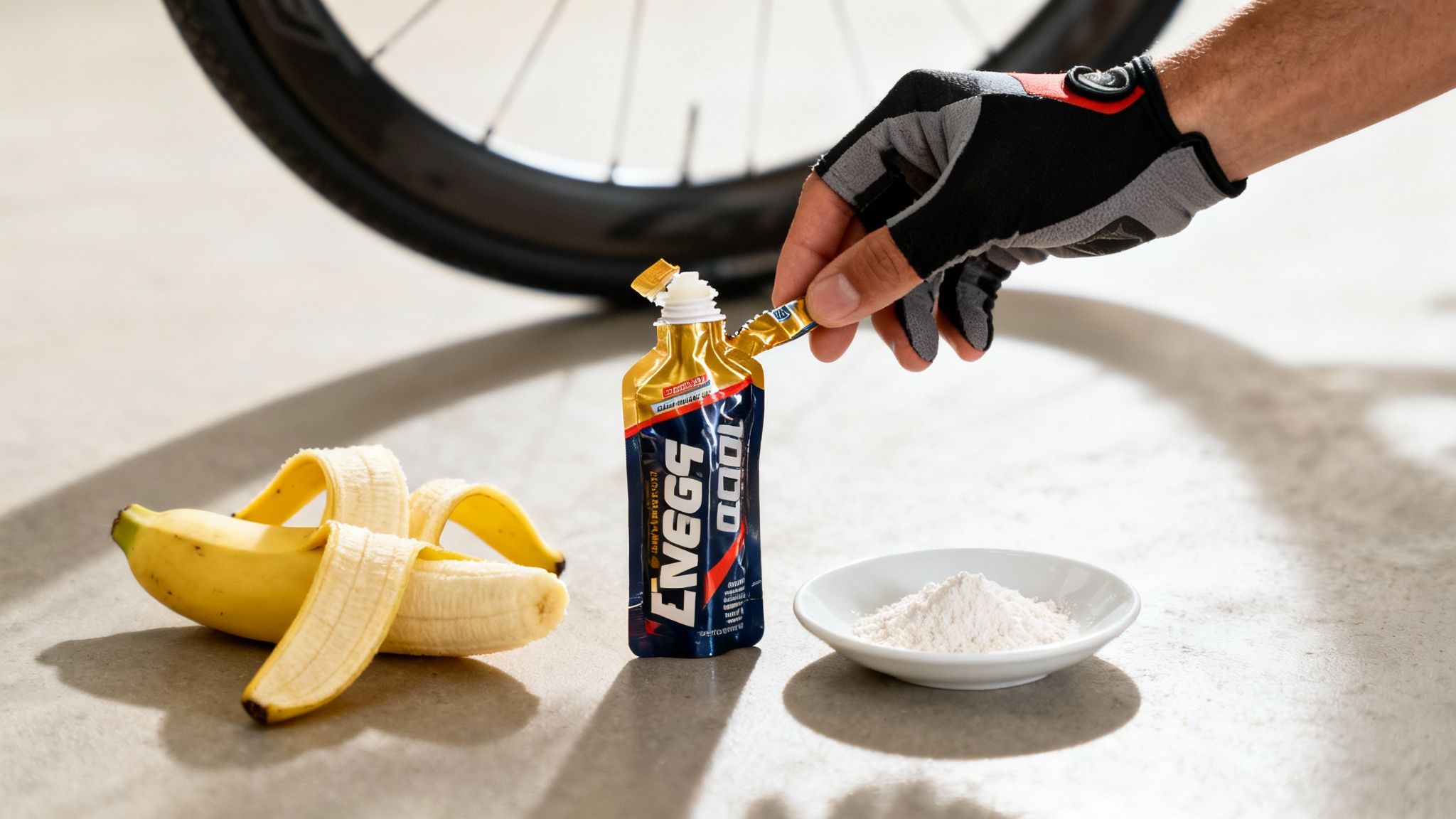
Dialing in Your Carbohydrate Intake
The golden rule is simple: for any workout lasting longer than 90 minutes, start fueling early and don't stop. Most triathletes should aim for 30-60 grams of carbohydrates per hour. Some highly-trained athletes can even push that to 90 grams or more, but the secret is training your gut to handle it.
You wouldn't show up on race day with a brand-new bike you've never ridden, right? The same goes for your nutrition plan. Use your long training sessions to experiment with different carb sources and find what your stomach can actually tolerate when you’re working hard.
- Energy Gels: Convenient, fast-acting, and perfect for a quick hit of energy on the bike or run.
- Chews: A great solid-food option that's easy on the stomach and helps you avoid the flavor fatigue that can set in with gels.
- Drink Mixes: The ideal way to get both your carbs and electrolytes at the same time, making it easy to fuel steadily on the bike.
And don't forget, fueling isn't just about what you do during a workout. Weaving in some smart high protein snacks for athletes throughout the day is key for recovery and keeping your overall energy stores topped up.
Performance Aids That Give You an Edge
Beyond the basic fuel of carbohydrates, a few key supplements can help you push harder and hold off fatigue. These aren’t your primary fuel source, but think of them as tools that help your body perform better under stress. Two of the most proven and effective are Beta-Alanine and caffeine.
Key Insight: Think of it this way: Carbs are the fuel. Beta-Alanine is the agent that helps clean out your engine during hard efforts. And caffeine is the tool that makes the whole effort just feel easier. Together, they create a seriously powerful performance punch.
Beta-Alanine
During those all-out efforts, your muscles produce lactic acid, which leads to that familiar burning sensation that forces you to back off. Beta-Alanine works as a buffer, helping to neutralize that acid. This allows you to hold a higher intensity for longer, whether you're powering up a steep climb or kicking for the finish line.
Caffeine
Caffeine is hands-down one of the most effective performance enhancers you can get. It works by lowering your Rate of Perceived Exertion (RPE), which is a fancy way of saying the same hard effort simply feels easier. That mental edge can be the difference-maker in the final, grueling miles of a marathon. Start with a low dose (100-200 mg) before or during a key workout to see how you respond.
Building a complete fueling plan takes time and practice, but getting these core pieces right is the first step toward a strong finish. For a deeper dive into building out your personal strategy, check out our complete guide on sports nutrition for endurance athletes.
Rebuilding Stronger with Smart Recovery
The real magic in triathlon training doesn't happen on the road or in the pool. It happens in the quiet hours between your workouts. Every grueling session is a form of controlled damage—you’re creating microscopic tears in your muscle fibers, which is the signal your body needs to adapt and rebuild.
Think of your body like a house undergoing a major renovation. Your workout is the demolition crew, breaking things down. Recovery is when the construction crew comes in to rebuild everything stronger and more resilient than before. And the single most important building material for that job? Protein.
Without enough protein, your body simply can't repair that damage effectively. You're left with lingering soreness, incomplete recovery, and a weakened immune system, which completely undermines the very reason you're training so hard in the first place.
The Science of Muscle Repair
Right after a tough workout, your body is primed for one thing: rebuilding. Your muscles are practically screaming for the raw materials they need to start the repair process. This is where a fast-acting protein supplement becomes an indispensable tool for any serious triathlete.
While whole foods are fantastic, a high-quality protein powder has a unique advantage in this critical post-exercise window. It’s digested and absorbed incredibly quickly, rushing essential amino acids to your muscles far faster than a chicken breast or a steak ever could.
This rapid delivery kickstarts a process called muscle protein synthesis—the scientific term for how your body rebuilds and strengthens muscle tissue. This isn't about replacing meals; it's a strategic move to sync your nutrition with your body's natural recovery cycles to maximize results.
Protein is especially crucial for triathletes who can burn through 8,000-10,000 calories during a full Ironman. It's no wonder whey protein dominates the market, making up 72.53% of global sports supplement revenue in 2024. Its proven ability to speed up muscle repair by delivering a powerful post-workout dose has been shown to dramatically cut down recovery time, as detailed in this sports supplement market report.
Nailing Your Protein Timing and Dosage
For the best possible recovery, the science is crystal clear. You want to get 20-40 grams of high-quality protein into your system within 30-60 minutes of finishing your session. This timing ensures your muscles get the building blocks they need right when they're most receptive to repair.
Making this small habit a consistent part of your routine pays off big time:
- Faster Recovery: Replenishing protein stores this quickly helps dial down muscle soreness and gets you ready to go for your next session.
- Improved Adaptation: Giving your body the amino acids it needs allows it to build stronger, more fatigue-resistant muscles.
- Immune Support: Heavy training can take a toll on your immune system, but getting enough protein helps keep it firing on all cylinders.
Our REVSCI Regains was formulated specifically for this purpose. It delivers a clean, fast-absorbing whey protein isolate to get that recovery process started without any unnecessary fillers. For a deeper dive on how various supplements can accelerate your comeback, check out our guide on supplements for muscle recovery.
Of course, nutrition is only part of the puzzle. Adding physical recovery methods can give your body an extra edge in rebuilding. Tools like floss bands can be a great way to target specific muscles and improve mobility. By combining smart supplementation with physical recovery work, you create a powerful, well-rounded approach that will keep you performing at your peak.
Putting It All Together: Your Personal Supplement Protocol
Alright, enough with the theory. The real gains happen when you move from reading about supplements to actually building a plan that works for you.
This is where you become your own performance scientist. What works wonders for your training partner might send your stomach into knots halfway through the run. The only way to know for sure is to test, test, and test again.
We call this N=1 experimentation, which is just a fancy way of saying the experiment has one subject: you. The cardinal rule is simple: nothing new on race day. Your long brick sessions are your dress rehearsal. Use them to fine-tune your nutrition and discover what gives you that steady flow of energy without any gut drama.
How To Spot Quality And Avoid The Junk
Before you start experimenting, you need to know what a good product looks like. The supplement aisle can be a confusing place, but a few simple checks can help you sort the high-quality fuel from the overhyped garbage.
A quality supplement will have a clean, easy-to-read label. Look for a short list of ingredients and be wary of "proprietary blends," which are often used to hide the tiny, ineffective amounts of each ingredient. Stick with brands that are transparent about what's in their formula and avoid anything packed with artificial sweeteners, colors, or other junk fillers.
For any serious athlete, safety is non-negotiable. Always look for products that have been put through third-party testing by organizations like NSF Certified for Sport or Informed-Sport. This is your independent guarantee that the product is free from banned substances and that what’s on the label is actually what's in the bottle.
This process of fueling and rebuilding is what turns hard work into real fitness gains.
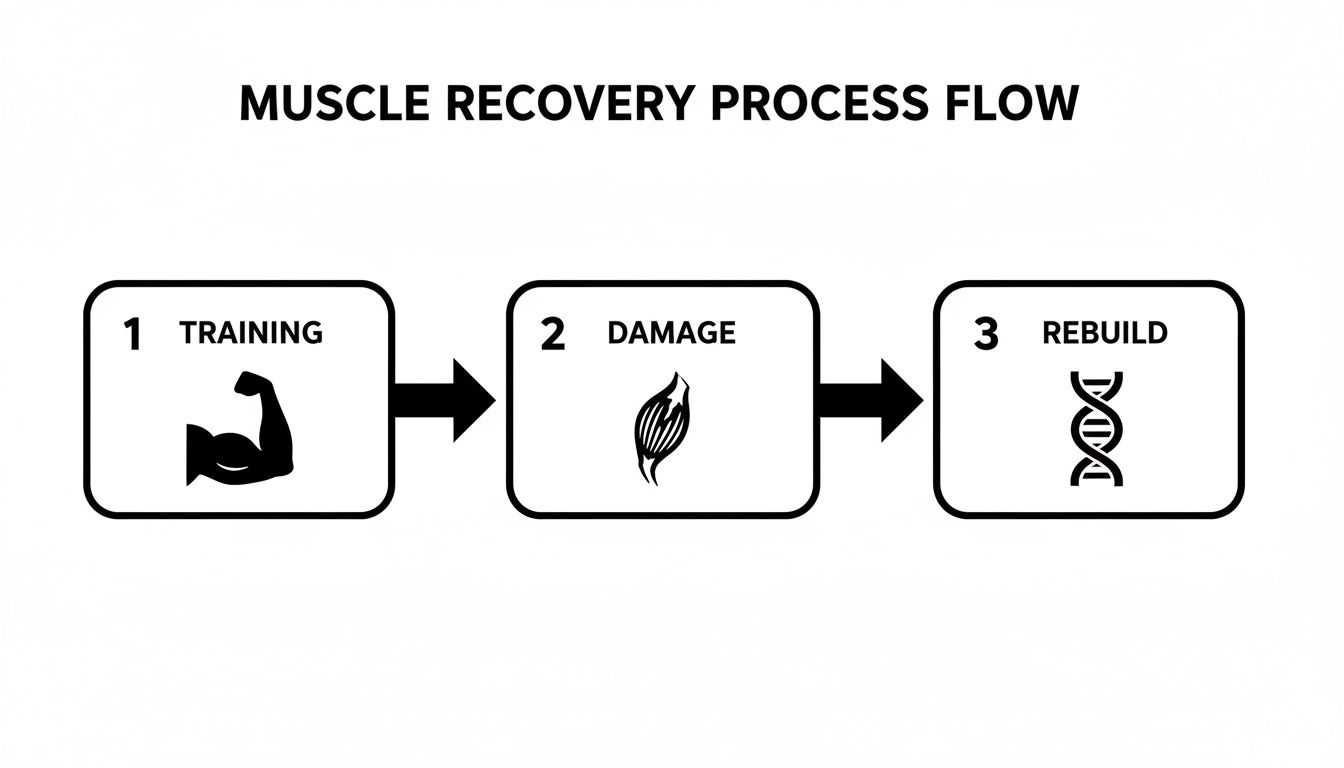
As you can see, training breaks down muscle tissue. The magic happens during recovery, where nutrients like protein step in to repair that damage, making you stronger and more resilient for the next session.
Building Your Fueling Framework
Your protocol starts with the three pillars we've already covered: electrolytes, carbs, and protein. Now, it's time to structure them into a plan. The big difference between a long training day and race day usually boils down to logistics and intensity.
During training, you can afford to be a little more flexible. You can pull over to refill a bottle or eat some solid food. On race day, however, everything has to be efficient, portable, and bulletproof. Your plan needs to be second nature.
To give you a starting point, we've put together a sample protocol. Think of this table as a template. Use it to build out your own strategy, and don't be afraid to tweak the numbers and timing until you find what works for you. If you want to dive deeper into product vetting, you can learn more about the importance of third-party tested supplements and why it's a must for competitive athletes.
Sample Race Day vs. Training Day Supplement Protocol
This table shows how a fueling plan might look for a key long brick session versus a 70.3 or full-distance race.
| Time/Event Phase | Long Training Day Protocol | Race Day Protocol |
|---|---|---|
| Pre-Workout | 500ml water with REVSCI Reviver Electrolytes 60-90 minutes before. 20-30g carbs 15 mins prior. | 500-750ml water with REVSCI Reviver Electrolytes starting 90 mins out. 75-100g carbs 2-3 hours before. 20g carbs 15 mins prior. |
| During (Bike) | Aim for 500-1000ml fluid per hour with electrolytes. Target 30-60g carbs/hour from gels, chews, or drink mix. | Sip constantly from bottles with pre-mixed electrolytes. Target 60-90g carbs/hour using a mix of gels and drink mix. |
| During (Run) | Carry a handheld bottle with electrolytes. Practice taking gels or chews every 30-45 minutes. | Rely on aid stations for water but carry your own proven gels. Continue with 30-60g carbs/hour. Maintain electrolyte intake via caps or concentrated mix. |
| Post-Workout | 20-40g protein from REVSCI Regains within 30 minutes. Rehydrate with electrolytes. | Same as training. 20-40g REVSCI Regains as soon as possible to kickstart muscle repair. Continue hydrating with electrolytes. |
Remember, this is a guide, not a prescription. Listen to your body, take notes after your workouts, and refine your plan until it feels completely dialed in.
Frequently Asked Questions About Triathlon Supplements
Diving into the world of triathlon supplements can feel like opening a can of worms. Even with a dialed-in strategy, things like a sudden heatwave, a change in race intensity, or just how your own body is feeling on the day can throw a wrench in the works.
This section is all about tackling those common questions head-on. We're here to cut through the noise and give you clear, straightforward answers so you can feel confident in your nutrition plan from start to finish.
Can I Just Use Whole Foods Instead of Supplements?
While a diet built on real, whole foods is the absolute cornerstone of any serious athlete's plan, trying to rely on it exclusively during a hard race or training session just isn't practical. Imagine trying to choke down a chicken breast and a baked potato on the bike leg of an Ironman—it’s a recipe for digestive disaster.
This is where supplements find their purpose. They are specialized tools designed to deliver very specific nutrients in an easy-to-digest format, right when your body needs them most.
- During Exercise: Gels, chews, and performance drinks give you fast-acting carbs and electrolytes without making your stomach do the heavy lifting required for solid food.
- Post-Workout: A quality protein shake can get muscle-repairing amino acids into your system way faster than a full meal, helping you make the most of that crucial post-exercise recovery window.
Think of it this way: Supplements don't replace your food. They work with it. They're built for the unique, high-stress demands of our sport, filling the gaps that food alone just can't cover in the heat of the moment.
How Do I Adjust My Electrolyte Intake for Heat?
When the temperature and humidity spike, so does your sweat rate—and that means you’re losing a ton more sodium than you would on a cool day. A one-size-fits-all approach is a surefire way to end up cramped and dehydrated.
Your baseline of 500-1000mg of sodium per hour is a great starting point, but it's not set in stone.
On a brutally hot and humid day, you’ll want to aim for the higher end of that range. If you know you're a heavy or particularly salty sweater, you might even need to push past 1000mg per hour. The best way to know for sure is to test your sweat rate in different conditions during your training blocks. This gives you the personal data you need to build a flexible plan, so you're ready for whatever race day throws at you.
What Is the Biggest Supplement Mistake Triathletes Make?
Without a doubt, the single biggest mistake is waiting too long to start fueling. So many athletes fall into the trap of waiting until they feel thirsty or hungry to start taking in calories and electrolytes. By that point, you're already behind the eight ball. You've dug a deficit that's almost impossible to climb out of mid-race.
Smart fueling is always proactive, never reactive.
For any workout or race lasting longer than 90 minutes, you need to start trickling in fuel within the first 20-30 minutes. Getting ahead of it like this keeps your energy stores topped off and is your best defense against the dreaded bonk. It sets the stage for a strong finish, not a desperate crawl to the line.
At Revolution Science, we focus on creating clean, third-party tested supplements that help you perform at your best, without compromise. Our formulas are designed with an athlete's real-world needs in mind, supporting your fueling and recovery with transparent, science-backed ingredients.
Explore the full REVSCI lineup and build your personal supplement protocol today.