
Your Cart is Empty


The Ultimate Guide to Your Intra Workout Drink
An intra workout drink is exactly what it sounds like: a supplement you drink during your training session to keep performance high, stay hydrated, and protect your hard-earned muscle.
Think of it as a mid-race pit stop for your body. It’s a strategic move to deliver real-time fuel, pushing back fatigue so you can finish stronger—especially when your workouts stretch past the 60-minute mark.
Your Mid-Workout Performance Fuel
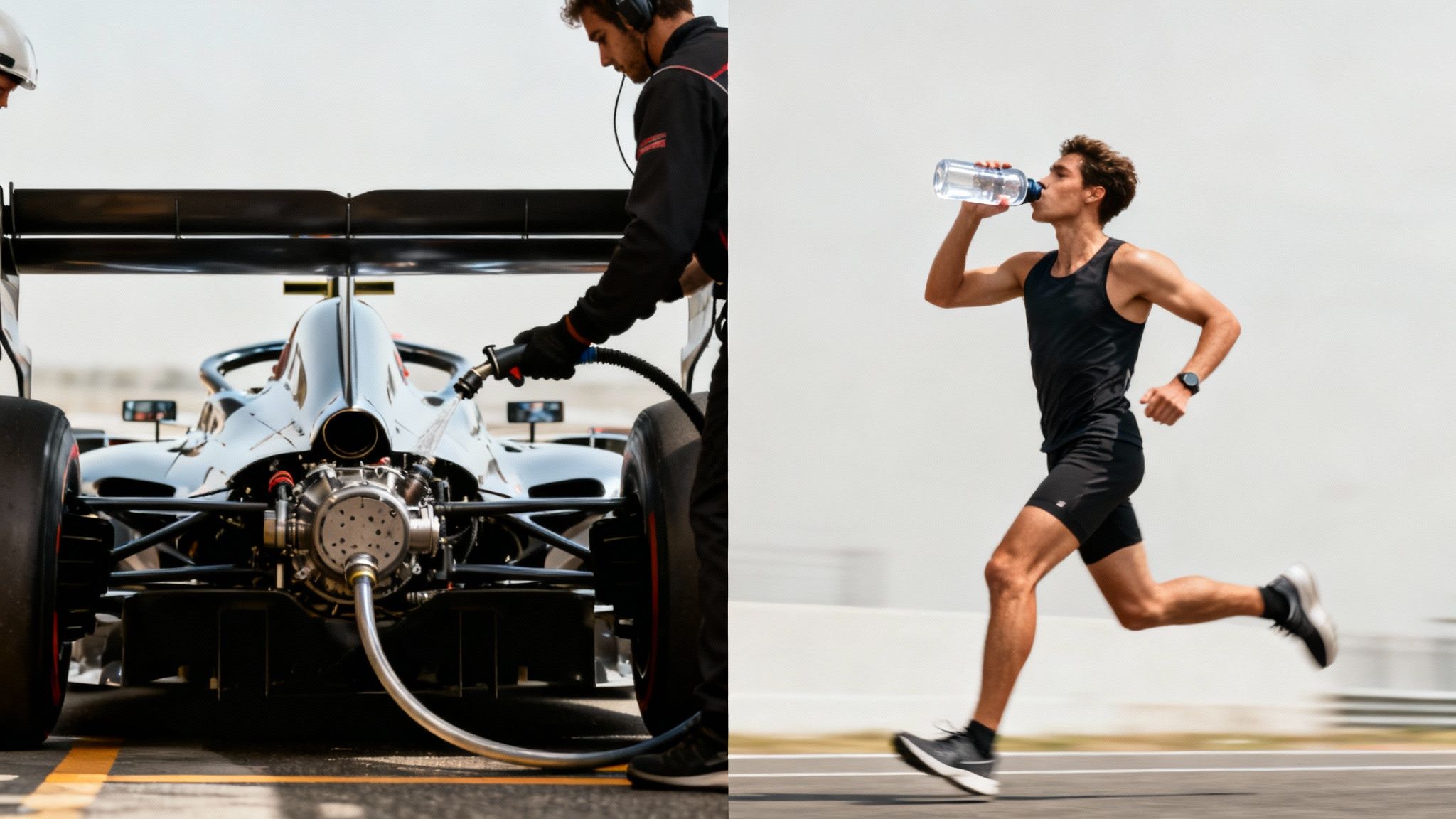
Imagine pushing a race car to its absolute limit. You wouldn’t just wait for the race to end before refueling or checking the fluids, right? You’d make a pit stop. An intra workout drink does the exact same thing for your body during a tough, demanding session.
This isn’t just flavored water. It’s a tool designed to tackle the specific physiological problems that pop up when you’re deep into a workout.
When you train hard for an hour or more, your body starts to hit a few performance-killing walls:
- Glycogen Depletion: Your muscles burn through their primary fuel source, stored glycogen. When it gets low, you get that classic "hitting the wall" feeling where your energy just vanishes.
- Dehydration and Electrolyte Loss: As you sweat, you lose more than just water. Critical minerals like sodium and potassium—essential for muscle contractions and nerve signals—go right along with it.
- Muscle Breakdown (Catabolism): During really intense and long workouts, your body can get desperate for energy and start breaking down muscle tissue to get it. This completely undermines all your hard work.
Let's break down how an intra-workout drink systematically solves these issues.
How Your Intra Workout Drink Solves Mid-Workout Problems
| Challenge During Exercise | What Your Body Experiences | How Your Drink Helps |
|---|---|---|
| Energy Crash | Muscle glycogen stores get dangerously low, causing fatigue and a sharp drop in performance. | Delivers fast-absorbing carbohydrates to refuel muscles in real-time and maintain energy output. |
| Dehydration | Fluid loss from sweat impairs cognitive function, muscle contractions, and temperature regulation. | Replenishes lost fluids and electrolytes (like sodium and potassium) to keep you hydrated and firing on all cylinders. |
| Muscle Breakdown | The body enters a catabolic state, breaking down muscle protein for fuel. | Provides amino acids (BCAAs/EAAs) that act as an alternative fuel source, sparing your muscle tissue from being cannibalized. |
By addressing these problems before they derail your workout, you shift from damage control to proactive performance management.
The Purpose of an Intra Workout Drink
The main goal here is to get ahead of these problems in real-time. By sipping a well-formulated drink, you’re actively managing your body's resources instead of waiting until they’re gone and you're just trying to survive the rest of the session.
This simple strategy has become a game-changer for serious athletes. The market for these specialized sports drinks is even projected to grow at a CAGR of 6.59% through 2031. That trend points to a big shift in how athletes think—moving toward proactive fueling to stop performance decline before it starts.
An effective intra workout drink aims to accomplish three critical jobs: maintaining energy levels with fast-acting fuel, preserving muscle tissue with amino acids, and ensuring optimal hydration with water and electrolytes.
Who Truly Benefits from This Strategy
Look, not every trip to the gym calls for mid-workout fueling. But it becomes absolutely crucial for certain kinds of training. If your workouts are consistently pushing past that 60-minute mark, you're a prime candidate.
This includes:
- Endurance Athletes: Marathoners, triathletes, and cyclists who need to sustain energy for hours on end.
- Strength Athletes: Bodybuilders and powerlifters grinding through high-volume, long-duration lifting sessions.
- Hybrid Athletes: CrossFitters and other functional fitness folks who get hit with both strength and endurance demands in the same workout.
A solid understanding of hydration for athletes is the foundation, but adding targeted fuel is what takes your performance to the next level. By feeding your body a steady stream of the right nutrients, an intra workout drink helps you maintain intensity from your first rep to your very last. It's the difference between a good workout and a great one.
The Core Ingredients That Fuel Elite Performance
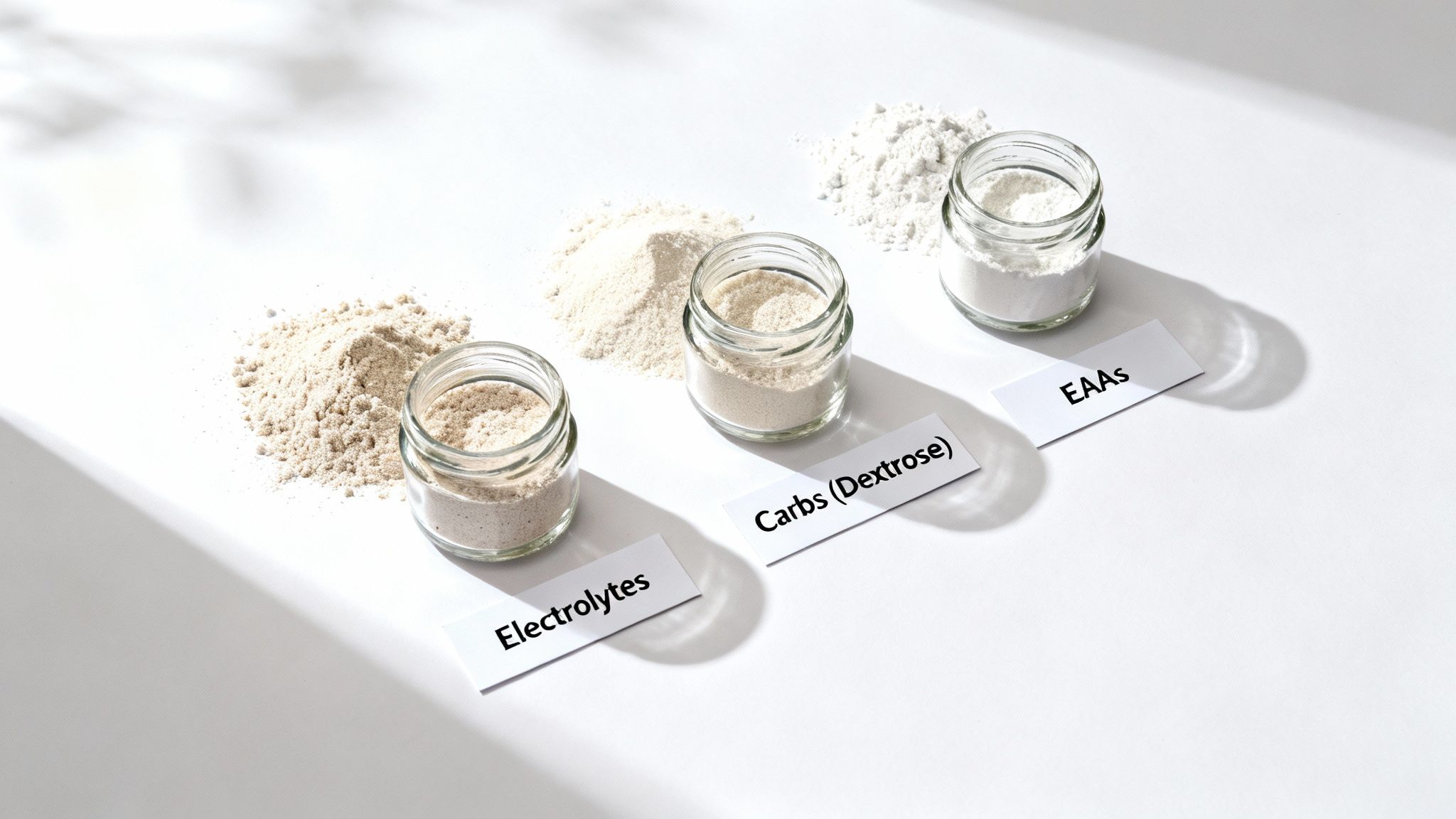
A truly effective intra-workout drink isn't just a scoop of random powders mixed into water. It's a precisely formulated blend designed to tackle the specific physiological problems that crop up mid-session. Think of it like a high-performance engine's fuel—every single component has a critical job to do.
When you understand these core ingredients, you can choose or create a drink that actually moves the needle on your performance. Most top-tier formulas are built on three pillars: electrolytes for hydration, carbohydrates for instant fuel, and amino acids to protect your hard-earned muscle. Each one works on a different aspect of fatigue, keeping you firing on all cylinders.
Electrolytes: The Electrical Wiring for Your Muscles
When you sweat, you're losing a lot more than just water. You’re also dumping out critical minerals called electrolytes, mostly sodium and potassium. These aren't just trendy additions; they are the literal conductors that allow your nerves to fire and your muscles to contract.
Think of your nervous system as a city's electrical grid. Electrolytes are the copper wiring carrying the signals. If those levels drop, the signals weaken or misfire, and performance plummets.
This is exactly why hydration is about more than just chugging water. The sports nutrition market is exploding, projected to hit USD 107.95 billion by 2035, and electrolyte-enhanced drinks are leading the charge. With over 60 million Americans hitting the gym yearly, people are demanding drinks that replace the sodium and potassium lost through sweat—which can be up to 3,500mg of sodium per liter for heavy sweaters—to stop cramps and support muscle function.
An intra-workout drink without electrolytes is like trying to run a high-tech machine with frayed wiring. It might work for a bit, but eventually, the system will fail, leading to cramps, weakness, and a serious drop in performance.
Fast-Acting Carbohydrates: Your High-Octane Fuel Source
During intense training, your body’s go-to fuel is glycogen—carbohydrates stored in your muscles and liver. As you burn through those stores, your energy tanks. A good intra-workout drink solves this problem by delivering fast-acting carbohydrates.
We're talking about ingredients like dextrose or maltodextrin. These are simple carbs that bypass any complex digestion and get absorbed straight into the bloodstream. This gives your working muscles an immediate shot of glucose to use as fuel.
This rapid-delivery system does two crucial things:
- It provides instant energy: This helps you keep your intensity and power output high, long after you would have otherwise hit a wall.
- It spares your muscle glycogen: By giving your body an alternate fuel source, you slow down how fast you burn through your stored reserves, saving them for the final push.
For anyone training longer than an hour, this strategy is a game-changer. It turns a potential energy crash into a steady, reliable flow of fuel. To get a better handle on how these components fit into the bigger picture, it's worth understanding the fundamentals of macronutrients and micronutrients.
Amino Acids: The Building Blocks That Protect Muscle
As a workout gets long and grueling, your body can slip into a catabolic state. This is bad news. It means your body starts breaking down its own muscle tissue for energy. The antidote? Amino acids.
Amino acids are the building blocks of protein, and by extension, muscle. Flooding your system with them during your workout gives your body a readily available pool of these blocks to pull from.
BCAAs vs. EAAs: What's the Difference?
You’ll see two main types of amino acids in these formulas:
- BCAAs (Branched-Chain Amino Acids): This is a group of three specific aminos—leucine, isoleucine, and valine—that are key players in muscle energy metabolism. They’re great for fighting fatigue and soreness.
- EAAs (Essential Amino Acids): This is the complete package of all nine essential amino acids your body can't make on its own. EAAs provide a full-spectrum profile to support muscle protein synthesis and prevent breakdown.
While BCAAs are solid, a full profile of EAAs is generally the superior choice for comprehensive muscle support during tough training. You can learn more about their specific roles in our complete guide to amino acids supplements.
By sipping on them mid-session, you're essentially telling your body, "Don't you dare touch my muscle tissue for fuel; use these amino acids I'm giving you instead." It’s a protective measure that ensures all your hard work translates into muscle gain, not muscle loss.
Customizing Your Drink for Your Specific Workout
A generic, one-size-fits-all approach almost never works in fitness, and your intra-workout drink is no exception. What a marathon runner needs to stay fueled is worlds away from what a powerlifter requires mid-session.
Tailoring your drink to your specific training style is what turns it from a simple supplement into a precision performance tool. Just like you pick certain exercises for specific goals, you need to select the right ingredients for your drink. This way, you’re giving your body exactly what it needs, right when it needs it most.
Let's break down how to build the perfect intra-workout drink for three very different types of athletes: endurance, strength, and hybrid. When you match the ingredients to the demands of your sport, you create a formula that directly supports your unique performance goals.
The Blueprint for Endurance Athletes
If you're a long-distance runner, cyclist, or triathlete, your two biggest enemies are dehydration and glycogen depletion. The mission here is to sustain energy over multiple hours and fend off the performance-killing effects of electrolyte loss. Your drink is a constant, steady drip of fuel and hydration.
The formula for endurance athletes needs to prioritize two things:
- Fast-Acting Carbohydrates: This is your non-negotiable fuel. You should be aiming for 30-60 grams of carbs per hour from sources like dextrose or maltodextrin. This constant supply keeps you from burning through your stored muscle glycogen too quickly, helping you avoid that dreaded "bonk."
- A Full Spectrum of Electrolytes: When you sweat for hours on end, you're losing a ton of sodium and potassium. An effective intra-workout has to replace these to prevent cramping, keep your fluid balance in check, and support muscle contractions.
For endurance athletes, amino acids are less of a priority mid-event. The entire focus is on immediate energy. Think of your drink as your lifeline, keeping the engine running when the tank is getting dangerously low.
The Blueprint for Strength Athletes
Powerlifters, bodybuilders, and other strength-focused athletes are fighting a different battle. While energy is important, the real war is against muscle catabolism—the breakdown of muscle tissue during long, high-volume workouts. Your sessions might drag on for two hours, packed with intense, muscle-damaging sets.
Here, the formulation shifts its focus entirely.
For strength athletes, the intra-workout drink is less about fueling the workout and more about protecting the muscle. The goal is to flood the system with amino acids to create an anti-catabolic environment, ensuring that every rep builds muscle, rather than breaking it down.
Your ideal mix will emphasize:
- Essential Amino Acids (EAAs): Giving your body all nine EAAs provides the raw building blocks needed to repair muscle tissue in real-time. This stops your body from cannibalizing its own muscle for energy between heavy sets. A dose of 10-15 grams is a great place to start.
- Electrolytes: Intense lifting still makes you sweat, a lot. Including electrolytes helps maintain sharp nerve function and muscle contractility, keeping you strong from your first set to your very last.
You can add carbs, especially if you're training fasted or hammering a particularly high-volume session, but the star of this show is undoubtedly the EAAs. This formula is your muscle-sparing insurance policy.
The Blueprint for Hybrid Athletes
Hybrid athletes—think CrossFit or functional fitness—live in that tough middle ground. Their workouts demand both explosive strength and sustained endurance, often back-to-back. One minute you’re lifting heavy, the next you’re deep in a high-intensity circuit.
This calls for a balanced, versatile intra-workout drink that can handle both challenges at the same time.
The formula needs to be a true hybrid:
- Moderate Carbohydrates: You need just enough fuel to power through those high-intensity bursts without feeling weighed down. A moderate dose of 20-30 grams of fast-acting carbs will give you readily available energy.
- Essential Amino Acids (EAAs): The strength parts of your WOD are going to tax your muscles. Including 5-10 grams of EAAs helps reduce muscle breakdown during those punishing circuits.
- Critical Electrolytes: High-intensity metabolic conditioning leads to some serious sweating. A solid electrolyte profile is non-negotiable to maintain performance and prevent cramping.
By creating this balanced blend, you’re giving your body a versatile tool that supports both the strength and endurance sides of your training. It lets you maintain a high level of performance no matter what the workout throws at you.
How to Choose a Clean Formula or Make Your Own
Walking down the supplement aisle can be a real headache. Every product screams at you with flashy labels and ingredient lists a mile long. But cutting through the noise to find a great intra-workout drink—or build your own from scratch—is actually pretty simple once you know the rules of the game.
The goal is to prioritize what actually works over what just looks good on a label. A clean formula gives you complete control, ensuring you’re only putting things in your body that directly fuel your performance.
Reading a Supplement Label Like a Pro
The first step is learning to decode the supplement facts panel. This little box is where the truth lives. A truly clean and effective formula isn't afraid to show you exactly what's inside.
If you see the words "proprietary blend," that's your cue to put the product back on the shelf. This is a common tactic where companies hide the exact doses of each ingredient under a fancy name. You have no way of knowing if you're getting a clinically-backed dose or just a sprinkle of "fairy dust."
Sorting the good from the bad doesn't have to be complicated. Here's a quick checklist to help you make a smart choice on the spot.
Spotting Quality a Clean Intra Workout Checklist
| Green Flags to Look For | Red Flags to Avoid |
|---|---|
| Full Transparency (Every ingredient and its exact dose is listed) | Proprietary Blends (Hides individual ingredient dosages) |
| Third-Party Testing (NSF, Informed-Sport, or similar certifications) | Artificial Fillers & Dyes (Sucralose, acesulfame potassium, Red #40) |
| Effective Dosages (Clinically supported amounts of key ingredients) | "Concentrated" Formulas (Often underdosed and ineffective) |
| No Artificial Sweeteners (Uses natural options like stevia or monk fruit) | Excessive Stimulants (High levels of caffeine not suitable for intra-workout use) |
Ditching the unnecessary junk is a non-negotiable for clean performance. A key part of this is understanding the value of electrolytes without artificial sweeteners, a foundational principle for any high-quality hydration supplement.
Building Your Own Intra Workout Drink
Want total control? Make your own. It's usually cheaper and lets you dial in the formula to your exact needs on any given day. All you need are a few core ingredients to create a seriously effective mix.
When you go the DIY route, you’re in the driver’s seat. No more guessing about weird fillers, artificial flavors, or weak doses. You can tweak the carbs, aminos, and electrolytes perfectly, whether you're hitting the pavement for a long run or grinding through a heavy leg day.
Here are three simple, battle-tested recipes to get you started:
-
The Endurance Engine: Built for long runs, bike rides, or triathlons.
- 30-40g Dextrose or Maltodextrin (for immediate energy)
- 1 scoop unflavored Electrolyte Powder (to stay hydrated)
- 20-24 oz Water
-
The Muscle Preserver: Your best friend for long, high-volume strength sessions.
- 10-15g Essential Amino Acids (EAAs)
- 1 scoop unflavored Electrolyte Powder
- 20-24 oz Water
-
The Hybrid Fuel: A balanced formula for CrossFit or high-intensity interval training.
- 20g Dextrose
- 5-10g EAAs
- 1 scoop unflavored Electrolyte Powder
- 20-24 oz Water
Start with these basic formulas and don't be afraid to experiment. Finding what works best for your body is part of the process. Whether you buy or build, a commitment to clean, transparently-dosed ingredients is what will ultimately power you through your toughest workouts.
Real World Fueling Plans for Your Next Challenge
Knowing the what and why behind intra-workout ingredients is half the battle. Now, let's get into the how. Theory is one thing, but a solid, real-world plan is what separates a good training day from a great one—or a PR from a DNF on race day.
This is where we put the science to work. Below are three different fueling protocols, each dialed in for a specific type of athletic challenge. Think of these as proven templates you can use to build your own perfect strategy.
Marathon Fueling Plan
For any endurance athlete tackling a marathon, the intra-workout drink isn't a luxury; it's a lifeline. The goal is simple but critical: systematically replace fluids, electrolytes, and carbs to keep "the wall" from ever showing up.
- The Mix: In a 20-24 oz handheld bottle, combine 30-40 grams of a fast-acting carb powder (like dextrose or maltodextrin) with one full serving of a quality electrolyte powder.
- The Strategy: Don't wait until you're thirsty. Start sipping around the 20-30 minute mark. From there, take small, consistent sips every 10-15 minutes. Your goal should be to finish one bottle over the course of each hour.
- Aid Station Logistics: This is a pro tip—don't rely on whatever the race is serving. Carry your pre-measured powder in small baggies. At aid stations, just grab plain water, dump your mix in, shake, and go. This gives you complete control over your fuel. To really dial this in, you'll want to understand the best time to take electrolytes and practice your timing long before you toe the line.
This timeline shows just how simple it is to take control of your fueling, from reading the label to making your own blend.
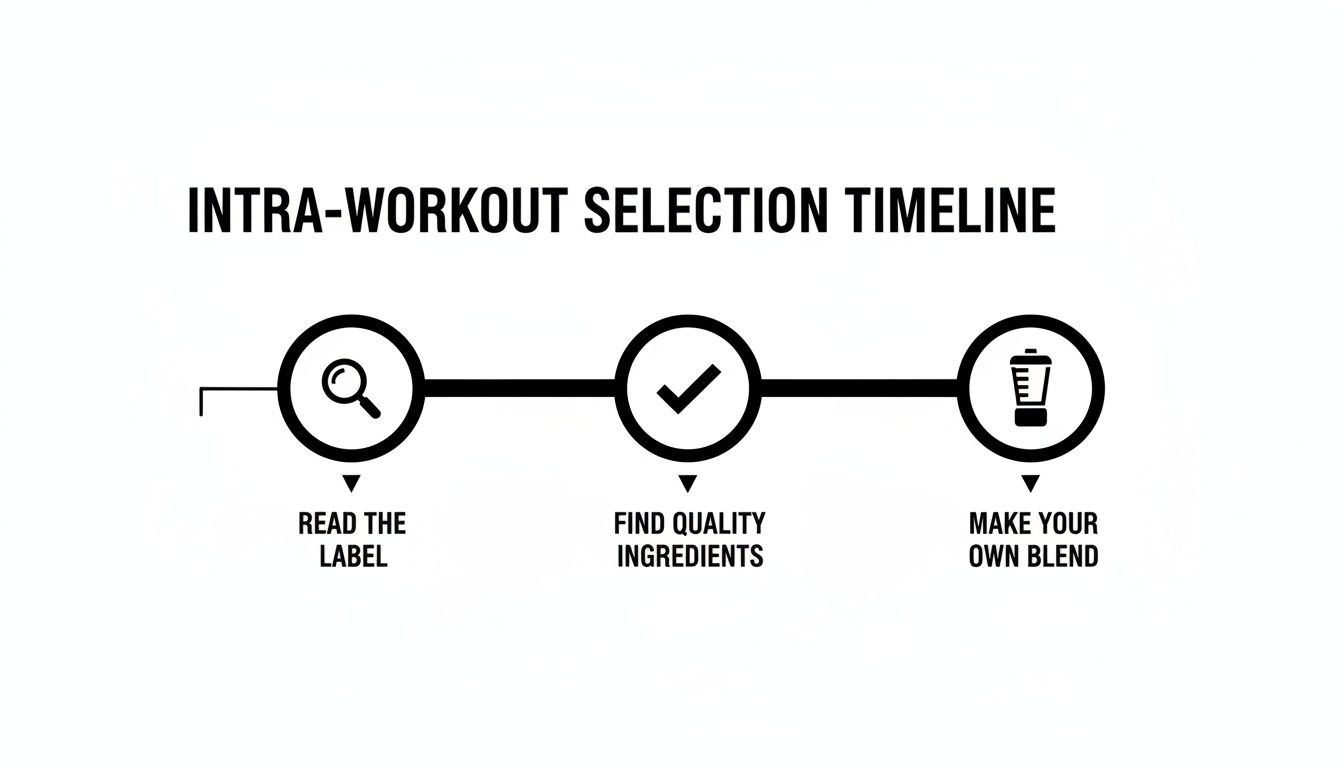
The takeaway here is that taking charge of your nutrition is a straightforward process. Whether you vet a pre-made product or mix your own, you're ensuring you get exactly what your body needs to perform.
Heavy Lifting Session Plan
When you're in the gym for a long, high-volume lifting session (think two hours plus), your biggest enemy is muscle breakdown, or catabolism. Your intra-workout drink needs to act as a shield, protecting your hard-earned muscle from the stress of heavy reps.
The goal is to keep your system flooded with amino acids. This gives your body an alternative fuel source so it doesn't have to start cannibalizing its own muscle tissue for energy.
Here’s how to do it:
- The Mix: In a 24-30 oz bottle of cold water, combine 10-15 grams of Essential Amino Acids (EAAs) with one serving of electrolyte powder. If you're training fasted, adding some carbs can give you a nice performance bump, but it's optional.
- The Timing: Start sipping after your warm-up, right as you begin your first real working set.
- The Cadence: Keep the bottle with you and drink consistently between sets for the entire workout. This isn't about chugging; it's about a steady drip of aminos to your muscles right when they need them most.
High-Intensity Circuit Plan
For CrossFit-style WODs or any high-intensity circuit, you're fighting a battle on two fronts. You need explosive power for the strength work but also the endurance to get through the conditioning. The trick is fueling that performance without filling your stomach with liquid that will slosh around during burpees or box jumps.
- The Mix: Go with a lighter, more balanced formula. In about 20 oz of water, mix 20 grams of fast-acting carbs, 5-10 grams of EAAs, and a single serving of electrolytes. The lower volume of both fluid and carbs is key for easy digestion.
- The Strategy: Sip, don't gulp. Only take small, quick drinks during your designated rest periods. Chugging fluid right before a set of double-unders is a surefire way to get a stomach cramp.
- The Goal: You're just trying to drip-feed your muscles enough fuel to maintain power and hold off fatigue. This approach keeps you feeling light and explosive while delivering the goods your body needs to finish strong.
Answering Your Top Intra Workout Questions
Even with the best game plan, you’re bound to have questions when you start dialing in your intra-workout nutrition. Let's tackle the most common ones head-on so you can fuel your training with total confidence.
Think of this as your quick-start guide for fine-tuning your strategy. Once you get the nuances of timing, need, and safety, all the guesswork disappears, and intra-workout fueling becomes an automatic part of your routine.
Is Plain Water Ever Enough for a Workout?
For shorter, less intense workouts—think anything under an hour—plain water is usually all you need. Your body has plenty of stored glycogen to power through a 45-minute session without hitting the wall. The main goal here is just hydration, and water handles that perfectly.
But once you start pushing past that 60-minute mark or really cranking up the intensity, water alone won't cut it. It replaces lost fluid, sure, but it does nothing to replenish the electrolytes you’re sweating out or the muscle glycogen you’re burning through at a rapid pace. This is the point where an intra-workout drink becomes a critical performance tool, not just a nice-to-have.
How Can I Avoid Stomach Discomfort?
Stomach issues are the number one reason athletes get spooked by intra-workout fueling, but here's the good news: they are almost entirely avoidable. The biggest mistake is trying something brand new on a day when performance really counts. The golden rule is simple: never try anything new on race day or during a max-effort lift.
Your regular training sessions are the perfect lab for testing your fueling strategy.
- Start with a Diluted Mix: If you know you have a sensitive stomach, begin with a half-strength formula. This lets you see how your body responds. You can slowly increase the concentration as your gut adapts over time.
- Sip, Don't Gulp: Chugging your drink is a recipe for disaster because it overloads your digestive system. Small, consistent sips every 10-15 minutes are the key to smooth absorption.
- Test Your Tolerance: Use your long runs, epic bike rides, or high-volume lifting days to experiment. Play with different carb and fluid amounts to find the sweet spot that gives you sustained energy without any digestive blowback.
Think of it this way: You wouldn't wear a brand-new pair of shoes for a marathon, right? So why would you use an untested fuel source? Practice your nutrition with the same dedication you give your physical training.
Do I Need an Intra Workout Drink for Short Sessions?
For most workouts under 60 minutes, a specialized intra-workout drink is overkill. Like we mentioned, your body’s stored energy and a good pre-workout meal are more than enough to get you through without a performance drop.
A well-formulated drink really comes into play when the demands of your training start to outpace your body's on-hand reserves. It’s a specific tool for prolonged, demanding efforts where that real-time replenishment makes a tangible difference in your output and endurance.
Is It Safe to Use an Intra Workout Drink Every Day?
For athletes who train long and hard on a daily basis, using an intra-workout drink is not only safe but often beneficial. When you’re consistently pushing your body with grueling sessions, a clean, well-formulated intra-workout is just part of a smart performance and recovery plan. It’s about proactively managing your energy and hydration.
The key word here, though, is clean. Stick to products that are free of junk like artificial sweeteners, dyes, and excessive stimulants. If your daily workout is a light 30-minute jog, you don't need one. But if your "daily" is a two-hour bike ride or a heavy lifting session, it's a perfectly safe and effective way to support that high level of activity. As always, listen to your body and adjust based on the intensity and duration of that day's training.
At Revolution Science, we formulate clean, transparent, and research-backed supplements designed to help you perform at your best. Our products are engineered without fillers or pseudoscience, giving you precisely what you need to push your limits. Explore our solutions at https://rvsci.com.