
Your Cart is Empty


Nutrition for Triathlon Training Your Ultimate Performance Fueling Guide
When you’re training for a triathlon, it’s easy to get laser-focused on what you’re eating and drinking during your workouts. But that’s just the tip of the iceberg. The real foundation of your performance—the thing that dictates your capacity for hard work and how well you bounce back—is your day-to-day nutrition. Think of your daily meals as the 95% of the iceberg hidden beneath the surface. It’s this consistent, everyday fueling that truly powers your engine and keeps you from burning out.
Building Your High-Performance Engine with Daily Nutrition
Before you even start strategizing your race-day fuel, you have to build a powerful and resilient engine. The food you eat every single day provides the raw materials for energy, muscle repair, and just staying healthy. If you neglect this, even the most dialed-in in-session fueling plan is going to fall flat.
Picture your body as a high-performance race car. To win, you don't just need a good driver. You need premium fuel in the tank, a top-tier pit crew, and a reliable energy system that can go the distance. That’s exactly where your daily macronutrient intake comes in.
-
Carbohydrates (45-60% of daily calories): This is your high-octane fuel. Carbs get stored as glycogen in your muscles and liver, giving you that immediate, accessible energy you need for hard efforts and to sustain volume across swimming, biking, and running.
-
Protein (20-25% of daily calories): Meet your expert pit crew. Every workout you do creates microscopic tears in your muscle fibers. Protein delivers the essential amino acids needed to patch up that damage, rebuild stronger muscles, and lock in all your hard-earned training adaptations.
-
Healthy Fats (20-30% of daily calories): This is your long-range reserve tank. Fats are absolutely crucial for those long, lower-intensity endurance sessions. They also play a huge role in hormone production and absorbing key fat-soluble vitamins, supporting everything from your immune system to your recovery.
Fueling for the Work Required
One of the most common mistakes I see triathletes make is eating the exact same way every day, no matter what their training looks like. A rest day has completely different energy demands than a five-hour brick session. The real secret is learning to match what you eat to your training load.
On your big volume or high-intensity days, your carbohydrate needs shoot way up to restock those glycogen stores and fuel your performance. On recovery days, you can dial back the carbs a bit while keeping your protein intake high to maximize repair. This "fuel for the work required" approach prevents under-fueling (which leads to fatigue and injury) and keeps you from packing on unnecessary weight. For a deeper dive, our guide on sports nutrition for endurance athletes breaks down more of these strategies.
Your training only provides the stimulus for improvement; your daily nutrition is what determines whether you actually adapt and get stronger. Chronic under-fueling is one of the quickest ways to derail a promising season.
Avoiding the Under-Fueling Trap
Consistent triathlon training burns a massive amount of energy. When you don't eat enough to meet those demands, you can slip into Relative Energy Deficiency in Sport (RED-S). This is a serious condition where your body doesn't have enough energy to support basic functions and your training. It can show up as constant fatigue, poor recovery, hormonal chaos, and a much higher risk of injury.
The best way to avoid this is to be proactive. A cornerstone of consistent, high-performance nutrition is good old-fashioned planning. Learning how to plan and prepare meals in advance is a game-changer because it ensures you always have quality, nutrient-dense food ready to go. Pay attention to your body—your energy levels, how you feel in workouts, and your general mood are all valuable clues as to whether your daily nutrition is hitting the mark.
Ultimately, building this nutritional foundation isn't optional. It’s what allows you to absorb heavy training, recover effectively between workouts, and show up to the start line healthy, strong, and ready to perform at your peak.
Fueling for the Swim, Bike, and Run
While your day-to-day diet builds the engine, your fueling strategy during a workout is what keeps it from sputtering to a halt mid-race. This is where we shift from big-picture principles to the nitty-gritty, moment-to-moment decisions that make or break your performance.
Let's be real: a 45-minute recovery swim and a 5-hour brick workout are two completely different beasts. Your fueling plan needs to respect that.
Think of it like an energy bank account. For those shorter, easier sessions—anything under 75 minutes—your stored glycogen (the fuel you banked from your regular meals) is usually enough to cover the withdrawal. You can often get by with just water and electrolytes.
But the second you push past that 75-minute mark, you've got to start making deposits. If you don't, your account will hit zero, and you'll "bonk." This is where carbohydrates become your best friend.
Scaling Your Carb Intake by Workout
The golden rule here is simple: fuel for the work required. This means adjusting your carbohydrate intake based on how long and how hard you’re going.
-
Workouts from 75 minutes to 2.5 hours: This is where active fueling really begins. You should aim for 30-60 grams of carbohydrates per hour. That might look like a single gel, a bottle of sports drink, or a few energy chews. Use these sessions as a dress rehearsal for race day.
-
Workouts over 2.5 hours: For these monster long-course training days, your fuel needs ramp up big time. The target jumps to 60-90 grams of carbohydrates per hour, and for some elite athletes, it’s even higher. Pro tip: the bike is the absolute best time to get the bulk of this fuel in, since it’s way easier to digest calories while cycling than it is while running.
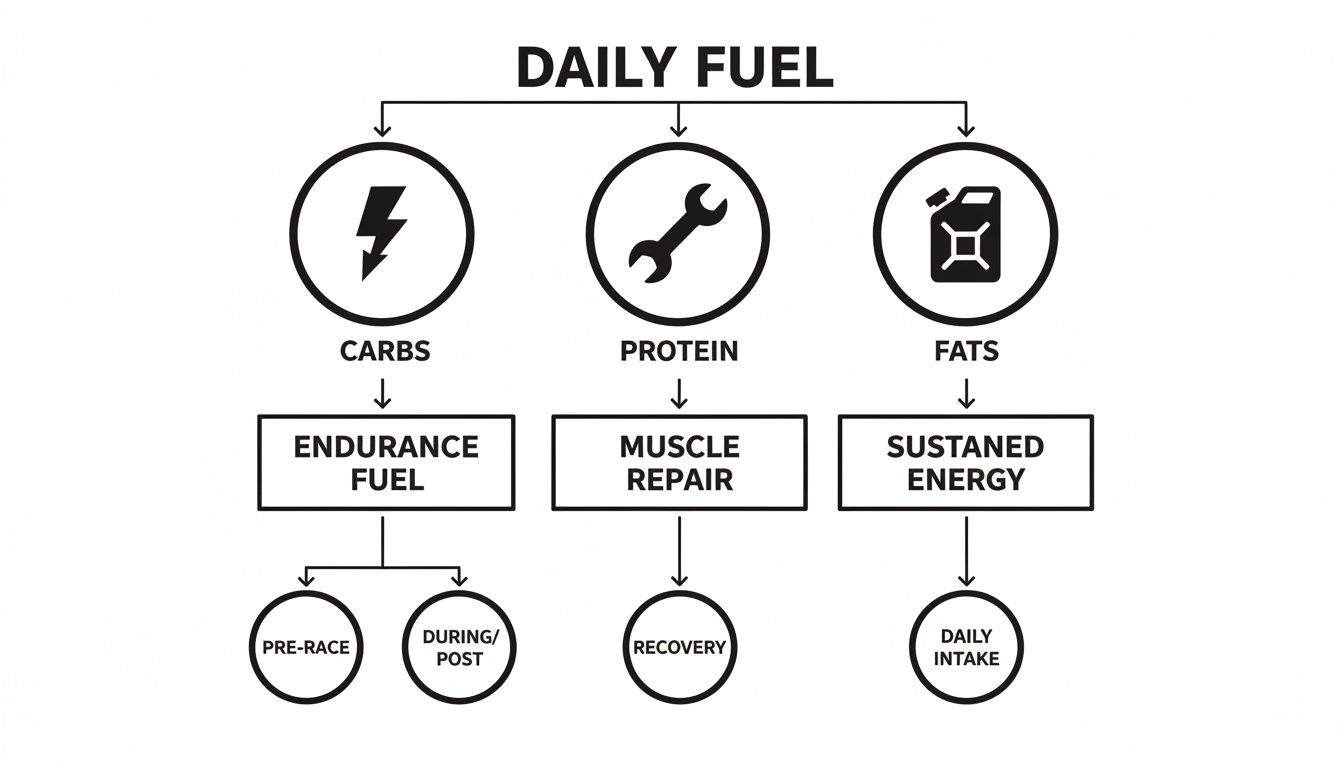
This hierarchy makes it clear: while all macros matter, carbs are the high-octane fuel that prevents you from hitting the wall during tough efforts.
The Science Behind High-Carb Fueling
Now, trying to push past 60 grams of carbs per hour isn't as simple as just stuffing more sugar down your throat. That's a one-way ticket to gut-rot. The trick is using different types of sugar.
Your gut has separate "doorways" to absorb different carbs. The main one, for glucose, gets maxed out at around 60 grams per hour. But fructose uses a completely different doorway.
By using a fuel that combines both glucose and fructose (often in a 2:1 or 1:0.8 ratio), you can open both doorways at the same time. This is a scientifically proven hack that lets your body absorb 90 grams of carbs per hour or more, giving you a massive energy boost without overwhelming your digestive system.
This strategy is an absolute game-changer for long-course triathletes, yet it's shocking how many people leave this free speed on the table. A study on Spanish triathletes found that while 86.1% used carbs during races, their average intake was a measly 22.1 grams per hour. Meanwhile, the pros are putting away 85-105 grams per hour. That's a huge part of what separates them from the rest of the pack.
You Have to Train Your Gut
Hitting those high carb numbers doesn't just happen. You have to train your gut, just like you train your muscles. This is a non-negotiable part of triathlon training.
Start small. Pick one long workout each week and try to slightly increase your hourly carb intake. Make sure you're using the exact gels, chews, and drinks you plan to use on race day. Week by week, gradually nudge that number up as your tolerance improves.
This process trains your gut to become more efficient at absorbing fuel under stress. Before you know it, your fueling strategy will be a seamless and powerful weapon in your arsenal. For more on this, check out our guide on the best intra-workout drinks to power your sessions.
Winning the Hydration Game with Smart Electrolyte Strategies
Let's be honest, we triathletes obsess over carb targets. But what if I told you that a leaky hydration plan could sink your race just as fast as a full-blown bonk? Proper hydration is so much more than just chugging water—it's about a delicate balance of fluids and electrolytes. Get this right, and you've found your secret weapon against fatigue.
Think of it like this: just pouring plain water into your body during a long, hot brick session is like trying to water your garden with a fire hose. Most of it just runs right off without ever getting to the roots. Sodium is the soil; it helps your body actually hold onto that fluid and shuttle it to your hardworking muscles.
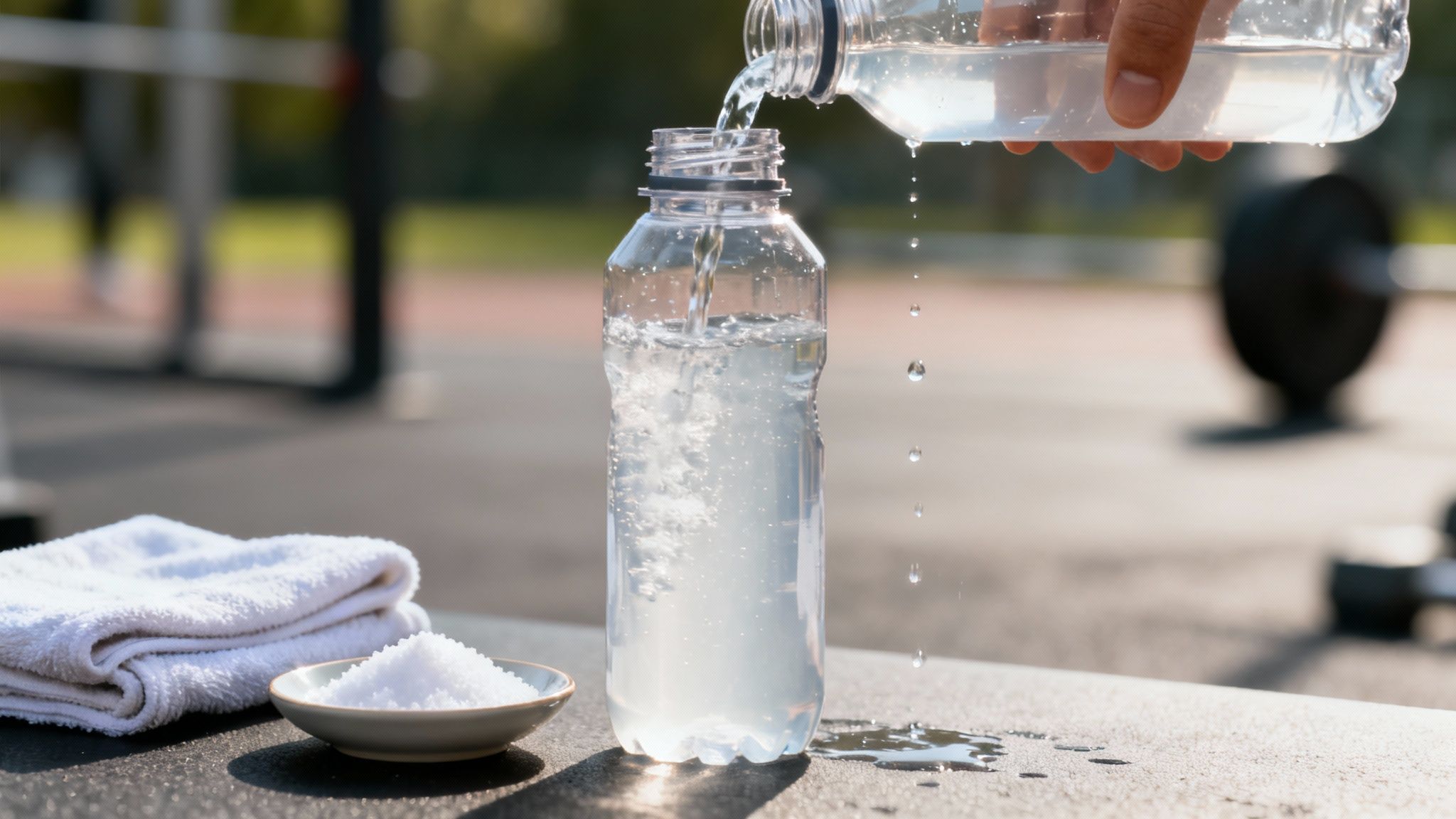
This isn't just a metaphor. In your gut, sodium is the key that unlocks the door for both water and glucose to enter your bloodstream. Without enough of it, your ability to absorb the fluids and fuel you're taking in plummets. It's a recipe for disaster on race day.
Why Your Sweat Is Unique
The single biggest mistake I see athletes make is following generic "drink X ounces per hour" advice. It's a total shot in the dark. Every single one of us has a unique sweat profile, with huge differences in both sweat rate (how much fluid you lose) and sweat concentration (how much salt is in that fluid).
Some of us are incredibly "salty sweaters," losing over 1,500 mg of sodium per liter of sweat. Others might lose less than 500 mg. That's a massive difference.
Your personal sweat profile is a crucial piece of your performance puzzle. Ignoring it is like trying to navigate a bike course without a map—you're bound to get lost. A personalized plan is non-negotiable for serious triathletes.
Once you understand your own numbers, you can stop guessing and start fueling with precision. And the good news? You don't need a fancy lab to get a pretty solid idea of what you're working with.
How to Estimate Your Sweat Rate
Ready to become your own sports scientist? Just follow these simple steps during a one-hour training session in conditions that mimic your goal race.
- Weigh Yourself: Get a baseline weight, naked, right after using the bathroom.
- Train for an Hour: Go do your workout. Be meticulous about tracking exactly how much fluid you drink (measure it in liters or ounces).
- Weigh Yourself Again: After the session, towel off completely and hop back on the scale, again naked.
-
Do the Math:
- Calculate your weight loss in kilograms (1 kg = 2.2 lbs).
- Convert the fluid you drank into kilograms (1 liter of water = 1 kg).
- Your Sweat Rate = (Pre-Workout Weight - Post-Workout Weight) + Fluid Consumed.
For example, if you lost 1 kg of body weight and drank 0.5 liters (which is 0.5 kg), your sweat rate for that session was 1.5 liters per hour. This number is the foundation for building a truly effective hydration strategy. For a deeper dive, check out our detailed guide to hydration for athletes.
Putting It All Together in Your Plan
Once you know your sweat rate, you can build a targeted plan. The goal isn't to replace 100% of your fluid losses mid-race—that's often impractical and can even be dangerous. Instead, a good target is to replace about 70-80% of what you lose to stay ahead of performance-killing dehydration.
The stakes are high. Triathletes can shed anywhere from 500-2,000 mg of sodium per liter of sweat. Fail to replace that, and dehydration can jack up your heart rate by 3-5% and slash your performance by up to 20% in the heat. It’s no wonder so many athletes complain of cramps and stomach issues.
This is where a high-quality, flexible electrolyte solution becomes essential. Products like REVSCI's Reviver Electrolytes are a game-changer because they're formulated without any extra flavors or fillers. This gives you total control to precisely dose your sodium based on your needs, the weather, and your intensity.
Suddenly, hydration isn't a liability; it's a powerful performance advantage.
Sample Hydration Plan Based on Sweat Rate and Conditions
The table below offers a starting point for dialing in your plan. Use your estimated sweat rate and the day's conditions to find a good baseline for your fluid and sodium intake. Remember to test this in training!
| Condition | Estimated Sweat Rate | Fluid Intake per Hour | Sodium Intake per Hour (using Reviver Electrolytes) |
|---|---|---|---|
| Cool (< 60°F) | 0.75 L/hr | 500-600 mL (17-20 oz) | 400-600 mg (1-1.5 scoops) |
| Mild (60-75°F) | 1.0 L/hr | 700-800 mL (24-27 oz) | 600-900 mg (1.5-2.25 scoops) |
| Warm (75-85°F) | 1.5 L/hr | 1.0-1.2 L (34-40 oz) | 900-1,200 mg (2.25-3 scoops) |
| Hot/Humid (>85°F) | 2.0+ L/hr | 1.2-1.5 L (40-50 oz) | 1,200-1,500+ mg (3-4+ scoops) |
These are just guidelines. Your perfect plan will come from consistent testing and listening to your body. Start here, make small adjustments during your training blocks, and you'll arrive on race day with a bulletproof hydration strategy.
Executing the Perfect Race Day Nutrition Plan
Race day is the final exam. After months of putting in the work, this is where your nutrition plan becomes your ultimate cheat sheet. You've spent countless hours training not just your body, but your gut. A well-rehearsed fueling strategy is your single greatest advantage, turning every calorie into pure, unadulterated performance.
Think of the days leading up to the race as the final top-off for a high-performance engine. This isn't the time for cramming or last-minute experiments. It’s about a calm, calculated execution of a plan you've practiced to perfection. The goal is simple: arrive at the start line with fully loaded glycogen stores and a happy, settled digestive system.
If there's one golden rule, it's this: nothing new on race day. Every single gel, chew, drink, or solid food you put in your body should be a familiar friend. You should have trained with it dozens of times. This simple discipline eliminates the biggest risk factor—unexpected gut issues that can instantly derail your entire race.
The Carb-Load and Pre-Race Breakfast
Your fueling strategy doesn't begin when the starting gun fires; it starts 48-72 hours before. This is your carb-loading window, where you'll gradually increase the percentage of carbohydrates in your diet to completely max out your muscle glycogen stores. The trick is to stick with familiar, easily digestible carbs like rice, potatoes, and pasta while dialing back the fiber and fat to avoid any digestive stress.
Race morning, your breakfast has one job: to top off the liver glycogen you burned through overnight. You should be eating this meal 2-3 hours before your start time.
- Focus: High in simple, easy-to-digest carbohydrates.
- Avoid: Anything high in fat, fiber, or excessive protein.
- Examples: A classic bagel with jam, oatmeal with a banana and a drizzle of honey, or even some white rice with maple syrup.
This is your final, critical fuel deposit before the massive withdrawals of the swim, bike, and run begin.
Your Fueling Map for the Swim, Bike, and Run
Once the race is on, your nutrition plan shifts to a steady, constant drip of energy. The entire game is about consistently replacing the fuel you're burning to keep from hitting that dreaded wall.
The bike is your rolling buffet. It's by far the easiest and safest place to get the bulk of your calories and fluids in. Once you hit the run, your gut is under way more stress, making it much harder to absorb anything.
Your hourly targets for carbs, fluids, and electrolytes should already be second nature from your training. Now, it's all about executing with perfect timing and consistency.
Sample Fueling Plan for an Olympic Distance Race (2-4 hours)
-
Bike (Aim for 45-75g carbs/hour):
- Start fueling within the first 15 minutes of getting on the bike. Don't wait.
- Take one gel or a few energy chews every 30-45 minutes.
- Sip consistently from your bottle that's mixed with a carbohydrate-electrolyte drink.
-
Run (Aim for 30-60g carbs/hour):
- Take your first gel within the first 15-20 minutes of the run.
- Keep it coming with another gel every 25-30 minutes.
- Grab water or sports drink at every single aid station, even if it’s just a quick sip to wash down a gel.
Sample Fueling Plan for a Long-Course Race (70.3 or 140.6)
-
Bike (Aim for 80-120g carbs/hour):
- Start fueling within 10-15 minutes. Seriously, right away.
- Set a repeating timer on your watch to eat or drink something every 15-20 minutes.
- Use a mix of liquid nutrition, gels, and some easily digestible solids like energy bars early in the ride.
- You must stay on top of your personalized hydration and sodium targets. No excuses.
-
Run (Aim for 60-90g carbs/hour):
- Pop a gel as you're running out of T2.
- At this point, switch almost entirely to liquids and gels. Solid food is a recipe for disaster.
- Walk the aid stations. This is non-negotiable. That small investment of time ensures you get enough fuel and fluid in, and it pays massive dividends in the final miles.
Your race day nutrition plan is your roadmap to a successful day. By trusting the plan you’ve relentlessly practiced, you give yourself the best possible shot at performing to your potential and crossing that finish line strong.
Unlocking Faster Gains with Optimized Recovery Nutrition
Your hardest training sessions don't actually make you faster. They break you down. The real magic—the adaptation that builds speed and endurance—happens in the hours and days after you finish. Nailing your recovery nutrition is what turns that breakdown into a breakthrough, making sure every ounce of effort pays off.
Think of your body after a tough workout like a construction site. The crew (your muscles) is exhausted, the fuel reserves (glycogen) are empty, and the demand for building materials (amino acids) is at an all-time high. Your recovery meal is the supply truck that arrives just in time to get the rebuilding process started.
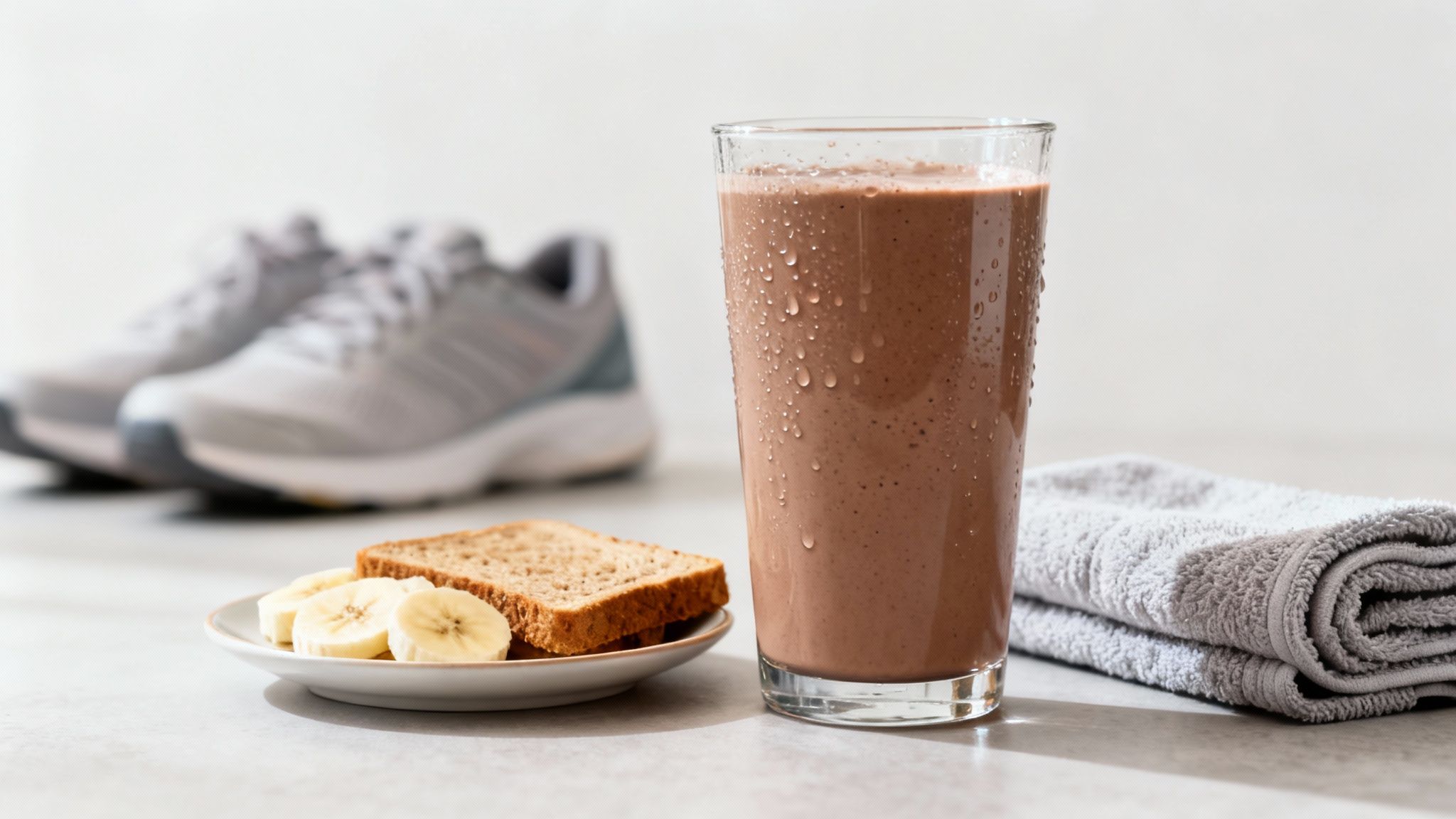
This whole process is so vital that sports scientists have boiled it down to three simple, non-negotiable pillars.
The Three Rs of Recovery
To get the absolute most out of every session, your post-workout fuel needs to hit three interconnected goals. Get these right, and you'll bounce back stronger, more resilient, and ready to attack your next workout.
- Rehydrate: You have to replace the fluids and electrolytes lost through sweat. This is priority number one for getting your cells and blood volume back to normal.
- Replenish: Your muscles have burned through their stored carbohydrate fuel, called glycogen. Restocking these stores is critical for having energy for your next session.
- Repair: Hard training creates tiny tears in your muscle fibers. High-quality protein gives your body the raw materials it needs to repair this damage and build back even stronger.
Getting this right isn't just about feeling less sore; it’s about making your training actually stick. You can learn more about how to recover faster after your workouts in our detailed guide.
The Golden Window for Recovery Fueling
Timing is everything. In the 30-60 minutes right after a workout, your body is in a hyper-receptive state. It’s like a sponge, ready to soak up nutrients at a massively accelerated rate.
During this "golden window," the enzymes that restock glycogen and synthesize muscle protein are working in overdrive. If you delay your recovery fuel, you miss this peak opportunity, slowing down the entire repair and refueling process. Acting fast kickstarts recovery, puts the brakes on muscle breakdown, and sets you up for a stronger performance tomorrow.
A huge mistake I see triathletes make is obsessing over carbs while totally undervaluing protein. Don't just refuel; rebuild. The combination of carbs and protein creates a powerful synergistic effect that speeds up recovery far more than either nutrient can on its own.
Nailing Your Post-Workout Macronutrients
So, what should you actually be eating or drinking in that golden window? The formula is simple but incredibly effective: a fast-acting combination of carbohydrates and protein.
The carbs spike insulin, which acts like a key to unlock your muscle cells, allowing both glucose (from the carbs) and amino acids (from the protein) to flood in. This is how you rapidly replenish your glycogen stores while delivering protein right where it's needed for repair. For athletes training 10-20 hours a week, protein needs are way higher than you might think. Getting 20-40 grams of high-quality protein within that 30-minute window is a non-negotiable step to kickstart muscle repair.
A perfect recovery shake often hits a 3:1 or 4:1 ratio of carbohydrates to protein. For example, a shake with 60 grams of carbs and 20 grams of protein is right in that sweet spot. This isn't just a random suggestion—it's a science-backed strategy for turning today's hard work into tomorrow's speed.
Common Triathlon Nutrition Questions Answered
Let's be honest, figuring out nutrition for a triathlon can feel like a puzzle with a million tiny pieces. Even when you think you have a solid plan, the real world throws a curveball. Questions always pop up.
This section tackles some of the biggest, most common hurdles triathletes face. These aren't just theories; they're the practical problems that can make or break your race day. Getting these answers right is how you unlock that next level of performance.
How Do I Train My Gut to Handle More Fuel?
Trying to go from taking 30g of carbs per hour to 90g overnight is a one-way ticket to GI disaster. The secret is gradual adaptation, or what we call "gut training."
Think of it just like lifting weights. You wouldn't walk into the gym for the first time and try to deadlift 400 pounds. You have to build up to it, and the same exact principle applies to your digestive system.
The process is simple, but it demands patience:
- Start Small: Pick one long session each week and just slightly bump up your hourly carb intake. If you're used to 45g, aim for 55g. That’s it.
- Be Consistent: This is critical. Use the exact gels, drinks, and chews you plan to use on race day. You're training your gut to recognize and process specific formulas.
- Progress Slowly: As you start to feel comfortable, add a little more over the following weeks. This process tells your gut to create more of the specific transporters needed to absorb those nutrients, effectively making the pipeline bigger.
This methodical approach is how you train your digestive system to handle a heavy fuel load under the stress of racing, dramatically cutting your risk of cramps, bloating, or nausea when it counts.
What’s the Ideal Pre-Race Dinner?
The night before a race is all about being safe, simple, and boringly predictable. The goal is to top off your muscle glycogen stores without eating anything that might cause a problem on race morning. This is absolutely not the time to get adventurous.
Your meal should be built around familiar, easily digestible carbohydrates. Pair them with a bit of lean protein, but keep fat and fiber super low. Fat and fiber slow down digestion, which is the last thing you want before a huge physical effort.
Classic pre-race dinner examples are dead simple for a reason: pasta with a basic tomato sauce, grilled chicken with a big side of white rice, or a baked potato with a small piece of fish. Stay away from anything heavy, spicy, greasy, or loaded with fiber.
Should I Adjust My Nutrition for Hot Weather?
Absolutely. Heat and humidity aren't just minor details; they are game-changers that demand you adjust your plan, sometimes significantly.
When it gets hot, your body has to work overtime to cool itself down. This sends your sweat rate through the roof, which means you’re losing way more fluid and electrolytes—especially sodium.
In hot conditions, you have to get more aggressive with your hydration. That means drinking more total fluid and taking in more sodium per hour to hold off dehydration and prevent those race-ending cramps. You’ll also probably find that liquid nutrition like sports drinks and gels goes down much easier than solid food when it’s scorching out. Be ready to lean more heavily on your liquids.
Can I Follow a Low-Carb Diet for Triathlon?
While the idea of "fat adaptation" gets a lot of buzz, the overwhelming body of scientific evidence points to one clear truth: high-intensity endurance performance runs on carbohydrates.
The hard, race-pace efforts you need in a triathlon are powered by your glycolytic energy system. That system runs on one thing: glucose.
Following a low-carb or ketogenic diet severely limits your body's access to this high-octane fuel. It’s like putting a governor on your engine—you just can't hit your top-end speed or power. For almost every single triathlete trying to perform their best, a carbohydrate-focused fueling strategy is still the most effective, evidence-backed way to train and race.
Dialing in your nutrition is a never-ending process of learning, testing, and tweaking. With clean, effective supplements from Revolution Science, you can take the guesswork out of your fueling and hydration, giving your body exactly what it needs to perform at its best. Explore our research-backed formulas at https://rvsci.com.